 Italy for me From Italy with love

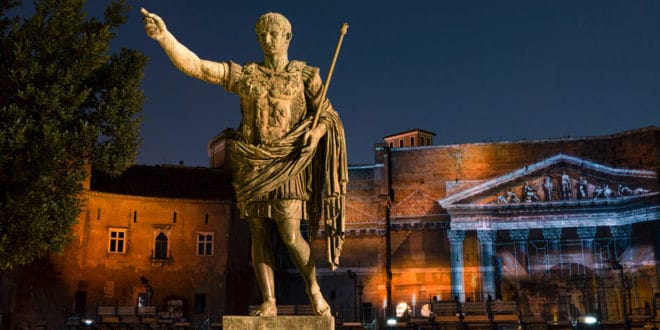
The Forum of Augustus (Foro di Augusto) is one of five monumental squares of Ancient Rome and a key part of the Imperial Forums (Fori Imperiali), located in the archaeological heart of the city center.
Unlike the older Roman Forum (*Foro Romano*), which dates back to the 6th century BCE and became the cradle of Roman law, the forums of the emperors served not only as religious, social, and political centers but also as lasting tributes to the glory and power of the rulers who commissioned them.
In addition to the Forum of Augustus, between 46 BCE and 113 CE, Rome saw the construction of the forums of Julius Caesar (Foro di Cesare), as well as the forums of Emperors Vespasian (Foro di Vespasiano), Nerva (Foro di Nerva), and Trajan (Foro di Traiano).
Page Contents
The Emperor
Gaius Julius Caesar Octavianus Augustus—better known simply as Augustus—was the first Roman emperor, reigning from 27 BCE to 14 CE. The Senate granted him the title “Augustus,” a designation of higher status than “Caesar,” often used in the East for gods or divinely appointed rulers. He declined the alternative title of “Romulus,” which would have framed him as the new founder and savior of Rome.
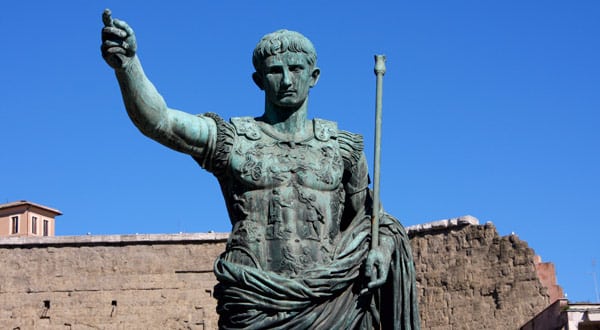
The role of Augustus as the first emperor is hard to overstate in the context of Ancient Roman and European history. During his 40-year reign, he introduced sweeping reforms that would continue to enrich the empire for the next 300 years.
One of his great undertakings in shaping a monumental image of Rome was the construction of numerous new buildings—including his own forum, the second of its kind after the Foro di Cesare.
How It All Began
Back in 42 BCE, on the eve of the Battle of Philippi (in the Roman province of Macedonia), the young Octavian made a solemn vow: if victorious over the conspirators who had assassinated Gaius Julius Caesar, he would build a temple in Rome dedicated to Mars Ultor—that is, Mars the Avenger.
Together with Mark Antony and Lepidus, Octavian emerged victorious, defeating the republican enemies Marcus Junius Brutus and Gaius Cassius Longinus.
Augustus kept his vow to the gods and began construction of a temple honoring the warlike Mars. Yet beyond fulfilling a sacred promise, his true aim was to glorify his lineage and strengthen his bond with the Roman people—especially by evoking their reverence for the deified Caesar. Within the temple, images of both Caesar and Augustus—his adopted son—would stand side by side.
At the same time, Rome was facing a very practical issue: the existing Roman Forum and Caesar’s Forum could no longer accommodate the growing number of citizens attending public court proceedings. The new forum would also help relieve this spatial strain.
Location and Funding for Construction
Augustus planned to build his forum in the center of Rome, directly adjacent to Caesar’s Forum, and intended it to rival its predecessor in both scale and splendor. But finding an appropriate site proved difficult, as the surrounding area in the 1st century was a densely populated residential district.
Historical sources indicate that Augustus was unwilling to expropriate land and demolish Roman homes to expand the construction zone, so the forum ended up smaller than originally planned.
In his political testament, the Res Gestae Divi Augusti, he declared that he had built the forum and temple on his own land, using wealth acquired from military campaigns in Spain, Germany, Dalmatia, and Egypt. While this claim is hard to verify, archaeological excavations in 1932 uncovered remnants of archaic or Republican-era dwellings in the eastern section of the forum—evidence that at least some homes were indeed cleared by Augustus to make way for the new complex.
When It Was Built
The clearing of the site and the laying of the foundation for the forum likely began around 30–27 BCE, but the main construction took place between 20–17 BCE, after Augustus had solidified his power and completed projects originally initiated by Caesar. The Forum officially opened in 2 CE, although even at that time the architectural project was still not fully finished.
It’s believed that the forum was hastily inaugurated on May 12, likely in connection with the *Ludi Martiales*—annual games held in honor of Mars. These festivals featured grand martial displays in the city’s circus. The opening may also have coincided with Augustus’s public designation of his younger grandson, Lucius, as his heir (Lucius tragically died of illness that same year at the age of 19).
A surviving fragment of the temple’s pediment lists Augustus’s official titles, which also helps date the forum’s inauguration.
Layout
The monumental complex of Augustus was clearly inspired by Caesar’s Forum, which had adorned the city since 46 BCE.
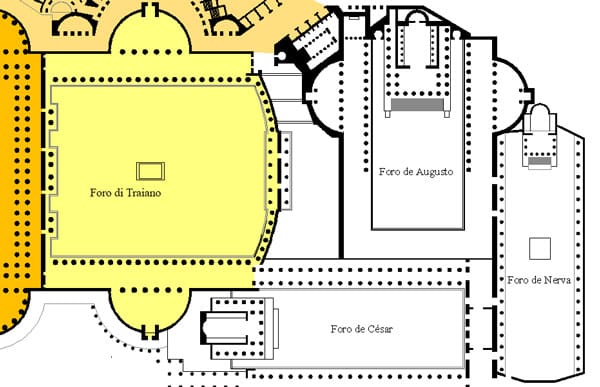
The *Foro di Augusto* measured 125 by 118 meters (410 by 387 feet) and was built around a rectangular courtyard of 70 by 50 meters (230 by 164 feet). At the short end of the central plaza stood the Temple of Mars Ultor, while the long sides were lined with porticoes (covered galleries) and exedrae (semicircular niches).
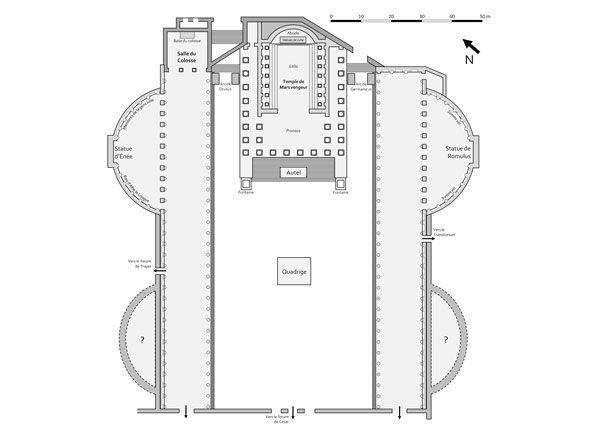
At the northeast edge of the forum stood a massive 33-meter-high (108-foot) firewall known as the *Muro della Suburra* (Wall of the Suburra). Constructed from square blocks of fire-resistant stone, this wall was designed to shield the forum from frequent fires that broke out in the densely packed, multistory buildings of the Suburra district. On either side of the temple, the wall included two entrances, which were connected to the forum’s plaza via staircases.
In 19 CE, Emperor Tiberius added two commemorative arches at the base of these staircases, honoring his son and grandson for their military victories. These became known as the Arch of Drusus and the Arch of Germanicus. The southern arch is referred to as the *Arco dei Pantani*.
To better visualize the site, be sure to check out this video with a digital reconstruction of the Forum of Augustus.
Sculptures
The Forum of Augustus was richly adorned with a multitude of statues, portraying not only the emperor himself but also both historical and mythological figures central to Rome’s identity.
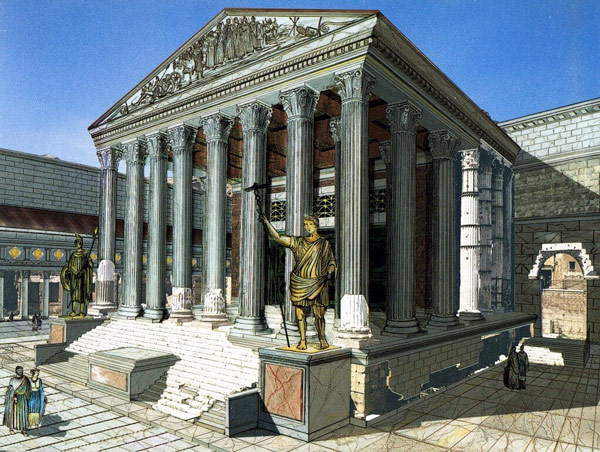
Each sculpture had a purpose: statues of prominent Republican figures, complete with the emblems of their triumphs, were meant to inspire citizens through heroic examples. Legendary heroes and celestial deities, on the other hand, served to underscore Augustus’s divine ancestry.
The statues of great Romans lined the porticoes in a long gallery, while the main sculptural centerpiece was a colossal figure of Augustus riding a triumphal quadriga, standing at the center of the forum square.
The side arcades, framed with Corinthian columns, were topped with tall attic stories adorned with gigantic figures of caryatids alternating with shields bearing the heads of Jupiter-Ammon and other gods. This arrangement drew a symbolic parallel: the young women of Caria, enslaved by the Greeks, and the bearded deities together evoked the image of conquered peoples and subdued rulers, underlining Augustus’s imperial authority.
Among the most important decorative cycles were the statues of **Aeneas** and **Romulus**, placed in the opposing exedrae of the forum. According to legend, both were descendants of divine parents—Venus and Mars—and Aeneas was considered the mythical ancestor of the Julian family, thus reinforcing Augustus’s own claim to divine lineage.
It’s worth noting that Augustus was the first to use **lunar marble** from the quarries of Carrara in Tuscany for major construction. He combined it with rare yellow and greenish marbles imported from Greece and Africa as spoils of war. This extravagant and colorful palette of precious stone made the Forum of Augustus a dazzling, luxurious architectural masterpiece.
Temple of Mars Ultor
The dominant feature of the Forum of Augustus was the **Temple of Mars Ultor** (*Mars the Avenger*). Its construction was a lengthy process, taking nearly 40 years and completed in 2 CE. The temple served as a sacred space where magistrates offered sacrifices before departing for service in the provinces, victorious generals displayed their military honors, and young noblemen donned the *toga virilis*—their first adult toga—symbolizing their readiness for military duty.
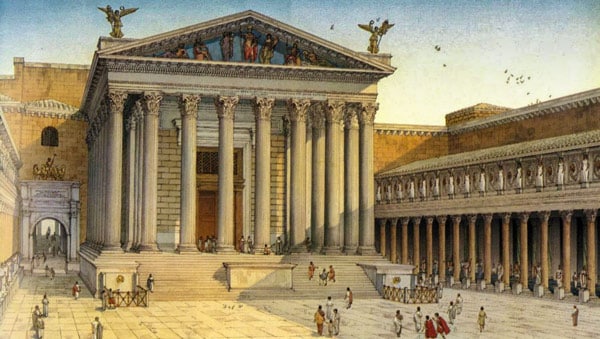
The temple impressed contemporaries with its grand scale, opulent decoration, and ceremonial significance.
Thanks to surviving Renaissance-era sketches and modern architectural studies of the ruins, scholars have been able to reconstruct the temple’s original appearance.
The temple, measuring 30 by 40 meters (98 by 131 feet), stood atop a 3.55-meter-high (11.6-foot) podium built from thousands of tuff blocks, concealed beneath a facing of white marble slabs. From the forum square, a grand staircase with 17 steps led to the entrance. At the center of the staircase stood a large altar, flanked by two square bases with fountains.
Surrounding the temple were 26 Corinthian columns of white marble, each approximately 15 meters (49 feet) tall. Today, only three of them remain, located on the southern side.
The pediment of the temple was adorned with a series of colossal statues, with Mars—the god of war—at the center. He was depicted wearing a helmet, holding a spear in one hand and a sword in the other, while his left foot rested on a globe. This fierce, armed portrayal of Mars was clearly a reference to **Augustus** as the victorious conqueror of the empire.
To either side were statues of reclining Palatine, Romulus, Venus with Eros, Fortuna, the goddess Roma, and the personified Tiber River.
The temple’s interior featured side columns and a large apse at the rear. On a 9-meter-long (30-foot) platform stood statues of Mars, Venus, and Julius Caesar, who had been deified. The temple also housed a sacred relic: Caesar’s sword, kept here in reverence.
Hall of the Colossus
In the northeastern corner of the Forum of Augustus stood an opulently decorated room known as the *Hall of the Colossus* (*L’Aula del Colosso*), named for the colossal statue of the Genius of Augustus once housed there. This chamber functioned as a true sanctuary of justice, where the emperor’s image was seen as a guarantor of fair rulings by magistrates.
The hall was likely around 24 meters (79 feet) high and lit by openings above the level of the portico roof. The floor was paved with alternating rectangular slabs of colorful marble, while the statue’s backdrop was a wall draped in blue fabric with golden and red stripes adorned with botanical motifs.
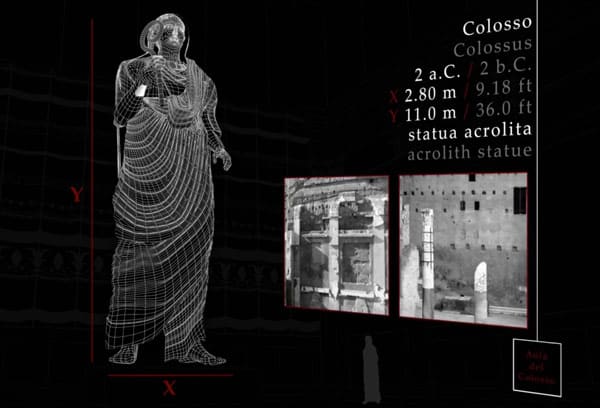
The statue itself, crafted from highly prized marble and standing no less than 12 meters (39 feet) tall, depicted Augustus in a toga with a veiled head, holding symbolic objects in his hands. Fragments of the arms and the left foot, which alone measures 1.66 meters (5.4 feet), have survived. These, along with decorative remains, are now exhibited at the Museum of the Imperial Forums (Museo dei Fori Imperiali). Watch the reconstruction video.
- Museum website: www.mercatiditraiano.it
According to Pliny the Elder, the hall’s walls may have featured masterpieces by the Greek painter Apelles, including depictions of the legendary twin brothers Castor and Pollux with Victory and Alexander the Great.
History After the Fall of the Roman Empire
During the reigns of later emperors, the Forum of Augustus was partially eclipsed by the construction of newer complexes such as the Forum of Trajan and the Forum of Nerva.
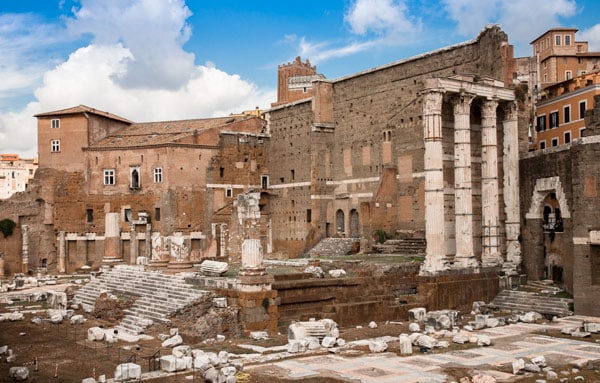
The last recorded mention of the Forum of Augustus dates to 395 CE. It was likely destroyed during the sack of Rome by the Visigoths in 410 CE or the Vandals in 455 CE. An earthquake in the 5th century further leveled the forum and the Temple of Mars Ultor.
For centuries, the area remained marshy and uninhabited. By the 10th century, the forum had become so overgrown with ruins and vegetation that locals began calling it Hortus mirabilis—the “Marvelous Garden.”
In the 9th–10th centuries, a monastery and small church dedicated to Saint Basil were built atop the ancient ruins. Known as San Basilio al Foro di Augusto, the church’s bell tower was erected by Basilian monks in the 12th century, atop the surviving architrave and three columns of the Temple of Mars Ultor. Though architecturally awkward, the bell tower helped preserve the columns from collapse.
A 1756 engraving by Giovanni Battista Piranesi captures the forum with this distinctive bell tower.
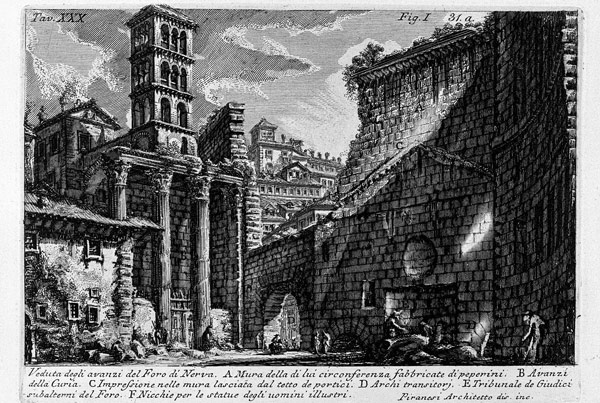
The tower was demolished in 1838 due to structural instability.
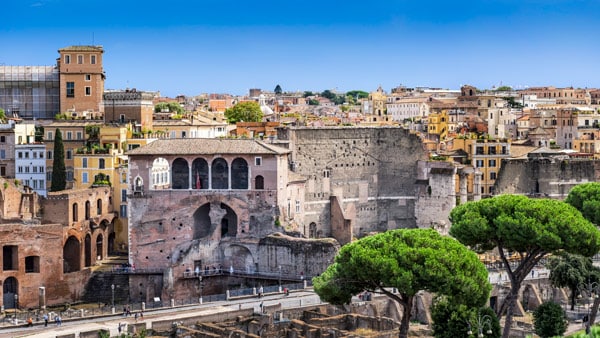
From the 13th century, the church and monastery came under the control of the Knights of Saint John of Jerusalem—later known as the Knights of Rhodes and the Knights of Malta.
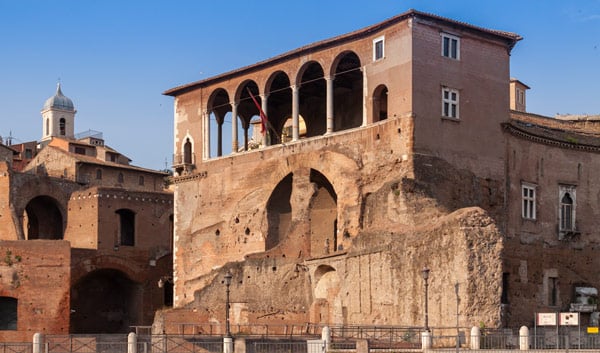
Between 1467 and 1470, extensive renovations gave rise to the present-day appearance of the Casa dei Cavalieri di Rodi.
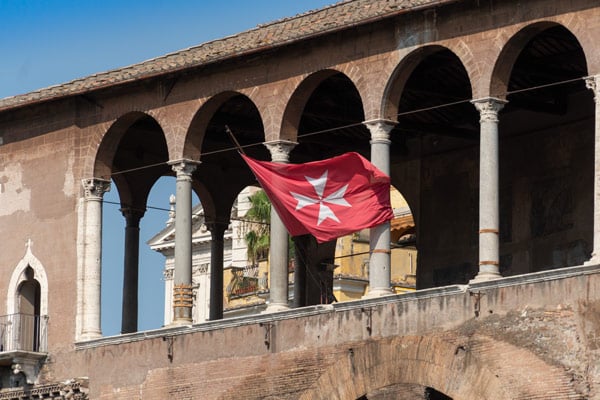
As the influence of the order declined, Pope Pius V housed Dominican nuns in the former monastery in 1568. They constructed a new church on the site of the original, named Santissima Annunziata.
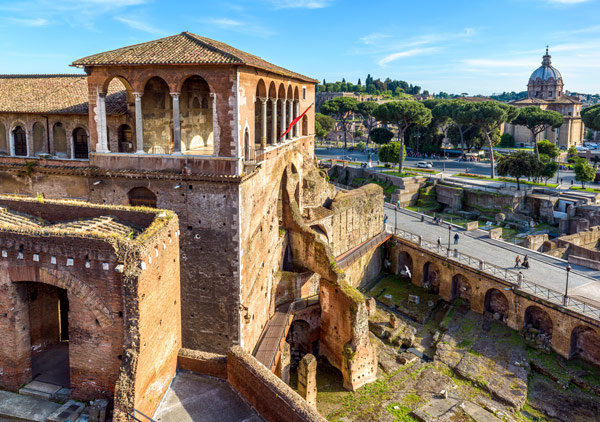
Starting in 1570, under Cardinal Michele Bonelli, the entire area was actively redeveloped and became known as the Alessandrino District.
Excavations in the Forum of Augustus began at the end of the 19th century, after the city of Rome acquired the land. Systematic research and scientific study followed in the 20th century.
In the 1930s, the Santissima Annunziata church and the Alessandrino District buildings were demolished to make way for archaeological excavations. Of the medieval structures on the site, only the House of the Knights of Rhodes survives today. It is now owned by the Sovereign Military Order of Malta.
The current ruins of the Forum of Augustus do not reflect its former grandeur. Only a few columns of the temple and a staircase remain. Not all artifacts have been uncovered, as no archaeological work was conducted during the construction of the *Via dei Fori Imperiali*, which cuts through part of the site.
Still, surviving architectural fragments, artworks, and Roman manuscripts help recreate an image of the Forum of Augustus, which Pliny once called the most beautiful building he had ever seen. On his deathbed, Augustus famously declared: “I found Rome a city of bricks and leave it a city of marble.” And indeed, there was truth in his words.
How to Get There, Opening Hours
The Forum of Augustus is located within walking distance of the Colosseum (Colosseo) and the Altar of the Fatherland (Il Vittoriano), just a five-minute stroll away. It’s open year-round and can be viewed for free.
From April through late October, a spectacular nighttime laser show takes place. A special grandstand is set up for spectators, and the installation runs every hour after sunset.
Tickets cost €15 and can be purchased on-site before the show. For up-to-date schedules and pricing, visit the official website: www.viaggioneifori.it.