 Italy for me From Italy with love


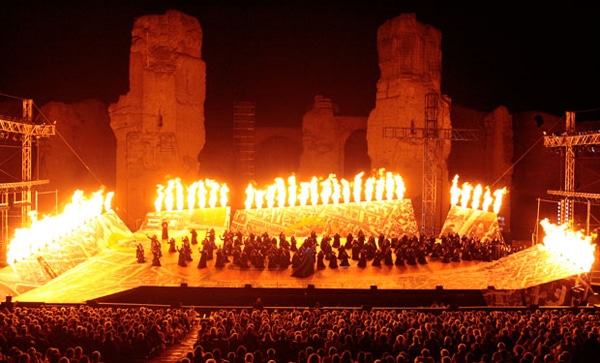
The Baths of Emperor Caracalla (Terme di Caracalla) — a landmark in Rome that impresses with its sheer scale and ancient grandeur. Towering stone ruins set against the backdrop of pine trees along the Appian Way (Via Appia) and lush greenery once formed the heart of public life in early Imperial Rome. Today, the vast bath complex serves the arts, becoming a stage for the Rome Opera House.
Page Contents
History
By the 1st century BCE, Rome was facing major challenges with water supply and basic hygiene—yet still became a model of cleanliness for the ancient world. A high-ranking official, Marcus Agrippa (Latin: Marcus Agrippa), invested enormous sums in building aqueducts that brought crystal-clear spring water into the capital.
Alongside canals, fountains, and plumbing systems, public baths began to appear across Rome. For a long time, they remained the privilege of the wealthy and powerful. In these bathhouses, not only was the body cleansed, but also political discussions and high-level meetings took place in a more relaxed atmosphere.
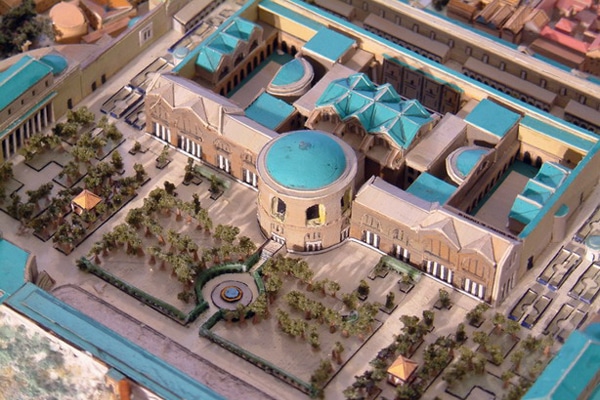
Emperor Caracalla (Latin: Septimius Caracalla), son of Septimius Severus, set out in the 3rd century CE to gift the Italian capital a bath complex of colossal proportions. Construction began in 206 CE and continued for 11 years. By 217, the builders had transformed 11 hectares (27 acres) of Roman land between the Celian (Celio) and Aventine (Latin: Aventinus) Hills. The Baths of Caracalla reached epic proportions: the courtyard measured 400 by 400 meters (1,312 x 1,312 feet), and the main bath complex spanned 150 by 200 meters (492 x 656 feet), accommodating up to 1,500 visitors at a time.
The baths were located in one of the most prestigious districts of Rome, although most of their clientele came from nearby, middle-income neighborhoods. For the imperial elite, politicians, and nobles, there were several exclusive facilities, including the Baths of Agrippa (Terme di Agrippa). The construction of the baths was so solid and refined that by the 5th century CE, they were considered another wonder of the world—on par with the Egyptian pyramids.
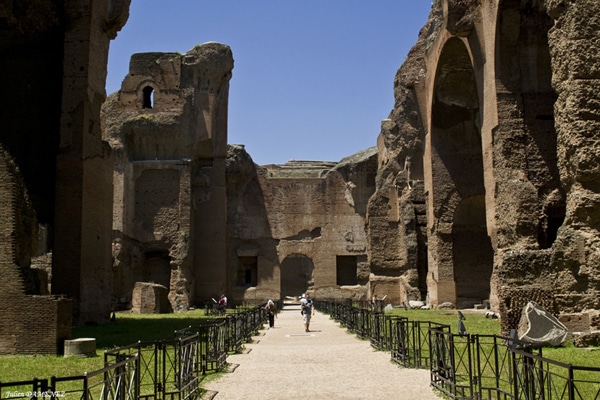
After two and a half centuries, the baths in Rome had become hugely popular. However, their triumphant era ended with the fall of the Roman Empire. In the mid-6th century, frequent invasions by the Eastern Goths damaged the aqueduct that supplied water to the complex. Over time, the structures fell into decay, and the open land was partially converted into a city cemetery. Some plots were repurposed for agricultural use.
Excavations
Forgotten for centuries, the baths were rediscovered in the 16th century. However, serious archaeological excavations of this corner of Rome began only in the 19th century. In the early 20th century, ruins revealed a large mithraeum—a sanctuary dedicated to the ancient god Mithras.
Modern Life – Rome’s Opera Theater
In the summer of 1937, the mayor of Rome, Piero Colonna, ordered the historical and archaeological complex to be handed over to the Rome Opera Theater (Teatro dell’Opera di Roma). A vast open-air stage, an amphitheater that could seat 20,000 spectators, and stunning scenery breathed new life into the Baths of Caracalla. The summer theater season at the baths was interrupted during World War II, and again in the 1990s. Since 2001, after ten years of restoration, the complex has once again served the arts.
The summer of 2015 at the Baths of Caracalla was scheduled to feature classic productions such as Turandot, Madame Butterfly, and La Bohème. These serious works would alternate with modern programs: a ballet inspired by Pink Floyd, and concerts by Elton John and Bob Dylan.
Description
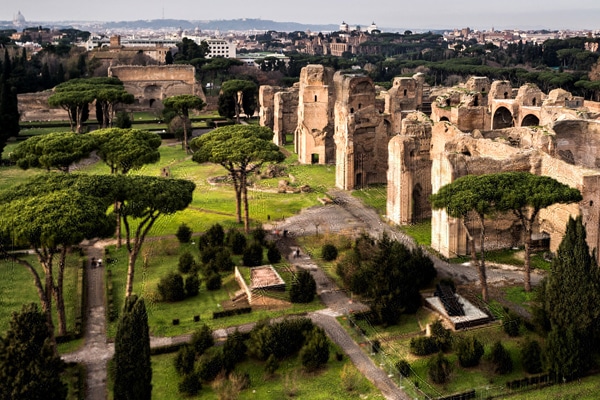
The main building of the Baths of Caracalla featured luxurious decoration: the exterior was clad in marble, while the interior used even more expensive marble slabs, bronze window frames, and masterfully crafted glass imitations for the windows. The entrance to the building was marked by two tall exedras, which have remained well preserved to this day. In addition to services directly related to bathing rituals, the baths also included an extensive library.
Interestingly, the Baths of Caracalla had their own stadium for various forms of entertainment. Spectators could enjoy performances without ever leaving the complex. The baths also housed a boys’ gymnastics school, called a Palaestra (Greek: Παλαίστρα) in the Greek tradition.
Plan
The water supply system of the baths originated from the Acqua Marcia spring (Latin: Acqua Marcia). A specially constructed aqueduct delivered clean water into the vaulted system of the baths, where it was heated and distributed among the bathing areas. Rooms were built in one of the following styles:
- Frigidarium (Latin: frigidarium) — open-air rooms enclosed by walls, where visitors would cool down after hot treatments;
- Tepidarium (Latin: tepidarium) — a room with hot dry air (about 113°F / 45°C), similar to a sauna;
- Caldarium (Latin: caldarium) — a large room with a pool of warm water at its center. The caldarium in the Baths of Caracalla measured about 115 feet (35 meters) in diameter and was decorated with rows of columns supporting the roof;
- Small rooms for individual baths.
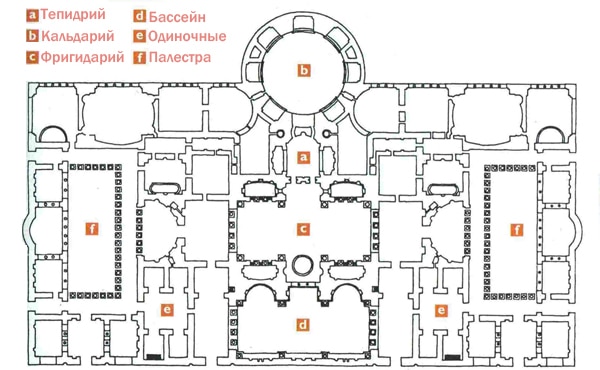
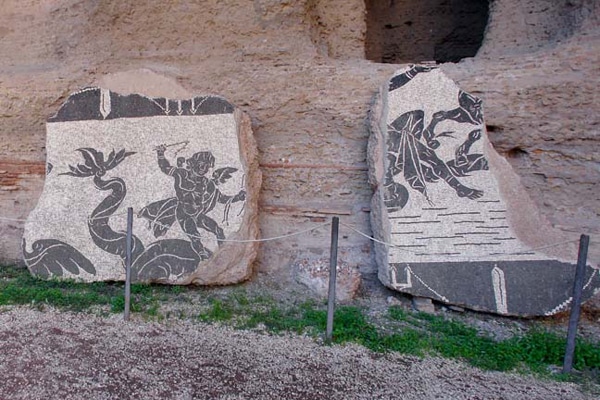
The bathhouse in the 3rd–4th centuries AD was richly decorated with mosaics depicting the feats of athletes and sportsmen. Fragments of mosaic flooring were uncovered by archaeologists in the 19th century and are now kept in the Lateran Museum. Evidence suggests that the baths, during their peak, also functioned as an exhibition space.
Famous works from the Vatican Museums, such as the Apollo Belvedere, the Farnese Bull, and sculptures from Ancient Rome, once adorned the imperial relaxation rooms within the baths.
How to Get There?
- Address: Viale delle Terme di Caracalla
- By metro: Line B, stop Circo Massimo.
- By bus: routes 118, 160, 628, 671, 714 stop near Via Terme di Caracalla; route 160 also stops near Via Baccelli.
- You can also order a taxi or rent a car.
- Ticket prices: for opera and ballet, tickets range from €20 to €100; tickets for celebrity concerts are higher, from €70 to €250 depending on the performer.
- Official theater website: www.operaroma.it
- Opening hours: daily, opening at 9:00 AM and closing at dusk (around 4:30 PM in winter, 5:00–5:30 PM in spring, 7:30 PM in summer, 6:30–7:00 PM in autumn).
- Combined ticket price for the Baths of Caracalla, the Villa of the Quintilii, and the Mausoleum of Cecilia Metella: €6 full price, €3 reduced.