 Italy for me From Italy with love


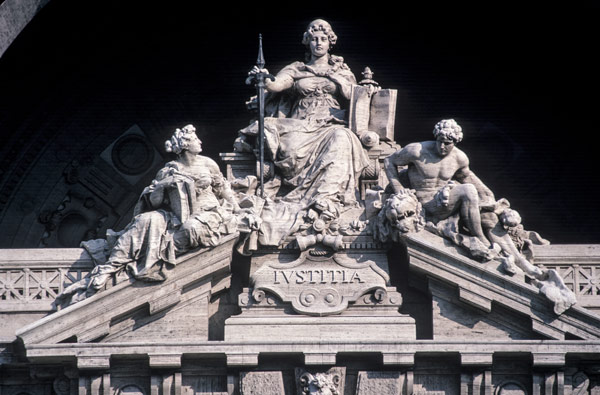
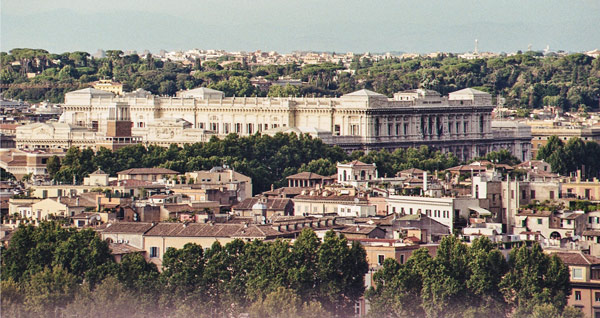
The Palace of Justice in Rome (Palazzo di Giustizia) is one of Italy’s great landmarks. Today, the building serves as the seat of the Supreme Court of Cassation and is located in the Prati district, near the Castel Sant’Angelo. One of its most striking features is its elaborate exterior, adorned with numerous statues and decorative moldings.
If you plan to visit Rome, this remarkable structure is definitely worth seeing. It’s worth noting, however, that locals are not particularly fond of it — Romans often refer to it as the “Ugly Palace.”
Guglielmo Calderini, the architect of the palace, did not initially intend to create such a bold and attention-grabbing design. His early plans depict a much more modest building. Construction took place between 1888 and 1910. After the main structure was completed, additional halls were added, and a large quadriga was installed on the roof. The final result was a building in the Neo-Baroque style.
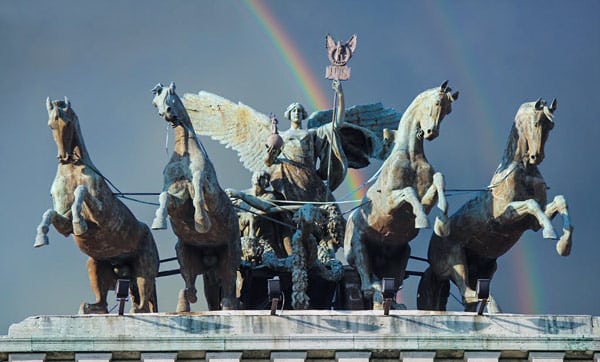
Why does the palace draw such disapproval from the locals? Primarily because of the numerous scandals that marred its construction era. These troubles were rooted in the widespread corruption that grew around the project. The Palace of Justice — a place meant to embody absolute integrity and the rule of law — became a symbol of controversy. The citizens of Rome were deeply outraged by the corruption, and the scandals dragged on for twelve years. This negative perception of Italy’s highest judicial institution has persisted since those times.
History of the Building’s Construction
Despite numerous challenges, the Palace of Justice turned out to be truly magnificent. Near the entrance, there are ten unique statues representing prominent Italian jurists. Inside, a grand hall awaits, its walls adorned with frescoes. The beauty of the structure is simply breathtaking! One of the façades features the coat of arms of the House of Savoy, crafted in smooth bronze tones.
Construction began on March 14, 1888. Giuseppe Zanardelli, Keeper of the State Seal, was present at the groundbreaking ceremony. He insisted that the Palace be built in the Prati district, which already housed some judicial offices, though the Palace of Justice would become the largest among them.
The construction required platforms made of concrete. Excavations carried out during the project unearthed numerous sarcophagi. On January 11, 1911, the Palace of Justice was officially inaugurated, with King Victor Emmanuel III of Italy attending the ceremony.
Over the years, the Supreme Court’s residence has undergone several renovations, resulting in architectural elements from different eras that add even more uniqueness to the building.
Official website: www.cortedicassazione.it.
The building is located at: Palazzo di Giustizia, Piazza Cavour – 00193 Rome. Nearby stands the Church of the Sacred Heart of Jesus — a rare example of Neo-Gothic architecture in Rome. The Umberto I Bridge leads from the palace toward the historic center and offers a postcard-perfect view of St. Peter’s Basilica.