 Italy for me From Italy with love


A special place of Catholic devotion in the heart of Rome is the Church of the Sacred Heart of Jesus in Prati (Chiesa del Sacro Cuore del Suffragio in Prati), also known as the Church of the Sacred Heart of Suffrage. Built only in the 20th century, it has already gained popularity for its graceful, unusual appearance that stands out among the heavy architecture of the Renaissance era.
Page Contents
Construction Site
The church is located in the historic part of the city near Vatican City (Stato della Città del Vaticano), on the banks of the Tiber River (Tevere), close to the Palace of Justice (Palazzo di Giustizia) and Umberto I Bridge. The idea for the church came from a French priest—missionary Victor Jouët from Marseille (Missionari del Sacro Cuore di Gesù), who in 1893 founded the Association of the Sacred Heart for the Suffrage of Souls in Purgatory (Associazione del Sacro Cuore del Suffragio delle anime del Purgatorio) in Rome.
Initially, the land where the church now stands was purchased by Victor Jouët for the construction of a chapel dedicated to Our Lady of the Rosary (Cappella della Madonna del Rosario). However, the structure did not last long—just three years after its completion in 1894, it was badly damaged by fire and later demolished.
The Cult of the Sacred Heart of Jesus
The meaning behind the church’s name may not be immediately clear. The central idea is that the Sacred Heart offers mercy to the souls in Purgatory—a place of suffering and purification from sin.
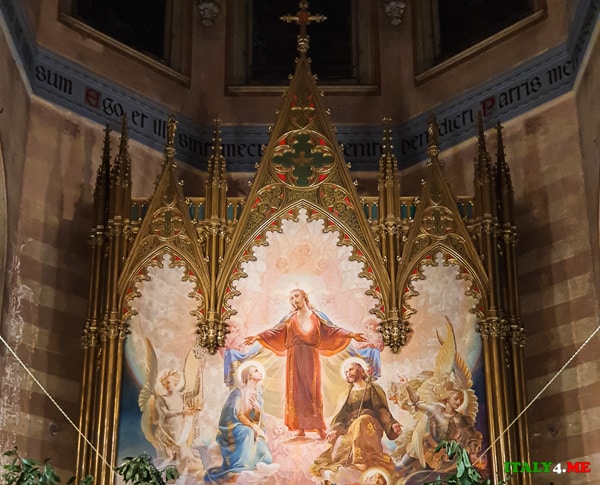
The devotion to the Sacred Heart of Jesus took shape in the 17th century, inspired by the visions of Sister Marguerite-Marie Alacoque (1647–1690) from the convent of Paray-le-Monial. According to her account, the Lord appeared to her and spoke of His deep love for humanity, revealing His heart and saying: “Behold the heart that has so loved men that it spared nothing, even unto exhausting and consuming itself… Therefore, I ask of you that the first Friday after the octave of Corpus Christi be dedicated to honoring My Heart.”
Another version describes a vision in which the Sacred Heart appeared to Marguerite on a fiery throne, encircled by a crown of thorns and topped with a cross.
The Jesuits played an active role in spreading this devotion throughout history.
Initially, the Roman Church was hesitant to accept the new form of worship. Pope Benedict XIV (Benedictus PP. XIV) believed that special veneration of Christ’s heart would fragment the concept of Christ’s body and confuse the faithful. Nonetheless, thanks to the efforts of the Jesuits, the cult of the Sacred Heart quickly spread through Germany, Switzerland, France, Poland, and beyond.
Dioceses from various countries petitioned the pope to establish a dedicated feast day for the Sacred Heart. The devotion received official Church-wide recognition only in 1856 under Pope Pius IX (Pius PP. IX). Numerous days were designated for celebration: every Friday, the last three days of Lent, the first and last day of the year—all carry their own significance and traditions.
Although its members could pray in any church, the Society of the Sacred Heart began establishing dedicated churches where this concentrated devotion to Christ’s love—embodied in the image of His heart—could be fully expressed. The heart became not just a symbol of love, but a divine object of worship in its own right, drawing prayers, petitions, and thanksgiving from devout Catholics.
Project Concept
The church was designed by Italian engineer Giuseppe Gualandi in 1913–1914 and approved by Pope Pius X (Pius PP. X). Construction took just three years, and under Pope Benedict XV (Benedictus PP. XV), the first service was held on November 1, 1917.
The church was built in the Neo-Gothic style and, due to its resemblance to another famous structure, earned the nickname “the Little Milan Cathedral.” Gualandi was indeed inspired by the Milan Cathedral (Duomo di Milano)—a majestic late-Gothic masterpiece that took centuries to complete.
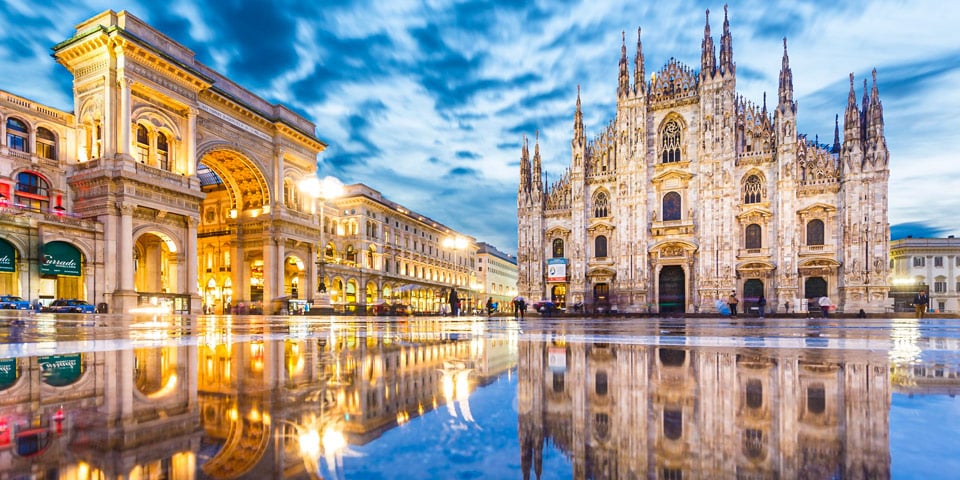
But while this white-marble Gothic giant towers over Milan’s central square as the city’s focal point, the Church of the Sacred Heart of Jesus in Prati is a relatively small structure nestled along a street lined with otherwise ordinary buildings.
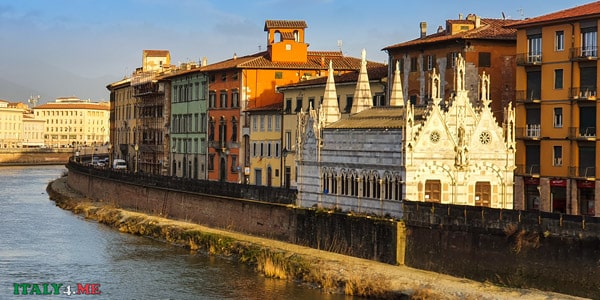
Some believe the church also shares architectural kinship with the Chiesa di Santa Maria della Spina in Pisa. Its refined design, compact scale, and lace-like Gothic detailing earned that church the nickname “the Pisan jewel box.”
The Church of the Sacred Heart of Jesus in Prati is impossible to overlook—its brilliant white façade, delicate pointed silhouette, countless spires, airy turrets, and slender columns immediately draw the eye. Sculptural figures seem to float before the church, inviting passersby into a silent, soulful conversation.
Exterior Description
The building’s dazzling white exterior may look like marble, but it is actually constructed from reinforced concrete, with travertine used for many of the decorative details.
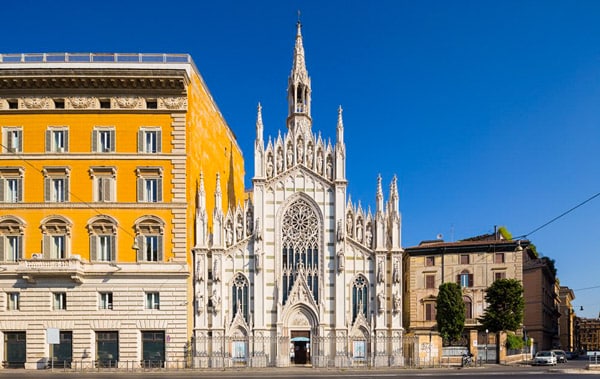
The stepped structure of the façade mirrors the church’s interior, which is divided into three naves. Six upward-thrusting quadrangular columns rise into elegant spires.
At the base of the façade are three portals framed by slender columns of pink Verona marble, topped with lunettes containing religious bas-reliefs.
The central relief depicts the “Souls in Purgatory”; on the right is the “Sacred Heart of Jesus” flanked by two angels; on the left, the “Resurrection of the Lord.”
The centerpiece of the upper façade is a classic Gothic architectural feature—a massive, lace-like rose window made of intricately carved marble.
Along the roofline of the façade are 19 statues of saints placed in individual niches. All were sculpted by Orsoni of Bologna. The saints featured were personally selected by Pope Pius X.
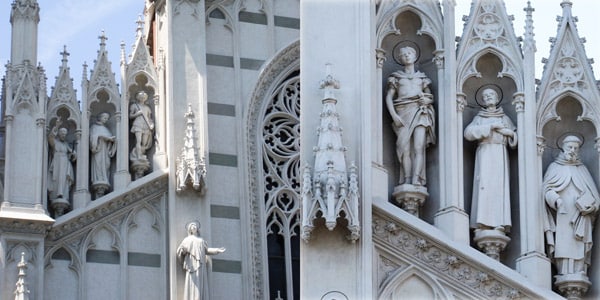
The three rows of statues include:
- Center: Augustine (Sant’Agostino), the Apostle Peter (San Pietro apostolo), Saint Joseph (San Giuseppe), Our Lady of the Sacred Heart (Nostra Signora del Sacro Cuore), John the Evangelist (San Giovanni evangelista), the Apostle Paul (San Paolo apostolo), and Odo of Cluny (Sant’Oddone da Cluny);
- Left: Francis Xavier (San Francesco Saverio), Saint Dominic (San Domenico di Guzman), and the Archangel Michael (San Michele Arcangelo);
- Right: Victor the Moor (San Vittore), Francis of Assisi (San Francesco d’Assisi), and Nicholas of Tolentino (San Nicola da Tolentino).
Among the saints featured on the façade is a statue of Saint Marguerite-Marie Alacoque, the very nun who witnessed the vision of the Sacred Heart of Jesus.
At the center of the church rises an octagonal bell tower with a spire reaching toward the sky. Its top is designed as a columned loggia, above which sits a cross surrounded by four lilies. Inside is a votive heart-shaped offering gifted by Victor Jouët.
Interior Design
The church’s interior is no less impressive than its exterior.
The space is divided into three naves, each composed of six bays—a typical feature of Gothic architecture—defined by ribbed vaults and pointed arches.
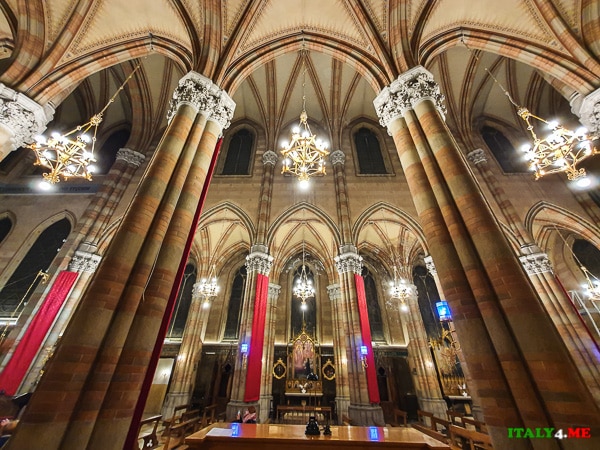
The floor is laid in a striking herringbone pattern of alternating gray and red marble stripes. Numerous columns support the vaults, repeating the color scheme of the floor and blending harmoniously into the warm and balanced palette of the space.
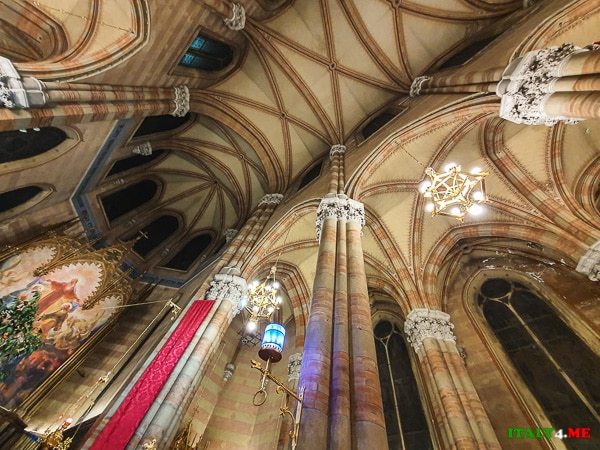
The pointed windows—three on the façade and 18 along the side walls—feature exquisite stained glass that bathes the interior in light and adds a luminous decorative element. The saintly figures and patterns depicted in the glass are of high artistic value and captivate with their brilliance.
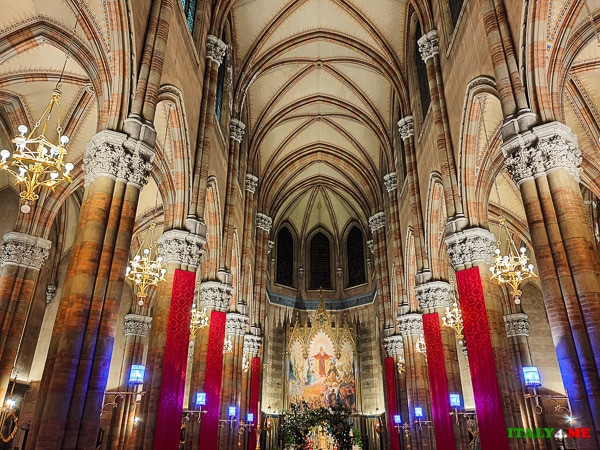
In the side aisles, small recessed chapels contain individual altars. On the right are altars dedicated to the Archangel Michael and Saint Marguerite-Marie Alacoque; on the left, to Saint Anthony of Padua (Sant’Antonio di Padova) and Pope Saint Gregory the Great, also known as Gregory the Dialogist (Gregorius Dialogus).
At the end of one aisle is an altar dedicated to Saint Joseph. This work by Giuseppe Brugo depicts Saint Joseph with the Christ Child, flanked by angels and saints Teresa (Santa Teresa) and Bernard (San Bernardo).
On the opposite side stands an altar in honor of Our Lady of the Rosary.
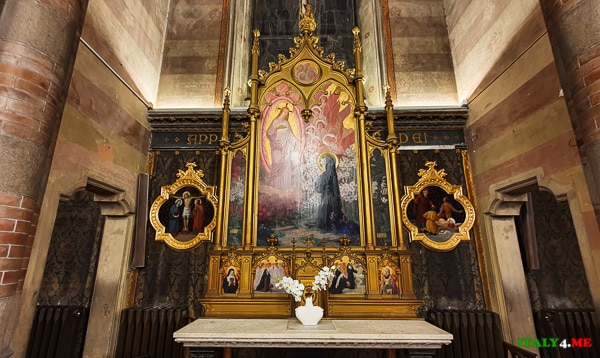
In the final side bay on the left is a marble funerary bust of Monsignor Pietro Benedetti. Below it sits a beautiful bronze Pietà by Giovanni Battista Conti.
The central nave culminates in an apse with the high altar, crafted from marble and gilded bronze.
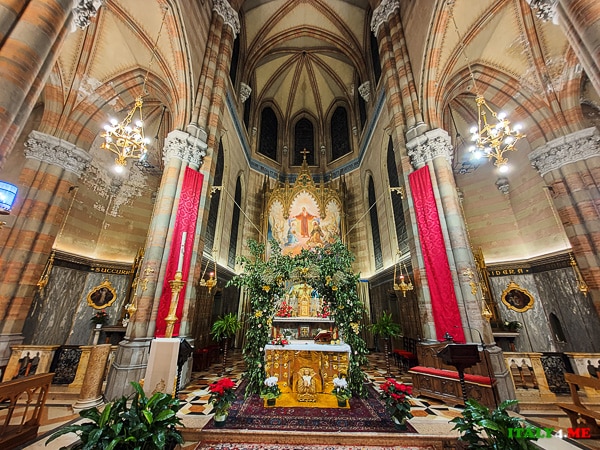
At the center stands an ornate golden tabernacle. The painting above the altar, created by artists Giuseppe and Alessandro Catani, depicts angels, demons in Purgatory, and of course, the Sacred Heart of Christ.
In 1960, the church installed a new 27-pipe organ with electric transmission, built by Fabbrica Orgi Ruffatti. Its deeply moving sound adds a powerful emotional presence to the liturgy and elevates the solemnity of the Mass.
The Strange Museum – Souls in Purgatory
In the sacristy of the church lies a one-of-a-kind museum that surprises and intrigues all who visit. The mystical bond between the living and the dead has fascinated humanity for centuries. In today’s material world, it may be hard to believe that souls of the deceased could interact with the present—but surprisingly, real, tangible evidence of the afterlife can be found in the Museum of the Souls in Purgatory (Museo delle Anime del Purgatorio), housed within the Church of the Sacred Heart of Jesus in Prati.
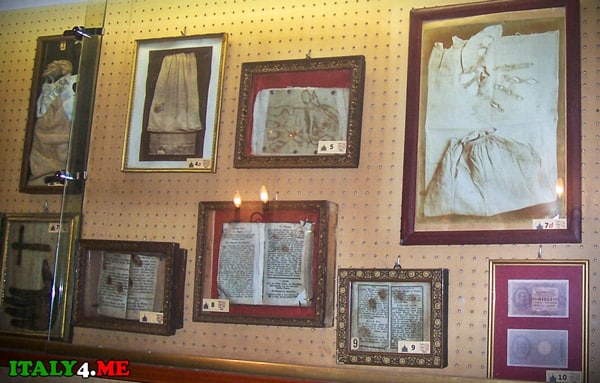
This otherworldly collection is also referred to as the “Museum of the Holy Souls” or “Museum of the Departed.” Strange and slightly eerie, it is said to be the only museum of its kind in the world.
How to Get There
- The Church of the Sacred Heart of Jesus in Prati is located at: Lungotevere Prati, 12, Rome
- To visit the museum, you must request it from the church’s rector, who is happy to show visitors the collection. Admission is free, though a small donation is appreciated.
- Nearest metro station: Ottaviano.
Opening Hours
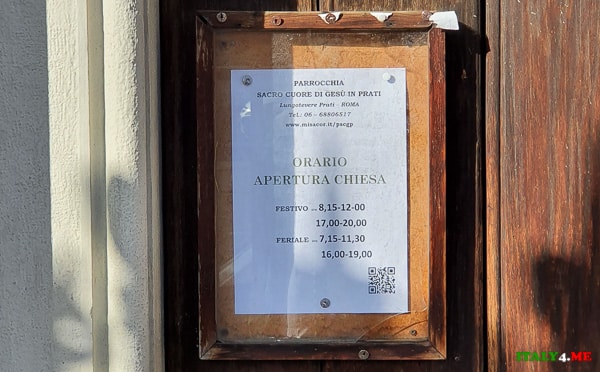
The church is open to visitors in the morning from 7:15 AM to 11:30 AM (on holidays from 8:15 AM to 12:00 PM), and in the afternoon from 4:00 PM to 7:00 PM (on holidays from 5:00 PM to 8:00 PM).