 Italy for me From Italy with love


The Borghese Gallery (Galleria Borghese) in Rome, a treasure trove of Italy’s most valuable cultural artifacts, is a testament to the enduring legacy of the Italian nobleman Scipione Borghese.
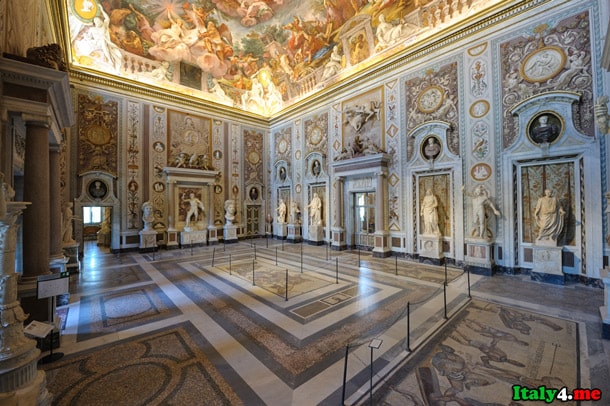
The gallery, nestled within a grand villa and sprawling park, is a masterpiece in itself. The interiors of the family residence, spanning the first and second floors, are adorned with paintings and sculptures by European masters.
The gallery is a must-see for art lovers and those eager to visit Rome’s most significant attractions.
Page Contents
The Borghese Family
The Borghese family, with its rich lineage and strong ties to the Catholic Church, has played a significant role in Italy’s history. In the 17th century, Scipione Borghese, a cardinal and a relative of Pope Paul V, began his journey as an avid art collector.
To escape the hustle and bustle of the city and showcase his collection in style, Cardinal Borghese began building a villa in 1613.
The Borghese Park and Palace
The **House of Delight (Casa di delizia)**, as the cardinal envisioned it, was designed by architect Giovanni Vasanzio.
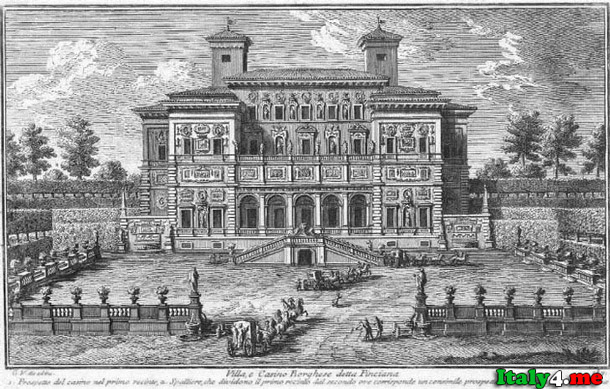
The magnificent 80-hectare park, nestled on the sloping hills of the Pincian Hill, is a serene oasis. Once a vineyard, it was transformed into a picturesque public park by the talented hands of Pietro Bernini. Since the 17th century, it has remained one of the most tranquil and scenic public parks in Rome.
How the Collection Was Assembled
As a wealthy Italian prince and an influential figure in the Church, **Scipione Borghese** had no trouble expanding his private collection. The finest works of Italian, French, Flemish, and German artists quickly made their way to the walls of his new estate. Borghese was particularly fond of **Caravaggio’s paintings** and **Gian Lorenzo Bernini’s sculptures**, which he acquired with great care.
When Scipione Borghese died in 1633, the gallery housed more than 800 paintings and an extensive collection of sculptures, including many from the ancient period.
Paintings
The nephew of the Pope wasn’t shy about using his religious title to acquire the most valuable paintings.
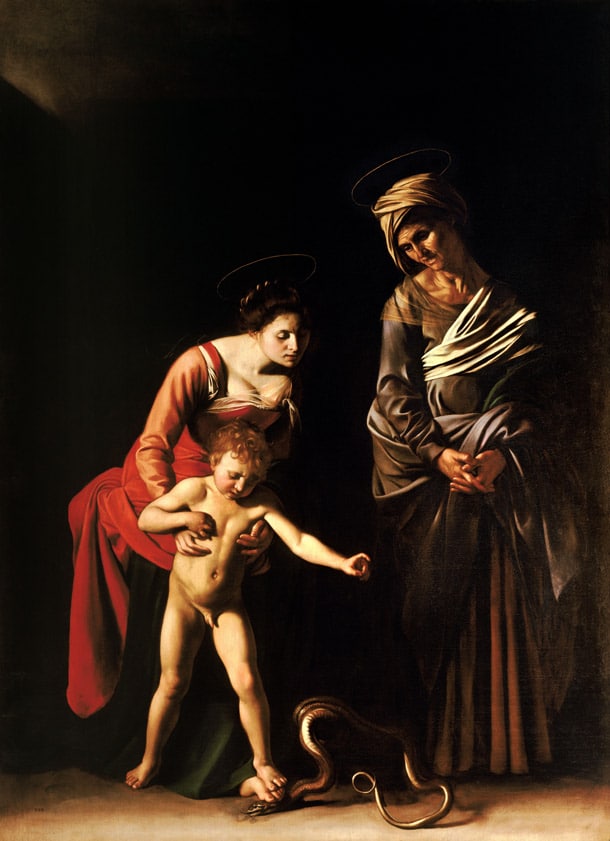
There were even rumors that those who were reluctant to part with their art were persuaded with harsh tactics. Some of the masterpieces Borghese acquired had been deemed too provocative by the Church, such as Caravaggio’s Madonna of the Palafrenieri.
Among Borghese’s acquisitions are masterpieces like Pinturicchio’s “Crucifixion with St. Jerome and Christopher”, dating to the 15th century. Another priceless painting is Sandro Botticelli’s Madonna and Child, also from the 15th century. A notable piece, Lady with a Unicorn, was painted by Raphael in the early 16th century, paying homage to Leonardo da Vinci’s “Mona Lisa”. Raphael’s “The Deposition” was also seized from a church in Perugia.
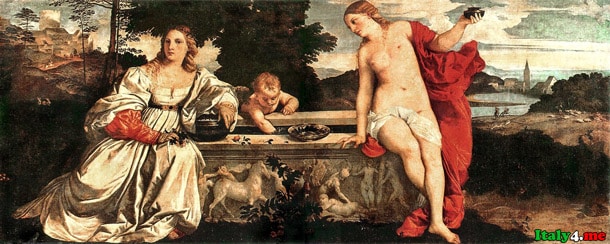
Titian’s “Sacred and Profane Love” represents a contrast between earthly and heavenly love.
Six of Caravaggio’s works, illustrating different stages of his career, are particularly highlights. These include the lyrical “Boy with a Basket of Fruit” and the somber “Young Sick Bacchus.”
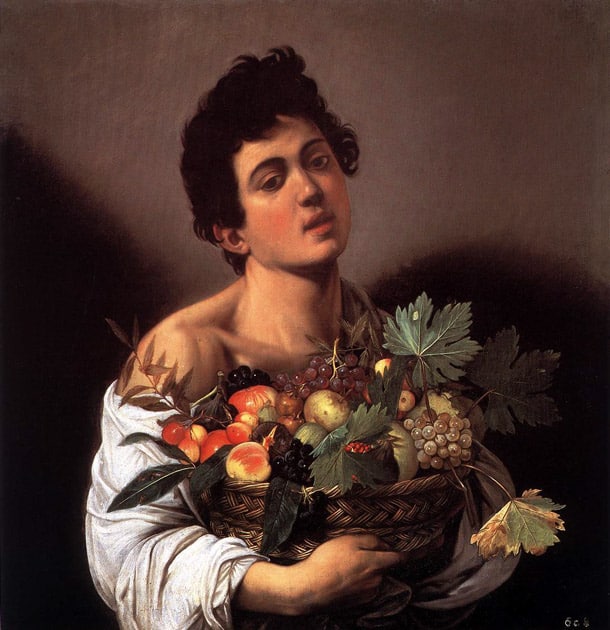
Sculptures
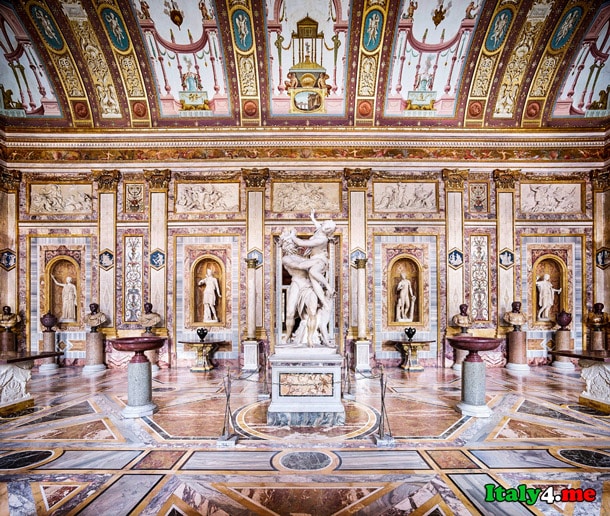
Another favorite of Scipione Borghese was Gian Lorenzo Bernini, whose works are renowned for their lifelike realism and grace. One of his most famous pieces is the “Apollo and Daphne”, which captures the moment when the nymph Daphne transforms into a tree to escape Apollo’s advances.
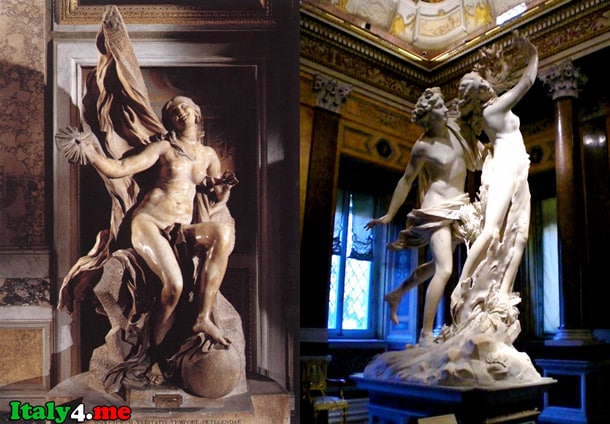
Another dramatic masterpiece is Bernini’s “The Rape of Proserpina”, which displays the intense struggle between the characters.
This sculpture was created on commission by Pope Urban III and carries a moral lesson.
Later generations of the Borghese family worked to preserve and expand the collection. However, during the reign of Napoleon Bonaparte, the gallery faced a challenging period. “Camillo Borghese”, husband of Napoleon’s sister Pauline Bonaparte, commissioned Antonio Canova to sculpt the famous “Venus Victrix”, with Pauline posing as Venus.
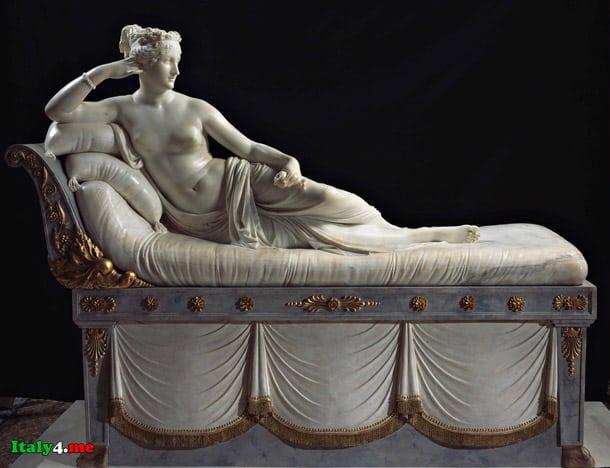
The Borghese family lost interest in the collection in the 18th century, selling off many pieces to fund other ventures. Many artworks were also sent to France for Napoleon.
Today, the Borghese Gallery houses an impressive and varied collection of sculptures on the villa’s first floor, including ancient works and 16th-century busts of Roman emperors. The second floor showcases paintings by renowned masters like Van Gogh, Degas, Cézanne, Modigliani, Bellini, and Domenichino.
See all artworks on website borghese.gallery
Tickets – Where to Buy
Tickets to the Borghese Gallery should be purchased in advance, as they are often limited. Tickets cost between €20 and €40 in 2026**.
For official tickets, only purchase through official ticket websites like www.tiqets.com or ticketone.it to avoid scams.
For a step-by-step guide on booking tickets to the Borghese Gallery, see: How to book tickets to the Borghese Gallery without extra.
How to Get to the Borghese Gallery
The Borghese Gallery is located at: Borghese Gallery and Museum Piazzale del Museo Borghese, 5 00197 ROMA
The museum is open from Tuesday to Sunday, from 8:30 AM to 7:30 PM.
Time inside is limited to two hours, although this restriction does not apply to the park area.
Find a hotel near the Borghese GalleryThe museum administration controls the number of visitors, and no more than 360 people can be inside the villa at the same time. You can get to the Borghese Gallery by:
- Metro – Line A, the nearest station is Spagna at the Spanish Steps, follow the signs for Villa Borghese – Via Veneto;
- City bus numbers: 5, 19, 52, 53, 63, 86, 88, 92, 95, 116, 204, 217, 231, 360, 490, 491, 495, 630, 910, 926;
- Taxi, mentioning your destination as: Borghese Museum and Gallery (Borghese Gallery).