 Italy for me From Italy with love


Mosaics are a truly unique art form. Images composed of tiny pieces of colored glass and stone are far more durable than paintings, resistant to fading, and capable of preserving their original appearance for centuries—or even millennia. A striking example of this art is the mosaic ensemble of the city of Ravenna.
Ravenna boasts a long and rich history, which you can read about in more detail in the article on its main attractions. The mosaics adorning its religious buildings were created throughout the 5th and 6th centuries. This was not a particularly peaceful period in the city’s history.
Additionally, at that time, Christian art had not yet established a canon for how to depict events from Sacred History. As a result, many of Ravenna’s mosaics may seem somewhat unclear at first glance. Let’s explore how to view and understand these remarkable works.
Page Contents
Basilicas
The city is home to three churches adorned with mosaics. Two are dedicated to Saint Apollinaris, the first bishop of Ravenna, and the third to Saint Vitalis.
Sant’Apollinare in Classe
The Basilica of Sant’Apollinare in Classe (Basilica di Sant’Apollinare in Classe) was built in the 6th century over the burial site of Saint Apollinaris. The suffix “in Classe” comes from “Civitas Classis,” meaning “city of the fleet.”
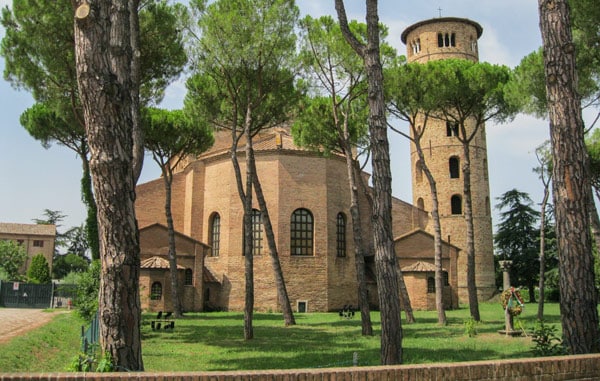
Originally, Ravenna stood right on the Adriatic coast and served as the main port of the Eastern Mediterranean. Over time, however, the Po River, whose delta includes the city, deposited large amounts of silt and sand, pushing the shoreline several kilometers away.
Of particular interest is the mosaic located in the conch of the basilica’s altar apse. We see a radiant cross inside a blue circle studded with stars. Directly above it is a hand. Below, on either side of the blue sphere, slightly elevated, are two saints appearing to emerge from a golden glow. Just beneath them, also flanking the blue circle with the cross, are three lambs.
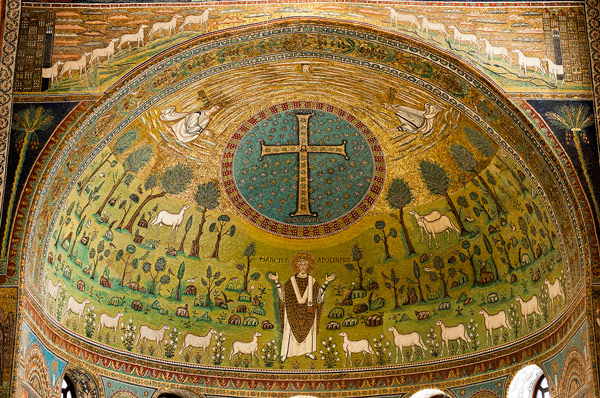
What we see here is a scene of the Transfiguration, depicted in a somewhat different manner. The cross, with a small image of Christ at its center, represents the Lord. The lambs symbolize the disciples, the apostles Peter, John, and James, while the two saints are the Old Testament prophets Moses and Elijah.
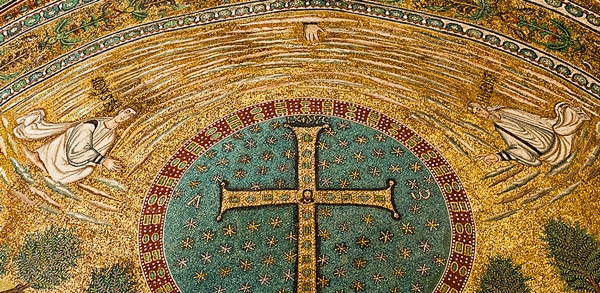
The hand above the sphere symbolizes God the Father. This reflects the absence of a formal canon for depicting New Testament events at the time. Depicting Gospel stories through symbols and allegories had even become something of a tradition.
The other mosaics are easier to understand. Below the Transfiguration scene is an image of Saint Apollinaris, toward whom twelve lambs are walking. According to one interpretation, they represent the apostles. Another view suggests that the white sheep symbolize all believers. Below these are scenes from the history of the Ravenna church, images of bishops, Old Testament events, archangels, and evangelists. Only the mosaic in the pediment of the church, in front of the apse’s semicircle, differs.
This mosaic is attributed to a later period, the 8th–9th centuries, when allegorical representations of saints began to give way to more literal depictions. Here, Christ is shown in human form, surrounded by the four evangelists.
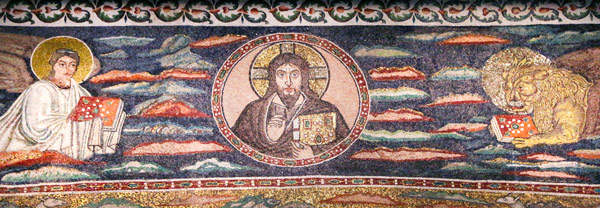
They have their own distinctive iconography. In the early centuries of Christianity, the four rivers of Paradise served as symbols for the evangelists. According to the Old Testament, a river flowed out of Eden to water the garden and then divided into four branches. The names of these rivers—Pishon, Gihon, Hiddekel, and Euphrates—can be found in the second chapter of Genesis. The evangelists, who carry the Good News of the life and teachings of Jesus Christ, were likened to rivers bringing life-giving waters, hence this comparison. Indeed, Christian art abounds with such examples where New Testament events are interpreted through Old Testament imagery.
So where did the animals come from? Once again, from the Old Testament, specifically the vision of the prophet Ezekiel. The Tetramorph—mysterious creatures with the faces of a lion, an ox, a man, and an eagle—also appear in the New Testament, in the Book of Revelation by John the Theologian. Over time, these images became associated with the evangelists: Matthew with the angel, Mark with the lion, John with the eagle, and Luke with the ox.
Why this association? It relates to the central themes of the Gospel texts. The Gospel of Matthew (angel) emphasizes Christ’s human nature. Mark portrays Jesus as a king (the lion being a royal animal). Luke focuses on the Savior’s sacrificial service (hence the ox as the evangelist’s symbol).
The Gospel of John is among the most complex in its writing, difficult to interpret without guidance. Its main theme is the triumph of life over death and the ascension of Christ into heaven, symbolized by the eagle.
Sant’Apollinare Nuovo
The Basilica of Sant’Apollinare Nuovo (Basilica di Sant’Apollinare Nuovo), by contrast, began construction about half a century earlier than the basilica in Classe. It was commissioned by Emperor Theodoric.
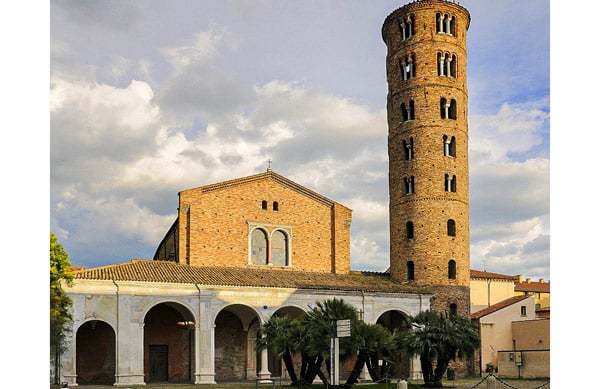
A brief note is necessary here. In the 5th–6th centuries, Christianity had not yet split into Western and Eastern branches. However, various sects—later deemed heretical—did exist. Theodoric adhered to Arianism, one such sect. Arians did not recognize the Holy Trinity, denying the equality of God the Father, God the Son, and the Holy Spirit. Sant’Apollinare Nuovo was originally an Arian church but was reconsecrated during the reign of Emperor Justinian.
The conflict between Arianism and true Christianity is reflected in the mosaic decoration of Sant’Apollinare Nuovo.
The addition of “Nuovo” (meaning “new”) came in the 9th century when the relics of Saint Apollinaris were transferred to the church. This distinguished it from the Basilica of Sant’Apollinare in Classe.
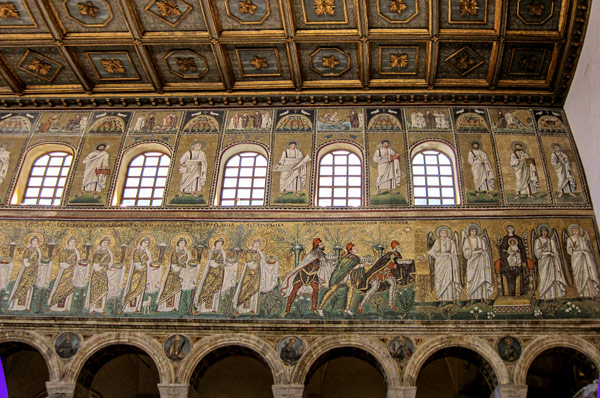
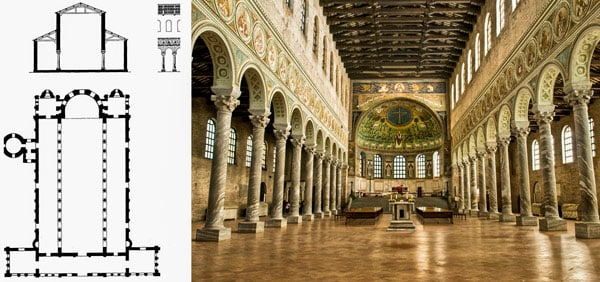
All the mosaic panels are arranged in three tiers along the north and south walls. The upper rows depict New Testament scenes: Christ performing miracles, healing the paralyzed and the possessed, the Last Supper, and events from the Passion.
Below these are images of prophets and saints. Beneath them are processions of martyrs (on the south wall) and virgins (on the north wall), each ending at depictions of the Virgin Mary and the Savior, respectively. Here is where it gets especially interesting.
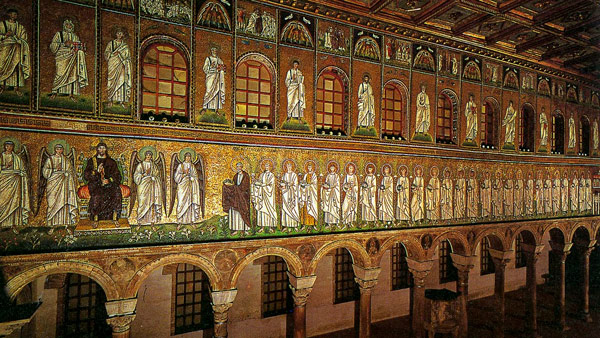
The procession of virgins is led by the three Magi—Balthazar, Melchior, and Gaspar—who brought gifts of gold, frankincense, and myrrh to Christ at His birth. Their procession begins at the walls of Ravenna’s port. The procession of martyrs is headed by Saint Martin of Tours and originates from a building with the inscription “Palatium” on its facade.
Over time, it was discovered that the Magi and Saint Martin were later additions. Originally, the processions were probably led by Emperor Theodoric and his wife. To eliminate traces of Arian heresy, Emperor Justinian ordered these images to be covered. Other elements were also altered.
In the “Palatium” building—believed to represent Theodoric’s private residence—we now see curtains between the columns. Originally, images of the Ostrogothic emperor’s servants occupied this space.
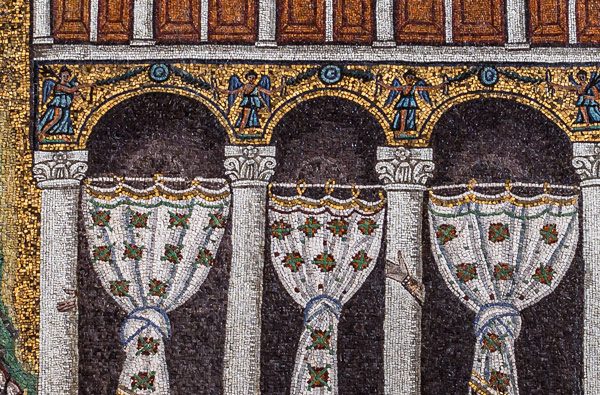
This is evidenced by fragments of human hands still visible on some of the columns.
San Vitale
The mosaics of the Basilica of San Vitale (Basilica di San Vitale) are relatively easy to interpret compared to the panels in the two previous churches. Like the basilica itself, they were created in the 6th century.
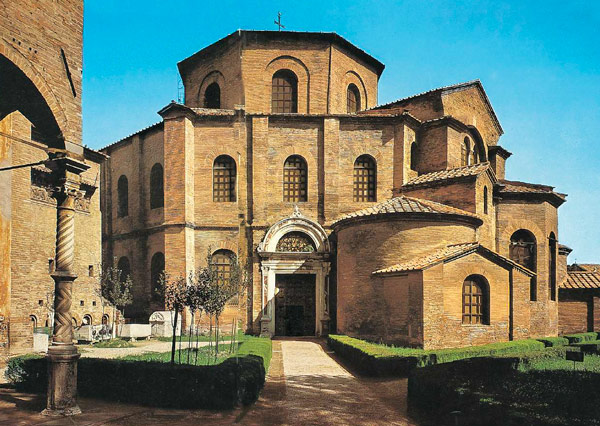
The images composed of tiny pieces of colored glass occupy only a small portion of the church, yet they are more than enough to inspire awe.
In the conch of the altar apse, we see Christ resting on a blue sphere. Notably, the Lord is depicted beardless, further evidence of the absence of a strict canon for portraying the Savior and the saints.
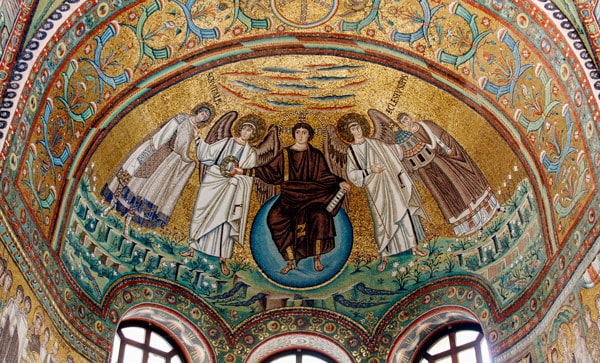
To the left, Saint Vitalis, presented by an angel, receives the martyr’s crown from Christ. To the right, Bishop Ecclesius of Ravenna, who initiated the basilica’s construction, offers the Lord a model of the church. Flowing from beneath the blue sphere, which symbolizes the cosmos, are the four rivers of Paradise. These are the early Christian symbols for the evangelists Matthew, Mark, John, and Luke.
Beneath this scene are portrait images of Emperor Justinian (on the left) and his wife Theodora (on the right), making offerings to the church itself. Surrounding them on the walls are Old Testament scenes, while the arch separating the mosaic apse from the rest of the church features images of Christ and the apostles within circular medallions.
Mausoleum of Galla Placidia
Much like the Basilica of San Vitale, the decoration of the Mausoleum of Galla Placidia (Mausoleo di Galla Placidia) was created immediately after the construction of the building, in the first half of the 5th century.
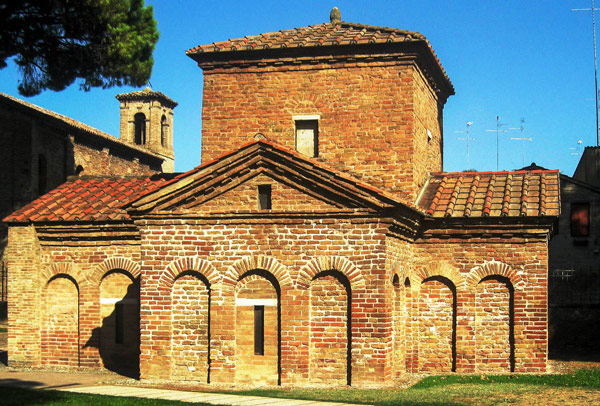
The tomb was intended for Galla Placidia (c. 380–450), daughter of Roman Emperor Theodosius. She herself held a position of power, serving as regent to her young son, Emperor Valentinian III, in 425. Until her son came of age in 437, Galla ruled the Western Roman Empire alone. Throughout her life, she actively supported the Church and played a vital role in promoting and establishing the Christian faith.
The mosaics covering the upper parts of the mausoleum convey the central message of Christian doctrine—the triumph of eternal life over death. The symbol of this victory is the cross, which we see at the very center of the mausoleum’s dome, representing the heavens adorned with golden stars. Below, in the four corners, are the evangelists shown in their now-familiar symbolic forms.
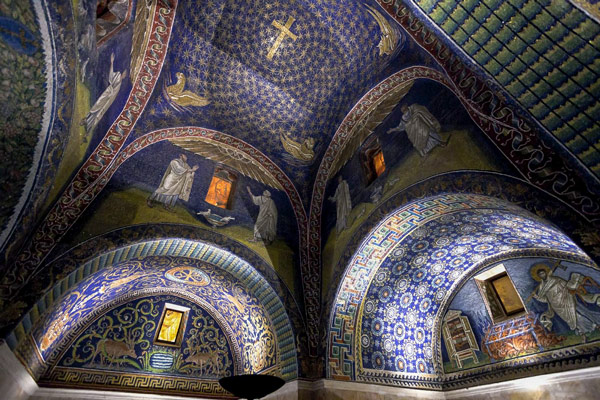
Directly beneath the dome, figures of the apostles can be seen. They are depicted in lunettes—wall sections that are curved at the top by an arch rather than capped by a flat cornice, creating a semi-circular shape. The curious part is that there are only eight apostles depicted, not twelve. This was an aesthetic choice: the mosaicists placed one apostle on each side of the windows to preserve symmetry. The remaining four apostles are integrated into the ornamental patterns of the lower vaults.
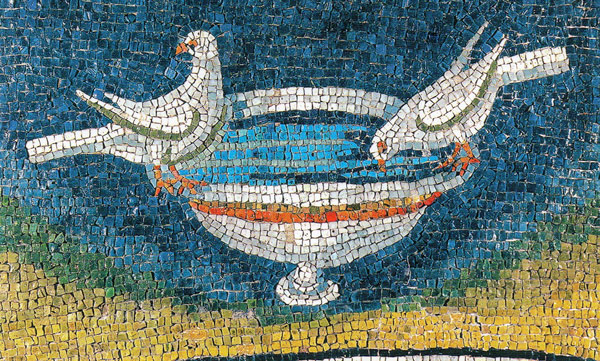
Attention is also drawn to the images of cups and fountains located slightly below, from which doves drink. This is one of the most widely recognized fragments of the mausoleum’s mosaic decoration, appearing frequently on postcards, magnets, and other souvenirs. However, the scene carries deep meaning: the doves symbolize human souls partaking in the Christian faith.
Finally, in the lunettes located just above the plain stone masonry walls, two scenes of significant interest are depicted.
On the south wall, we see a man dressed in white robes, holding a cross in his right hand and a book in his left, approaching a flaming gridiron.
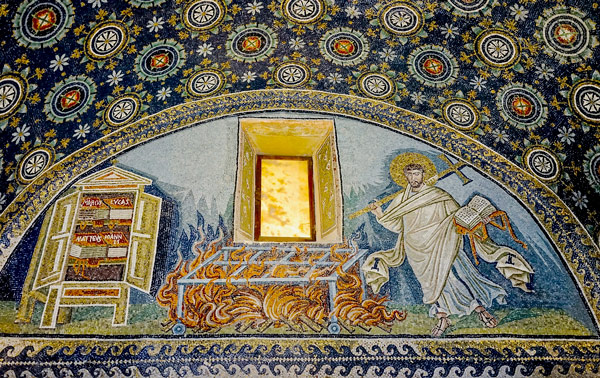
To the left stands an open cabinet with the four Gospels visible on its shelves. The figure’s identity remains a topic of scholarly debate. The most popular theory is that the man is Saint Lawrence. The gridiron represents the instrument of his martyrdom, the book is a Psalter, and the cross is a liturgical symbol. The Psalter and cross indicate Lawrence’s status as a deacon, while the four Gospels symbolize the entire Christian teaching.
Directly above the entrance, in the northern lunette, Christ is depicted as the Good Shepherd.
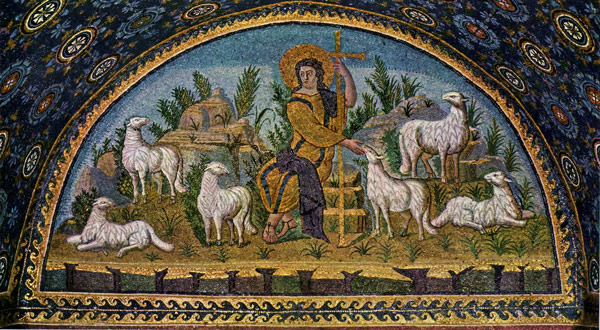
This iconography dates back to the 1st–2nd centuries and is based on the words of the evangelists: the Lord gathers the Christian Church just as a shepherd gathers his flock.
Archiepiscopal Chapel
In the former residence of the bishops of Ravenna, now a museum, there is a small private church. This is the Archiepiscopal Chapel (Cappella Arcivescovile di Sant’Andrea), dedicated to the Apostle Andrew. It was created at the turn of the 5th and 6th centuries.
Interestingly, not all the decoration here is mosaic; there is also a lunette painted in tempera at a much later date, depicting the Deposition of Christ from the Cross.
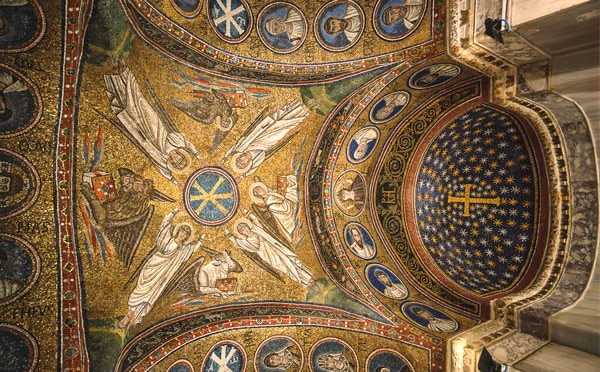
The iconography of the chapel is quite simple. In the altar apse, a radiant cross is set against a dark blue starry sky. The arches are adorned with medallions featuring images of the Savior and saints. On the central vault, four angels hold a blue sphere inscribed with the Chi-Rho monogram, the first two letters of the name of Christ. Between the angels are the evangelists in their symbolic forms.
One mosaic that might cause some confusion is located above the chapel’s entrance door. It is a rare image of Christ as a warrior, influenced by the established iconography of Roman emperors.
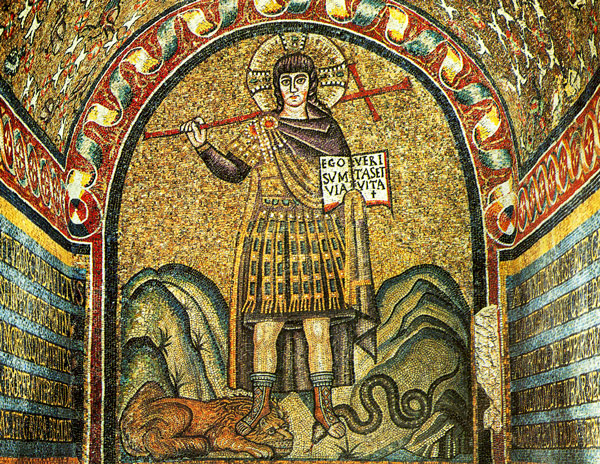
Jesus is dressed in armor, with a blue cloak fastened by a jeweled brooch draped over his shoulder. In his right hand, He holds a cross, and in his left, an open book bearing the inscription “Ego sum via, veritas et vita,” which translates to “I am the way, the truth, and the life.” The Lord stands with His feet trampling the symbols of evil—a lion and an asp. The lion, a universal figure, can symbolize either light or dark forces. The asp presents no ambiguity; it is the same serpent that tempted Eve with the apple from the tree of knowledge and has no other symbolic meanings.
Baptisteries
In addition to the structures described above, Ravenna is home to two baptisteries—the Arian Baptistery (Battistero degli Ariani) and the Orthodox or Neon Baptistery (Battistero degli Ortodossi, or Neoniano).
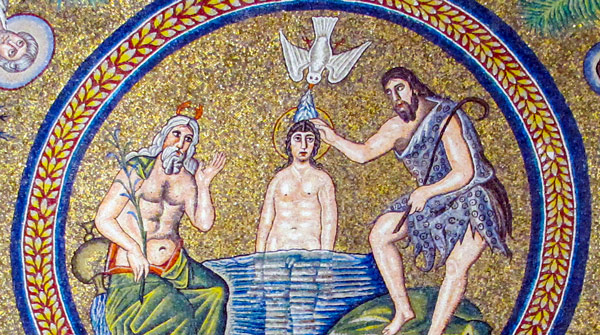
Inside these buildings, designed for the sacrament of baptism, one can also admire mosaics of stunning beauty. Both sets of mosaics were created around the same period—the late 5th to early 6th centuries. The iconography is straightforward: the domes of both baptisteries feature a scene of Christ’s Baptism, surrounded by figures of the twelve apostles.
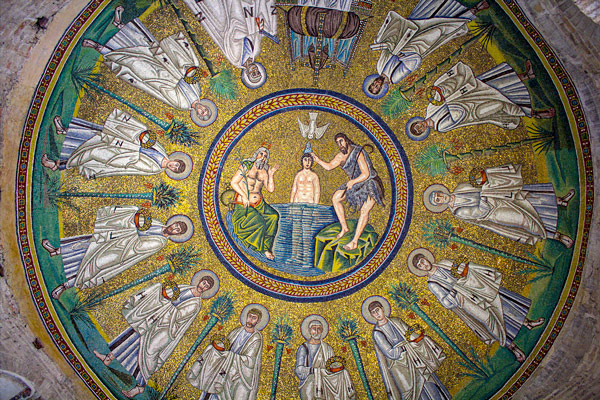
The differences appear in the details. For instance, in the Orthodox baptistery, the apostles’ names are inscribed, while in the Arian baptistery, they are not.
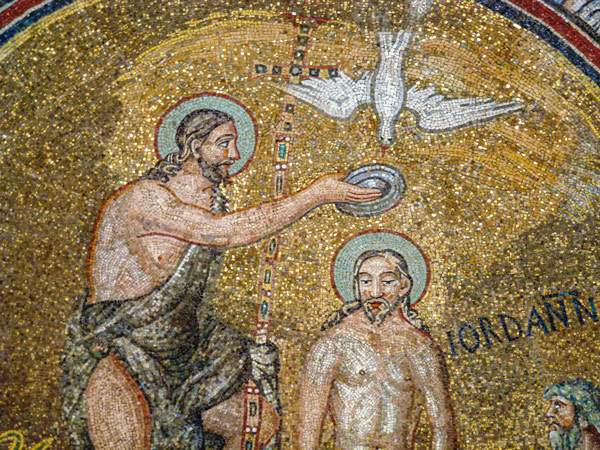
This makes it difficult to identify them. Though they possess some distinctive features, it is important to remember that a strict canon for depicting saints did not yet exist, allowing room for interpretation. Only Peter and Paul are easily recognizable, as they bear their traditional attributes: Peter holds the keys to Paradise, and Paul carries a scroll.
Another key distinction lies in the doctrinal differences between true Christianity and Arianism, which are reflected in the mosaics. Christians understand Christ’s baptism as the union of God the Father, God the Son, and the Holy Spirit.
Arians believe that before his baptism, Jesus was merely human and that it was only through this sacrament that He acquired divine nature. Therefore, in the Arian baptistery, water is shown pouring onto the mosaic Christ from the beak of a dove, symbolizing Jesus receiving His new divine nature.
One of the remarkable things about the attractions of Ravenna is that from the outside, the buildings give no hint of the breathtaking mosaics within. The facades do not reflect the splendor of the interiors. So, for those seeking awe, wonder, and inspiration, this is truly the place to be.
Tickets and Opening Hours
To view all the mosaics, you’ll need to purchase a combined ticket for €12.50 either on the official website www.ravennamosaici.it or at the following locations in Ravenna:
- Basilica di Sant’Apollinare Nuovo, via di Roma 53
- Museo Arcivescovile, piazza Arcivescovado 1
- Basilica di San Vitale, via Argentario 22
Children under 10 enter free of charge.
The ticket is valid for seven days and allows one-time access to each site. All religious monuments featuring mosaics are within walking distance of each other.
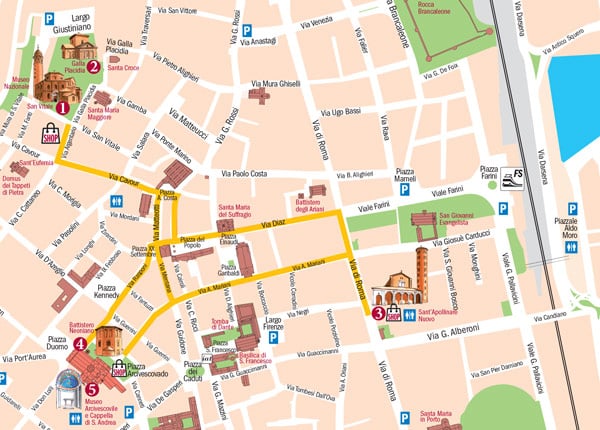
A map of Ravenna is available for free at the ticket office or can be downloaded in advance using this PDF link.
Opening hours: 9:00 AM to 7:00 PM from March to November 1, and 9:00 AM to 5:00 PM from November 2 to March. Closed on Christmas and New Year’s Day. In July and August, the Basilica of San Vitale and the Mausoleum of Galla Placidia are open on Thursdays and Fridays from 9:00 PM to 10:45 PM.
Tips
- If you arrive in Ravenna by train, it’s recommended to begin your mosaic tour at the Basilica of Sant’Apollinare Nuovo, just a 5-minute walk from the station. Plan for a 30-minute visit.
- If traveling by car, park at Largo Giustiniano, 1 and start your visit at the Basilica of San Vitale, which is a 7-minute walk away.