 Italy for me From Italy with love


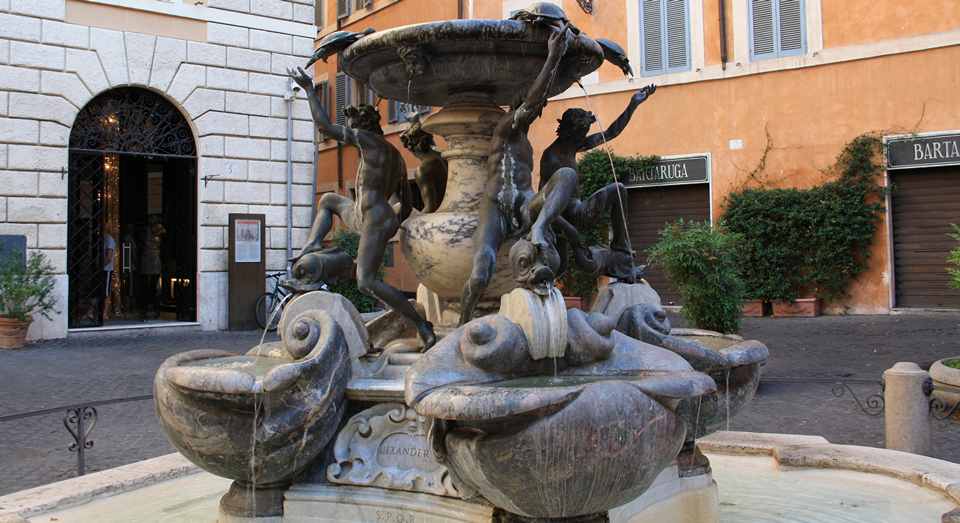
The Fountain of the Turtles (Fontane delle Tartarughe) is located in the center of Rome, in Piazza Mattei. It is considered one of the most beautiful fountains in Rome.
Despite its central location, the square and fountain can be a bit tricky to find, as they are situated within Rome’s former Jewish Ghetto, an area isolated from the rest of the city until 1870. The fountain stands near the gates that once separated the city from the restricted Jewish quarter.
Page Contents
When and Why It Was Built
The fountain was constructed between 1580 and 1588. In 1570, restoration of the ancient Aqua Virgo aqueduct (dell’Aqua Virgo) was completed. Work then began on underground branches of the canal to reach the crowded districts around the Campo Marzio (Campus Martius). While 18 fountains were originally planned, the Turtle Fountain was not among them. However, Muzio Mattei, an Italian nobleman and member of the water commission, insisted on bringing a new fountain to the Ghetto and personally pledged financial support for the project.
The Mattei Family
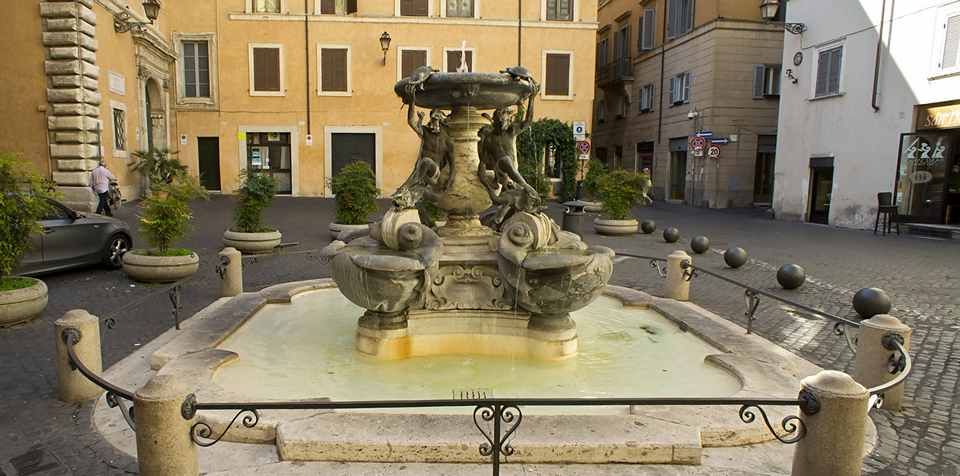
Unlike other fountains of the same period, this fountain was commissioned not by Pope Gregory XIII but by the Mattei family. This wealthy dynasty of patrons, merchants, and clergy (eight cardinals of the Vatican hailed from the Mattei lineage) owned the quarter known as “Isola Mattei.” They also held the keys to the Ghetto, which partially lay on their land, and owned numerous buildings, including three palaces.
Among them was the Palazzo Mattei (Palazzo Mattei Di Giove), from whose windows there is a view of the fountain. Since 1938, when the state acquired the palace, it has been open to the public, housing the Library, the Ministry of Cultural Heritage, and the Institute of Contemporary History.
Pope Alexander VII
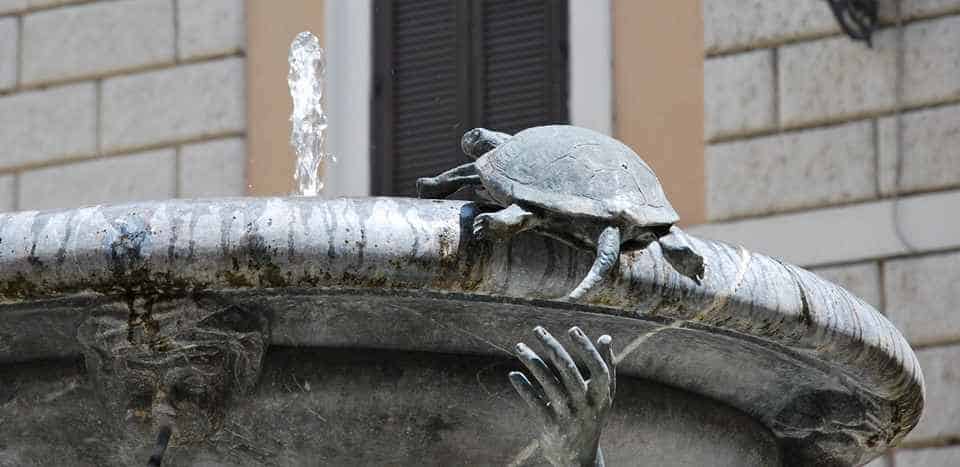
However, the Vatican’s attention to the fountain did not wane. In 1658, by order of Pope Alexander VII, a patron of many architectural works, four turtles were added. These decorative additions are attributed to either Gian Lorenzo Bernini (1598–1680) or Andrea Sacchi (1599–1661). To commemorate this restoration—which not only transformed the fountain’s appearance and name but also improved its water pressure—a scroll inscribed with “ALEXANDER VII” was placed at the base, between the shells.
History and Artistic Design
The fountain received its current name only after its renovation under Pope Alexander VII. Originally, there were no turtles; in their place were dolphins, similar to those still seen at the base today.
The fountain’s structure is typical for its time: a pedestal topped by a globe, surrounded by a square basin holding four large shells. Water flows from the center into the shells and then into the main basin. Its distinctive feature is the exquisite decoration. Muzio Mattei insisted on a refined artistic design and hired the relatively unknown artist Taddeo Landini (1550–1596) for the work. The figures of four young men and eight dolphins were cast in bronze—an innovation, as most fountain ornaments were usually carved from cheaper marble. The combination of bronze figures with a marble base adds an important artistic contrast.
The design is truly striking: dynamic, fully nude male figures astride dolphins support a giant bowl. The composition conveys energy, movement, and elegance.
Soon after, the four dolphins were moved to the Fountain of the Terrina (Fontana della Terrina) near the Church of Santa Maria in Vallicella (Chiesa Nuova) because there wasn’t enough water pressure to support all the sculptures. This left the young men seemingly reaching out into empty space. During the 1658–1659 restoration, their outstretched hands were completed with the addition of turtles.
The naturalistic bronze turtles, likely created by Gian Lorenzo Bernini (1598–1680), became a focus for art lovers. They were repeatedly stolen; in 1944, all four turtles were taken. They were later recovered and reinstalled. After another theft in 1979, the remaining original turtles were moved to the Capitoline Museums (Musei Capitolini), and faithful replicas were placed on the fountain.
Architect and Sculptor
The fountain was designed by Giacomo della Porta (1532–1602), a Roman architect and sculptor who worked in the Mannerist style. Mannerism is characterized by sensuality, spirituality, tension, distortion of forms, and unusual compositions.
Elements of Mannerism can also be found in the works of Titian (Tiziano Vecellio), Tintoretto, Raphael (Raffaello Santi), and Michelangelo. For a long time, the Turtle Fountain was mistakenly attributed to either Raphael or Michelangelo.
Giacomo della Porta’s other notable works in Rome include:
- The main dome of St. Peter’s Basilica (Basilica di San Pietro);
- Church of the Gesù (La chiesa del Santissimo Nome di Gesù);
- The Sapienza University of Rome (Sapienza Università di Roma);
- Villa Aldobrandini (Villa Aldobrandini).
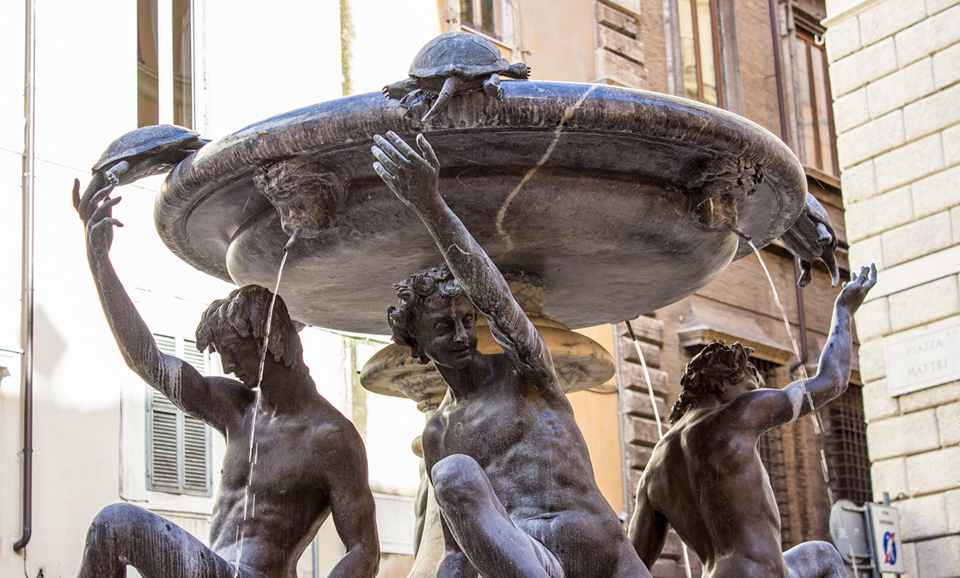
The sculptures of young men and dolphins were created by the young Florentine sculptor Taddeo Landini. This was his first and most significant work, which brought him fame.
Although Gian Lorenzo Bernini’s involvement with the turtles remains speculative, it is a plausible theory given that Pope Alexander VII was one of his major patrons.
Legend
The exact origin of the legend is unknown and mirrors the familiar theme from many folk tales, where a commoner or a hapless young man wins the hand of a beautiful maiden by performing miraculous feats, such as building a bridge overnight. There are many versions of the story, but the essence is as follows:
One of the Mattei dukes was an avid gambler. Having lost his estate and left with no means of support, he fell out of favor with a wealthy landowner who forbade his daughter from marrying a man deemed reckless, despite his noble lineage. Determined to restore his reputation and prove his worth, the duke invited the skeptical father to his home one evening. After a night of entertainment, the duke led his guest to the window at dawn: there stood the newly constructed fountain, a marvel that hadn’t been there the night before. Impressed, the father agreed to the marriage. Later, the duke allegedly ordered the window bricked up.
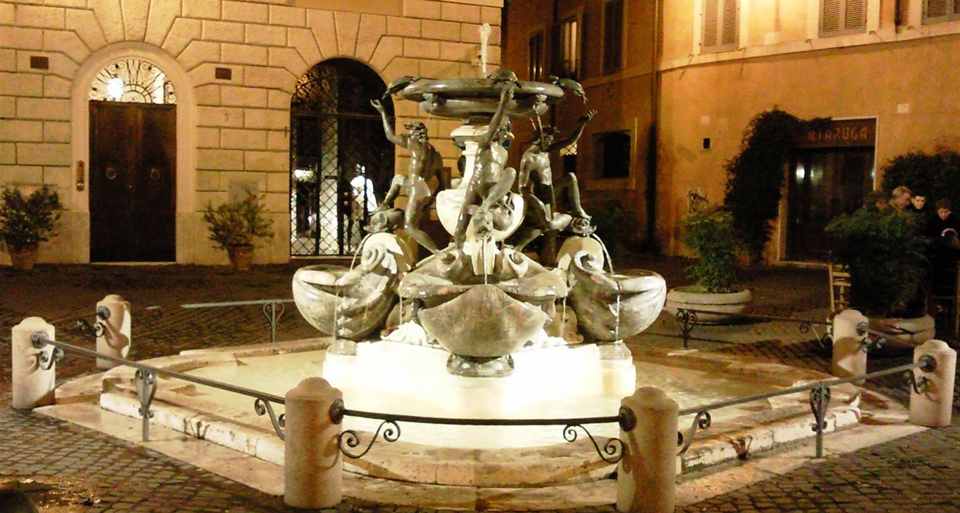
In reality, the Mattei Palace was built later, in 1616, after the fountain’s construction. However, the legend likely arose because:
- The Mattei family played a significant role in the fountain’s history, actively patronizing it over several centuries;
- The fountain offers a particularly stunning view from the palace windows, a view accessible to visitors today—any bricked-up windows have long been reopened.
Symbolism
There is a theory that the dolphins accompanied by turtles symbolize the motto “Make haste slowly” (Greek: Speude bradeôs), a favorite saying of Roman Emperor Octavian Augustus.
Others see a link to the myth of Jupiter and Ganymede, based on several observations:
- The fountain’s patron was a duke named Giove (Italian for Jupiter);
- The turtles were added 70 years later and were not part of the original design;
- The dynamic poses of the young men, with arms reaching upward and knees bent, their youthful, nude bodies, and minimal attributes, are traditionally associated with depictions of Ganymede being carried off by an eagle.
Summary of the Myth: The myth is a Roman adaptation of one of Zeus’s (Jupiter’s) many amorous adventures. Captivated by the beauty of Ganymede, a young shepherd, Jupiter fell in love, transformed into an eagle, and swooped down to carry him away. Ganymede later became a demi-god and Jupiter’s cupbearer.
There is substantial documentary evidence that the Mattei family, great patrons of the arts, were well familiar with Ganymede imagery—for example, Ganymede by Baldassarre Peruzzi at Villa Farnesina (1541).
Why Turtles?
It may seem surprising that turtles were chosen to replace the missing mythological dolphins. Turtles were not a common iconographic element at the time. The presumed creator of the turtles, Gian Lorenzo Bernini, moved within scholarly circles that understood the syncretic (inseparable) connection between the turtle and the myth of Jupiter and Ganymede. Thus, the choice of these creatures could have been quite intentional.
The Fountain in Art
The Turtle Fountain quickly gained popularity and captured the attention of many artists.
- It was meticulously illustrated by Giovanni Battista Falda (1640–1678), the Italian engraver who documented the architecture and urban layout of 17th-century Rome;
- Joseph Brodsky referenced it in his poem “Piazza Mattei”: “I drank from this fountain in Rome’s ravine…”;
- In the final scene of the Italian gangster series Romanzo Criminale (2008–2010), the character Del Freddo is killed on Piazza Mattei and thrown into the Turtle Fountain.
How to Get There
Finding the Turtle Fountain is very easy since it is located right in the heart of Rome. Nearby attractions include:
- Teatro di Marcello
- Tiber Island
- Largo di Torre Argentina — the famous square where Rome’s cats live.