 Italy for me From Italy with love


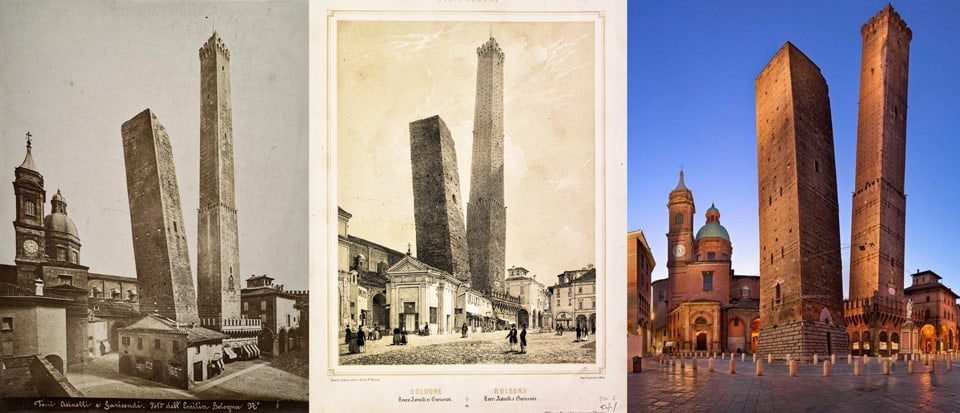
The Asinelli Tower (La torre Asinelli) and the Garisenda Tower (La torre Garisenda) are among the most famous landmarks in Bologna and are considered the city’s main symbol.
The towers stand side by side and attract countless tourists every year. Asinelli is the tallest leaning tower in the world, but Garisenda has a steeper tilt!
Page Contents
Origin and History
During the Middle Ages, noble families had a peculiar way of flaunting their wealth—by building taller and more imposing structures. There was hardly a more striking way to show off than with towering buildings, which is why Bologna earned the nickname “Manhattan of the Middle Ages.”
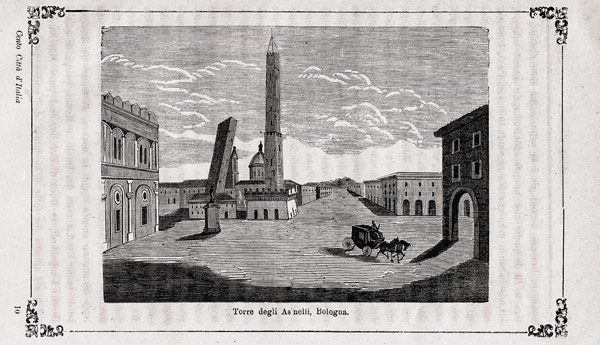
Most of these high-rises served as private strongholds for the elite. The towers functioned as fortified homes storing valuable possessions, but they were also powerful symbols of status. In medieval Bologna, there was an unspoken rule: the taller your tower, the wealthier you were.
According to legend, two families once challenged each other to prove who was more powerful and prosperous. Not only did they compete to build the tallest tower, but each tried to add a unique feature to distinguish their structure from the other.
The towers were typically constructed using the same method—at the base were trapezoidal selenite blocks, buried 23–33 feet (7–10 meters) deep for stability. The walls followed a “the higher, the thinner” design trend. Foundations were reinforced with stakes driven into the ground and covered with stones. Typically, two wall layers were used: a thick inner layer and a much thinner outer one. The space between them was then filled with rubble.
Asinelli Tower
Bologna is often called the “city of a hundred towers,” though many of these structures have not survived. Some collapsed within 30 or 50 years, while others were intentionally demolished by the city authorities. Earthquakes also played a significant role in their destruction.
Asinelli Tower was luckier than most of its medieval counterparts. Archival records date its construction to 1109, although some legends suggest it began rising as early as the 11th century. The tower stands 318 feet (97 meters) tall.
Contrary to popular belief, the tower didn’t start leaning due to the Asinelli family’s “creative” vision. The tilt resulted from construction flaws and noncompliance with proper building techniques. Today, the tower leans nearly 7 feet (2.1 meters) off its vertical axis.
In the 14th century, ownership of the tower transferred from the Asinelli family to the city government, which converted it into a municipal prison. This required raising its height slightly. A century later, a guard post was added. During World War II, the tower housed watchmen, and afterward, it served as a broadcasting antenna for the RAI television network. Today, the tower houses a variety of artisan shops selling handmade decorative crafts.
Scientists have also left their mark on the tower. In the 17th century, Giovanni Battista Riccioli conducted gravity experiments here, followed in the 18th century by Giovanni Battista Guglielmo, who dropped objects from the top to study their fall.
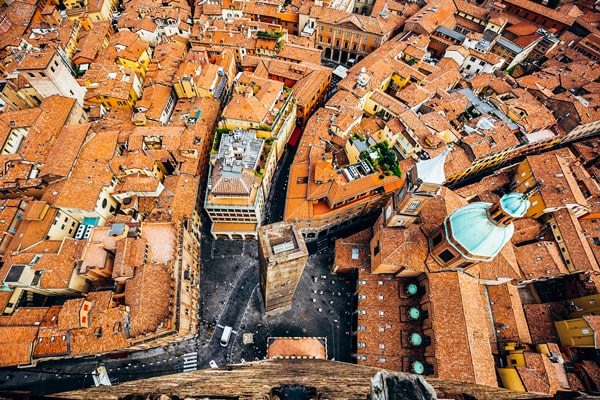
Visitors can now climb the tower via a narrow spiral staircase. To enjoy one of the finest panoramic views of Bologna, you’ll need to conquer all 498 steps.
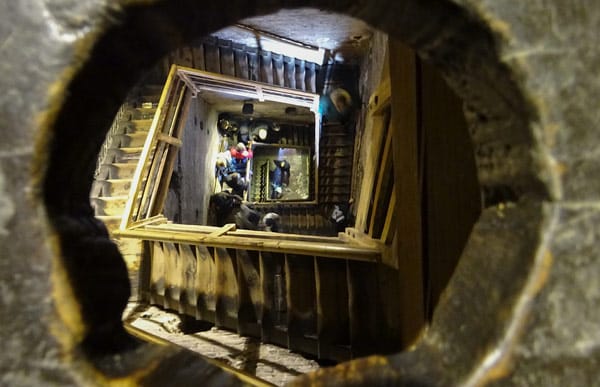
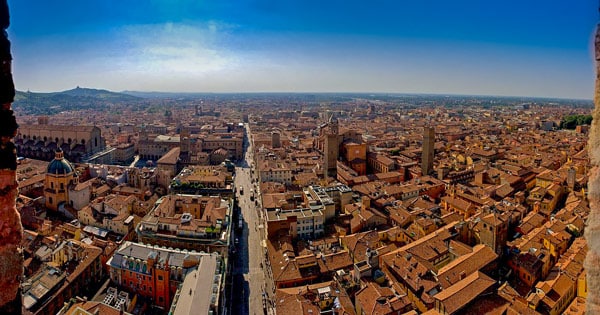
Before beginning your ascent, consider tying a ribbon to the iron gate above the entrance—locals believe this small act brings good luck. From the top, you’ll be rewarded with one of the most breathtaking views of Bologna.
Garisenda Tower
Over time, Garisenda Tower has proven to be less stable than its “sister” tower. While Asinelli’s tilt has remained within a safe range, allowing it to stand firm to this day, Garisenda began leaning more than 10 feet (3 meters), posing a serious threat not only to the tower itself but also to nearby residents and surrounding buildings.
Historians believe that in the Middle Ages, around the 13th–14th centuries, Garisenda was originally taller than its sister. However, due to the risk of collapse, it had to be shortened three times. Today, Garisenda stands at 157 feet (48 meters).
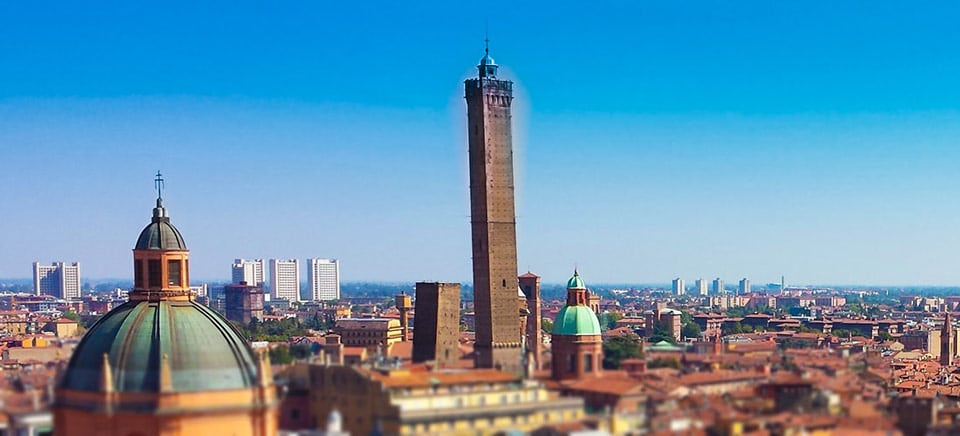
Construction of the tower dates back to the 13th century. It remained in the hands of the Garisenda family until the 15th century. From the 15th to the 19th century, it belonged to a textile company before eventually being acquired by the municipal government. At one point, parts of the tower were used by the military.
When construction was completed, the tower was connected to Asinelli by a wooden bridge 98 feet (30 meters) above the ground. The bridge did not survive—it burned down in the 1380s. In fact, this fire was not the first. Two arson attempts had occurred a century earlier, but both were extinguished in time.
Other Leaning Towers
In addition to Asinelli and Garisenda, Bologna is home to several other leaning towers, including:
- Prendiparte Tower (Torre Prendiparte), also known as Coronata, built in the late 12th century. It reaches a height of 200 feet (61 meters), making it the second tallest after Asinelli;
- Uguzzoni Tower (Torre degli Uguzzoni), 105 feet (32 meters) tall, built in the late 12th to early 13th century;
- Scappi Tower (Torre degli Scappi), constructed in 1220, with a height of 128 feet (39 meters);
- Galluzzi Tower (Torre dei Galluzzi), built in 1257, standing at 98 feet (30 meters);
- Guidozagni Tower (Torre dei Guidozagni), built in the early 13th century, reaching 66 feet (20 meters).
Be sure to also read about the Leaning Tower of Pisa
Legends
Like many other famous landmarks, Asinelli and Garisenda are surrounded by legends passed down through generations.
Asinelli Tower is home to a romantic tale. Long ago, a poor young man lived in Bologna in a small shack and owned just a few pack donkeys. He made a living hauling sand and gravel from the Reno River on his animals for construction projects across the city. One evening, returning from a hard day’s work, he caught a glimpse of a beautiful girl standing at the window of a noble house.
Unable to stop thinking about her, the boy eventually mustered the courage to ask her father for her hand in marriage. The wealthy man laughed and said, “If you build the tallest tower in the city, then I might just give you my daughter.” He thought the challenge would discourage the young suitor. But the boy accepted and doubled his efforts. One day, while transporting materials along the river, he discovered a chest of gold coins hidden beneath the water. With this newfound wealth, he hired workers and began constructing the tower. He kept his promise, and the magnificent structure that still bears his name rose in the heart of Bologna. The girl became his wife.
Opening Hours
You can visit the Asinelli Tower during the following hours:
- November to February – daily from 9:30 AM to 5:45 PM; last entry at 5:00 PM;
- March to November – daily from 9:00 AM to 7:30 PM; last entry at 6:30 PM.
The official tower website: www.duetorribologna.com is available in English, Italian, and Chinese.
Admission prices:
- Adults: €5;
- Children under 12, seniors over 65, students, groups of up to 20 people, and Musei Metropolitani cardholders: €3.
Garisenda Tower is currently closed to the public for safety reasons, as its tilt remains dangerously severe.
How to Get There
The Asinelli and Garisenda Towers are located at Piazza di Porta Ravegnana. Walking from Bologna Centrale train station takes about 25 minutes. 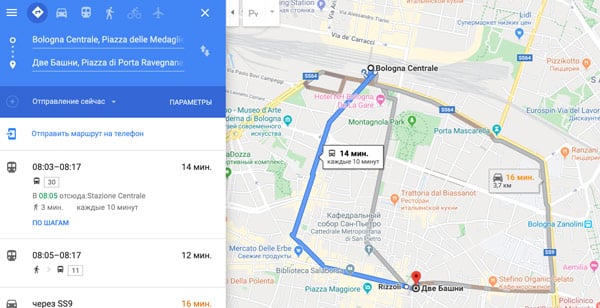
You can also take buses 11, 25, 27, or 30, which run every 10 minutes. Get off at the Rizzoli stop.
You may also find these guides helpful for getting to Bologna:
- from Milan
- from Genoa
- from Rimini
- from the airport
- from Florence
- from Venice