 Italy for me From Italy with love

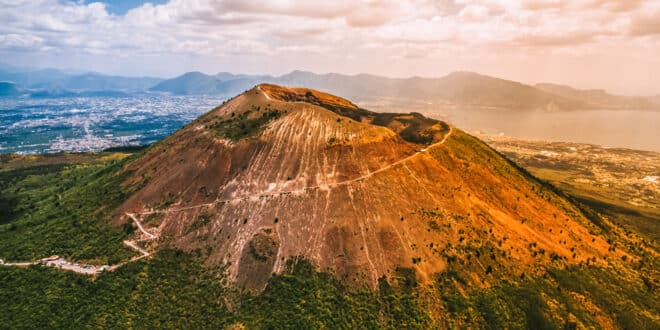
Mount Vesuvius is an active volcano located 15 km (9.3 miles) from Naples in the Campania region of southern Italy, near the shores of the Neapolitan Bay. The volcano stands at a height of 1281 meters (4202 feet) and is part of the Apennine mountain system.
Geographical coordinates: 40° 49′ N, 14° 25′ E
Vesuvius is the only active volcano in mainland Europe. Its name may have originated from the Oscan word *fest*, meaning “smoke,” or from the Proto-Indo-European root *ves*, meaning “mountain.” It is considered one of the most dangerous volcanoes in the world, with over eighty recorded significant eruptions.
Recommended Tour from Naples: Mount Vesuvius Transfer with Entry Tickets
Page Contents
The Destruction of Pompeii
The most famous eruption occurred on August 24, 79 AD, resulting in the destruction of the cities of Pompeii, Oplontis, and Herculaneum.
This catastrophic event was preceded by an earthquake on February 5, 62 AD, which severely damaged many of the buildings in the region.
The eruption that destroyed Pompeii lasted about 24 hours, covering the city with several meters of ash. Ash from the volcano reportedly reached as far as Syria and Egypt. At the time, Pompeii had an estimated population of 20,000, most of whom fled before the catastrophe. However, around 2,000 people perished in the city, with remains found beyond Pompeii’s borders, making it impossible to determine the exact number of victims.
Vesuvius in Art
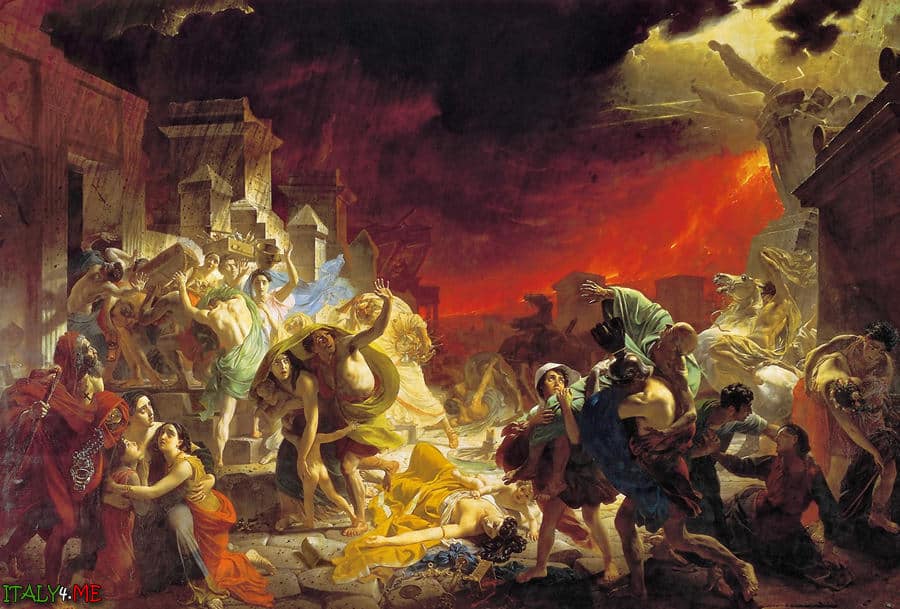
The volcano’s eruptions have inspired many artists.
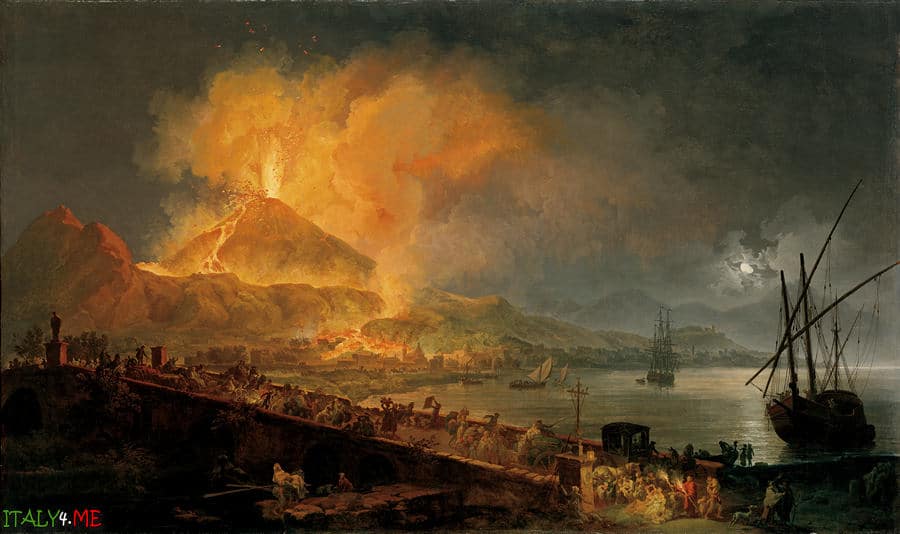
In 1777, French landscape painter Pierre-Jacques Volaire created the painting *”The Eruption of Vesuvius.”* Later, in 1833, Russian artist Karl Bryullov painted his masterpiece *”The Last Day of Pompeii,”* commemorating the disaster.
Seismic Activity and Structure of the Volcano
The last eruption of Vesuvius occurred in 1944.
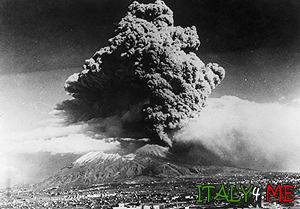
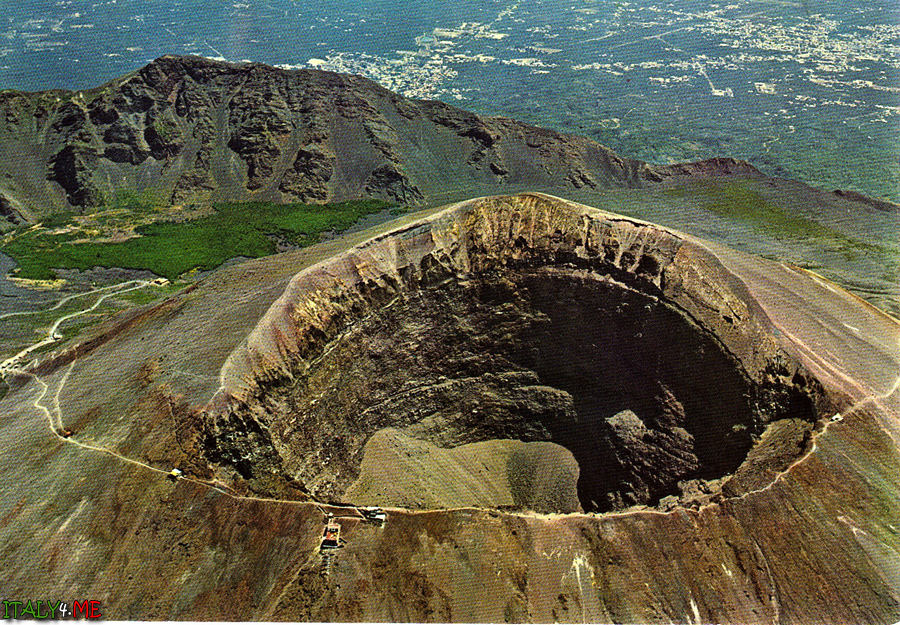
Vesuvius is part of the Mediterranean mobile belt, which stretches for 15,000 km (9,320 miles) from Indonesia to Western Europe. It is the only mountain rising above the plains of Campania. On the western slope at 600 meters (1,969 feet), there is a volcanological observatory, founded in 1842. Modern research has identified several magma chambers beneath Vesuvius. The nearest chamber is 3 km (1.9 miles) below the surface, while a deeper one lies at a depth of 10–15 km (6.2–9.3 miles). The continental crust beneath the volcano consists of a 7-km-thick layer of Triassic dolomite, based on geodetic and drilling data.
Vesuvius has three nested cones. The oldest remains only on the eastern and northern slopes and is called Monte Somma. The second cone (Vesuvius itself) is inside Monte Somma. At Vesuvius’ summit lies a crater, within which a temporary third cone appears during eruptions and then disappears.
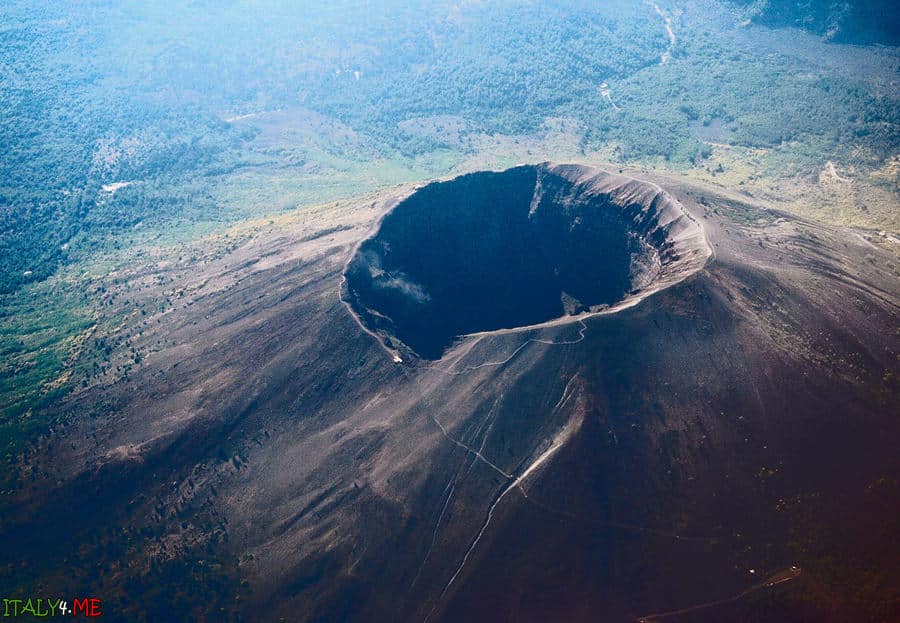
The main cone is composed of volcanic tuff and alternating layers of lava. The weathering process contributes to the fertility of the soil on the slopes, supporting gardens and vineyards at the base, with pine forests growing up to 800 meters (2,624 feet).
How to Get There
For instructions, see: how to climb Vesuvius on your own. We visited the volcano during our trip to the Campania region and Amalfi Coast.
In 1880, a funicular was built to reach the summit of Vesuvius. The funicular featured two large cars powered by a steam engine. This attraction became a famous tourist symbol of the region, even inspiring a famous song still known today.
The 1944 eruption destroyed the funicular.
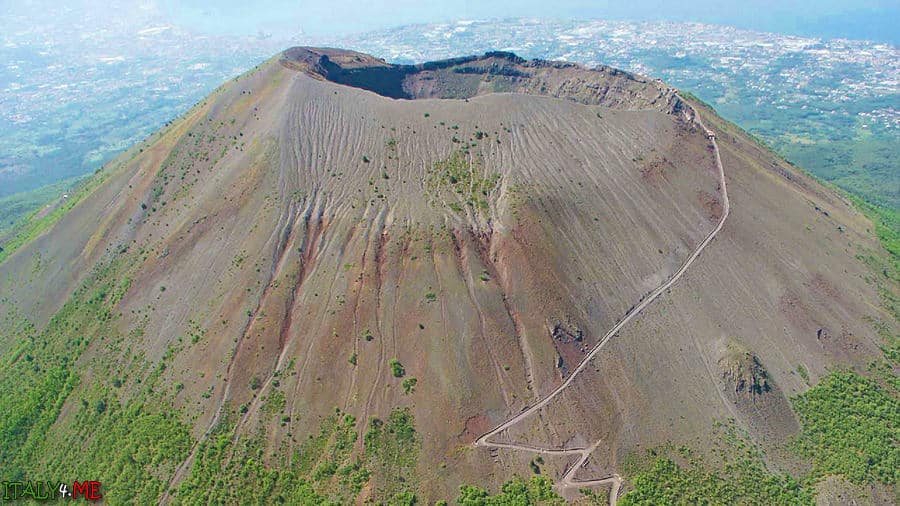
In 1953, a chairlift was built on Vesuvius’ eastern slope, which became popular among tourists.
However, the 1980 earthquake damaged the chairlift beyond repair. Today, visitors can hike along a well-marked trail to explore Vesuvius.