 Italy for me From Italy with love

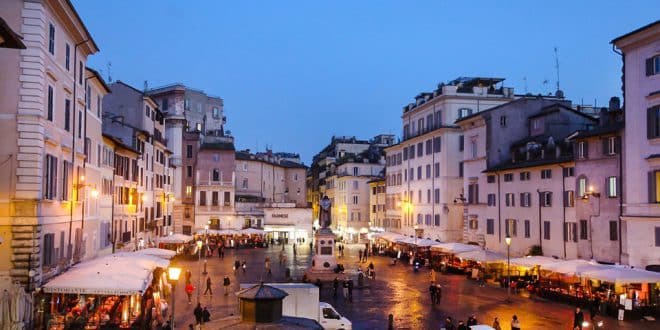
Campo de’ Fiori Square is located in the historic heart of Rome and stands out as a unique destination among the Eternal City’s top attractions.
At the center of the square stands the striking monument to Giordano Bruno, the renowned philosopher known around the world. The statue draws curious travelers and admirers of this brilliant thinker.
This powerful site rarely leaves visitors unmoved—it’s where Bruno cast his final gaze at the stars before being burned at the stake by the Inquisition.
Page Contents
History of the Square and Its Name
Campo de’ Fiori has a captivating history shaped by its creation, transformation, and dramatic episodes in the life of the city. It even has its own ghostly legends—restless spirits said to appear at midnight, bearing the weight of injustice and sorrow.
Another interpretation links the square’s name to a romantic legend—the great Roman general Pompey (Gnaeus Pompeius Magnus) is said to have named it in honor of a beloved woman named Flora.
A less poetic version ties the name to the ancient road known as Via Florea, which once connected the Castel Sant’Angelo with the small church of Chiesa di Sant’Angelo in Pescheria.
Since the 13th century, the land surrounding Campo de’ Fiori belonged to the powerful Roman Orsini family. Up to the 15th century, the area was largely filled with inns and small merchants’ shops.
In 1456, Pope Callistus III began revitalizing the Parione district, which included Campo de’ Fiori. Streets were paved with cobblestones, and major development soon followed.
The construction of grand buildings like the Palazzo della Cancelleria and Palazzo Farnese transformed the square into a bustling hub of commerce and culture.
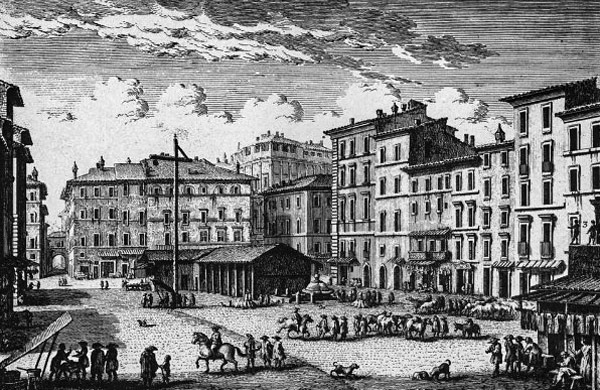
It became a ceremonial route for ambassadors, cardinals, and dignitaries on official missions. This influx brought prosperity to the area: market days became regular events, workshops and boutiques flourished, and inns multiplied. One such inn, Taverna della Vacca, still stands today in its original form. It was once a gift from Cardinal Rodrigo de Borgia to his mistress.
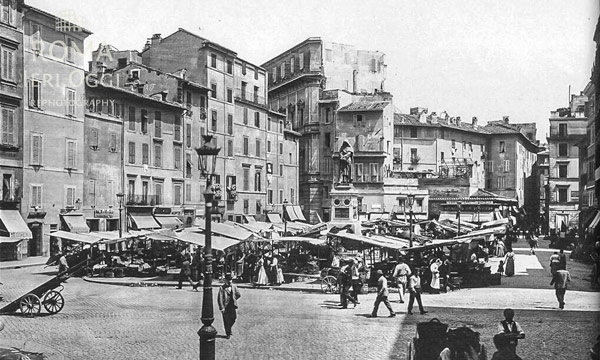
The square became part of the sacred “Papal Route.” A newly elected pope would ride a mule from the Vatican (Stato della Città del Vaticano) to the Basilica of San Giovanni in Laterano. These processional routes connected the city’s squares and served as arteries for civic and religious life in Rome.
- Fun fact: Campo de’ Fiori is the only square in Rome without a church.
The Fountain
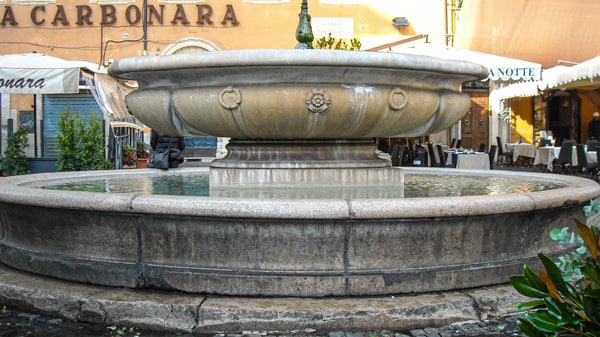
In 1582, under the order of Pope Gregory XIII (Gregorius PP. XIII), the Fontana della Terrina was installed in Campo de’ Fiori to provide the area with a water supply. Designed by the renowned Roman architect Giacomo della Porta—a student of Michelangelo Buonarroti—the fountain reflected the refined aesthetics of the late Renaissance.
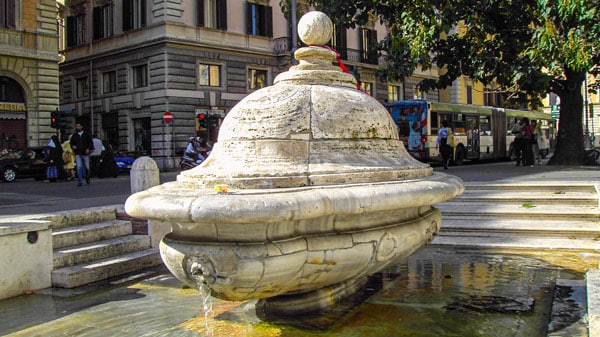
The fountain’s marble basin, crafted in elegant curves from white stone, embodied late Renaissance style. It took the shape of a large oval, flanked by bronze dolphins spouting refreshing streams of water. As the only drinking water source in the neighborhood, it served the market vendors—though not always for the most honorable purposes. Over time, waste and refuse turned it into a garbage pit. In response, Pope Gregory XV (Gregorius XV) ordered a travertine dome-shaped lid with a central handle to be placed over the basin, giving the fountain the appearance of an enormous serving dish.
Water flow was redirected through perforations in decorative rose motifs on the sides of the basin. The original bronze dolphins—once the fountain’s most prized feature—were removed and have since vanished without a trace.
In 1924, the original fountain by Giacomo della Porta was taken out of storage and reinstalled in Piazza della Chiesa Nuova, about 650 feet (200 meters) from Campo de’ Fiori. The dolphins were replaced with sculpted turtles, leading locals to affectionately nickname it “The Soup Tureen” because of its resemblance to a large serving bowl.
At the same time, a replica of the fountain was placed in Campo de’ Fiori itself, without the lid. Today, this version is known as the Fontana di Campo de’ Fiori.
Since 1869, the square has hosted a lively and colorful market, a scene made famous by the 1943 film *Campo de’ Fiori* starring Anna Magnani and Aldo Fabrizi.
Campo de’ Fiori has since appeared in many Italian films. Check out this video compilation of memorable scenes:
- *Straziami ma di baci saziami* (1968), directed by Dino Risi and starring Nino Manfredi, Pamela Tiffin, and Ugo Tognazzi
- *Un amore a Roma* (1960), also by Dino Risi, featuring Mylène Demongeot, Elsa Martinelli, Peter Baldwin, Claudio Gora, and Umberto Orsini
- *Macchie solari* (1975), directed by Armando Crispino with Mimsy Farmer, Barry Primus, and Ray Lovelock
- *Un maledetto imbroglio* (1959), directed by and starring Pietro Germi, alongside the stunning Claudia Cardinale and Franco Fabrizi
Palazzo della Cancelleria
The most striking and grandiose structure near Campo de’ Fiori is the Palazzo della Cancelleria.
Commissioned by Cardinal Raffaele Riario, the nephew of Pope Sixtus IV (Papa Sisto IV), the palace is wrapped in legend—rumor has it the funds for its construction were won by the cardinal in a single night of gambling.
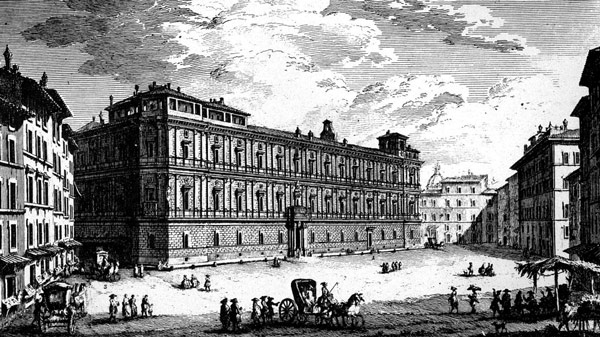
Built between 1489 and 1513, the palazzo is attributed to the brilliant architect Donato Bramante, a pioneer of Roman classicism in urban design. His notable works include the original design of St. Peter’s Basilica (Basilica di San Pietro), the sacristy of Santa Maria presso San Satiro in Milan, and more.
Some historians dispute Bramante’s involvement in the project, suggesting that lesser-known architects Francesco di Giorgio and Baccio Pontelli may have contributed to the building’s design.
Palazzo della Cancelleria was the first Renaissance-style architectural structure built in Rome.
As was common in that era, materials from ancient Roman ruins were repurposed for the construction. Travertine and 44 Egyptian granite columns were sourced from the nearby ruins of the Teatro Pompeo and installed in the palace’s courtyard.
To the right of the building’s façade, a small church—Basilica di San Lorenzo in Damaso—was erected on the site of a 4th-century early Christian church.
In 1517, the palace was confiscated by Pope Leo X (Leo PP. X), the first Medici pope, and transformed into the chancellery of the Papal States.
To this day, the building serves as the Papal Chancellery and belongs to the Vatican. It is listed as a UNESCO World Heritage Site and forms part of the “Historic Center of Rome and Properties of the Holy See enjoying extraterritorial rights.”
The palace’s greatest artistic treasure is its series of frescoes by Giorgio Vasari—a renowned Italian painter, architect, and writer. These are located in the “Hall of the Hundred Days,” named for the astonishingly short time in which Vasari completed the project. Known for his speed, Vasari worked with the assistance of several young apprentices. The frescoes stand out for their vivid colors, expressive detail, and intricate narrative scenes.
Leonardo da Vinci Museum
Inside the palazzo, you’ll find the Museo Leonardo da Vinci. The remarkable machines and inventions imagined and sketched by this genius of human thought have been recreated with extraordinary precision and meticulous attention to detail. From tiny models to massive structures, the exhibits move and function, bringing da Vinci’s original vision to life. Virtual displays, holograms, and 3D imagery immerse visitors in the world of discoveries that were centuries ahead of their time.
A Dark Past
Campo de’ Fiori earned a grim reputation during the Middle Ages as a site for public executions and punishments. The square bore witness to gruesome scenes of beheadings and burnings.
On February 17, 1600, Dominican monk Giordano Bruno was burned alive at the stake, chained in iron, after the Catholic Church condemned him for heresy due to his support of the heliocentric theories of Copernicus and Galileo.
His final words were: “I die a martyr freely, and I know that with my last breath my soul will ascend to heaven!” His execution remains a deeply dramatic reminder of human ignorance.
Eventually, executions moved to the outskirts of the city, and the square was used solely as a marketplace.
Giordano Bruno Monument
In 1884, Roman Freemasons commissioned Italian sculptor Ettore Ferrari to create a monument to the philosopher and pantheist Giordano Bruno. The project sparked controversy and was initially rejected by city authorities. Nonetheless, Ferrari completed the statue free of charge, and it remained stored in his workshop for several years.
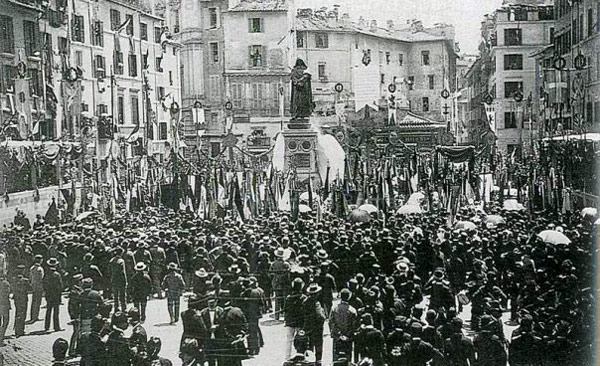
Eventually, a newly elected city council—moved by public support—approved the monument. On June 9, 1889, Bruno’s bronze figure was solemnly unveiled in the flower- and flag-adorned square, placed at the exact spot where the old fountain once stood.
The statue depicts the philosopher standing tall, hands crossed tightly over a book—a symbol of wisdom and enlightenment. His gaze is fixed in the direction of the Vatican, a silent reproach to the abuse of power. The hood draped over his head adds a somber, mysterious aura to the sculpture.
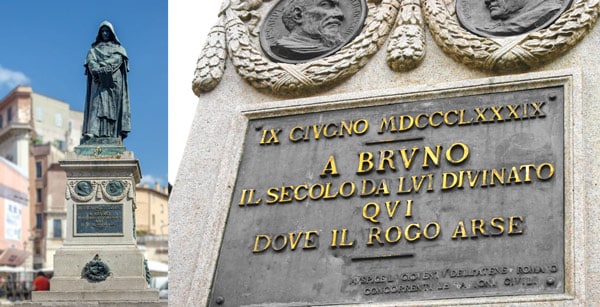
The statue’s pedestal features several thematic bas-reliefs. One depicts historic figures who shared Bruno’s beliefs: Miguel Servet, Petrus Ramus, Tommaso Campanella, John Wycliffe, Jan Hus, Aonio Paleario, Paolo Sarpi, and Giulio Cesare Vanini. Other panels illustrate key moments in Bruno’s life: his debate at Oxford, the delivery of his death sentence, and his execution by fire.
In the year 2000, centuries after the event, Pope John Paul II (Ioannes Paulus PP. II) publicly apologized for the Inquisition’s errors and formally rehabilitated Giordano Bruno.
To this day, the philosopher’s life and death remain cloaked in mystery. His trial records are still sealed in the Vatican—raising the question: was Bruno’s vision of an infinite universe filled with inhabited worlds considered too dangerous, or too real?
The Market Today
The square’s grim history has long since faded, replaced each day with the vibrant buzz of market life. Beneath the statue of Giordano Bruno, vendors offer fragrant spices, Italian cheeses, cured meats, fresh vegetables, and, of course, flowers. Watch the video:
The open-air market runs from early morning until lunchtime, after which the square becomes a lively scene for tourists and local youth alike.
Surrounding the medieval square are numerous restaurants offering Roman, Asian, European, and other international cuisines, along with cafés and boutique shops. Italians often meet here, while visitors linger over a glass of wine to reflect on the day’s experiences.
How to Get There
Campo de’ Fiori is nestled between Piazza Navona and Palazzo Farnese. This is one of my favorite neighborhoods in Rome—every step feels steeped in history. Watch this video to take in its charm:
- There’s no metro station in this part of the city, so walking is the most convenient option. The closest stations—Spagna and Ottaviano—are about a 30-minute walk away.
- Several buses stop near the square: 23, 30, 40, 46, 62, 64, 70, 81, 87, 130F, 190F, 280, 492, 628, 916, 916F, 5, 6, 10, 15, 20, 25, and C3.
Check out this helpful article on where Rome’s city center is and how to choose a hotel.
Where to Eat
Around Campo de’ Fiori, you’ll find countless charming side streets and local restaurants perfect for a delicious break. Most of the spots right on the square tend to be heavily tourist-focused.
Ristorante Isidoro
- Address: Via di San Giovanni in Laterano 59/A, 00184 Rome, Italy
Just off Campo de’ Fiori, this cozy and welcoming restaurant is popular with locals and tourists alike. The extensive menu features European, Italian, and traditional Roman cuisine, including regional specialties from Lazio. Gluten-free, vegetarian, and vegan options are available.
Virgilio
- Address: Piazza Campo De’ Fiori 10/A
Located directly on the square, Virgilio offers outdoor seating year-round, with heaters for the colder months. Live performances by cellists, guitarists, and violinists add a romantic touch.
The restaurant specializes in pizza and serves classic European, Italian, and Roman dishes. It also caters to gluten-free, vegetarian, and vegan diners.
Be sure to try the Napoli pizza, grilled vegetables, and pasta with basil and tomato.
Forno Campo de’ Fiori
- Address: Piazza Campo De’ Fiori 22
For a quick bite, this small takeaway bakery is ideal. Watch the bakers at work while grabbing fresh pizza, bread, pastries, sandwiches, and drinks. It’s always buzzing with locals and visitors.