 Italy for me From Italy with love

Page Contents
At the Edge of the Campus Martius
On the very edge of the Campus Martius, where the murky waters of the Tiber gently lap against the embankment, stands a remarkable monument — the Museum of the Altar of Augustan Peace (Ara Pacis Augustae). Tucked away from the city’s most popular tourist routes, this site is visited only by a handful of particularly curious and inquisitive travelers who carve out precious time to witness a genuine piece of antiquity.
Those well-versed in history understand that many of Rome’s ancient ruins and fragments of former grandeur are, in fact, modern reconstructions — brilliantly crafted to mimic the past. But the marble colossus on the banks of the Tiber River, encased in an elegant shell of glass and concrete, is considered — along with the Colosseum and the Pantheon — one of the five most important monuments of the Roman world, according to leading historians and archaeologists.
How did an ancient Roman monument, unknown to most in the early 20th century, become one of the most celebrated treasures of classical antiquity? That is the story we’re here to tell.
The history of the monument unfolds like a stage play with a host of major characters — and the leading role belongs to Augustus, the first emperor of Rome.
The Beginning — Emperor Augustus
In 13 BCE, Augustus returned from a lengthy expedition to the West, where he had been inspecting affairs in Gaul and Spain. The Senate chose to commemorate his return by commissioning a monument to Augustus in the Forum, the main square of Rome. And not just any grand stone monument, but a sacrificial altar — a religious structure where Augustus and his inner circle could offer praise and make appeasements to the almighty gods.
Yet the emperor, while approving the senators’ proposal, selected a different and less ostentatious site in Rome — the Campus Martius.
What the Monument Looked Like in Ancient Times
At the Altar of Peace, also known as the Altar of Augustan Peace, rituals were held involving animal sacrifices or offerings such as fragrant oils, rare plants, and food. 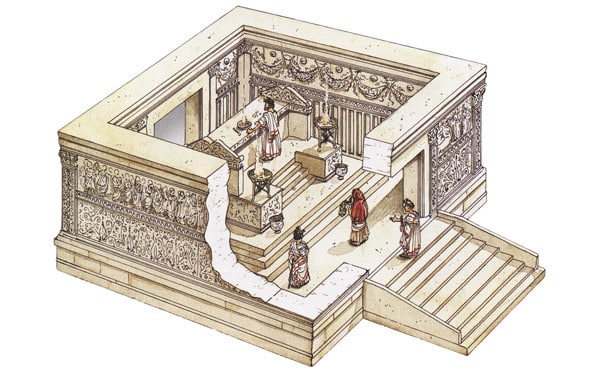
That’s why both the outer and inner walls of the structure were richly decorated with bas-reliefs depicting scenes of these rites. Of course, the walls were once colorful — not plain white as they appear today.
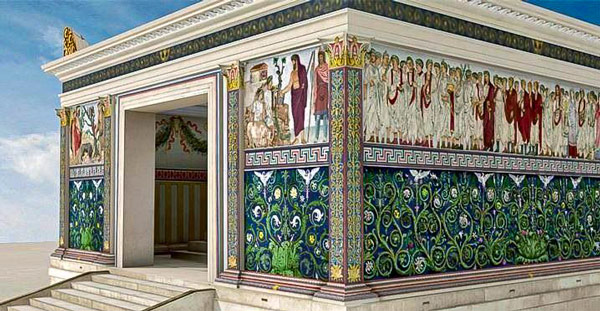
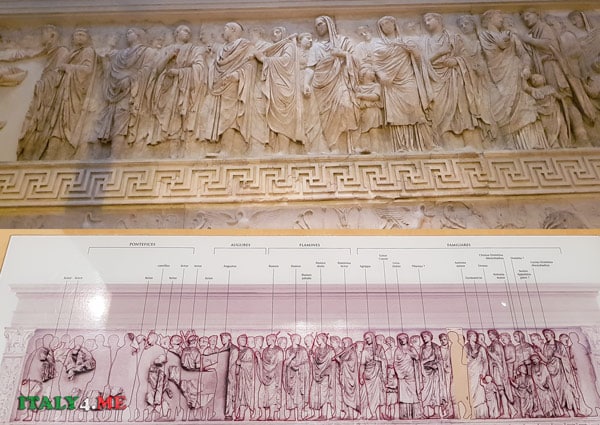
Greek artisans carved revered deities into Carrara marble, portrayed sacrificial rituals, and — something historians value highly — immortalized the emperor’s family.
Augustus brought an obelisk from Heliopolis in Egypt, standing 72 feet (22 meters) tall, and used it as a sundial on the Campus Martius. On his birthday, September 23, the shadow of the obelisk would point directly toward the altar — a symbolic nod to the one born to bring peace to the empire.
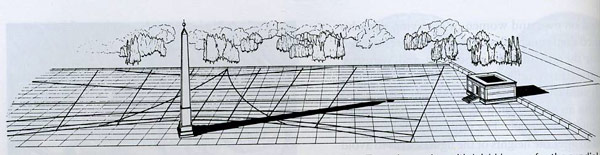
In the late 18th century, Pope Pius VI decided to move the obelisk to decorate Piazza di Montecitorio.
The reconstruction below shows the layout of the obelisk, the Altar of Peace, the Mausoleum of Augustus, and the Pantheon. 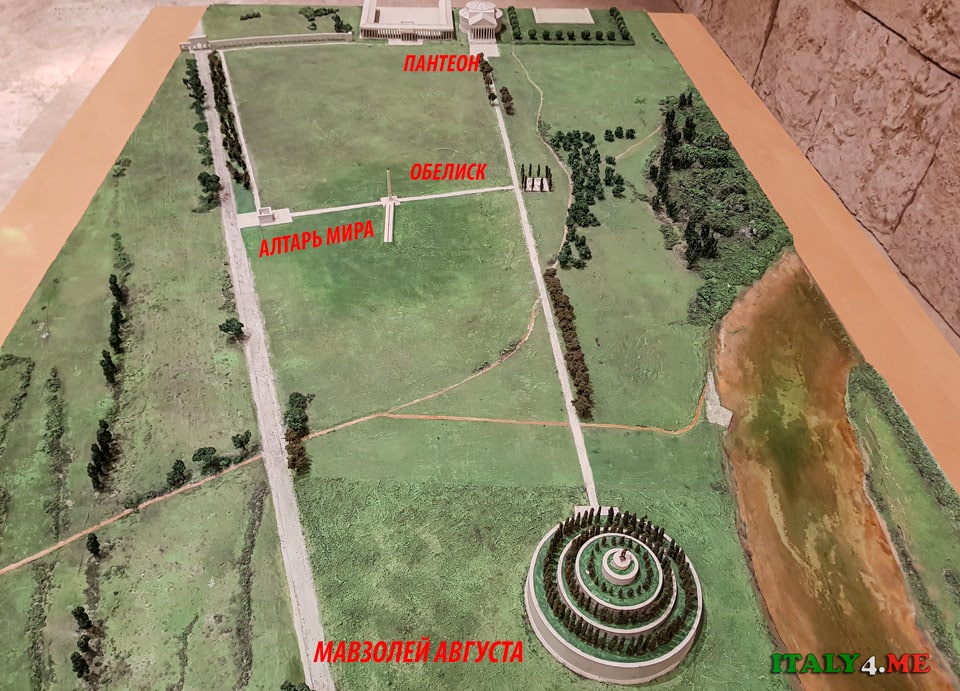
We recommend reading more about the obelisks of Rome.
Pope Eugene IV
Centuries passed. The Tiber repeatedly flooded the land, burying Rome’s houses and temples beneath layers of silt. A new square emerged on the site where the Altar of Peace once stood, now surrounded by churches and palaces.
When Eugene IV ascended the Catholic throne, he brought with him a passion for archaeology and architecture. It was during his papacy in the 14th century that relief fragments from an unknown ancient structure were discovered in the basement of Palazzo Fiano. Over time, these pieces began appearing in museums around the world — including the Vatican Museums, the Louvre in Paris, and Florence’s Uffizi Gallery.
Friedrich von Duhn
In the late 19th century, German archaeologist Friedrich Carl von Duhn proposed that these scattered fragments all belonged to a single structure — the Altar of Augustan Peace, which had been mentioned in ancient manuscripts.
In 1903, excavations unearthed 53 additional fragments. These discoveries helped scholars create detailed drawings of the Altar of Peace, descriptions of its structure, and a plan for further work. However, due to the marshy ground and the risk of damaging Palazzo Fiano, excavations were halted.
Benito Mussolini
Italian Prime Minister Benito Mussolini had a deep admiration for all things ancient Roman — especially Emperor Augustus. His urban planning vision included clearing away layers of history to reveal Rome’s ancient roots. The Altar of Peace topped his list of priorities.
Mussolini himself struck the first blow with a pickaxe to begin clearing the layers covering the ancient monument. His dream was to reconstruct a colossal relic from Augustus’s era — and the Altar of Peace was the perfect candidate.
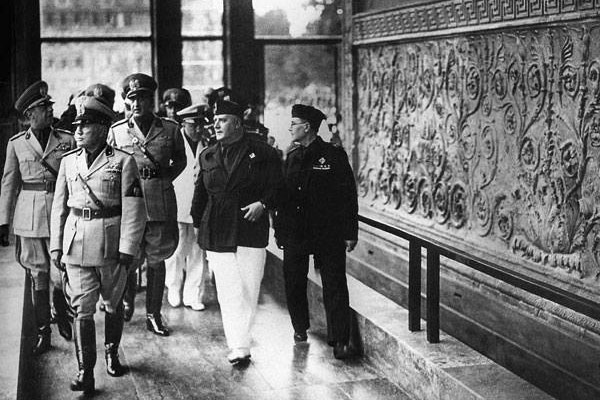
To fully restore the ancient monument, two steps were required:
- Collect all fragments scattered across museums worldwide.
- Reconstruct the monument with complete accuracy.
Giuseppe Moretti
The project succeeded thanks to Italian archaeologist Giuseppe Moretti, who led the excavation works. He achieved the impossible: extracting fragments of the altar buried beneath the foundations of Palazzo Fiano, despite the area’s heavily waterlogged soil.
Moretti’s team of engineers devised an ingenious solution. They dug a trench around the perimeter of the palazzo and inserted hollow metal tubes along its length. Liquid carbon dioxide was pumped into the tubes, freezing the soil and halting the water flow. This allowed for the safe excavation and removal of the ancient marble blocks.
A protective pavilion was constructed to house the altar, and in 1938 the museum was officially opened to the public.
Richard Meier
In the mid-1990s, during a forum in Davos, the mayor of Rome approached renowned American architect Richard Meier — known for projects like the public library in The Hague and the Miami Museum — to design a new museum building around the monument, as the previous structure had deteriorated. The plan sparked controversy among Romans for several reasons:
- As the first modern structure in decades in Rome’s historic center, its glass-and-concrete design sharply contrasted with the city’s traditional color palette.
- Locals were displeased that an American, not an Italian, had been chosen to oversee the project.
- A portion of the building blocked the view of the beloved Church of San Rocco (San Rocco).
Despite the debate, the new museum opened in 2006. It spans three levels: the main hall houses the priceless relic — the Altar of Peace — surrounded by busts of notable Roman figures, while the basement includes a space for temporary exhibitions and a conference auditorium.
Opening Hours and Ticket Prices
The Altar of Augustan Peace in Rome has a remarkable story — from its grand inauguration and centuries of oblivion to its extraordinary revival. In many ways, the monument’s history mirrors that of Rome itself, from its ancient origins to the present day.
The museum is open daily from 9 AM to 7 PM at Via di Ripetta, 190. Admission is €10.50. Entry is free with the Roma Pass.
- Official website of the Ara Pacis: www.arapacis.it