 Italy for me From Italy with love

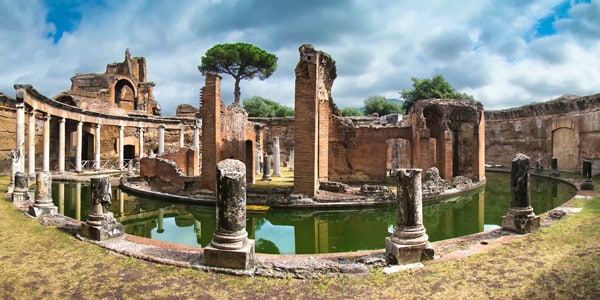
Villa Adriana in Tivoli is one of the most remarkable ancient structures in the Lazio region. Dating back to the 2nd century AD, this architectural masterpiece, though partially in ruins, continues to captivate with the grandeur of its design and the precision of its execution.
Page Contents
History of Its Creation
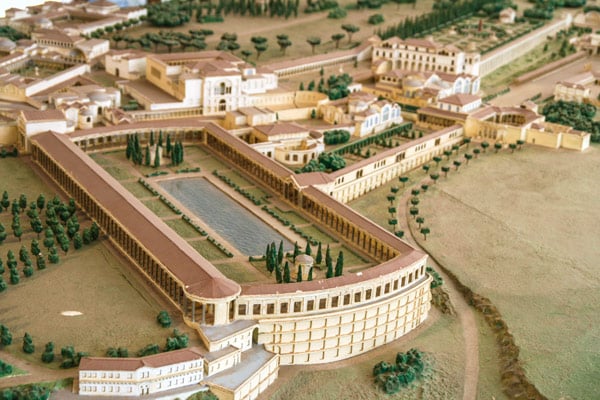
Roman Emperor Hadrian (Publius Aelius Traianus Hadrianus), a renowned philosopher of antiquity, despised the luxury and bustle of the palace on the Palatine Hill. He sought a quiet retreat for reflection and scholarly pursuits, surrounded by nature.
Thus arose the idea of building a countryside residence. The chosen location near the town of Tibur (modern-day Tivoli) offered a charming landscape and peaceful atmosphere that appealed to the emperor-philosopher. The land was inherited by Hadrian’s wife, Vibia Sabina. It had previously been home to a villa dating back to the 2nd–1st century BC. The atrium of the old estate was preserved, while other parts were rebuilt and expanded according to Hadrian’s personal vision.
Construction began in 118 AD and continued until Hadrian’s death in 134 AD. Legend has it that the emperor personally designed the villa. While it’s hard to verify this claim today, his deep involvement in the project is well documented.
The residence comprises over 30 structures, many named after Roman provinces visited by Hadrian.
Above all, the emperor cherished his peace and solitude. For that reason, Villa Adriana features an extensive network of underground tunnels used by servants and supply carts. Hadrian ensured that the voices of attendants and the creaking of wheels would never disturb his family or guests.
Structures of the Villa
Originally, Villa Adriana covered 740 acres (300 hectares), with buildings occupying about 0.4 square miles (1 km²). Today, only one-fifth of the complex has survived. Scholars cannot definitively determine which Roman provinces inspired each structure’s name—only the Canopus (Canopo) has been positively identified, while the rest remain informed guesses.
The primary construction material was local Tiburtine limestone. For arches and other architectural details, builders used *plinths*—thin bricks about 1 inch (2.5 cm) thick. Two paths lead directly to the villa: a cypress-lined avenue and a paved road near the old olive grove.
Pecile
Pecile is a rectangular courtyard measuring 761 by 318 feet (232 by 97 meters), located behind a towering 30-foot (9-meter) wall near the entrance. It was once encircled by a wall and elegant double colonnades, now almost completely ruined. A small pond lies at the center. The design likely mimicked an ancient Greek stadium. Adjacent to Pecile is Cento Camerelle—“one hundred small rooms” used to house servants who cared for the emperor and his guests.
Underground Road
At the lower level of Cento Camerelle, an underground passage leads to the Large Baths (Grandi Terme) and Small Baths (Piccole Terme), separated by a modest courtyard.
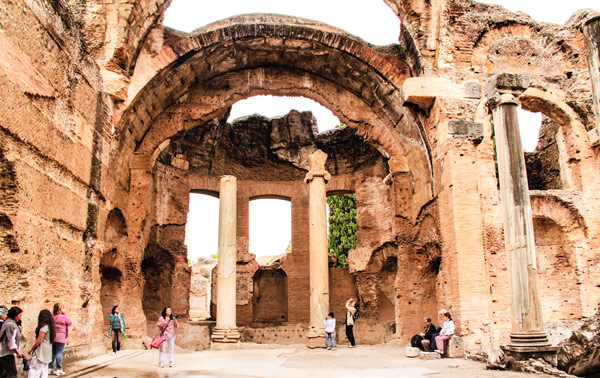
Researchers believe the baths were used separately by men and women.
The bath chambers contain remains of two heating systems—one for dry heat (hot air) and one for moist heat (steam). The area beside the Large Baths, called the Palaestra, was used for wrestling and fencing exercises, and also featured an indoor hall for ball games.
Praetorian Quarters
Behind the Large Baths lies the Praetorian Quarters—a multi-story building for the imperial guard. It is one of the best-preserved parts of the villa.
Canopus
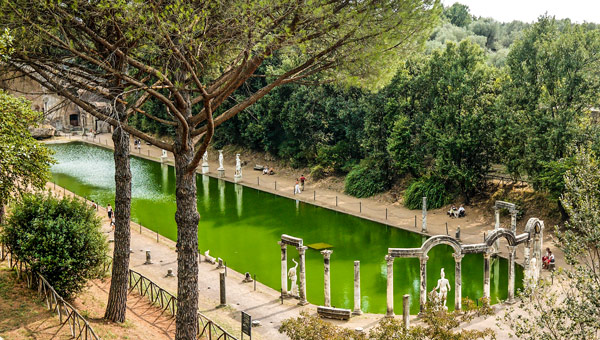
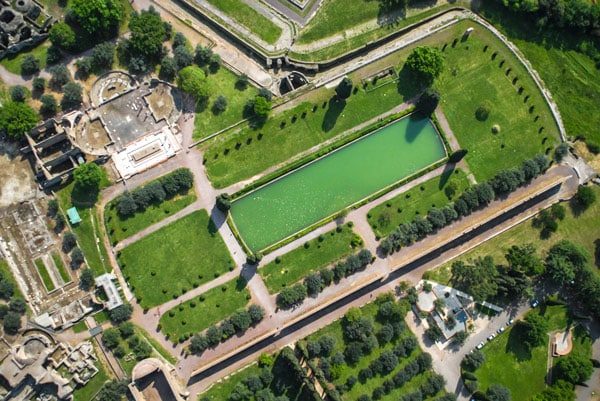
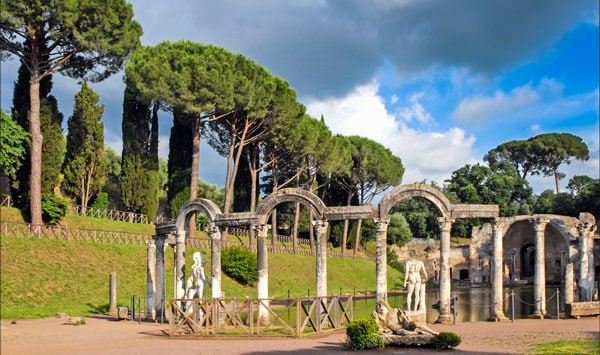
The Canopus (Canopo) was modeled after the Egyptian settlement of Canopus (modern-day Abu Qir), where Antinous, the emperor’s beloved companion, drowned. It is the estate’s most intriguing structure, a pond about 328 by 66 feet (100 by 20 meters), once lined with sculptures and columns (now lost). Near the Canopus stood the Serapeum, a replica of an Egyptian temple dedicated to Serapis. Its vaulted ceiling offers a scenic view over the Baths and Canopus, framed by lush stone pines.
Canopus Museum
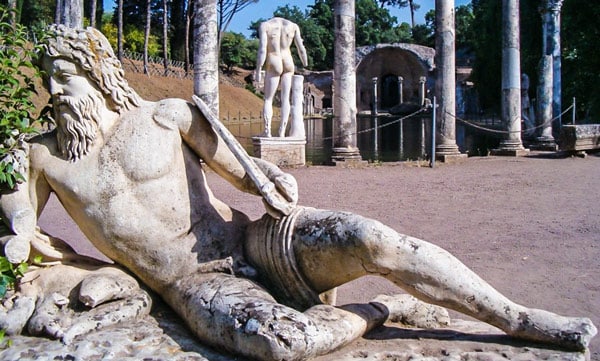
The Canopus Museum is housed in ancient tavern buildings (tabernae) on the right side of the valley. It features a small collection of ancient Greek statues and Roman casts, the highlight being a copy of the famed Venus of Knidos.
Golden Square
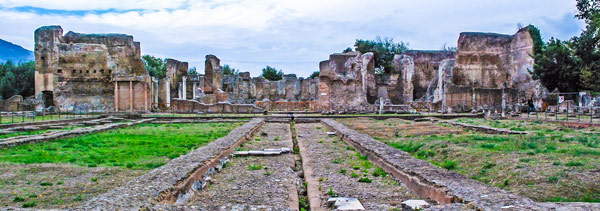
The Golden Square, located in the villa’s northeast section, is a spacious atrium with a double portico. Its open section once featured sixty granite and marble columns. On one side sits the imperial hall, topped with a well-preserved dome supported by eight marble columns, along with a vestibule adorned with exquisite floor mosaics.
Maritime Theater
The Maritime Theater (Teatro Marittimo) is notable for its elaborate architecture—a circular room built on a round island surrounded by a water canal and a cylindrical wall with a colonnade. Bridges leading to the island could be controlled only from within. It’s believed that the island’s structure was used as a retreat for the imperial family and is therefore often called the Island Villa.
Later History
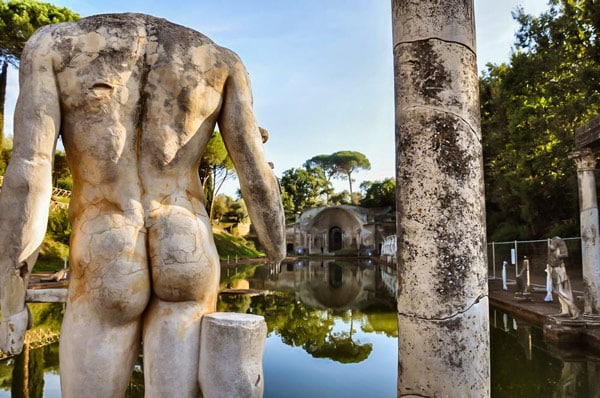
Hadrian chose to reside at his countryside estate, ruling the empire from there until the end of his life. His successors, less devoted to philosophy, used the villa merely as a summer retreat.
In the late 3rd century, the villa was restored by Emperor Diocletian (Aurelius Valerius Diocletianus). Later, Constantine the Great (Flavius Valerius Aurelius Constantinus) transported several works of art from the site to his palace in Constantinople. In the 6th century, the Ostrogoths and Byzantines used the villa as a military camp, contributing to its destruction and abandonment. During the Middle Ages, locals from Tivoli quarried the ruins for building materials for their homes.
The first archaeological excavations took place in the 16th century. At that time, many statues and marble columns were removed by order of Cardinal Ippolito II d’Este to decorate his nearby Villa d’Este in Tivoli. In the 18th century, part of Villa Adriana was owned by Count Giuseppe Fede, who planted the cypress trees still standing today. Since 1870, the villa has been the property of the Italian state, and in 1999, it was declared a UNESCO World Heritage Site.
Interesting Facts
- The villa’s porticoes were intentionally built low so that the emperor—who was short—would appear tall and imposing.
- Many priceless ancient statues were discovered here, including Antinous (now in the Capitoline Museums), Diana the Huntress (Louvre), and the Discobolus (British Museum).
- Scenes from the 2010 film “The Excavation News” were shot on the villa’s grounds.
How to Get There
Villa Adriana is located about 2.5 miles (4 km) from Tivoli. It can be reached via bus No. 4 from the town’s main square. For bus schedules, visit www.cattivoli.com.
- For a more insightful and hassle-free experience, book a tour from Rome – you’ll be visit all the villas in Tivoli, hear fascinating stories, and be driven back.
- Step-by-step guide: how to get from Rome to Tivoli for €3.
- If you prefer to travel on your own, the fastest and most comfortable way is to book a transfer with Sergio from Rome to Tivoli—travel time is about 45–60 minutes.
Opening Hours and Tickets
The villa opens at 9:00 AM and closes 90 minutes before sunset. Admission is €15, or €4 for EU citizens.
During the annual exhibition (April to October), tickets cost €14 (discounted €7). From March through October, school tours are available for €1 per student. Admission is free on the first Sunday of each month. The site is closed on January 1, May 1, and December 25.
Official website of Villa Adriana: www.villa-adriana.net