 Italy for me From Italy with love

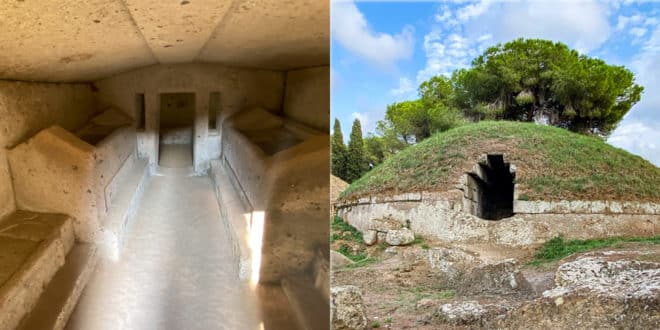
Archaeological excavations and discoveries around the cities of Cerveteri and Tarquinia in the Lazio region became a sensational event not only among historians and art experts but also for the global community.
The unearthed ancient burial sites—Etruscan necropolises—offered a glimpse into the world of a once-powerful and little-known state in Italy: Etruria.
The word “Etruscans” is forever associated with a mysterious people who had a profound influence on the development of Ancient Roman culture. Millennia of history have preserved very few traces of this great civilization, making the surviving evidence and artifacts even more valuable.
Since 2004, the Necropolises of Cerveteri (Necropoli di Cerveteri) and Tarquinia (Necropoli di Tarquinia) have been included in the UNESCO World Heritage List as unique monuments of Etruscan culture.
Page Contents
Who Were the Etruscans?
Who were the Etruscans? Both in the past and today, there are more questions than answers. Where did they come from? Where is the key to unlocking their written language and sophisticated culture?
As early as the 1st millennium BC, the northeastern lands of the Apennine Peninsula were inhabited by a people known as the Etruscans (etrusci) or Tusci, while they called themselves Rasenna. The exact boundaries of their territory remain unclear, but most of ancient Etruria corresponds to today’s Tuscany (Toscana)—its name derived from the Latin “tusci”—as well as parts of Umbria and Lazio.
The Etruscans became the first major civilization in northern Italy, displacing the indigenous people of the Apennine culture from the 2nd millennium BC. The origins of the Rasenna remain a mystery. The theory that they were native to Italy has not been confirmed. There are three main hypotheses: they could have originated from Asia Minor (Anatolia, modern-day Turkey), from Alpine populations, or from Scythian tribes of the North Caspian steppes.
This ancient civilization reached its peak in the 8th–7th centuries BC, becoming a dominant power with a highly developed economy and culture.
All the power and achievements of this great civilization were later inherited by the Romans, who arrived as conquerors in the 3rd century BC but, instead of destroying Etruscan culture, assimilated it.
Etruscan Burials in Cerveteri
Much about the life of this ancient civilization remains unknown, but the excavations at the Etruscan necropolis in the area of Cerveteri have provided invaluable insights into Etruscan domestic architecture, religion, and rituals, as well as remarkable examples of ancient art.
The City and Necropolis
The Cerveteri Necropolis developed around the center of an ancient settlement that was one of the mega-cities of the Etruscan civilization during its golden age.
The present-day town of Cerveteri was once part of the league of twelve independent city-states of Etruria and was known as Caisra (Caisra), later as Caere or Cere (Caere).
Archaeological excavations have confirmed that the earliest traces of settlement here date back to the 9th century BC. At its peak in the 7th century BC, the city covered an area almost 15 times larger than today and had a population of 25,000 to 40,000 inhabitants.
Within the archaeological zone of Cerveteri, several major necropolises are distinguished, notably Banditaccia and Monte Abatone, along with smaller ones such as Il Sorbo, Cava della Pozzolana, Macchia della Signora, San Paolo, and Greppe San Angelo.
Banditaccia
The largest and the only necropolis open to visitors in Cerveteri is the Banditaccia Necropolis.
The first systematic excavations of Etruscan tombs in this area were conducted between 1909 and 1936 under the direction of Italian archaeologist and Etruscologist Raniero Mengarelli. After 1936, work was halted for decades, only to resume in the 1960s and continue to this day.
The Banditaccia burial grounds stretch west of Cerveteri and occupy about 1,000 hectares of rolling plateau.
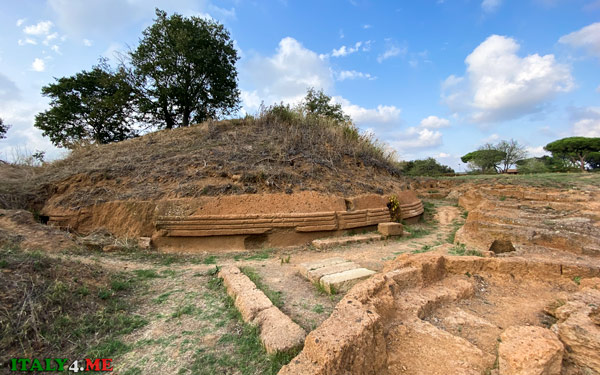
The fenced open area covers just 10 hectares and contains about 400 large burial structures. What visitors see is astonishing and moving—it is not just a cluster of stone graves but a genuine ancient city of the mysterious Etruscans, complete with streets, alleys, and squares.
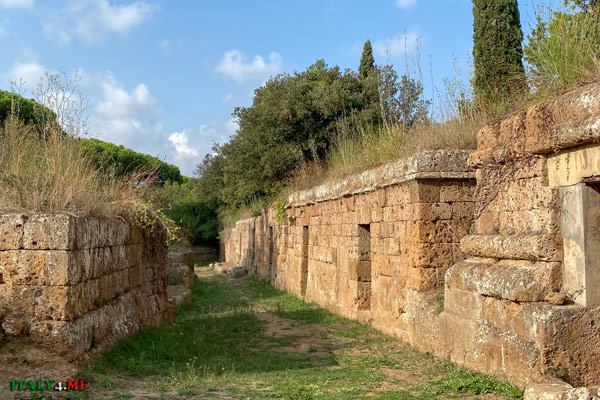
The necropolis was structured as a projection of the city’s urban plan for the living, and it remains the only surviving testimony of Etruscan residential architecture.
Types of Tombs
Tomb types evolved over time depending on religious traditions, the deceased’s wealth, and artistic trends.
The oldest burials (from the 9th to 8th centuries BC) feature small well-shaped tombs carved into the rock to store the ashes of the cremated. For the poorest, simple pit graves were used.
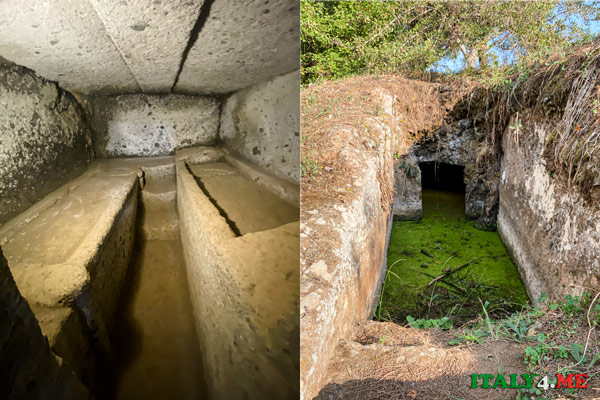
From the 7th century BC, most burial structures transitioned to the tumulus type, coinciding with the shift from cremation to body burial. These monumental mounds are round structures carved from tuff rock and topped with dome-like roofs.
Tumulus tombs were constructed as complete reconstructions of houses, featuring a stairway entrance, corridor, main hall, and multiple rooms richly decorated with columns, reliefs, and wall paintings. The main feature of these burial chambers was the presence of luxurious sarcophagi, placed in niches or on stone benches. In particularly wealthy tombs, sarcophagi were made of marble or alabaster, with lids adorned with sculptures of the deceased.
Later, between the 5th and 3rd centuries BC, simple rows of square stone tombs appeared along roads inside the necropolis.
The decline in elaborate burial traditions reflects the crisis that struck southern Etruria due to conflicts with cities of Magna Graecia and increasing Roman influence over Etruscan territories.
The Tombs
For the Etruscans, death marked the beginning of a new life in the afterworld. The deceased were sent off with elaborate ceremonies featuring memorial banquets, athletic contests, and ritual dances.
The names of tumulus tombs reflect the paintings and items discovered within: the Tomb of the Painted Lions (Tomba dei Leoni dipinti), the Tomb of Shields and Chairs (Tomba degli Scudi e delle Sedie), the Tomb of Sea Waves (Tomba delle Onde Marine), and the Tomb of the Sarcophagi (Tomba dei Sarcofagi), among others.
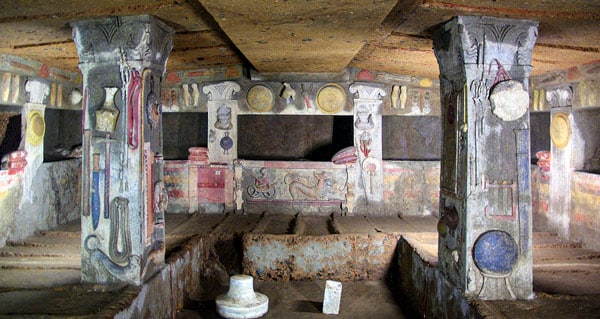
The most remarkable discovery is the Tomb of the Reliefs (Tomba dei Rilievi), dating from the 4th century BC. The burial chamber has been preserved with its frescoes and the complete setting of everyday objects intended for the afterlife.
A small collection of burial artifacts found at the necropolis is housed at the Archaeological Museum of Cerveteri (Museo Archeologico Cerite), where visitors can see sarcophagi, terracotta vases and plates, a statue of the Etruscan god Charon, and more.
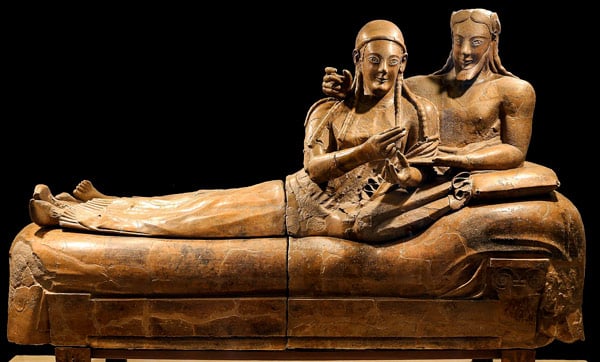
The majority of artifacts from the Banditaccia Necropolis are preserved at the National Etruscan Museum of Villa Giulia (Museo Nazionale Etrusco di Villa Giulia) in Rome and in other world-famous museums.
Be sure to explore our guide on must-visit museums in Rome.
Etruscan Burials in Tarquinia
Despite their close proximity, the burial sites in Tarquinia differ significantly from those at Cerveteri—here, there are no tumuli or networks of streets. The main value of the tombs discovered in this area lies in the preserved wall paintings, which reveal much about the mysterious Etruscans.
Monterozzi Necropolis
The primary site of Etruscan burials in Tarquinia is the Monterozzi Necropolis (Necropoli dei Monterozzi), located on a long hill bearing the same name. It is a unique archaeological complex of the Mediterranean, containing thousands of tombs with incredibly valuable frescoes. 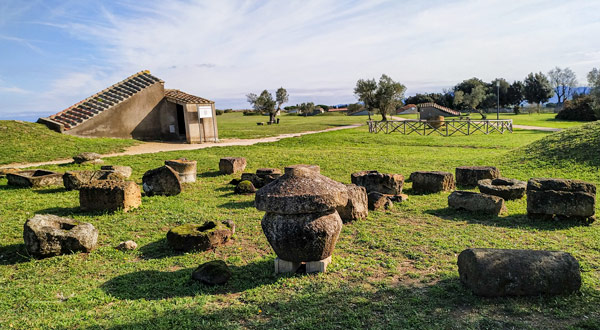
The Tarquinia necropolis was developed and expanded throughout the entire history of the Etruscan settlement, offering invaluable insight into the city’s former grandeur and the way of life of its inhabitants.
To date, about 6,000 ancient tombs dating from the 7th to 3rd centuries BC have been discovered, and the site still holds many secrets yet to be uncovered. Most tombs were uncovered during the 19th and 20th centuries, though some were discovered as early as the Renaissance and later lost track of.
The oldest burials, dating to the 9th century BC, are round tombs resembling wells carved into the rock, designed to store the ashes of the cremated.
From the 7th century BC onward, family burial chambers appeared, resembling the living quarters of Etruscan houses.
To signify prestige, the wealthier classes constructed surface-level tumuli over their burial chambers. After excavations in the 19th century, the above-ground portions of about 600 tombs were dismantled, explaining the current absence of tumuli in Tarquinia.
Most stone tombs are square-shaped chambers with double-sloped ceilings, designed for the burial of a single couple. During the Hellenistic period, from the 4th century BC onward, the underground rooms were expanded to accommodate multiple generations of a family. These tombs took on grander forms, featuring flat ceilings and central columns.
The Tombs
The most valuable discoveries within the tombs—around 200 in total—are the vivid frescoes, the only surviving examples of painting that predate Roman culture. Moreover, it is believed that some of the works were created by Greek artists invited by the wealthy Etruscans, making them particularly significant since Greek painting has been completely lost.
Today, several individual tombs are open to visitors, offering insights into the life, culture, and art of the Etruscans. The frescoes depict a wide range of scenes, and the tomb names speak for themselves—Tomb of the Ship (Tomba della Nave), Tomb of the Olympics (Tomba della Olimpiadi), Tomb of the Chariots (Tomba della Bighe), Tomb of the Lionesses (Tomba della Leonesse), and more.
Among the highlights are:
- The Tomb of the Leopards (Tomba dei Leopardi), dating from 480–450 BC, was discovered in 1875 and is notable for its excellent state of preservation.

The central fresco depicts two leopards and a scene of a funeral or memorial banquet taking place in a natural setting, presented as a joyous celebration of life rather than death. - The Tomb of Hunting and Fishing (Tomba della Caccia e della Pesca), dating from 530–520 BC, was discovered in 1873.

It is considered the most beautiful and original due to its numerous small figures depicted amidst scenes of celebration, hunting, and fishing in a natural landscape. - The Tomb of the Blue Demons (Tomba dei Demoni Azzurri), dating from the 5th century BC, was discovered during excavations in 1985.

The frescoes depict scenes of the deceased being guided into the afterlife, accompanied by fearsome blue and black-skinned demons. The contrasting scenes of feasting and joyful dancing during a funeral ceremony highlight the tension between life and death.
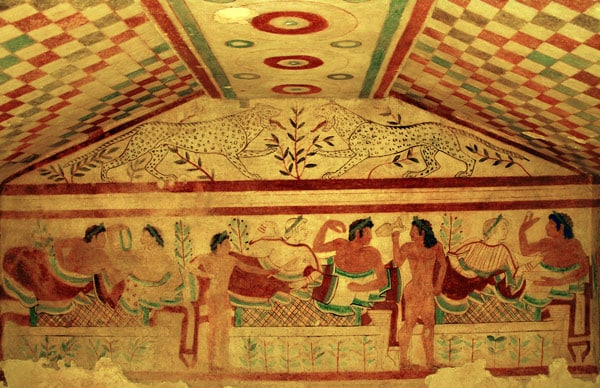
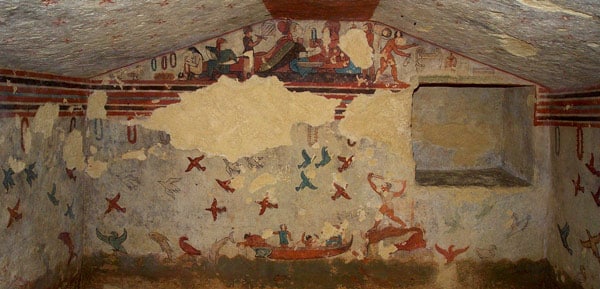
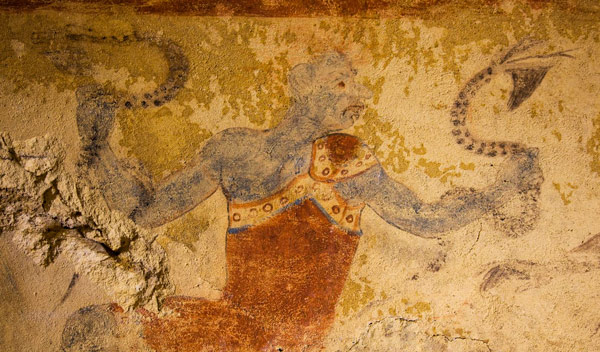
Some frescoes have been moved for preservation to the National Museum of Tarquinia (Museo archeologico nazionale di Tarquinia), located at Piazza Cavour, 1, 01016 Tarquinia VT, where they have been restored and are now protected from damage.
Everything connected to the Etruscans inspires interest and admiration. Many tombs have yet to be discovered, and the mysteries of this great and enigmatic civilization remain unsolved.
An ancient Roman saying still holds true today, not only regarding their writing: “etruscum non legitur” — “the Etruscan cannot be read.”
How to Get There
The Etruscan necropolises are located about 30 miles (50 kilometers) from Rome. The best way to reach them is by car, with the drive taking approximately one hour. 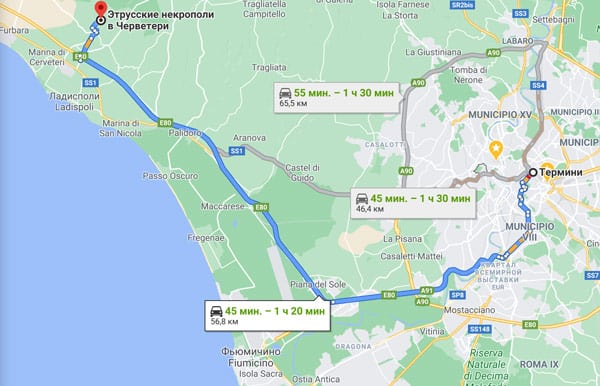
Public transportation is not recommended, but theoretically, you can take a regional train from Roma Termini Station to Marina di Cerveteri and then try to catch a bus from there.
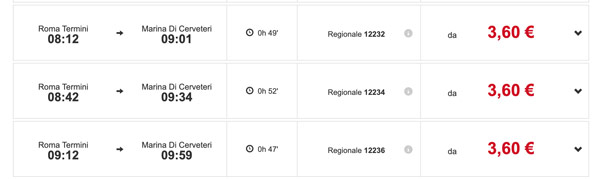
The train ticket costs €3.60 ($3.90), while the exact price for the bus fare is not clearly known.
Opening Hours and Tickets
Typically, the necropolises are open for visits from Tuesday to Sunday, from 8:30 AM until sunset. It is advisable to check the opening hours beforehand on Google Maps and the official website, as schedules frequently change.
An adult ticket costs €8 ($8.60), or €10 ($10.80) if combined with museum admission.
You can find all Etruscan museums in Italy listed on the website www.museoetru.it/scopri-il-museo.