 Italy for me From Italy with love

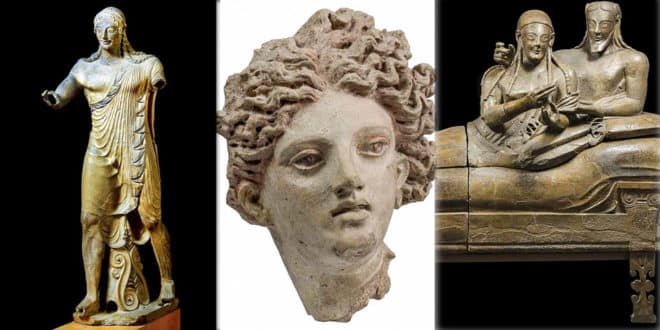
The National Etruscan Museum of Villa Giulia (Museo Nazionale Etrusco di Villa Giulia) is located in Rome, on the square of the same name, within the building that once served as the summer residence of the Roman popes. It is considered one of the most prestigious museums dedicated to Etruscan civilization, housing world-renowned masterpieces of art and artifacts.
Page Contents
Villa Giulia
Today, the architectural and park complex of Villa Giulia, a masterpiece from the Renaissance period, is rightfully regarded as a temple of Etruscan culture. The two-story building, with its strict yet elegant forms, is surrounded by greenery and open spaces that create a picturesque landscape of gardens and terraces, linked by decorative stairways, nymphaea, and fountains.
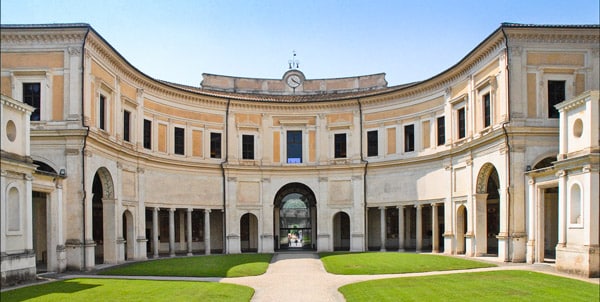
Villa Giulia, one of the finest examples of Mannerist architecture, was built by Pope Julius III (Iulius PP. III) between 1550 and 1555 on what was then the outskirts of Rome.
The design of the building involved some of the greatest artists of the time: Jacopo Barozzi da Vignola, Bartolomeo Ammannati, Michelangelo Buonarroti, and Giorgio Vasari.
The decorative work was entrusted to Prospero Fontana, who engaged Pietro Venale da Imola and Taddeo Zuccari to create the magnificent frescoes.
After its papal glory in the 16th century, Villa Giulia fell into a long period of decline, although it remained the property of the Vatican until 1870, when it was eventually designated as the home of the National Etruscan Museum in 1889.
Foundation of the Museum
In Italy’s history, the Etruscan period remains one of the most mysterious and fascinating. The Romans, who absorbed the Etruscan civilization in the 3rd century BC, sought to erase all traces of their predecessors’ achievements, leaving very few surviving artifacts.
Discoveries related to the ancient Etruscan culture became a worldwide sensation. The need to preserve and beautifully display these artifacts and works of art arose in the 18th century when systematic excavations began in Tuscany, Lazio, and Umbria—regions once part of ancient Etruria.
The idea of creating a museum was championed by the Italian archaeologist and politician Felice Barnabei. He worked tirelessly to restore the building and establish a museum dedicated to pre-Roman antiquities of the Etruscans, Faliscans, Umbrians, Latins, and Sabines. The museum’s core collection featured finds from ancient Etruscan cities such as Veio, Cerveteri, Tarquinia, and Vulci.
In the 20th century, the museum’s holdings were further enriched by pieces from private collections of prominent Italian families such as the Barberini, Castellani, and Peschiotti.
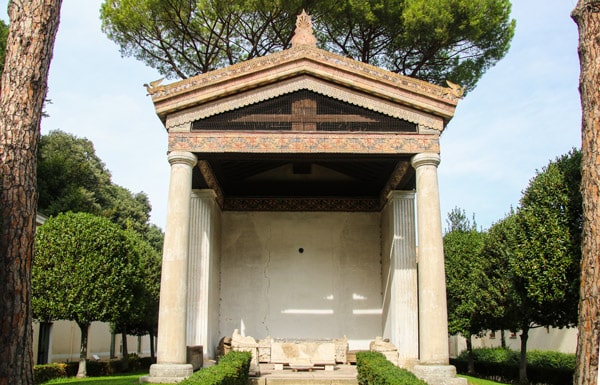
By the time of the museum’s official opening in 1889, a full-scale reproduction of the Etrusco-Italian Temple of Alatri (Tempio di Alatri)—dating back to the 3rd–2nd centuries BC in Lazio—was erected in the garden of Villa Giulia.
Exhibits of the Museum
Today, the National Etruscan Museum of Villa Giulia houses around 6,000 objects distributed across 50 halls, covering an exhibition space of more than 32,000 square feet (3,000 square meters). The diverse collection includes models of ancient cities, terracotta and bronze sculptures, ceramics, funerary monuments, weapons, jewelry, and other artifacts and works of art.
Many archaeological finds preserved in the museum are internationally famous for their exceptional historical and artistic value.
The Sarcophagus of the Spouses
The centerpiece of the Etruscan Museum’s collection is the terracotta funerary monument known as the Sarcophagus of the Spouses (Sarcofago degli Sposi), dating from 530–520 BC. It depicts a reclining couple—either husband and wife or bride and groom—at a banquet. The sculpture was discovered in the 19th century in one of the tombs of the Banditaccia necropolis in Cerveteri.
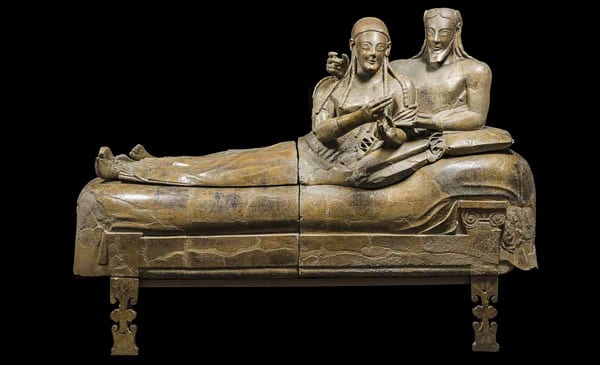
This delicate masterpiece is composed of 400 fragments of fired clay, forming a stunning and captivating composition.
The Sarcophagus is not only a testament to the highly developed art of the ancient people but also a source of fascinating insights into their clothing, footwear, hairstyles, and furniture.
The presence of the wife alongside her husband at a banquet suggests that women in Etruria enjoyed equal rights with men—unlike Roman women—and this is evident in their postures, gestures, and serene expressions.
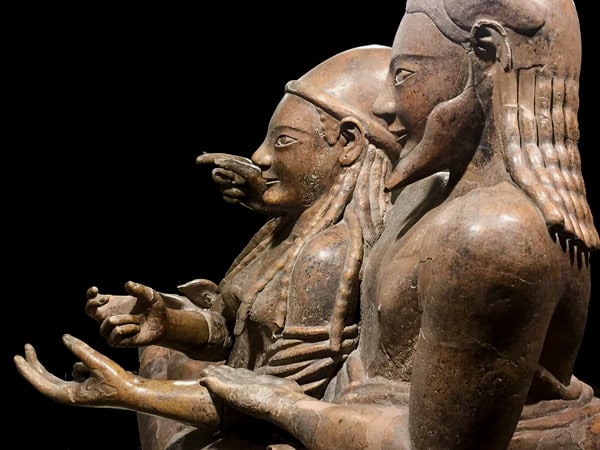
Originally, the sculpture was painted in vivid colors, though the pigments have not survived the passage of time. The positioning of the hands suggests that the man once held a ritual garland or wine cup, while the woman possibly carried a vessel of incense.
The couple chose to immortalize their fondest memories in this funerary monument. The terracotta sculpture draws viewers in with its heartfelt love story, leaving no one indifferent.
Head of Leucothea
The sculptural fragment known as the Head of Leucothea (Testa di Leucotea), dating from 330–320 BC, was originally part of the facade decoration of an Etruscan temple located in the ancient port of Caere near Cerveteri, dedicated to the goddess Leucothea. 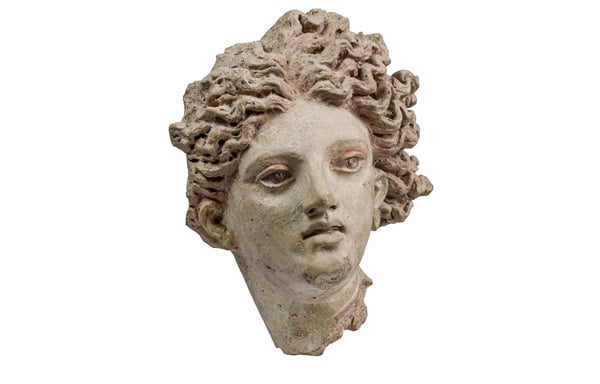
The beautifully crafted female head still retains traces of its original colorful paint—red for the curly hair and black for the pupils.
The Pyrgi Tablets
The three golden foils known as the Pyrgi Tablets (Lamine di Pyrgi), inscribed with Etruscan and Phoenician texts, represent a rare and invaluable resource for comparing two ancient languages, bringing us closer to deciphering the still-mysterious Etruscan script. 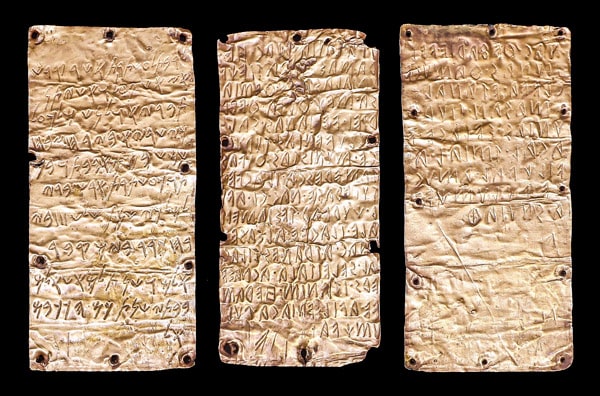
Despite being over 2,500 years old, the tablets are remarkably well-preserved and provide evidence of friendly relations between the Etruscans and the Phoenicians in their opposition to the Tyrrhenians.
Holes on the tablets suggest they were used during a ritual of nail-driving, a ceremony practiced in Ancient Rome at the Temple of Jupiter.
The Phoenician text reveals that the king of Caere dedicated these offerings to the goddess Astarte or the Etruscan Uni.
The Apollo of Veii
The Apollo of Veii (l’Apollo di Veio) is a life-sized Etruscan sculpture (approximately 6.5 feet or 2 meters tall) crafted from painted terracotta, featuring a characteristic archaic smile.
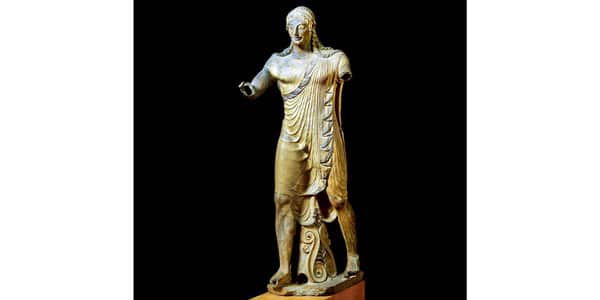
Nevertheless, Apollo’s posture reveals a sense of anger and readiness to confront Heracles, who had stolen the sacred hind of his sister. Dated to 510–500 BC, the statue is attributed to a sculptor from Veii known as the “Master of Apollo.” The statue originally adorned the roof of the Temple of Minerva.
The Pyrgi Relief
The Pyrgi Relief (Altorilievo di Pyrgi) was discovered on the site of the ancient port of Cerveteri and is a magnificent fragment of an Etruscan temple pediment. 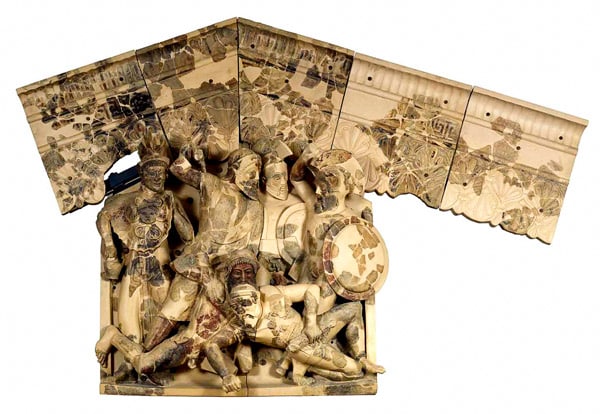
Found damaged during plowing, more than 2,000 fragments of terracotta were recovered and reassembled to restore the image. The relief, dated to 470–460 BC, belongs to the classical period of art. It depicts a dramatic mythological scene where the two brothers, Eteocles and Polynices (sons of Oedipus), fight over the throne of the Greek city of Thebes and end up killing each other.
Hours and Tickets
- The museum is open daily from 9:00 AM to 8:00 PM, except on Mondays. Admission is €10 ($10.80).
- Official website: www.museoetru.it
- Address: Piazzale di Villa Giulia, 9, Rome – Accessible by trams N2, 3, and 19, or by Metro Line A, Flaminio station. From Piazza del Popolo, the museum is a 14-minute walk.
Following its distinguished mission, the National Etruscan Museum of Villa Giulia not only expands its collections but also shares unique exhibits with other museums around the world through temporary exhibitions of ancient masterpieces. In addition to Etruscan art, the museum also displays ancient Greek artifacts dating from the 8th to 5th centuries BC.