 Italy for me From Italy with love


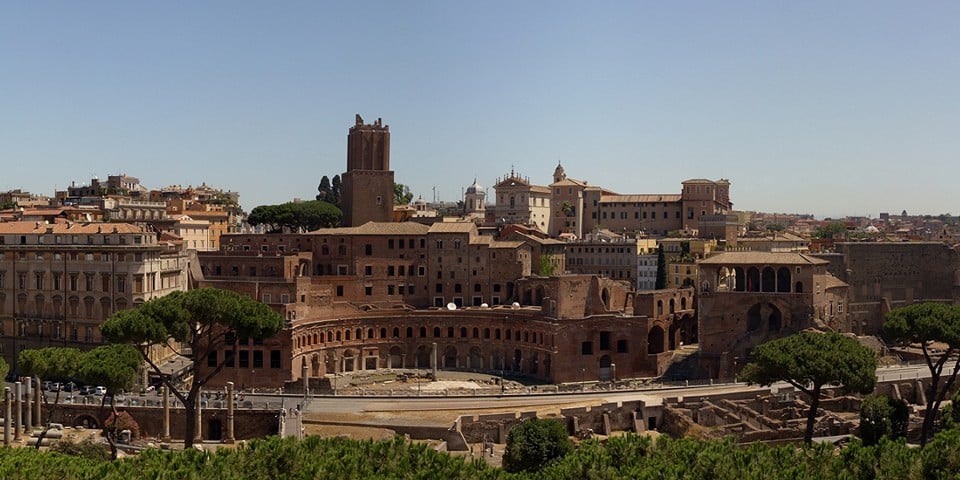
Trajan’s Forum (Foro di Traiano) is a magnificent architectural complex and historical monument located in the heart of Rome, near Piazza Venezia. Construction of this impressive site began in 106 AD, shortly after Emperor Trajan (Marcus Ulpius Nerva Traianus) achieved victory over Dacia. Built to commemorate this triumph, the forum was completed on January 1, 112 AD. Trajan’s Forum is considered the last of the Imperial Forums built in Rome.
Page Contents
History of Its Construction
Following his remarkable military campaign against the Dacian Kingdom—waged from 101 to 106 AD—Emperor Trajan made the decision to immortalize his victory. Perhaps he was driven by the legacy of the great Alexander the Great, or maybe the economic impact of annexing Dacia (which brought substantial new revenues to the Roman Empire) played a key role. Regardless, Trajan didn’t merely erect a column or a statue—he commissioned the largest Imperial Forum ever constructed in ancient Rome.
The chief architect of the project was Apollodorus of Damascus, a favored designer of the emperor who had accompanied Trajan during his campaign in Dacia (105–106 AD). In fact, it was Apollodorus who designed the impressive bridge over the Danube—over 1 kilometer (0.62 miles) long—built specifically for that military campaign. It later became known as Trajan’s Bridge. In the same year, 106 AD, Apollodorus also restored the Odeon (a venue for concerts, theatrical performances, and competitions, built in the form of an amphitheater) under the rule of Domitian, the last emperor of the Flavian dynasty.
To bring this ambitious project to life, the architect had to cut through the slopes of both the Quirinal and Capitoline hills—something no previous forum had ever required. No earlier Roman construction had altered the landscape on such a scale.
Despite the enormous challenge, the workers under Apollodorus’ supervision completed the task brilliantly. At the time of its completion, the forum measured 300 meters (984 feet) in length and 185 meters (607 feet) in width. At its heart stood the majestic Column of Trajan, which reached a height of 38 meters (125 feet) and was dedicated in 113 AD. The forum complex also included the Basilica Ulpia (basilica Vlpia), the Imperial Library (bibliotheca Vlpia), and Trajan’s Market (mercatvs Traiani). After the emperor’s death, the Temple of the Deified Trajan (Templvm Divi Traiani) was added to the site.
Architectural Layout
Art historians agree that Rome had never seen a more magnificent complex—neither before nor after the reign of Trajan. The sheer scale of the site alone was impressive: it occupied as much space as all previous Imperial Forums combined (those of Augustus, Nerva, and Caesar).
The forum was laid out as a grand colonnade with seating areas, enclosed by walls and sheltered by a roof. The entrance was crowned with a majestic triumphal arch, featuring a statue of a chariot drawn by six horses. On the northern end of the colonnade stood the famous Basilica Ulpia, clad in gleaming white marble.
Trajan’s Column
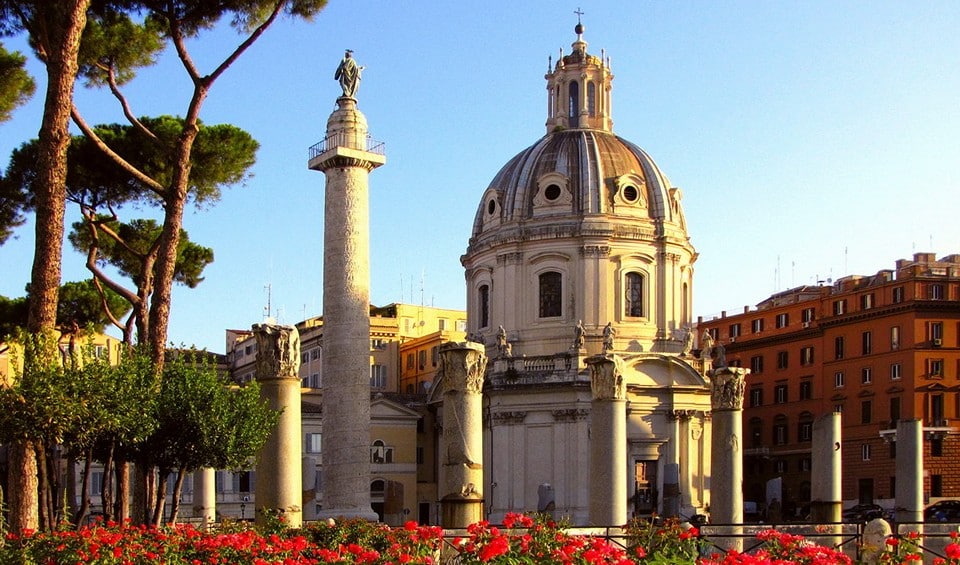
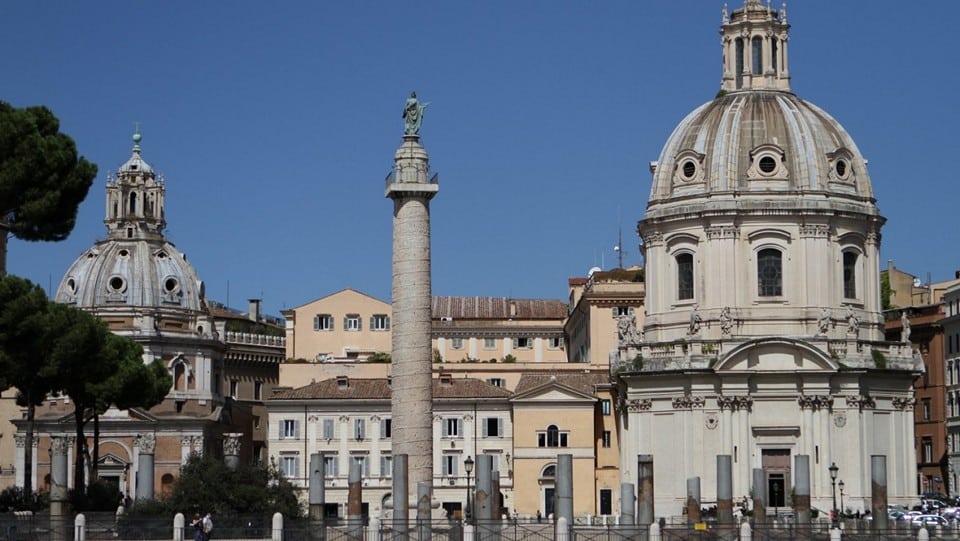
The imposing Trajan’s Column, rising 38 meters (125 feet), celebrates the might of the Roman Empire and the valor of its military commanders.
The column is adorned with marble reliefs that narrate historical events with striking accuracy—albeit with the dramatic flair typical of Roman commemorative monuments. These friezes depict the story of the Dacian campaigns, including the crossing of the Danube, major battles, and Trajan’s triumphant return to Rome. For historians, these carvings are an invaluable source of insight into the era’s events, military uniforms, and the perspectives of the Roman people.
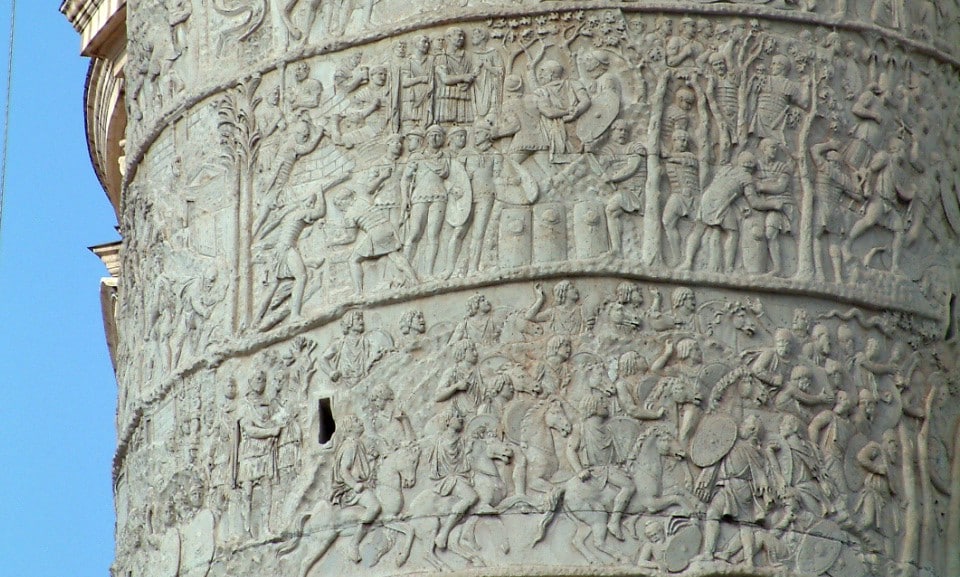
The reliefs depict disciplined ranks of powerful Roman soldiers clad in full armor. At the base of the column, defeated Dacian warriors lie powerless before the Roman legions. More than 2,500 human figures are carved into the friezes of Trajan’s Column, with the emperor himself appearing over 59 times. The decorative narrative clearly communicates the supremacy of the Roman Empire.
Originally, the top of the column featured a gilded statue of an eagle, symbolizing Rome’s imperial glory. This was later replaced by a statue of Trajan himself, which in turn was removed in the late 16th century by order of Pope Sixtus V. It was replaced with a statue of Saint Peter, which still crowns the column today.
Looking at the grandeur and scale of the column, it’s hard to believe it’s hollow inside! In fact, it contains a spiral staircase (186 steps) that leads to a viewing platform at the top. Unfortunately, this terrace is not open to tourists.
Not all of the original monuments that made up Trajan’s Forum have survived to this day. The column is the best-preserved part—undeniably magnificent—but it was designed to shine in the architectural context of the surrounding forum. Standing alone, it feels a bit isolated.
Remarkably, the base of the column holds the tomb of Emperor Trajan himself and his wife. The Roman Senate and Emperor Hadrian made a rare exception to the city burial ban to honor Trajan’s extraordinary contributions to Rome and its people.
Trajan’s Market
By order of Trajan, the world’s first prototype of a modern shopping center was created within the forum complex. To ensure the achievements of the empire were always in public view, more than 150 market stalls were built on-site. They were arranged facing the central square, giving rise to the concept of a public-facing “display window.” It’s strikingly similar to the layout of today’s shopping malls, isn’t it?
The ancient street Via Biberatica passed directly through Trajan’s Market. It was lined with taverns and eateries, and likely derives its name from the Latin word bibere, meaning “to drink.”
In addition to commercial spaces, Trajan’s Market also included facilities for distributing free food to the city’s poor.
The market’s architectural design is particularly impressive—thanks to walls constructed from a mix of stone and Roman concrete, the structure reaches a height of five stories.
Today, the site houses the Museum of the Imperial Forums. Admission is €14 and includes access to exhibitions and other Roman museums.
You can find up-to-date ticket prices and opening hours on the official website: www.mercatiditraiano.it
How to Get There
To explore Trajan’s Forum in peace and truly soak in the atmosphere of ancient Rome without the crowds, we recommend a visit during the “Rome at Dawn” private tour. The forum is located just a short walk from Piazza Venezia and Palazzo Valentini. If you’re facing the Altar of the Fatherland, the Column of Trajan will be just 100 meters (328 feet) to your left.