 Italy for me From Italy with love


The Cathedral of Saint Peter (Cattedrale di San Pietro) has been the main church in Bologna since 1582 and is one of the city’s most important attractions.
Page Contents
History
According to archaeological excavations, an early Christian church once stood on the site of the current cathedral, alongside a Romanesque bell tower.
Construction of the cathedral began in the 10th century and it was rebuilt several times, as a powerful fire in 1141 destroyed almost the entire interior. During its restoration, a bell tower and crypt were added. After reconstruction, the cathedral took on Romanesque features. In 1184, the newly rebuilt building was consecrated by Pope Lucius III (Ubaldo Allucingoli).
Unfortunately, the church did not stand for long, and in 1222 it was once again destroyed by an earthquake. Afterward, the authorities decided to rebuild the cathedral in Gothic style. The bell tower was redesigned, and the Porta dei Leoni (Lions’ Gate) was installed on the Altabella Street side. In the 14th century, a tall portico was added to the western façade.
In 1575, construction resumed on the cathedral’s interior. Two years later, architect Domenico Tibaldi rebuilt the crypt and the main bell tower. However, his approach led to another tragedy— in 1599, the ceiling collapsed, once again destroying the newly restored interior.
The next reconstruction began in 1607 and lasted until 1747. During this period, the side aisles were built under the direction of architect Niccolò Donati in 1618, and the central nave was completed in 1622 by Giovanni Battista Natali.
From 1743 to 1755, the façade of the cathedral was once again rebuilt. Pope Benedict XIV commissioned architect Alfonso Torreggiani for the work. During this time, two bell towers were added, and the front of the church acquired a completely new appearance, featuring many Baroque elements.
Interior
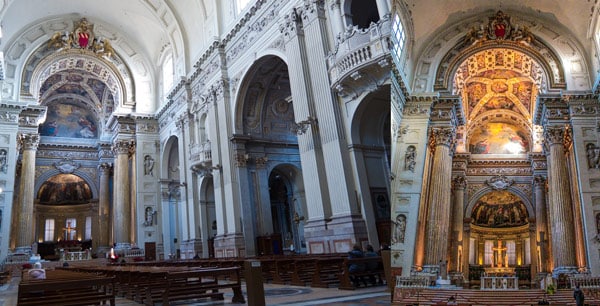
The original interior of the Cathedral of Saint Peter has not survived, but inside the building you can find many valuable historical items, including frescoes and sculptures from the medieval period.
Frescoes and Paintings
Numerous frescoes adorning the cathedral’s interior were painted by masters Ercole de Roberti and Francesco del Cossa in the mid-15th century. Due to later renovations, these artworks have only partially survived. Historians say that Michelangelo Buonarroti drew inspiration from these frescoes when creating his masterpieces.
In the Garganelli Chapel, wall paintings from the 16th century by Prospero Fontana and from the 18th century by Donato Creti and Marcantonio Franceschini have been preserved.
Chapel
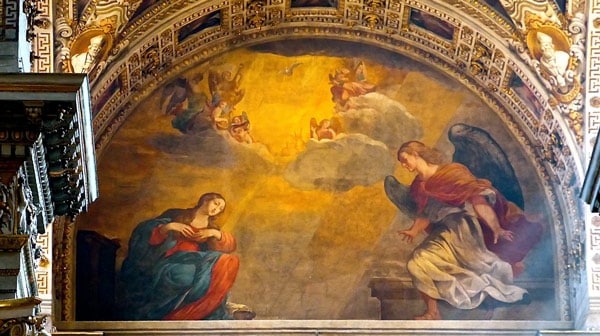
The cathedral’s interior is lavish and majestic, fully embodying the detailed style of Baroque architecture. Especially striking is the apse chapel’s decoration, featuring “The Annunciation” by Ludovico Carracci, painted in 1619.
Looking toward the altar, you’ll see a crucifix along with statues of Mary Magdalene and the Apostle John, dating back to around the 12th century.
Sculpture of Christ
The sculpture titled “Lamentation Over the Dead Christ” holds significant historical value.
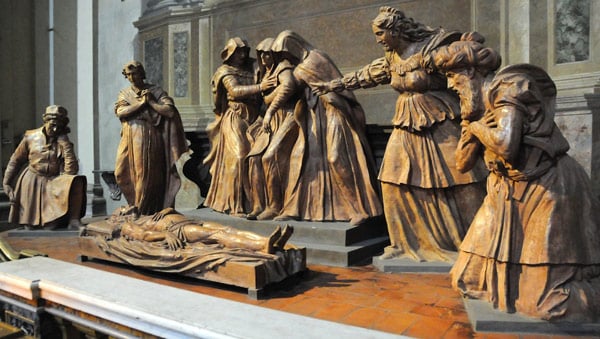
It dates back to the 16th century and is located in the chapel of the right nave. The masterpiece was created by Alfonso Lombardi.
Recommended reading: Michelangelo’s Pietà in the Vatican
The Bell
The bell tower houses the cathedral’s largest bell, “La Nonna” (meaning “the grandmother”), with the base of the structure dating to the 11th century. Historians claim that since then, the bell tower has not undergone any major modifications.
In the 16th century, a special bell-ringing technique was introduced in the cathedral, which has since become a lasting tradition. Unique methods, closely guarded by the clergy, generate sound waves by pairing finely tuned bells and applying a distinctive striking technique.
Museum
The left side of the nave leads to several rooms now serving as the museum “Cathedral Treasury” (Tesoro Della Cattedrale), which opened relatively recently, in the early 2000s. Initially, it was used for the cathedral’s ceremonial events, including exhibitions, but its tremendous success led the clergy to establish the display as a permanent exhibition.
Over the centuries, the cathedral has received numerous religious artifacts as gifts. Among the benefactors were Popes Benedict XIV and Gregory XV.
Opening Hours
The Cathedral of Saint Peter is located at Via Independenza, 7. Admission is free, and the cathedral is open for visitors Monday through Saturday from 7:30 AM to 6:45 PM, and on Sundays it opens an hour later.
The bell tower is open every Saturday from 2:00 PM to 4:30 PM and from 7:00 PM to 11:00 PM. Ticket price – €5.