 Italy for me From Italy with love


The Garden of Carlo Alberto (Giardino di Carlo Alberto), also known as the Quirinal Garden (Giardino del Quirinale), was opened to the public in 1969 at the initiative of Italian President Giuseppe Saragat.
Together with the nearby garden of the Sant’Andrea al Quirinale church, it forms a true green oasis located in the historic center of Rome, right next to the residence of the President of Italy.
Page Contents
Where Is It Located?
This small park, created in the late 19th century and named after the King of the Kingdom of Sardinia, Carlo Alberto di Savoia, lies in the southeastern part of the Quirinal Hill (Colle Quirinale).
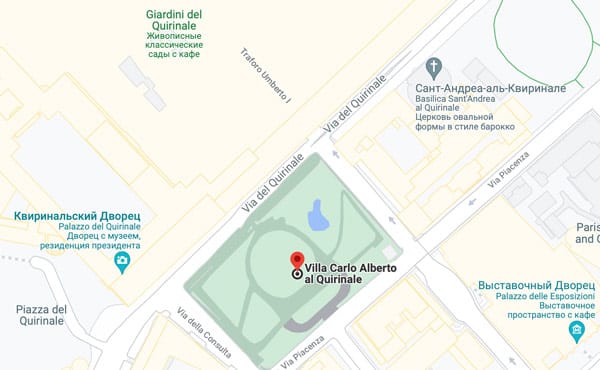
The green area, covering 74,470 sq ft (6915 sq m), is bordered on four sides by Via del Quirinale, Via delle Consulta, Via Ferrara, and Via Piacenza.
The main entrance to the Garden of Carlo Alberto is located on Via Piacenza, featuring a double travertine staircase. The entire park is surrounded by a stone balustrade with two light metal gates embedded on either side. In the background, opposite the garden, stands the impressive Palazzo del Quirinale—specifically its southern section known as the Manica Lunga (Long Sleeve).
When Was It Created and for What Occasion?
The new garden on the Quirinal was conceived in 1887 during preparations for a visit to Rome by Wilhelm II, the last Emperor of Germany and King of Prussia. The main objective of the talks was to finalize an agreement on the Triple Alliance between Germany, Austria-Hungary, and Italy—a military and political bloc that would later play a key role in dividing Europe and triggering World War I.
Wilhelm II stayed at the Quirinal Palace twice, in 1888 and 1893. For the German delegation, rooms were prepared on the first floor of the Manica Lunga, including imperial quarters and several guest rooms, which are still used today for receiving high-ranking visitors. To provide greater comfort for the German Kaiser, the Roman authorities decided to create a small garden beneath the windows of his rooms.
Grounds
The area intended for the new green space to delight Wilhelm II’s eyes had, until 1886, been an unsightly scene of abandoned church buildings. The new Italian government planned to demolish several religious structures on the Quirinal to make way for new ministry buildings.
The land where the Garden of Carlo Alberto now lies was initially slated for tree planting by the city administration, while the Royal Household intended to construct royal stables there. Wilhelm II’s visit played a decisive role in the final project selection.
In 1886, to make way for the garden, the 16th-century churches and monastery buildings of Santa Maria Maddalena al Quirinale and Santa Chiara al Quirinale were hastily demolished. The latter stood precisely where the equestrian statue of Carlo Alberto is now located.
This decision sparked outrage among Romans, particularly among the faithful, as these churches had centuries of history.
Construction
The development of the park was entrusted to royal gardener and landscape architect Giuseppe Roda. Work began in 1887 and was completed by Roda in 1888. The elliptical layout of the new garden featured tall trees, winding paths, flower beds, a rose arbor (no longer extant), and a small rustic-style fountain. The entire green space was originally enclosed by a tall wall, which was later replaced by a more refined stone balustrade.
\
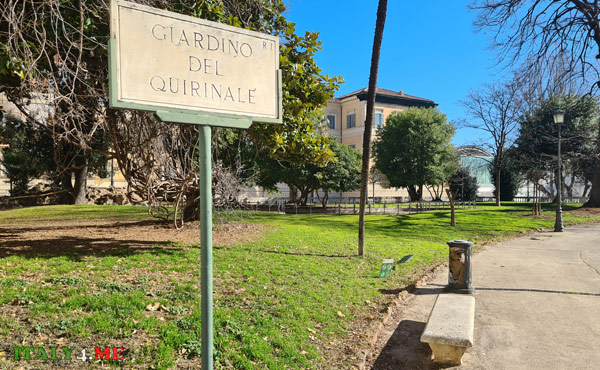
Originally, the garden’s design was intended only for the duration of Wilhelm II’s visit. However, by agreement between the city municipality and the Royal Household, further enhancements continued. A major contributor to the garden’s transformation was Baron Guglielmo Heffer, a wealthy tobacco merchant. His home was nearby, and he generously funded improvements to the surrounding area. The design and landscaping work was commissioned to French garden architect Édouard François André, who, in 1894, refined the park’s layout and introduced more than 500 new plant species.
Unfortunately, later modifications and insufficient maintenance prevented the garden’s greenery from retaining its original splendor. Nevertheless, extensive efforts were made in the 20th century to restore and care for various valuable trees and shrubs, including magnificent wisterias, magnolias, lindens, centuries-old plane trees, and exotic palms.
Dedication to Carlo Alberto
In 1900, a large equestrian statue dedicated to Carlo Alberto of Savoy (Carlo Alberto di Savoia)—father of Victor Emmanuel II (Vittorio Emanuele II), the first king of unified Italy—was installed in the imperial garden.
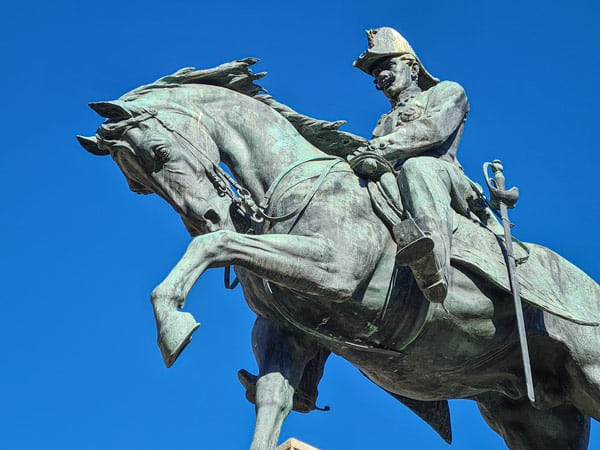
Two years earlier, a competition had been announced for the creation of the equestrian statue to commemorate the centenary of Carlo Alberto’s birth. The winner was Florentine sculptor Raffaello Romanelli, who cast the bronze sculpture in 1899 at a foundry in Pistoia.
The monument was unveiled on March 14, 1900, the birthday of Umberto I, the second king of unified Italy, who attended the inauguration ceremony. Incidentally, it was to be his last birthday celebration, as he was assassinated shortly afterward in Monza. Among the guests were diplomats from Russia and Austria.
From the moment the equestrian statue of the King of Sardinia was installed, the Quirinal Garden also became known as the Giardino di Carlo Alberto—a name still used today on the official website of the Municipality of Rome.
Read also about the kings and queens of Italy.
Equestrian Statue
The bronze monument to Carlo Alberto stands at the center of the garden and is its only sculptural element.
The ruler of the Kingdom of Sardinia is depicted in the uniform of a Piedmontese general, with his head bowed and a contemplative gaze. He sits gracefully atop a horse that has paused and impatiently paws the ground.
The emperor clearly does not appear as a triumphant figure, evoking a sense of melancholy and the understanding that even those with great power are not omnipotent. Carlo Alberto is remembered as a talented military leader and a champion of Italian unification, though his opposition to the Austrian Empire—which controlled much of the Italian peninsula—ended in failure.
The bronze side panels on the pedestal depict, on one side, a scene from the Battle of Goito (1848), the first war for Italy’s independence, in which the Piedmontese army achieved an unexpected victory,
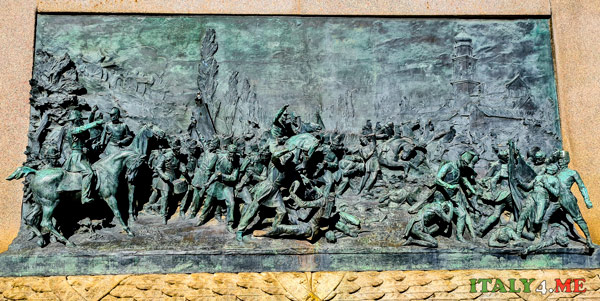
and on the other, Carlo Alberto’s abdication at Novara after his defeat at the Battle of Custoza.
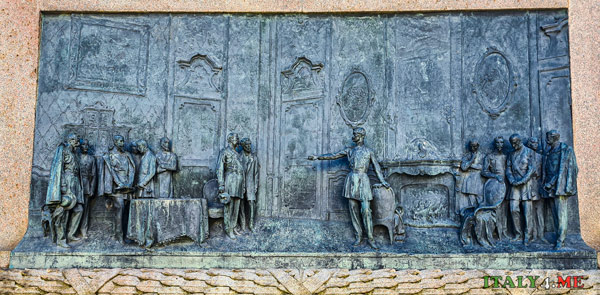
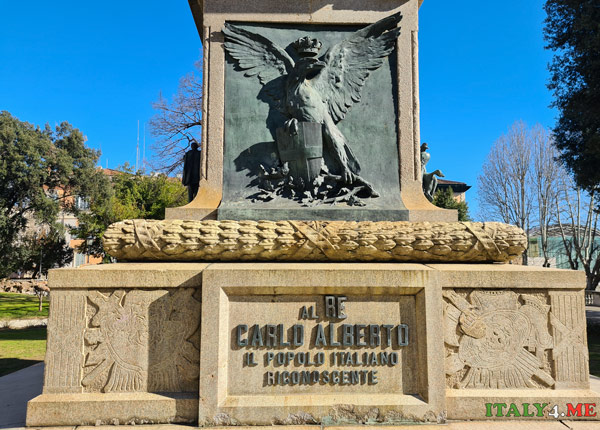
Two other panels feature bas-reliefs: one shows an eagle crowned with a royal crown supporting the Savoy shield,
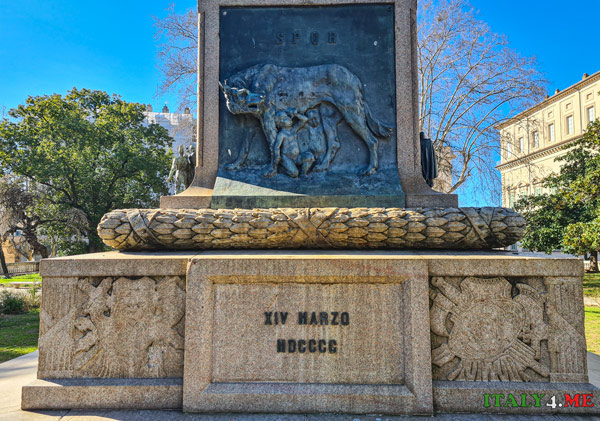
and the other depicts the Capitoline Wolf.
Today, the Giardino di Carlo Alberto continues to delight Romans and tourists alike. Following recent restoration efforts, it has preserved the atmosphere of a 19th-century park and remains a fine example of English landscape design.
Visitors can relax on stone benches beneath the shade of chestnut trees, stroll along gravel paths, admire the picturesque pond with tuff rock formations and a cascading waterfall, and enjoy the fresh scent of greenery.
A brief rest will recharge you to fully appreciate and compare the nearby architectural masterpieces of two eternal rivals—the churches of Sant’Andrea al Quirinale (by Francesco Borromini) and San Carlo alle Quattro Fontane (by Giovanni Lorenzo Bernini).