 Italy for me From Italy with love


Sant’Andrea al Quirinale is a small, distinctive 17th-century church located in the central Monti district of Rome on Via del Quirinale.
It is dedicated to the apostle Andrew the First-Called and belongs to the Diocese of Rome. Since 1998, it has served as a titular church.
Page Contents
History
This area of the Italian capital is home to 13 churches, each with its own unique character and fascinating history.
The Decision to Build
As early as the 12th century, a church known as Sant’Andrea in Monte Cavallo stood on the site now occupied by Sant’Andrea al Quirinale.
By 1566, the parish church had fallen into disrepair and was donated by Bishop Giovanni Andrea Croce to the newly formed religious order of the Jesuits. The growing popularity of the Society of Jesus and the expanding number of novices created a pressing need for larger premises and grounds.
In 1622, the Jesuits secured papal authorization to rebuild the old structure, and a young, talented architect, Francesco Borromini, was already selected for the project.
However, by the authority and will of Pope Innocent X, the decision to commence construction was indefinitely postponed. The Pope was reluctant to have a grand Jesuit church built near the Quirinal Palace (Palazzo del Quirinale), his official residence.
It was not until 1658, under the newly elected Pope Alexander VII and with financial backing from Cardinal Camillo Pamphili—the nephew of the previous pontiff—that the construction of the new church was finally approved and made possible.
Architect
The choice of architect for Sant’Andrea al Quirinale was practically predetermined. At the time, Borromini was already engaged, under the commission of Camillo Pamphili, in constructing Sant’Agnese in Agone on Piazza Navona.
The design of the new church was entrusted not merely to the best but to a genius in architecture and the creator of the Baroque style in sculpture—Giovanni Lorenzo Bernini.
Pope Alexander VII held the master in high regard, already renowned for his previous works, and approved the choice of architect. However, the Pope requested that the church be set back from the road and enclosed by a tall wall.
For Lorenzo Bernini, receiving this new commission was an opportunity to rekindle his rivalry with his former friend and now competitor, Francesco Borromini. The intrigue was heightened by the nearby location of San Carlo alle Quattro Fontane, which Borromini had worked on from 1633 to 1678.
The construction of Sant’Andrea al Quirinale brought Bernini not only renewed fame but also deep personal satisfaction. According to his son, the architect considered the church his ideal creation and, in his later years, frequently visited his beloved Sant’Andrea al Quirinale to attend Mass or simply to savor the beauty of the space.
Construction
The construction and decoration of Sant’Andrea al Quirinale took place between 1658 and 1678. Bernini’s mastery produced a church that, while modest in size, is a truly exquisite example of Baroque style. The tall wall once requested by the late pope to conceal the building was never erected—hiding the beauty of this new structure from the people of Rome would have been nothing short of sinful.
Bernini’s project brought together a team of talented architects, sculptors, and painters, including Mattia de Rossi, Antonio Raggi, Giacinto Brandi, Carlo Maratta, Ludovico Mazzanti, Giovanni Galli (known as Baciccio), Guglielmo Cortese, and others.
Exterior
Sant’Andrea al Quirinale is distinguished by its innovative form and composition. Its grand style, tall façade, and framing by a concave wall resembling a semicircular rotunda lend the church a monumental presence and a resemblance to theatrical scenery. 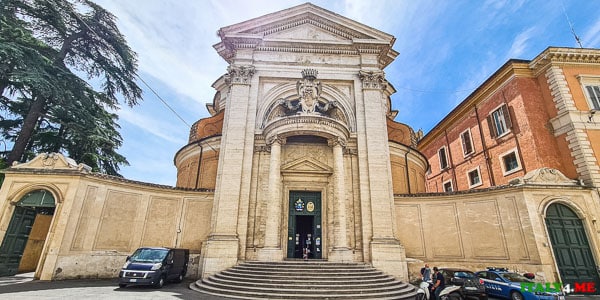
The main axis of the church runs perpendicular to the central entrance—a unique artistic choice that creates an unconventional spatial rhythm. Stepping into the church, one feels as though entering a giant Easter egg.
The façade, disproportionately tall compared to the body of the church, serves as a majestic grand entrance, featuring enormous pilasters and two graceful Ionic columns. It conceals a small dome topped with a cross.
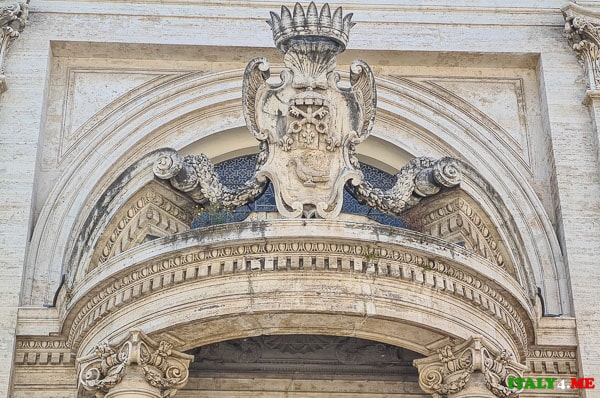
The portal is crowned by an elegant semicircular entablature supporting the Pamphili family coat of arms, crafted from travertine in Bernini’s workshop.
To the right of Sant’Andrea al Quirinale stands a three-story building that once housed a women’s monastery. Inside the grounds are courtyards containing a garden and living quarters for novices.
I also recommend reading about Villa Doria Pamphili.
Interior and Decoration
It is within the interior that the artistic expressiveness of the Baroque style is most vividly revealed. The architecture, sculpture, and paintings of Sant’Andrea al Quirinale serve as opulent settings for Catholic religious ceremonies.
Materials
For the interior of Sant’Andrea al Quirinale, Bernini employed not only white Carrara marble but also other rare and noble stones in shades of pink, gray, light green, and yellow, naturally veined with white.
Unlike many of his contemporaries who reused ancient columns from ruined monuments, Bernini insisted on using new, high-quality marble, sourced from a quarry in the Apennines near Casperia that had been abandoned since Roman times.
Altar
Upon entering the church, the altar immediately draws the eye—an extraordinary play of light and shadow highlights the small central apse adorned with gilded bronze.
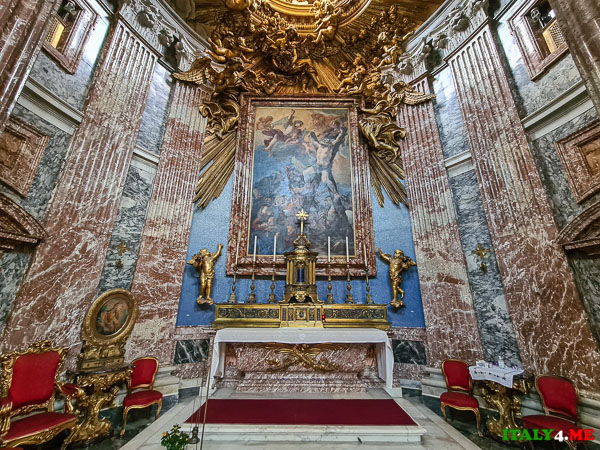
Against the contrasting blue walls appears a depiction of Saint Andrew’s martyrdom, captured in a painting created in 1668 by the French artist Guillaume Courtois.
At the junction between the altar and the dome stands a sculpture by Antonio Raggi—a pristine white statue of Saint Andrew reclining on a cloud.
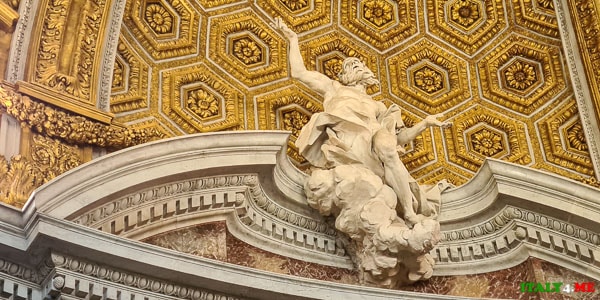
His upward gaze connects the two realms—the altar and the dome—symbolizing heavenly light and earthly suffering.
It is believed that Bernini himself created the preliminary model for this masterpiece.
Dome
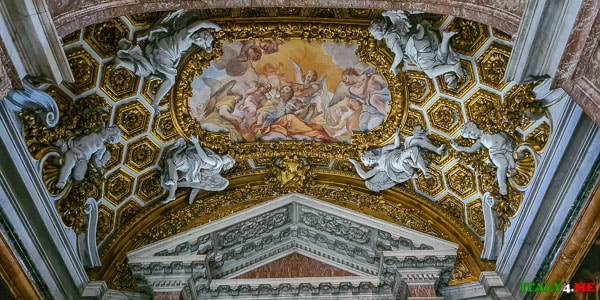
The dome of Sant’Andrea al Quirinale, barely noticeable from the outside, astounds visitors upon entering the church. A magical light pours through the oculus (central lantern), flooding the gilded vault.
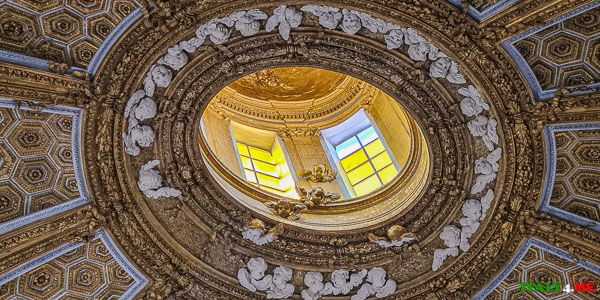
The dome’s sense of lightness and infinity is enhanced by progressively smaller rosette motifs set within hexagonal coffers. Ten radiating ribs, stylized as palm branches, extend from the center, supporting the dome and symbolizing martyrdom.
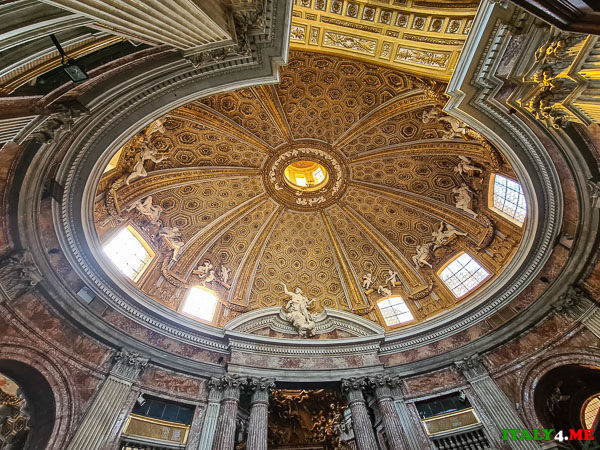
The “heavenly vault” is adorned with 138 sculptures of fishermen, saints, and cherubs crafted by the brilliant Raggi.
Chapels and Tombs
Sant’Andrea al Quirinale contains four chapels dedicated to the Jesuit order’s founders—Saints Francis Xavier and Ignatius of Loyola—as well as to the young novice Stanislaus Kostka and the Passion of Christ. The floor, featuring colorful mosaic and inlay, serves as the burial site for Cardinals Giulio Spinola, Pietro Sforza Pallavicino, and Camillo Melzi.
To the left of the main altar, where a large crucifix stands, lies the tomb of an extraordinary Jesuit novice—Charles Emmanuel IV, King of Sardinia and Piedmont (Carlo Emanuele IV di Savoia), who abdicated the throne and lived in the monastery adjoining the church until his death in 1819.
Sacristy and the Room of Stanislaus Kostka
The door to the right of the main altar leads to a small sacristy, where visitors can admire a magnificent ceiling fresco, “The Apotheosis of Saint Andrew,” painted by Giovanni II di Brosse, along with a lavabo made of colorful marble, possibly crafted by Bernini himself.
A staircase from the sacristy ascends to the room of Saint Stanislaus Kostka, where his incorrupt relics are preserved. The room also contains an extraordinary life-size polychrome marble statue of the dying novice monk, created by the French sculptor Pierre Le Gros the Younger. The Jesuits hold Stanislaus Kostka in deep reverence for his strength and purity of faith.
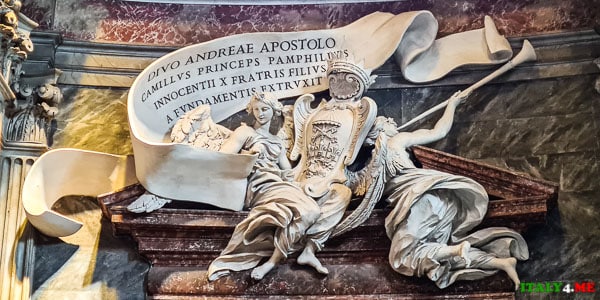
As visitors exit the church, a memorial plaque and a splendid composition featuring two winged women—symbols of fate—remind them of the church’s founder from the Pamphili family, who invested significantly in the construction of Sant’Andrea al Quirinale. This masterpiece was executed by Giovanni Rinaldi based on designs by Bernini.
Hours and How to Get There
Address: Via del Quirinale, 30
The Church of Saint Andrew on the Quirinal is open for visits from 9:00 AM to 12:00 PM and from 3:00 PM to 6:00 PM, except Mondays.
Mass is celebrated on Sundays at 10:30 AM.
The easiest way to reach the church is on foot. The walk from Roma Termini Station takes about 20 minutes, from Piazza Venezia about 15 minutes, and from the Trevi Fountain about 10 minutes.
Time has fortunately preserved the magnificent Sant’Andrea al Quirinale. Its perfect Baroque style, unconventional form, and breathtakingly rich interior make it a true jewel among Rome’s architectural masterpieces.