 Italy for me From Italy with love

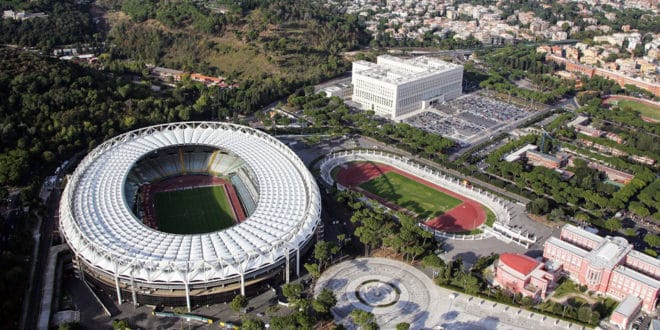
The Stadio Olimpico in Rome is a multi-purpose sports facility owned by the Italian National Olympic Committee and served as the main venue for the 1960 Summer Olympic Games.
Today, the stadium is the home ground for Rome’s football clubs AS Roma (Associazione Sportiva Roma) and Lazio (Società Sportiva Lazio). It is also used by the Italian national rugby and athletics teams and regularly hosts music concerts and major events held in the Italian capital.
The Olimpico is the largest sports venue in Rome, accommodating over 70,000 spectators. Thanks to its modern facilities and unique design, it is classified as a UEFA Category Four stadium, the highest ranking, second only to London’s Wembley Stadium in the number of UEFA Champions League finals hosted.
Page Contents
Location
The Stadio Olimpico is located in the northwestern sector of Rome at the foot of Monte Mario and is part of the Foro Italico, a grand multi-sport complex. The site also includes the Marble Stadium (Stadio dei Marmi) with monumental statues of athletes, the Olympic swimming complex (Stadio Olimpico del Nuoto), a tennis center, the Mussolini Obelisk (Mussolini-Obelisk), and the Piazzale del Impero.
Access to the Olimpico passes over the impressive Ponte Duca d’Aosta (200 x 30 m), a stone bridge spanning the Tiber River, constructed between 1939 and 1942 based on a design by architect Vincenzo Fasolo.
The Foro Italico is surrounded by picturesque landscapes that lend the modern sports complex a distinctive atmosphere filled with Italian charm and southern natural beauty. In ancient times, this peaceful, verdant area was a favored retreat for wealthy patrician families seeking to escape the hustle and bustle of the city.
During the Renaissance, this splendid natural setting was chosen by Cardinal Giulio de’ Medici—who would later become Pope Clement VII—as the site for his country house, known as Villa Madama.
History
The history of the Stadio Olimpico includes several phases of construction and renovation. Although the concept of building a grand sports complex in Rome originated and began to take shape during the height of Italian Fascism, the beauty and harmony of the Foro Italico today are widely admired as an architectural and landscape masterpiece.
Cypress Stadium at the Mussolini Forum
The Italian Forum was originally known as the Mussolini Forum (Foro Mussolini). It was built between 1928 and 1938 at the dictator’s behest, in the hope that Rome would be chosen to host the 1940 Olympic Games. 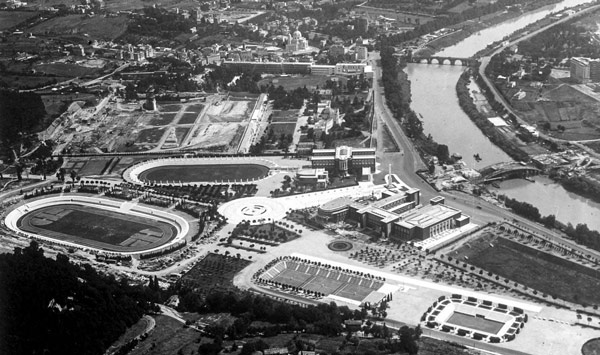
Japan ultimately won the right to host the games, and the Mussolini Forum became a site dedicated to promoting physical education among members of the fascist party’s militarized youth organization, Opera Nazionale Balilla. In reality, it served as an ideological tool for propagating fascist ideas. To popularize the regime, the design of the new sports forum drew heavily on associations with the traditions of ancient Roman architecture.
The complex resembled imperial-era structures—with large-scale forum-style development, the Duce’s namesake obelisk, a square with a fountain, and an avenue lined with statues of athletes reminiscent of ancient depictions of gods.
Construction of the Cypress Stadium (Stadio dei Cipressi)—the original name of what would become the Stadio Olimpico—began in 1927. It was designed by architect, university professor, and public figure Enrico Del Debbio, with the involvement of Turin engineer Angelo Frisa.
Work resumed in 1937 with the participation of the renowned 20th-century architect Luigi Moretti, but in 1940, construction was halted due to the outbreak of World War II.
Also read the biography of Benito Mussolini.
Stadium of One Hundred Thousand at the Italian Forum
After the war, the sports complex in Rome became the property of the Italian National Olympic Committee and was renamed Foro Italico. Starting in 1951, architect Annibale Vitellozzi resumed construction of the stadium and completed it in 1953.
The Cypress Stadium underwent major redevelopment, continuing the vision of Enrico Del Debbio. The seating areas were significantly expanded and upgraded, allowing for a capacity of around 100,000 spectators! The impressive scale earned the facility a new name, and from 1953 to 1960, it was known as the “Stadium of One Hundred Thousand” (Stadio dei Centomila).
The grand opening took place on May 17, 1953, featuring a football match between Italy and Hungary, which ended 3–0 in favor of the visitors.
A Stadium of Olympic Proportions
In 1955, Rome was selected to host the XVII Summer Olympic Games, held from August 25 to September 11, 1960.
A distinctive feature of the Stadio Olimpico was its visually low profile despite its large capacity (65,000 spectators), which was slightly reduced by removing ground-level seating. This vast bowl-like effect was achieved by lowering the field surface and blending the stadium with the surrounding landscape.
Renovations Since 1990
A major overhaul of the Olimpico was carried out for the 1990 FIFA World Cup. A team of architects and engineers led by Annibale Vitellozzi designed and executed an innovative renovation plan for Rome’s largest stadium. Key upgrades included reinforced concrete stands and a unique tensile fiberglass canopy covering the spectator sections.
Following the renovations, the Stadio Olimpico became the second-largest stadium in Italy with a capacity of 82,922, just behind Stadio Giuseppe Meazza (San Siro) in Milan and ranked 29th in the world.
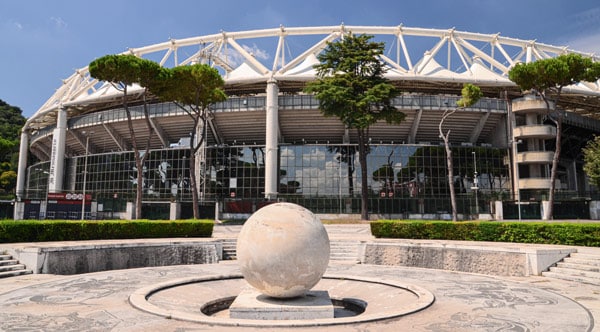
With advancements in technology and new opportunities, the Olimpico has continued to evolve. After a 2008 renovation, the stadium received upgraded security systems, a modern press center, new locker rooms, LED screens, and improved spectator seating. As a result of this extensive modernization, the Stadio Olimpico earned UEFA elite stadium status with a capacity of 70,634 seats.
Stadium Specifications
Today, the Stadio Olimpico in Rome ranks among the world’s most important and largest sports venues. The numbers speak for themselves:
- 90,000 sq. m – total area of the stadium;
- 33,500 sq. m – area of the buildings;
- 105 x 70 m – size of the playing field;
- 30.0 km – total length of spectator seating;
- 10 entrance gates labeled A to L;
- 12 locker room groups accommodating up to 1,500 athletes simultaneously;
- 375,000 watts – power output generated by the main power station and 11 substations, with an autonomous backup system for emergencies.
In addition to these features, the Olimpico football field is equipped with an advanced drainage and irrigation system, while the running tracks and athletic areas boast the latest design and equipment.
What to See Nearby
Adjacent to the Olimpico is the Marble Stadium—an early creation of Enrico Del Debbio built during the first phase of the sports complex’s development. Designed in the style of a Greek stadium and constructed using pristine Carrara marble, it is especially notable for its gallery of 60 statues. 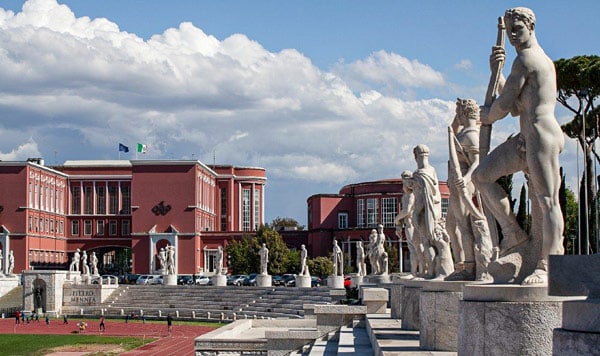
The magnificent 4-meter-tall figures, set against a backdrop of hills and green cypresses, evoke the sculptures of Ancient Rome. Modern statues celebrating various sports disciplines were crafted by several artists, including Aroldo Bellini, Eugenio Baroni, Aldo Buttini, and others.
The Stadio Olimpico, which draws tens of thousands of sports enthusiasts from around the world, has become another landmark of the Eternal City. The beauty of its surroundings and its distinctive atmosphere make every event held at the Olimpico an unforgettable experience.
How to Get There
The Stadio Olimpico is located 5 km (3.1 miles) from the city center. Walking from landmarks such as the Pantheon takes about an hour. 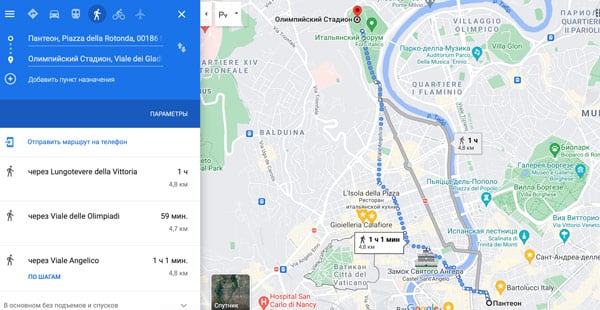
You can also take a bus, though you’ll need to walk approximately 800 meters from the closest stops.
- From Piazza Navona, take bus 628 from the Senato stop and get off at De Bosis/Stadio Tennis.
- From the Vatican, take bus 32 from the Risorgimento or Ottaviano stops and get off at De Bosis/Stadio Tennis.
On match days, buses may not reach the stadium and could stop a few stops earlier, requiring a walk of about 2 km (1.2 miles).
Where to Find the Football Ticket Offices
There are no football ticket offices near the stadium, so if you plan to attend a match, I recommend purchasing your tickets in advance. You can buy tickets at official Roma or Lazio stores or at specialized ticket offices. Here’s a helpful guide.
Which Stand Offers the Best View?
Traditionally, Lazio’s tifosi occupy the north stands (Curva Nord), while Roma supporters fill the south stands (Curva Sud). Access to these sections is generally reserved for active fan club members.
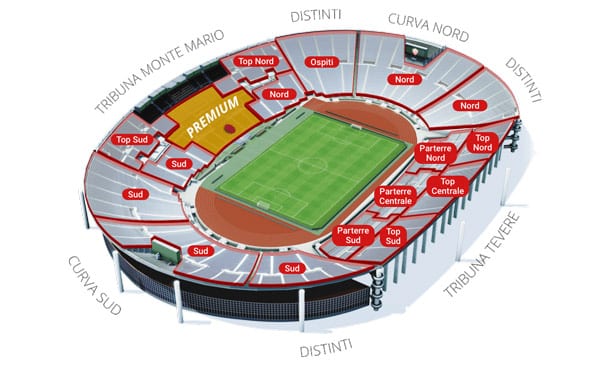
Regular fans and tourists typically choose between central or corner stands. The most expensive premium seats are located in the Monte Mario central stand and cost around €150.
The opposite stand, called Tevere, also provides a good view of the match. For example, my friends and I chose seats there when we attended a preseason game between Roma and Real Madrid.
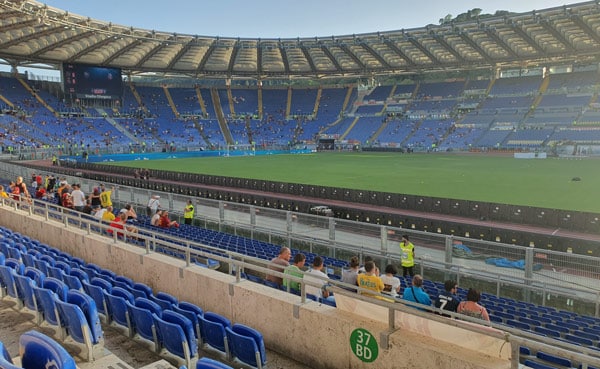
If you want to experience the festive atmosphere, I suggest selecting seats in the corner stands (Distini), which are livelier than the central areas.
Of course, if you support Roma, it’s best to avoid the Distini Nord section, and Lazio fans should steer clear of Distini Sud.
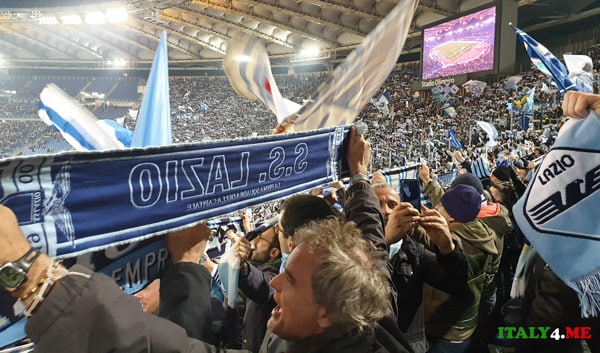
Overall, the fans are very positive, and people even attend matches with young children. Lazio supporters usually gather three to four hours before kick-off at Piazzale di Ponte Milvio, where they enjoy beer and pizza and sometimes light flares. The walk to the stadium from there takes about 20 minutes.
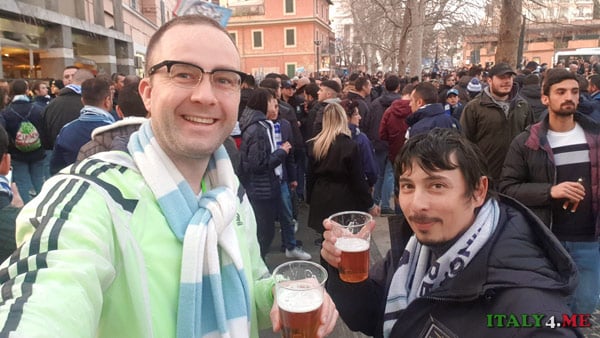
The celebrations often continue for a few hours after the match.
Roma fans, unfortunately, don’t have a dedicated gathering spot before games.
Fans and Safety
The stands foster a friendly and positive atmosphere. Check out this video of Lazio fans singing their anthem after a victory over their main rivals: