 Italy for me From Italy with love


Scala Sancta (Latin for Holy Stairs) is one of the most treasured relics of the Christian faith, located in Rome. These 28 marble steps lead to the Sancta Sanctorum—the chapel of the Roman Popes, situated in the Lateran Palace (Palazzo del Laterano).
Ancient tradition holds that these very steps were the ones Pontius Pilate used when he escorted Jesus Christ to judgment. Today, pilgrims from around the world ascend the staircase on their knees.
Page Contents
History
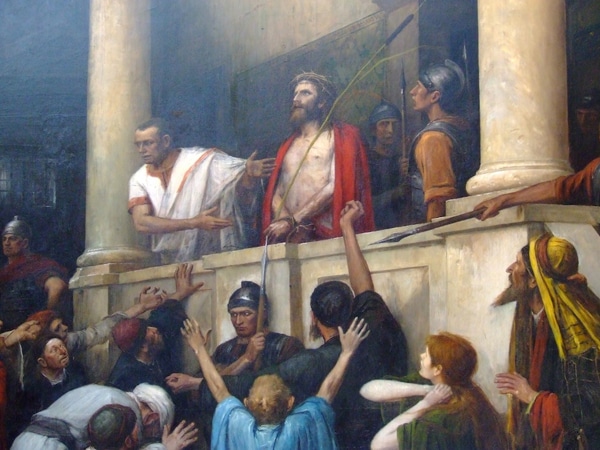
According to the Holy Scriptures, Pilate judged Jesus in his praetorium in Jerusalem. The Son of God, condemned to death, walked upon these wide marble steps. Pope Sergius II noted in his writings that in the 4th century AD, thanks to Julia Helena Augusta (Latin: Iulia Helena), mother of Emperor Constantine I, the relic was brought to Rome. Bishop Sylvester I accepted the sacred gift from the Empress and ordered the relic to be installed in the Papal palace.
In the late 16th century, the Lateran Palace underwent major reconstruction, and the Holy Stairs were relocated to their current position. It is believed that four steps were added to the original 24. The construction was completed swiftly, with workers taking care not to desecrate the holy steps with their feet. The staircase was reassembled from top to bottom.
By the end of the 19th century, veneration of the Holy Stairs, also known as Pilate’s Stairs (Latin: Scala Pilati), had reached its peak. Countless pilgrims gathered at the Lateran Palace on the eve of major religious festivals. They ascended the stairs on their knees, reciting prayers at each step, progressing from the base of the staircase to the Chapel of St. Lawrence (Cappella di San Lorenzo in Palatio). Eventually, the marble had to be covered with wooden panels to prevent further damage.
Of particular reverence to the faithful are the traces of the Savior’s blood, shed from his scourged back during his path to Golgotha. Cross-shaped openings in the protective wooden coverings allow devotees to touch the most sacred relics of the Holy Stairs. Today, the staircase features special viewing windows installed in the 2nd, 11th, and 28th steps.
Architecture
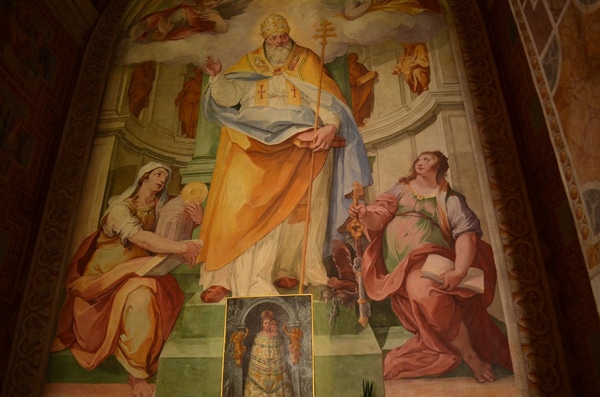
The journey leading to the Sancta Sanctorum is enhanced by frescoes painted by the medieval artist Baldassare Croce. The central piece features a depiction of the crucified Christ, the Virgin Mary, and Saint John. Other illustrations from the Holy Scriptures emphasize the significance of the Lateran Palace and the Holy Stairs. In 2007, a restoration project revived Croce’s frescoes, restoring their lost colors and vividness.
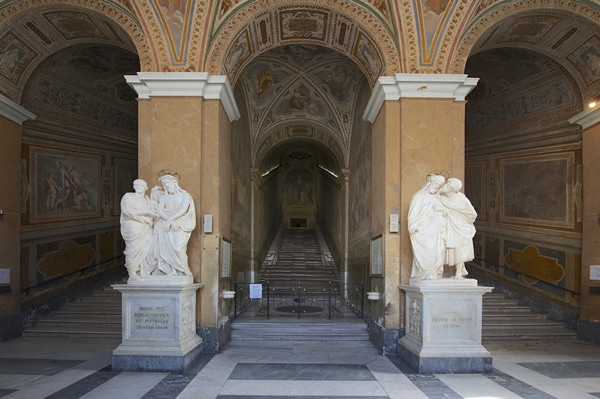
Near the first step of the Holy Stairs stand two white marble statues. One is The Kiss of Judas by Alberto Giacometti, and the other is Pilate’s Judgment, also by the same sculptor. Giacometti lived and worked throughout the 20th century, with these works dating from 1901 to 1966.
Recommended reading: the Vatican City-State
Interesting Facts
It is believed that pilgrims who ascend the Holy Stairs during the observance of Lent (every Friday) receive a plenary indulgence. On other days, visitors may receive partial remission of sins if they climb all the steps on their knees with an open and humble heart.
While on the ancient steps, Catholics recite the Prayers for Ascending the Holy Stairs, while Orthodox Christians offer the Akathist to the Passion of Christ.
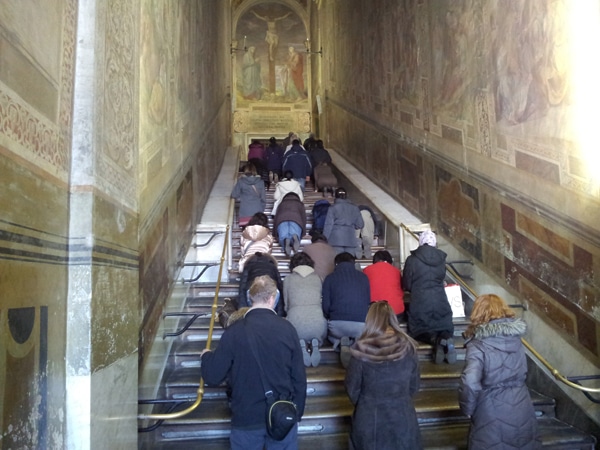
There are side stairs available, allowing visitors to reach the Sancta Sanctorum without joining the line of kneeling worshippers.
In the Chapel of Saint Lawrence, or Sancta Sanctorum, where the stairs lead, treasures of the Roman pontiffs are preserved. The most revered relic is an acheiropoietos icon of Christ known as the Acheropita, dating to the 6th century AD.
Location, How to Get There, Opening Hours
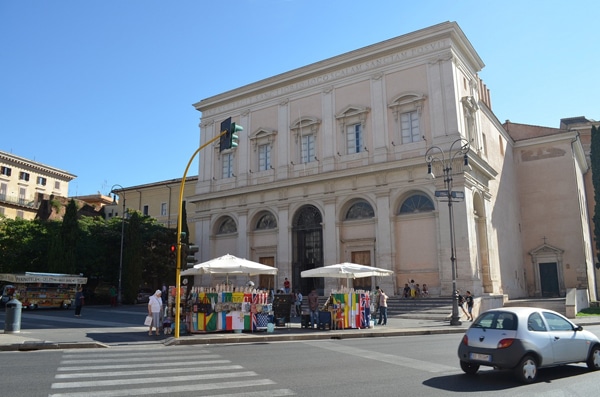
- Address: Piazza San Giovanni in Laterano, 14
- The Holy Stairs are located in the palace next to the Lateran Basilica, also known as the Basilica di San Giovanni in Laterano. You can reach it by metro (San Giovanni station) or by buses No. 116, 81, 85, 87, 810, and 16.
- Opening hours: from 6:00 AM to 1:00 PM, on holidays from 7:00 AM to 12:30 PM and from 3:00 PM to 6:30 PM (until 7:00 PM in summer).
- Masses are held in the Sancta Sanctorum chapel at 6:30, 7:00, 9:00, and 5:30 PM.
- Entrance fee for Sancta Sanctorum is €3.50. Opening hours are from 9:30 AM to 12:40 PM and from 3:00 PM to 5:10 PM. Audio guides are available for rent.
- Praying on the steps of the Scala Santa is completely free. A prayer book written in one of eight languages costs €2.
- Official website: www.scala-santa.com