 Italy for me From Italy with love

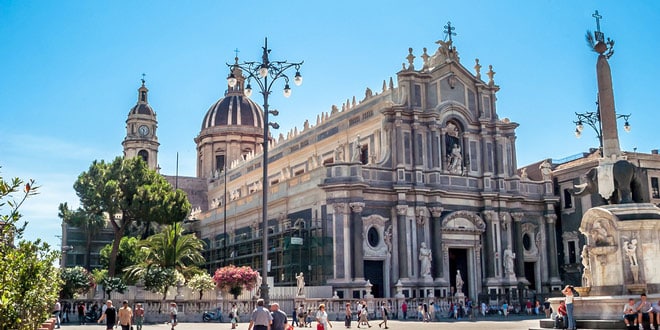
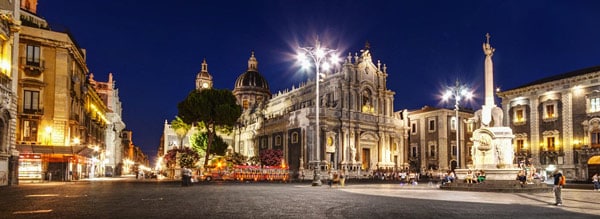
The Cathedral of Saint Agatha (Cattedrale di Sant’Agata) in Catania stands on Piazza del Duomo, directly across from the famous Elephant Fountain – the symbol of the city. This is virtually the historic center, located close to the main city port.
The cathedral was built in honor of the martyr Agatha, who is the patron saint of Catania. Her remains are entombed here.
Page Contents
History
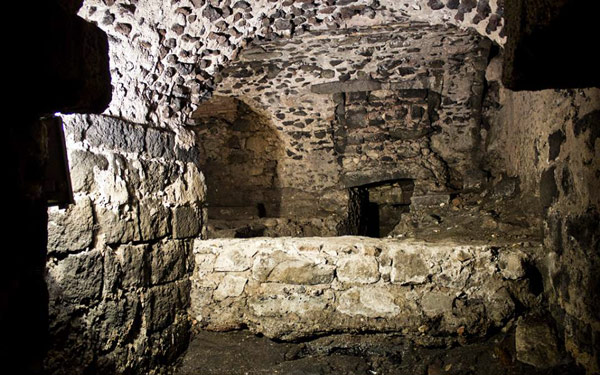
Construction of the cathedral first began in the second half of the 11th century. In ancient times, the site was occupied by the Achillean Baths (Terme Achilliane). Remnants of these baths can still be seen beneath Piazza del Duomo today.
Throughout its history, the cathedral has undergone numerous renovations, reconstructions, and even complete rebuilds from ruins.
For example, in 1169, a devastating earthquake caused irreparable damage, leaving only the eastern altar section intact. Before restoration efforts could be fully completed, a major fire broke out in 1194, causing significant new destruction. After being resurrected from the ashes, the church resumed its functions. In 1387, a 70-meter bell tower was added to the left of the western façade. In the mid-17th century, another level was added, housing a bell chamber with a clock.
Only three decades later, in 1693, a powerful earthquake struck the entire Val di Noto valley, nearly leveling the cathedral once again. Over seven thousand parishioners perished during a communal prayer service, as the walls and ceiling collapsed under the tremors.
In 1711, the cathedral and bell tower were reconstructed thanks to Palermo-born abbot and architect Giovanni Battista Vaccarini. In the 18th century, he was celebrated as one of Sicily’s most talented architects. He rebuilt the church in the Sicilian Baroque style. A churchyard was laid out around the cathedral, enclosed by an ornate wrought-iron fence adorned with bronze sculptures of saints.
Exterior
The church’s exterior façade is clad in marble and richly adorned with statues of saints, intended to protect the city from potential eruptions of Mount Etna.
The main entrance features 32 wooden panels, each intricately carved with scenes from the life and martyrdom of Saint Agatha. Several coats of arms of Roman popes and Christian symbols are also displayed.
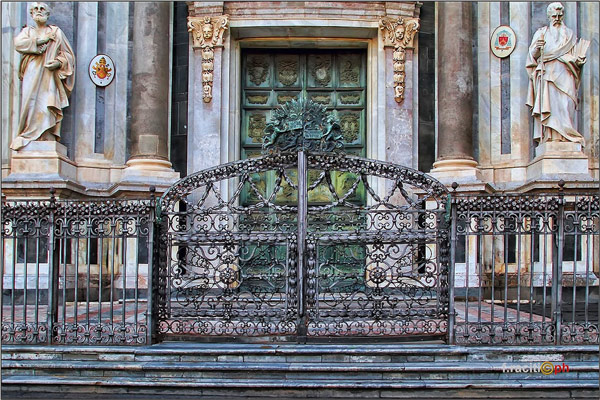
The western façade is visually divided into three levels, each highlighted by Corinthian columns and a marble attic. A monumental statue of Saint Agatha crowns the main portal, flanked by statues of Saint Euplius of Catania and Bishop Berillus of Catania. Statues of the apostles Peter and Paul stand on either side of the portal.
Interior
When viewed from above, the cathedral reveals the shape of a Latin cross, divided inside into three naves. The dome, built in 1802, rises on the eastern side of the church. Tall windows cut into it allow sunlight to flood the entire interior. The niche in the right nave is adorned with a fresco depicting the “Baptism of Christ.” This area also houses the baptistery, separated from the main space by a wrought-iron balustrade.
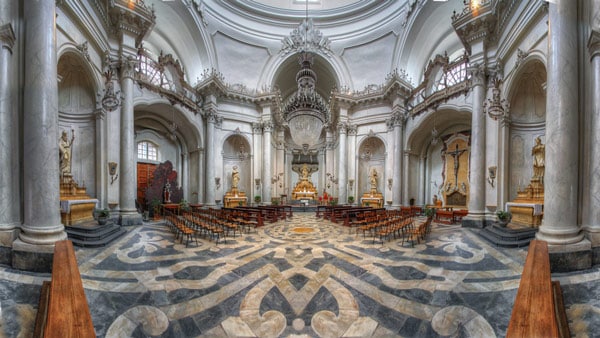
Directly across from the altar stands the marble and bronze tomb of Vincenzo Bellini, Catania’s famous 19th-century composer. Further down the nave lies the majestic Chapel of Saint Agatha, decorated with 18th-century frescoes. Above the altar is a bas-relief showing Saint Agatha being crowned with a wreath of glory, surrounded by Saints Peter and Paul, and the Evangelists Luke, Matthew, John, and Mark. On the left side, a small golden door leads to the crypt beneath the church, where the bust and relics of Saint Agatha are kept.
The main altar is located in the central apse, the only part preserved from the original structure. It is surrounded by wooden choir stalls. In the left nave are four chapels dedicated to the Holy Crucifix, Saint Anthony the Great, and Saint George the Dragon Slayer, containing the sarcophagi of Catania’s bishops.
The cathedral also houses the remains of several Sicilian monarchs, including Constance of Aragon, Frederick III, Giovanni di Randazzo, and even Louis of Sicily. Constance was originally buried with her ornate tiara, which has since been removed and is now kept separately in the church treasury. Nearby lie the remains of Cardinal Dusmet.
The Legend of Saint Agatha
Long ago, on the island of Sicily, a young girl named Agatha was born. Her family was among the first to embrace Christianity, and from an early age, she grew up deeply religious, eventually deciding to devote her entire life to the Savior.
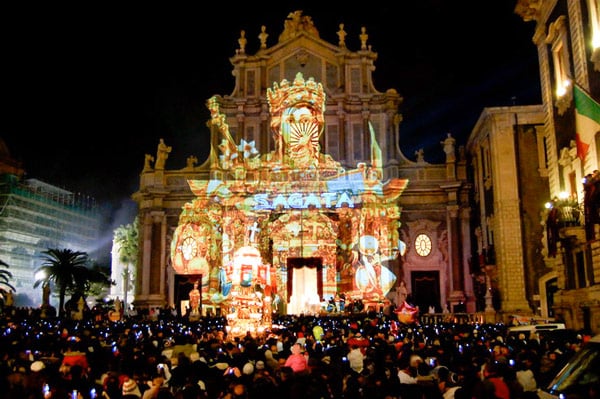
Unfortunately, during the early Christian persecutions, Agatha was among the first to be arrested. At the time, the city was ruled by Proconsul Quintian (Lucius Tiberius Claudius Aurellius Quintianus Pompeianus). Upon seeing the Christians destined for execution, he was captivated by Agatha’s beauty and offered her clemency in exchange for her favors. However, the young woman stood firm in her faith and refused. She was imprisoned for a month in a brothel.
But Agatha’s faith remained unbroken and grew even stronger. When Quintian made his advances again, she refused once more. As punishment, she was thrown into prison and subjected to brutal torture, including the severing of one of her breasts.
Here, the legends diverge. One version claims she was burned alive in the main square. Another tells that after her final torture, Saint Peter appeared to her and healed her wounds. Enraged by the miracle, Quintian ordered her to be tortured with hooks and burning coals right before him.
Despite the support of heavenly protectors, Agatha could not survive such torment. She heroically died on February 5, 251, without renouncing her faith. News of her tragic death spread quickly across Sicily, and she became a revered symbol in the islanders’ struggle against Roman occupation.
Justice came swiftly: those responsible for her suffering soon perished during an earthquake. Shortly afterward, Mount Etna erupted violently. As the lava approached the city, the people, carrying Agatha’s burial veil, went out to meet the advancing flow. The veil turned bright red and miraculously stopped the lava’s advance. Deeply moved, the people proclaimed Saint Agatha the patroness of Catania.

This powerful legend is closely tied to the Cathedral of Saint Agatha. Whether for its rich history or its breathtaking architecture, the cathedral is an essential stop in Catania—it is the city’s largest church and a true sacred landmark.
Official website: www.cattedralecatania.it
Nearby, you’ll find the Monastery of Saint Nicholas, notable not for its decor but for its remarkable organ, along with Sicily’s largest library.