 Italy for me From Italy with love


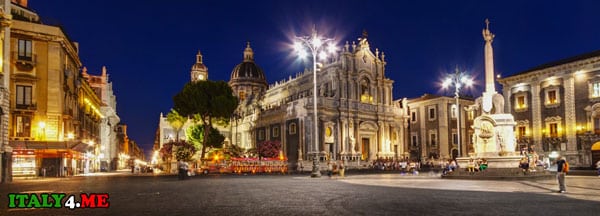
Exactly when and how the black elephant appeared in their city remains uncertain for the native residents of Catania. Nevertheless, this did not prevent the fountain with the elephant statue at its base from becoming a beloved symbol of the city, standing proudly alongside the Cathedral of Saint Agatha. Locals firmly believe that these city emblems protect them from the volatile eruptions of Mount Etna.
Page Contents
How Did Elephants Appear in Catania?
When you start to think about it, you’ll notice that “elephant” imagery is everywhere in Catania. One version for the abundance of these depictions claims that elephants were introduced to the island by the Arabs. During their reign, the city’s name even translated as “City of Elephants.”
Another theory suggests that elephants originally lived in the areas surrounding the city. Archaeological discoveries support this, revealing that dwarf elephants once roamed the island during prehistoric times.
The Municipal Museum of Mineralogy, Volcanology, and Paleontology even features an exhibit showcasing one of the best-preserved fossil skeletons of these ancient trunked creatures. It’s entirely possible that early settlers found similar formations naturally created by lava.
With the arrival of Christianity on the island, the church attempted to replace the pagan elephant symbol with the image of Saint George. However, the substitution never took root in people’s hearts, and after a series of uprisings, the original symbol was restored. Over time, the elephant became emblazoned on the city’s coat of arms, the emblems of its universities, and various sports clubs.
Description of the Fountain
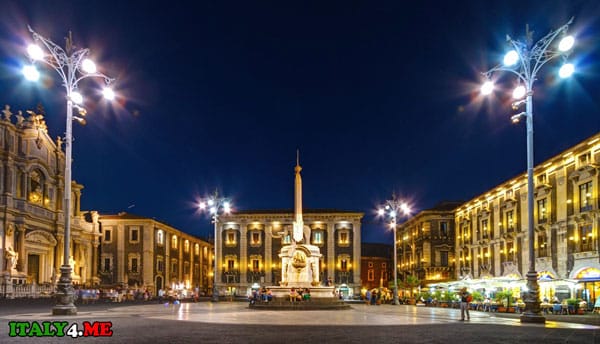
The Elephant Fountain (Fontana dell’Elefante) has adorned Catania’s Cathedral Square for nearly 300 years. It is considered the finishing touch of the architectural ensemble at Piazza del Duomo. The entire project was designed by Giovanni Battista Vaccarini.
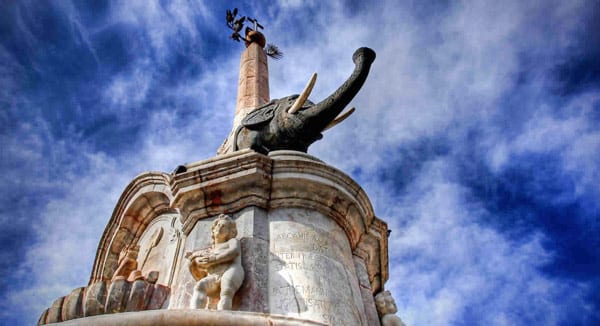
At first glance, the monument may appear simple, but look closer. Its structure is quite complex, combining architectural and sculptural elements from different cultures and eras. The foundation of the composition is a white marble basin. At its center rises a tall white marble pedestal, decorated with bas-reliefs depicting the allegorical figures of the rivers Amenano and Simeto, along with Sicily’s most revered symbols—Abundance and Fertility. Water jets flow from the base of the pedestal.
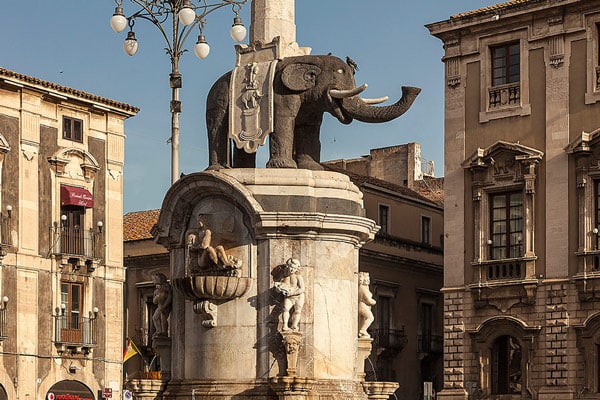
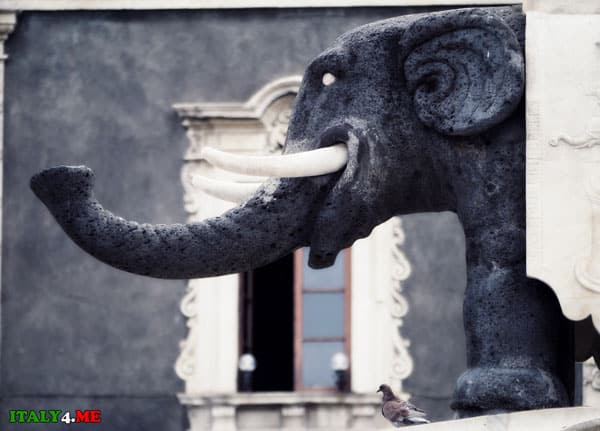
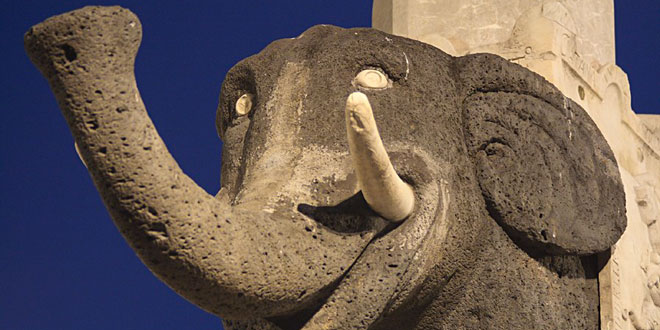
The focal point of the monument is the figure of a black elephant carved from basalt. The elephant stands quietly, facing the Cathedral of Saint Agatha. Draped over its back is a white mantle bearing the coat of arms of Saint Agatha, Catania’s patron saint. Rising from the elephant’s back is a three-and-a-half-meter-tall granite obelisk, its surface adorned with four rows of Egyptian-style reliefs. The obelisk is crowned with a sphere, topped by a cross surrounded by olive and palm branches.
The monument stands near the City Hall, a building dating back to the 18th century. Because of this proximity, the town hall earned the nickname “Palazzo degli Elefanti” (Elephant Palace). Sadly, the City Hall is also remembered for the loss of the city’s archive in the mid-20th century.
History and Legends
The fountain’s construction date on Cathedral Square is fairly well documented. However, the origin of the black elephant statue remains a mystery.
According to one local legend, the statue arrived after the last eruption of Mount Etna in 1669. Lava flowing from the volcano supposedly carried both the obelisk and the elephant figure to the site. The architect, working on the square and the cathedral, is said to have stumbled upon them. That’s why locals believe so strongly in the elephant’s power to protect the city from fiery volcanic flows.
Unfortunately, even the charm of this story does not align with historical facts. Researchers have uncovered documents proving that by the 13th century, a black volcanic basalt elephant statue already existed in Catania. It even had a name—”Liotru” (Liotru), presumably derived from a sorcerer named Heliodorus who lived in the city during the 8th century and was said to possess the power to transform people into animals using a similar statue. Some legends even claim he could turn himself into a giant creature.
The 13th century also marked the first official use of the elephant as the city’s symbol.
How Was the Elephant Monument in Catania Created?
Some researchers believe that Vaccarini used as a model the work of Giovanni Lorenzo Bernini, whose famous elephant sculpture has adorned Rome’s Piazza della Minerva since 1667. This theory is highly plausible, given the striking similarities between the two monuments. The exact origin of some of the monument’s components, however, remains unknown.
Read more about Bernini’s Elephant in Rome.
The elephant figure came to Vaccarini already damaged, with broken legs. During restoration, the architect not only rebuilt the legs but also added eyes and tusks made of white marble.
The granite obelisk is believed to have originated from Aswan, a city on the banks of the Nile. Archaeologists suggest that it was initially dedicated to the goddess Isis and arrived in Sicily after a Crusade in the 13th century.
Vaccarini’s work did not mark the end of the black elephant’s story. The monument underwent its first restoration in 1757, and in 1826, it was even fenced off. At one point, there was talk of moving the statue to another city, but local resistance preserved their beloved symbol. The fountain’s most recent restoration took place in 1998, when the protective fence was removed. Today, visitors can sit and relax right at the foot of the famous black elephant.
Regardless of its origins, the unforgettable “Elephant” monument has evolved beyond a mere attraction to become Catania’s proud symbol and cherished protector. If you find yourself in Catania, be sure to admire this magnificent work of art.