 Italy for me From Italy with love


A remarkable architectural and historical legacy of Greece’s past grandeur in Italy is the archaeological center of Segesta, located on the island of Sicily (Sicilia), just 30 km from Trapani.
On the hills with stunning views stand the grand ancient structures — the Doric Temple (Tempio di Segesta) and the Greek Theater (Teatro di Segesta), which have survived near the ruins of the old city of Segesta. Discovering these landmarks will open a new chapter in the rich and fascinating history of Sicily.
Page Contents
Ancient Segesta
The ancient city of Segesta, also known as Egesta or Acesta, was built at the confluence of two rivers at the foot of Monte Barbaro (Monte Barbaro) around the 4th century BC.
Founding of the City
There are several theories regarding the founding of Segesta.
Another version suggests that Egestes founded the city before the legendary Aeneas’ arrival. Egestes’ homeland was Sicily, but as a child, he was taken to Troy. Years later, after fleeing from Troy on three ships, Egestes founded the cities of Segesta, Erice, and Entella on Sicily and became the first king of Segesta. The Elymians, considered one of the island’s native peoples, settled in these cities.
Along with beautiful myths, there is solid evidence that Segesta’s lands were inhabited as early as the 9th century BC by the island’s native Sicani people, who were later displaced by the Sicels and Elymians.
Development and Decline
Segesta was not a Greek colony; it was more often considered a “barbarian” settlement. Over time, it had both allied and hostile relations with Greek states. Nevertheless, Greek civilization’s influence on Segesta’s development was evident. This is confirmed by the discovery of city coins bearing Greek letters during excavations. The coins featured the river god Crimisus in the form of a dog and his Trojan lover depicted as a nymph. The Trojan hero Egestes and the god Pan were also often depicted on the coins.
Starting from the 7th century BC, the city constantly fought with neighboring Selinunte (Selinunte) over its borders and privileges. Segesta sought assistance from Athens, using deception to promise large rewards. The Athenians, arriving in Sicily (415-413 BC), used this opportunity to turn their attention to a more significant threat — Syracuse (Siracusa). After Athens’ defeat, Segesta once again faced attacks from Selinunte. This time, Segesta called on the Carthaginians, who responded in 410 BC by sending an army of 5,000 Africans and 800 mercenaries from Campania. Carthage not only destroyed Selinunte but also established dominance over western Sicily. Segesta became a dependent ally of Carthage.
The next notable event in Segesta’s history occurred in 307 BC, when the powerful and authoritative Agathocles, later king of Sicily, ravaged the city and killed nearly all its inhabitants (around 10,000 people). He resettled the city with deserters and fugitives and renamed it Dicaeopolis, meaning “just city.” This was a period of humiliation for Segesta, which regained its independence and name only after Agathocles’ death.
In 276 BC, Segesta allied with Pyrrhus of Epirus against Rome, but after his defeat in Sicily, the city once again fell under Carthaginian influence. Segesta’s fortunes rose during Roman rule, especially after it sided with Rome during the First Punic War in 264 BC, earning special privileges, including exemption from taxes.
The city’s decline began in the 5th century AD with the invasion of the Vandals, and its fall became more apparent in the 9th century during the Saracen conquest of Sicily.
Ruins Today
The remnants of the once-great city sit 305 meters above sea level atop Monte Barbaro, whose name translates to “mountain of barbarians.” The hill, surrounded by steep slopes on three sides, offers views of the expansive valley leading to the Gulf of Castellammare (Castellammare del Golfo). 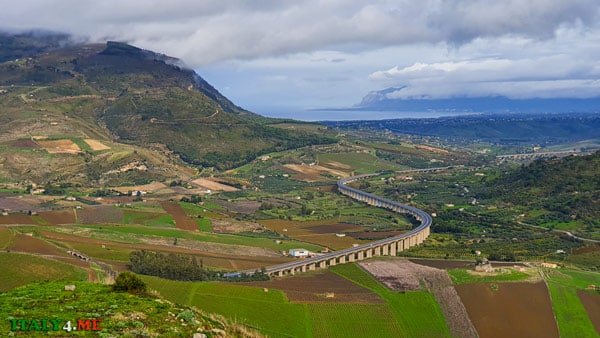
It is believed that the city was built on terraces, and its panoramic view allowed for control over the roads leading from the coast into the island. During archaeological excavations in 1967, city gates and walls, residential structures from the time of Agathocles, a 12th-century mosque, and a Norman castle were discovered.
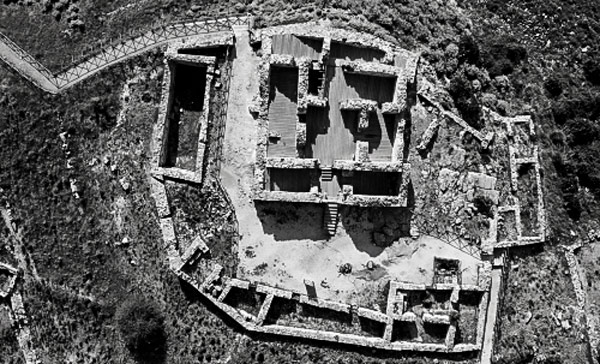
The ruins of the ancient settlement are scattered across the hill, offering a glimpse into the grandeur of the ancient city.
Doric Temple
Not far from the city ruins, set against a strikingly barren landscape, stands the ancient Doric temple of Segesta. 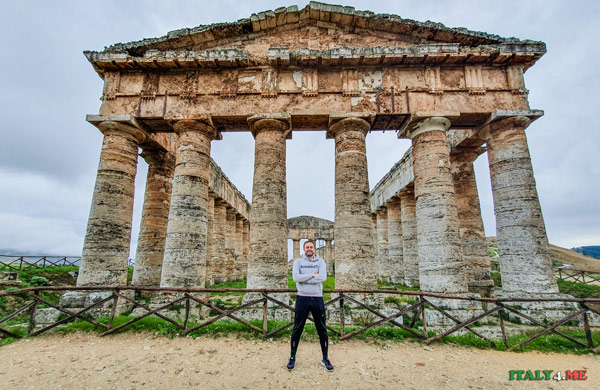
This temple was likely built in 420 BC by an unknown Greek architect and miraculously survived the Vandals’ invasion, the Saracen conquest, and the Norman occupation. Positioned on a hill, visitors must ascend an ancient staircase to reach the temple.
The temple stands on a three-tiered platform. The building’s foundation consists of an external colonnade with 36 columns. The stylobate (upper platform) measures 23.25 by 57 meters. The columns, impressive in size, are 9.36 meters high and 1.95 meters in diameter at the base, with 2.4 meters between them.
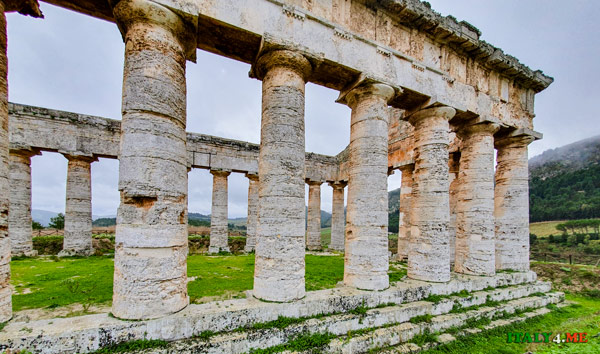
The temple has several interesting features, including a subtle curvature in its horizontal elements, creating the illusion of straight lines.
Curiously, despite the temple’s grandeur, it has never been completed or used for worship. This is evident from the lack of a roof and the absence of fluted columns, which are common in Doric architecture.
Many historians believe the temple was built to showcase Segesta’s loyalty to Greek culture rather than for religious purposes.
Greek Theater
The historical landmarks of Segesta are spread across the slopes of Monte Barbaro. To reach the Greek theater, visitors can take a bus or hike up an approximately one-kilometer path.
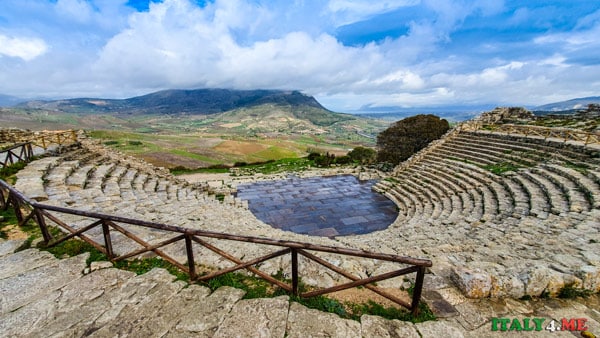
Recent research suggests that the theater was built in the second half of the 3rd century BC. The theater was carved into the hill and had a seating capacity of around 3,000 people. Although its stage has not survived, the theater’s layout follows the classical Greek design, with a circular orchestra and terraced seating.
Visitors can enjoy breathtaking views of the surrounding countryside from the theater, making it one of the most scenic ancient theaters in the world.
Before your visit, I recommend downloading the official app with an audio guide available in English, Italian, or French from www.segestatours.com.
How to Get There
The Greek Temple (Tempio di Segesta) and Theater (Teatro di Segesta) are located in the commune of Calatafimi-Segesta.
Opening hours: Daily from 9:00 AM to 5:30 PM.
By Car
The most convenient way to reach Segesta is by car, as public transportation is infrequent. You can find advice on renting a car in Sicily on en.italy4.me/road-trips/ section.
The drive from Trapani usually takes around 30-40 minutes.
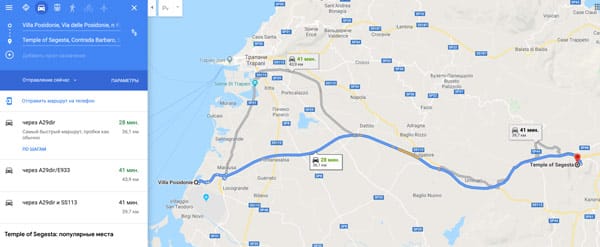
Parking for all visitors is located about one kilometer from the entrance to the archaeological park.
Parking address: Parcheggio Area Archeologica di Segesta.
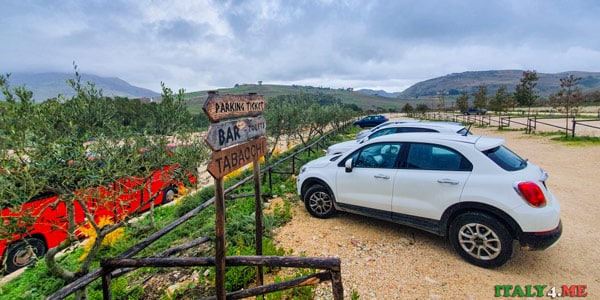
Parking fees:
- Car – €5
- Minivan – €10
- RV – €7
- Motorcycle – €3
- Bus – €30
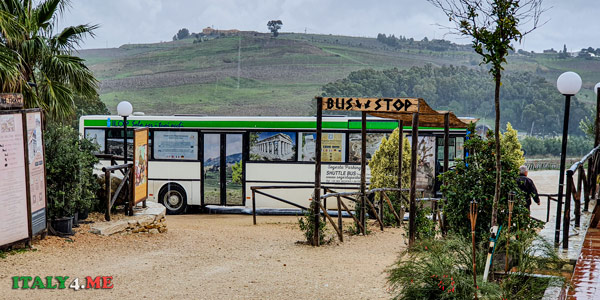
Shuttles run every 15 minutes from the parking lot to the park entrance.
By Bus
Traveling to Segesta by bus from Trapani is an adventure in itself. Although I haven’t personally tried it, it’s theoretically possible. Public transport schedules can be unpredictable.
Tarantola operates bus services between Trapani and Segesta, and the journey takes about 45 minutes. Buses depart from Autostazione Piazza Ciaccio Montalto near the train station.
The fare is €4 one-way or €6.60 round-trip.
Schedule:
- Trapani – Segesta: 08:00, 10:00, 14:00
- Segesta – Trapani: 13:10, 16:10
No buses on Sundays or holidays.
Check the current schedule on the website www.trapanistruzioniperluso.com.
Hours and Ticket Prices
- January 1 – December 28: 09:00 – 17:00
- March 1 – March 30: 09:00 – 18:30
- March 31 – September 30: 09:00 – 19:30
- October 1 – October 26: 09:00 – 18:30
- October 27 – December 31: 09:00 – 17:00
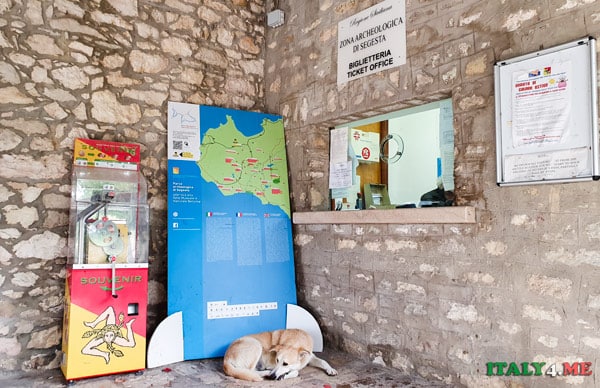
Ticket prices: €6 for adults, €3 for youth aged 18-25, free for children. Tickets can be purchased at the ticket office upon arrival from the parking lot.
You can walk up to the Greek theater or take a special bus for €1.5, which runs every 30 minutes.
Official park website: www.segestawelcome.com
In the beautiful region of Sicily, Segesta holds a prominent place as a land rich in history and tradition. The traces of Magna Graecia’s culture and the Italian flair have made this site an interesting destination for travelers seeking vivid impressions and new encounters with Italy.