 Italy for me From Italy with love

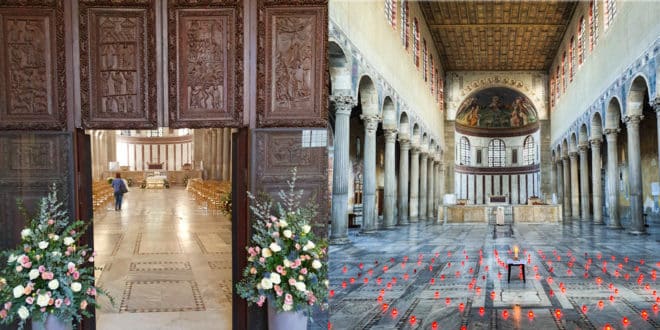
The Roman church of Santa Sabina houses a set of extraordinary wooden doors that are over 1,500 years old! This remarkable piece of Christian history is free to visit for anyone interested in the early church.
Page Contents
Who Was Saint Sabina?
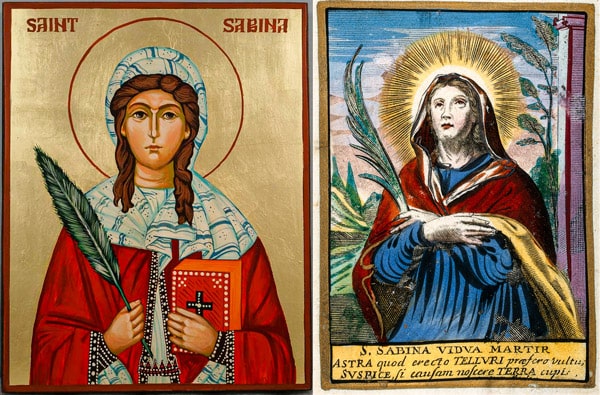
Serapia converted her mistress to the new faith, for which she was sentenced to death. Sabina could not prevent the execution; all she could do was give Serapia a proper burial according to Christian rites. The martyr’s remains (Serapia is also venerated in the Orthodox Church as Saint Seraphima of Rome) were laid to rest in the family mausoleum, where Sabina herself was also expected to be buried.
But fate had other plans: the senator’s widow was likewise condemned to death for practicing Christianity. She met a martyr’s end in the year 125, far from her native Rome, in what is now the region of Umbria.
Basilica
The basilica was constructed between 422 and 432 AD. It was likely intended from the start to be dedicated to Saint Sabina, as it was built on the site of her former home, which had been destroyed on the Aventine Hill. However, the translation of her relics and her canonization as a martyr did not take place until 430 AD. The church stands as a remarkable example of early Christian architecture and has survived in notably good condition. Over the centuries, only the interior has undergone changes, while the façade has remained untouched.
What Makes the Doors Unique?
Of particular interest are the wooden doors—marking the main entrance to the basilica. 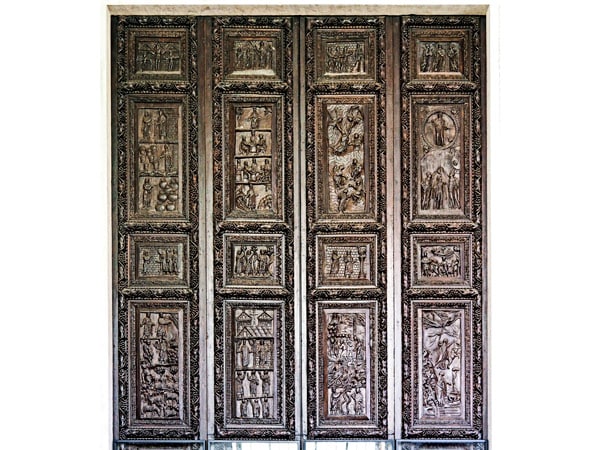
They were created in the 5th century and are among the oldest surviving examples of Christian wooden sculpture. What do they depict? Various scenes from both the Old and New Testaments. But before delving into the descriptions of these sacred narratives, a couple of clarifications are in order.
The first relates to how to interpret such works. These scenes are traditionally read like a book—from left to right and top to bottom, line by line. This approach helps piece together a coherent story.
In the case of the basilica doors, we can say with certainty that reading the panels from left to right reveals no obvious logical sequence—this might be because only eighteen of the original twenty-eight panels have survived. It is possible that a panel that once occupied the lower row was moved to a missing spot in the upper tier, leading to confusion in interpretation.
The second clarification concerns the inclusion of both Old and New Testament scenes. As mentioned earlier in the article on the mosaics of Ravenna, it was not customary in early Christian times to depict Gospel events directly.
At that time, Christian iconography had yet to fully develop, and believers often faced persecution. As a result, New Testament events were typically illustrated through Old Testament stories, leading to a rich tradition of metaphor and allegory in Christian art.
Scenes
We will explore the scenes vertically, column by column, for clarity.
First Column
The first column features the Crucifixion scene and three miracles of Jesus Christ, all framed within a single panel—healing the blind man, the multiplication of loaves, and the wedding at Cana. Below that is the story of Thomas’s doubt, followed by several scenes from the life of the prophet Moses, and the column concludes with Christ before Pilate.
The Crucifixion
The Crucifixion scene deserves special attention. For us, viewers of the 21st century, it’s a familiar and unquestioned image. But for someone in the 5th century, it was a truly extraordinary subject.
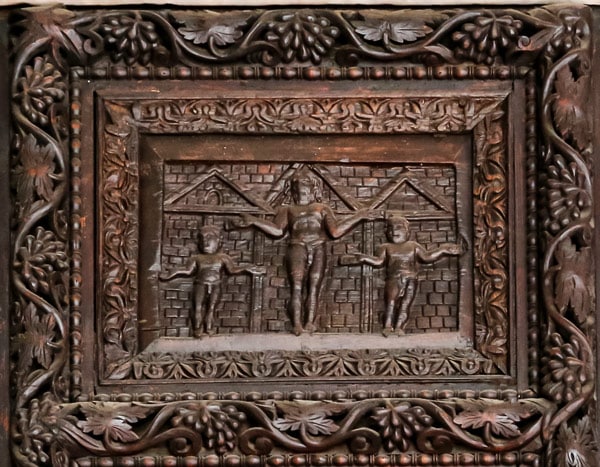
Crucifixion scenes weren’t created at that time not only because the canons for depicting Gospel events were still forming, but also because crucifixion was a common form of execution. It was only abolished in the 5th century, around the same time depictions of the Crucifixion began to spread widely in Christian art.
It’s also important to note how the Crucifixion is depicted. Christ is shown alive, with open eyes and no halo. He appears not so much nailed to the cross as hovering in front of it, his arms extended.
The image is strikingly simple. It seems to visually express the meaning of the phrase “by death He conquered death,” celebrating the triumph of eternal life. That’s why Christ is not portrayed in agony, but rather as though He is already resurrected.
Next comes the panel depicting three miracles, which is best read from bottom to top.
The Three Miracles
The Wedding at Cana was the first miracle performed by Christ.
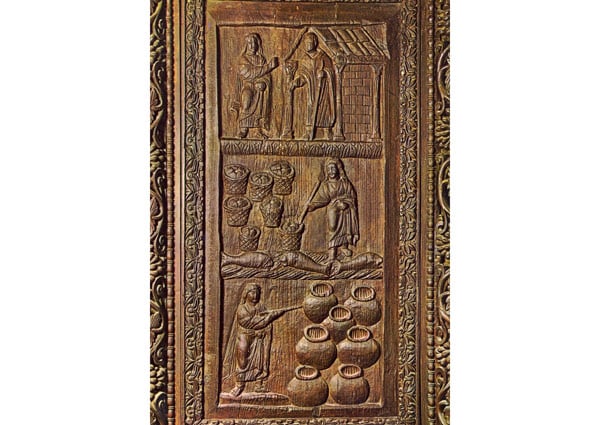
This event is described only in the Gospel of John. The Apostle tells of a wedding in the town of Cana, attended by the Virgin Mary, Jesus, and His disciples. When the newlyweds ran out of wine for their guests, Mary asked Christ to turn water into wine. In some interpretations, this transformation symbolizes the shift from Old Testament times to the New.
On the wooden panel, Christ extends His hands toward seven vessels, though John’s Gospel mentions “six stone water jars.” Perhaps the artist chose seven containers for compositional harmony with the next scene.
Immediately above Cana is the miracle of the multiplication of loaves. In Scripture, there are actually several such miracles. One, described in all four canonical Gospels, tells how five thousand people were fed with five loaves and two fish. “They all ate and were satisfied, and the disciples picked up twelve basketfuls of broken pieces of bread and fish” (Mark 6:42–43).
The reference to twelve baskets is important, as it helps distinguish this event from a similar one that occurred later.
That second miracle, mentioned only by Mark and Matthew, tells of feeding four thousand people with seven loaves and a few small fish. “They all ate and were satisfied. Afterward the disciples picked up seven basketfuls of broken pieces that were left over” (Matthew 15:37). It is this second miracle that is depicted on the doors of Santa Sabina, as Christ is shown standing next to seven baskets—and fish appear at the bottom.
At the top of the panel is the healing of the blind man, described in chapter nine of the Gospel of John. There’s nothing unusual in this depiction; in fact, the way the scene is presented here (Christ standing to the left and raising His hand toward the blind man leaning on a staff) became the model for later representations of this miracle.
The Doubting of Thomas
The Doubting of the Apostle Thomas is one of the most familiar and comprehensible narratives in Christian tradition. It is recounted only by the Evangelist John.
On the day of the Resurrection, Christ appeared to His disciples, but Thomas was not among them. When the apostles told him what had happened, he refused to believe their words.
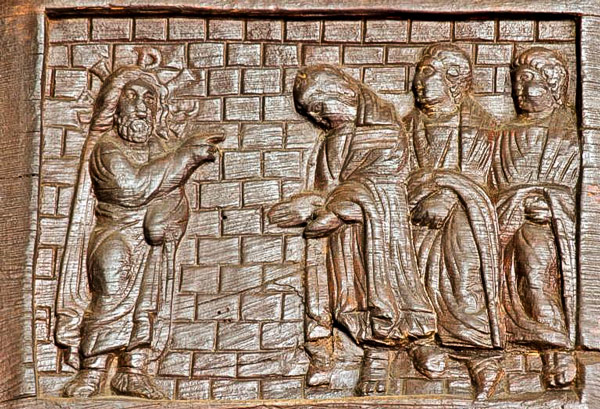
Thomas could not accept the miracle of the Resurrection without seeing Christ with his own eyes. A week later, “His disciples were again inside, and Thomas was with them,” as John the Theologian writes. Once more, the Lord appeared to them. Seeing Thomas, Christ said, “Do not be unbelieving, but believing.”
Over time, the iconography of this event has remained remarkably consistent. Every depiction includes the figure of Christ allowing Thomas to touch His wounds, so the apostle might be convinced of the truth.
Beneath the “Doubting…” panel is one featuring several Old Testament scenes, all from the life of the prophet Moses and grouped under the title “Moses on Mount Sinai.” This panel is also easier to read from bottom to top.
Moses on Sinai
A small clarification: in addition to “Mount Sinai,” the name “Horeb” also appears in reference to the location where Moses received the Ten Commandments. 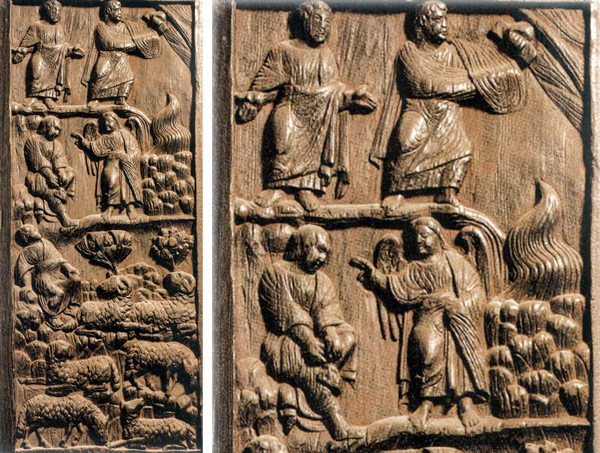
All the scenes here are a direct illustration of the beginning of chapter three of the Book of Exodus. The story tells how Moses was tending the flock of his father-in-law far out in the wilderness when he “came to the mountain of God, Horeb” (that is, Mount Sinai). Suddenly, he saw an angel calling to him from a burning bush. “He looked, and behold, the bush was burning with fire, but the bush was not consumed.” Moses could not understand why this was happening and decided to come closer.
As soon as Moses moved toward the fire, God called to him “from the midst of the bush” and said, “Do not come near here; remove your sandals from your feet, for the place on which you are standing is holy ground.” This forms the basis of the iconography. The result of this divine encounter was God’s calling Moses to lead the people of Israel out of Egypt.
Pilate Washing His Hands
The column concludes with the scene of Christ before Pilate, who washes his hands. 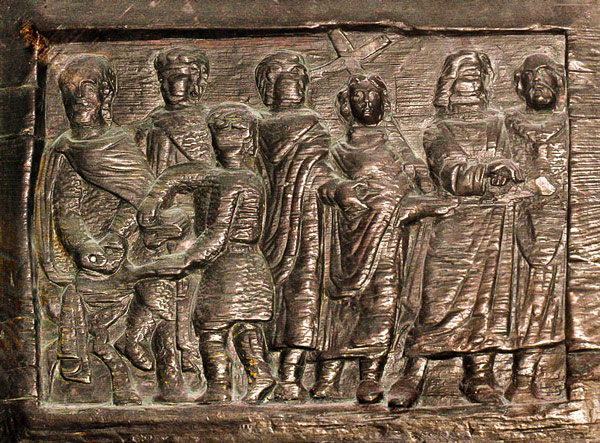
As the Evangelist Matthew writes in chapter twenty-seven, “When Pilate saw that he was accomplishing nothing, but rather that a riot was starting, he took water and washed his hands before the crowd, saying, ‘I am innocent of this man’s blood…’” In doing so, the Roman governor publicly absolved himself of responsibility.
Second Column
The second column contains only four scenes: the Myrrh-bearing Women at the Holy Sepulchre, Old Testament depictions of the Jewish people in the wilderness, the appearance of Christ to the Myrrh-bearing Women, and an ambiguous panel described in sources as a “greeting scene,” though it is unclear who is greeting whom.
The Greeting Scene
This scene is most likely tied to the parish life of the Basilica of Saint Sabina.
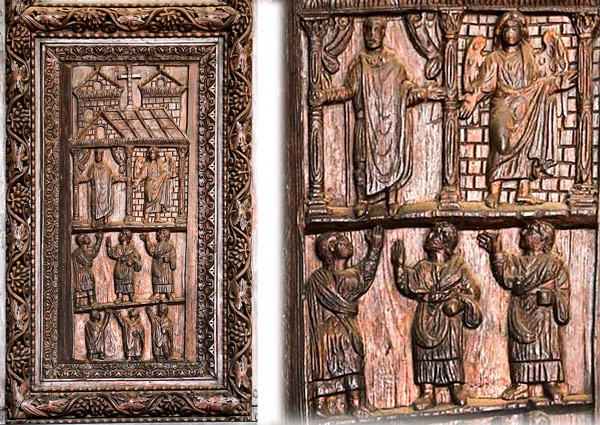
This wooden panel may have originally belonged to the lower row and was later “moved” to the upper section due to the loss of other scenes.
The scenes of the Myrrh-bearing Women at the Holy Sepulchre and Christ’s appearance to them are rooted in the Gospels. The former is described in all four Gospels, while the latter is found in Matthew, Mark, and John. Both events occur after the Resurrection.
The Myrrh-bearing Women Meet the Angel at the Holy Sepulchre
Who were the Myrrh-bearing Women? These were Christ’s followers who were the first to come to His burial cave to anoint His body with fragrant oils and mourn Him.
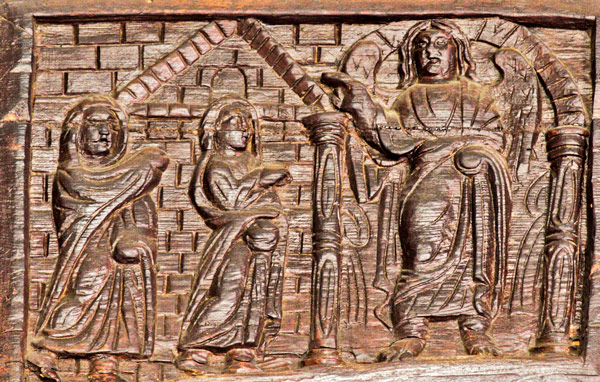
The Gospels provide their names: Mary Magdalene, Joanna, Mary of Clopas, Mary the mother of James, Susanna, Salome, and the sisters Martha and Mary (siblings of Lazarus the Four-Days-Dead); occasionally, the Virgin Mary is also included among them.
The Appearance of Christ to Mary Magdalene and “the Other Mary”
Not all of the women witnessed the Crucifixion or were present at the tomb (for instance, Martha and Mary are not mentioned in the Passion narratives). The Risen Christ appeared only to Mary Magdalene and “the other Mary,” as Matthew writes, instructing them to proclaim the miracle of the Resurrection to the apostles and to all people. Nevertheless, all the Myrrh-bearing Women are deeply venerated by the Christian Church.
The Israelites in the Wilderness
The long panel depicts scenes of the Israelites’ time in the wilderness.
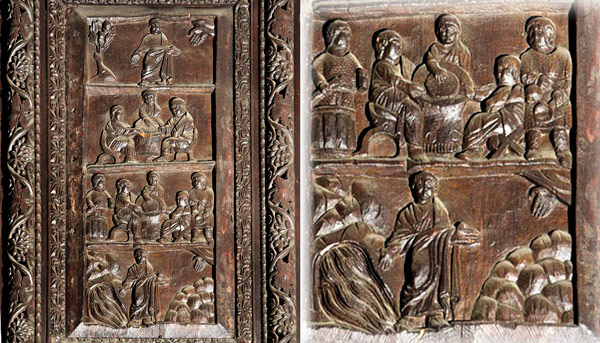
At the very top, we see Moses, and to the right, in the corner, a hand reaching from the clouds—symbolizing God. This divine gesture suggests that the scene portrays God giving Moses a command to lead the Israelites out of Egyptian slavery.
Below are depictions of events described in chapter sixteen of the Old Testament Book of Exodus.
In both scenes, the Israelites are eating food sent by God: first quail, then manna—bread “that tasted like wafers made with honey.” At the bottom of the panel, Moses, following God’s command (once again symbolized by a hand to his right), brings forth water from a rock to quench the people’s thirst.
Third Column
The third column again features four biblical scenes: the Adoration of the Magi, the Ascension of Christ, Peter’s Denial Foretold, and additional Old Testament scenes of the Israelites in the wilderness.
The Adoration of the Magi is a key event that highlights one of Christianity’s fundamental messages.
The first to learn of Christ’s birth were shepherds guarding their flocks nearby. Angels brought them the news, and the shepherds, without hesitation, went to Bethlehem to worship the Infant. Their role is straightforward—but the Magi’s story is more enigmatic. Scripture describes them as men who came from the East; in European tradition, they are seen as wise men, astrologers, or magicians.
The Adoration of the Magi
The term “magus” is the most accurate in this context, as it is the very word used in the original Greek version of the Gospel.
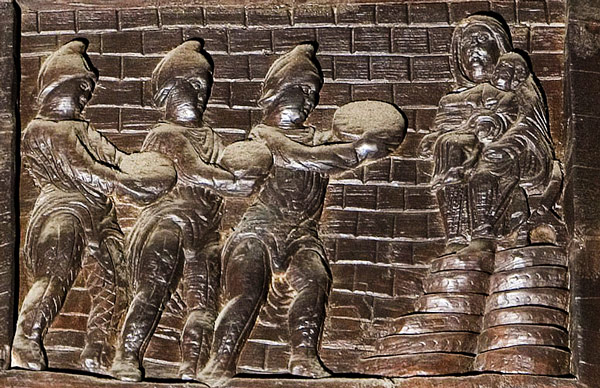
However, “magus” is a broad term—it can mean astronomer, priest, or keeper of secret knowledge. It’s natural to wonder, “Is this really about Christianity?” Without a doubt, it is. The Magi were not part of the chosen people of Israel, yet they came to worship Christ as King.
They exalted Jesus above their own knowledge, beliefs, and ethnic identity, thus opening the path to God for all humanity.
The Ascension of Christ
Next comes the scene of Christ’s Ascension—an event that followed the Resurrection.
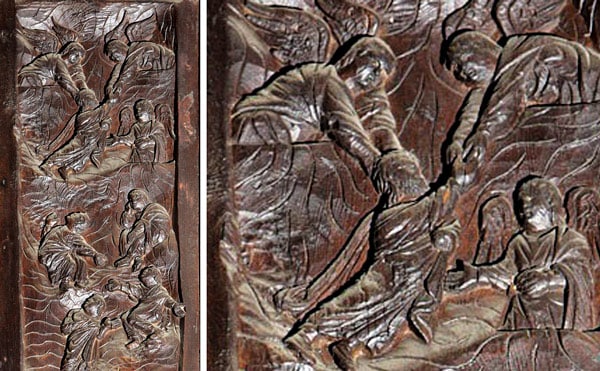
This is described by the Evangelists Mark and Luke, and also mentioned in the Acts of the Apostles. Luke writes at the end of chapter twenty-four: “And while He was blessing them, He withdrew from them and was carried up into heaven.” These words are vividly captured on the wooden panel of the basilica’s doors. We see Christ being lifted into the heavens by angels holding His hands. Below, the apostles rejoice and glorify God.
Over time, the iconography of this event evolved slightly: now Christ is often shown within a bluish sphere, symbolizing divine light. This sphere, in turn, is carried upward by angels along with Christ.
Scholars often associate the neighboring panel with the Ascension as well, but we will address that one shortly.
Christ’s condemnation to crucifixion was preceded by the Last Supper. During the meal, He said, “Truly I say to you, one of you will betray Me” (Matthew 26:21). Nearly all the apostles, including Judas, asked, “Surely not I?” The only one who did not seem to ask was Peter.
Peter’s Denial Foretold
Later, on the Mount of Olives, Peter declared that even if others doubted Christ, he never would. Christ replied, “…this very night, before the rooster crows, you will deny Me three times” (Matthew 26:35). This moment is captured on the wooden panel: the Lord is shown telling Peter of his forthcoming denial.
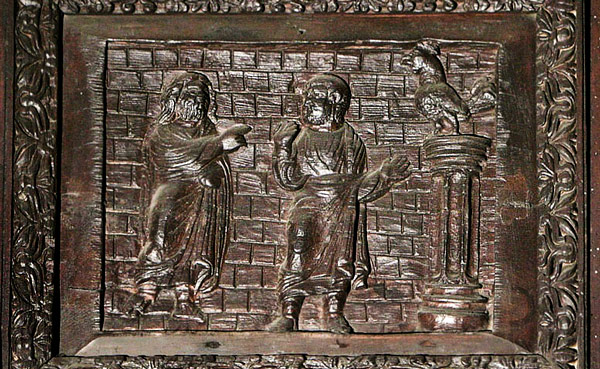
To the right, a rooster is depicted—an important detail that immediately identifies the scene.
The column ends with an Old Testament story—several episodes from the Book of Exodus. Again, it’s best read from bottom to top.
The Miracle of the Serpents, Pharaoh Perishes in the Red Sea, and the Exodus of the Israelites
The lower portion depicts the moment when Moses asks Pharaoh to release the Israelites, as commanded by God.
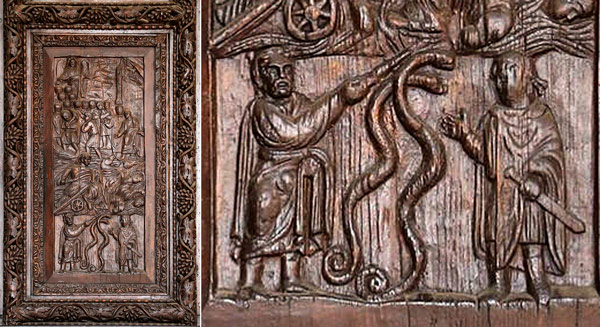
God told Moses that Pharaoh would demand a miracle as proof of divine authority. “If Pharaoh says, ‘Show a miracle,’ then you shall say to Aaron, ‘Take your staff and throw it down before Pharaoh,’ and it will become a serpent.” This is precisely what Moses and Aaron did. But it had no effect—“Pharaoh summoned wise men and sorcerers, and the magicians of Egypt did the same by their secret arts.”
Pharaoh refused to release the enslaved Israelites. As the Old Testament recounts, ten plagues were sent upon Egypt. Eventually, the Exodus took place, but Pharaoh did not give up easily: he pursued the Israelites and caught up with them at the “Sea of Reeds.”
The dramatic moment when the waters close over Pharaoh and his entire army, drowning them, is also depicted on the wooden door panel.
The panel concludes with an image of the Israelites’ procession toward the Promised Land, led by the Angel of the Lord.
Fourth Column
The fourth column once again features five scenes: Christ on the road to Emmaus, the Triumph of Christ and the Church; followed by several Old Testament events—the prophet Habakkuk being transported to the prophet Daniel, and a large panel depicting the prophet Elijah ascending to heaven in a fiery chariot. The column concludes with a New Testament scene: Christ before Caiaphas.
The Breaking of Bread (Emmaus)
Christ on the road to Emmaus is a story described only in the Gospel of Luke. It takes place after the Resurrection, when “two of them were going to a village named Emmaus, about sixty stadia from Jerusalem, and they were talking with each other about all these things” (Luke 24:13–14).
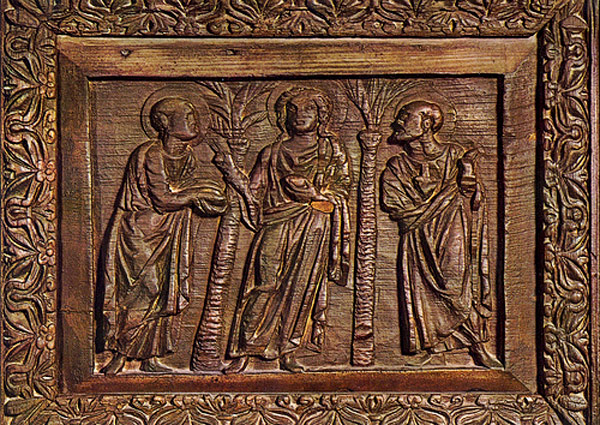
The two were Cleopas and the Evangelist Luke himself. On the road, they were joined by Christ, though “their eyes were kept from recognizing Him.” Luke and Cleopas began telling the stranger everything that had occurred in Jerusalem—Christ’s crucifixion and Resurrection. When they arrived in Emmaus, the three sat down to eat, and Jesus “took the bread, blessed and broke it, and gave it to them. Then their eyes were opened and they recognized Him.”
This very moment of Christ breaking the bread is what’s depicted on the wooden panel.
Beneath the “Emmaus” panel is the one that scholars initially mistook for the Ascension.
The Triumph of Christ and the Church
In the upper portion, within an ornamental circle, Christ is shown holding a scroll in His left hand. Beside Him are the first and last letters of the Greek alphabet—Alpha and Omega.
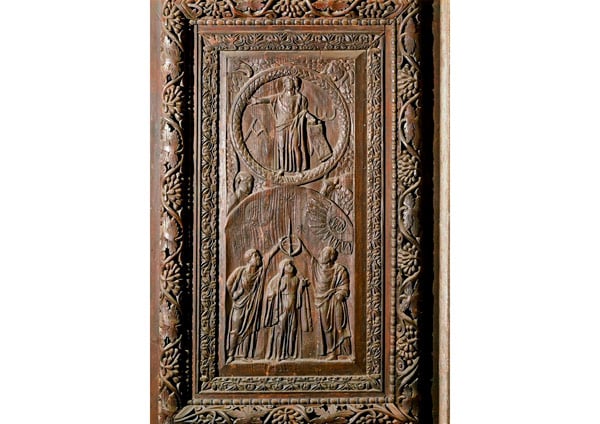
This imagery references the New Testament, specifically the Book of Revelation, where Christ says in chapter one, “I am the Alpha and the Omega, the beginning and the end.” Saint Andrew of Crete interpreted this as representing Christ’s eternal existence—He was, is, and will be.
Surrounding the sphere with Christ are the symbols of the four evangelists. Below them are three more figures. In the center is likely the Virgin Mary. Flanking her are the apostles Peter and Paul, holding a crown and a sword—symbols of victory. Above them are depictions of the moon and the sun. These celestial bodies again allude to Revelation: “And a great sign appeared in heaven: a woman clothed with the sun, with the moon under her feet, and on her head a crown of twelve stars” (Revelation 12:1). This woman is interpreted as the Church, the gathering of Christians throughout the world.
So the lower composition—with the Virgin Mary, the apostles, the crown and sword, moon and sun—represents the triumph of the Christian Church. The upper part represents the triumph of Christ.
Such iconography never became widespread. The Triumph of Christ later evolved into depictions of Christ Enthroned. The Triumph of the Church visually echoes the lower compositional structure seen in icons of the Ascension.
Habakkuk Bringing Food to the Prophet Daniel
Below the Triumph is an Old Testament scene. It tells the story of the prophet Habakkuk delivering food to the prophet Daniel.
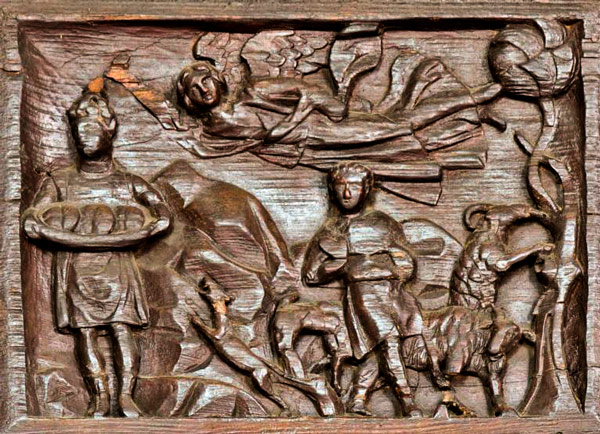
Habakkuk (on the left) is being carried by an angel to Daniel (seen at the bottom right, surrounded by lions). This scene has a rich backstory. In chapter 14 of the Book of Daniel, the prophet is living in Babylon. Though favored by the king, Daniel refuses to worship idols. After he destroys the idol Bel, the people, enraged, demand his death.
The king, unable to resist the crowd, “was forced to hand Daniel over to them, and they threw him into the lions’ den.” The lions were deliberately left unfed “so they would devour Daniel.”
At this time, the Jewish prophet Habakkuk had prepared a stew and “breaking bread into a bowl, was on his way to the field to take it to the reapers.” But suddenly an angel appeared and asked Habakkuk to take the meal to Daniel in Babylon. The prophet, surprised, responded: “Sir, I have never seen Babylon, and I don’t know where the den is.” Then the angel “took him by the crown, and carrying him by the hair of his head, set him in Babylon above the den by the power of the Spirit.”
Habakkuk gave the meal to Daniel, and was immediately returned home. This story is precisely what is depicted on the basilica’s doors: the prophet Habakkuk, carried by the angel, delivers the meal to Daniel.
Elijah Ascends to Heaven
Below is a scene depicting the prophet Elijah’s ascent to heaven.
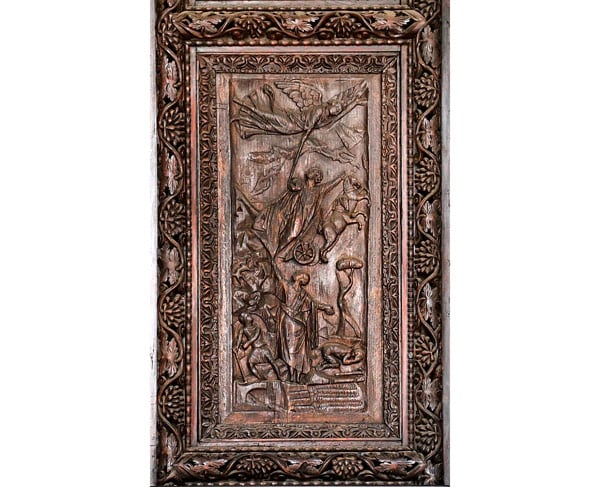
Elijah is one of the most revered saints of the Old Testament. As we know, some Gospel events—especially in early Christian times—were interpreted through the lens of the Old Testament. One of the most common parallels was drawn between the prophet Elijah and Jesus Christ.
For instance, in the town of Zarephath, Elijah resurrected the son of a widow who had helped him hide from Queen Jezebel’s persecution. “…look, your son lives. Then the woman said to Elijah, ‘Now I know that you are a man of God and that the word of the Lord in your mouth is truth’” (1 Kings 17:23–24). The Gospel of Luke also recounts this miracle, and later Christ performs a similar act, raising the widow’s son in Nain. Elijah appears again at the Transfiguration of Christ on Mount Tabor, where he and Moses speak with Jesus, bathed in divine light.
In fact, in the Gospels themselves, Christ is occasionally mistaken for Elijah. This is not surprising, as all of Israel at that time was awaiting the coming of the Messiah, and Elijah remained the most venerated prophet in Jewish tradition.
Fragment of Elijah’s Ascent
Finally, we have the depiction of Elijah ascending to heaven in a fiery chariot.
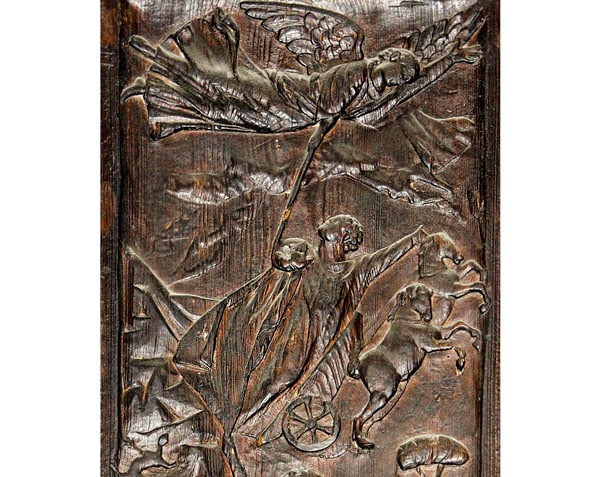
Here too, comparisons to Christ are drawn: Elijah is one of the few who ascended to heaven in bodily form.
This event is described at the beginning of 2 Kings, chapter 2. Elijah, accompanied by his disciple Elisha, traveled to the Jordan River. After striking the water with his cloak, the river parted, and both crossed on dry ground. Elijah then asked Elisha what he could do for him before he was “taken away.” Elisha requested a double portion of Elijah’s prophetic spirit. The prophet agreed, but only if Elisha witnessed his ascent to heaven. And so it happened.
As they walked on, “suddenly a chariot of fire and horses of fire appeared and separated the two of them, and Elijah went up by a whirlwind into heaven” (2 Kings 2:11).
The wooden panel captures the moment Elijah is taken up in the fiery chariot, while at the bottom, his disciple Elisha raises his hands toward the heavens.
Christ Before Caiaphas
The narrative of the fourth column concludes with a New Testament scene—Christ before Caiaphas.
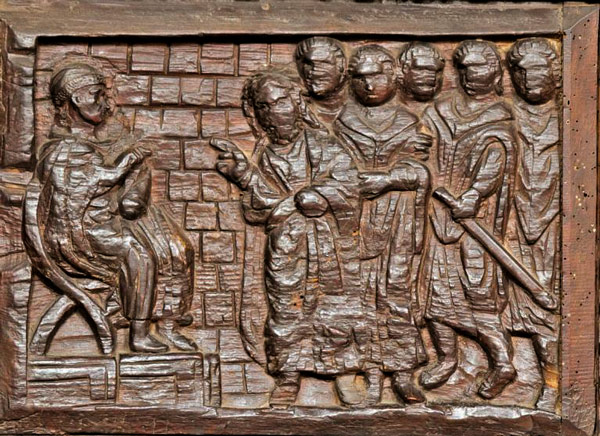
Caiaphas was the high priest; according to the Gospel of Matthew, it was in his house that the scribes and elders gathered shortly before the Jewish Passover. “They plotted together to seize Jesus by stealth and kill Him.” After Judas’s betrayal, Christ was first taken before Caiaphas, where the scourging took place. Only afterward does the Gospel recount Christ’s appearance before the Roman governor, Pontius Pilate.
Conclusion
It is reasonable to assume that the original doors of the basilica featured the entire Passion Cycle (after all, we see the Crucifixion, Peter’s Denial, and scenes of Christ before both Pilate and Caiaphas). Evidently, some panels were lost over time—perhaps there were once depictions of the Triumphal Entry into Jerusalem, the Last Supper, or Judas’s Kiss.
There are also scenes that take place after the Crucifixion (the Myrrh-bearing Women, Christ on the road to Emmaus, the Ascension). One panel depicts miracles performed by Jesus. This indicates that the doors once illustrated episodes from Christ’s life following His Baptism.
This raises the question—why include the Adoration of the Magi? Beyond the meaning already discussed, this scene carries an additional significance. The Magi, and more specifically their gifts, symbolize what lay ahead for Christ.
They brought Him gold, frankincense, and myrrh. Gold signified that the Child was born to be King; frankincense, a symbol of priesthood, foretold Christ’s role as Teacher and High Priest. Myrrh—used in Israel for embalming the dead—foreshadowed His coming death.
As for the Old Testament scenes, they appear in the Christian context not only as parallels to New Testament events. Throughout the Old Testament, we find foreshadowings of the coming of the Messiah—Jesus Christ. That’s why depictions of Old Testament prophets are common in churches, as they foretold the advent of Christianity long before its birth.
Ultimately, each scene carries a didactic message. Interpreters have long seen in the apostles and prophets reflections of all Christians—their actions, their choices. In this sense, works like the wooden doors of the Basilica of Saint Sabina serve not only as illustrations of biblical history but also as a guide for life.