 Italy for me From Italy with love

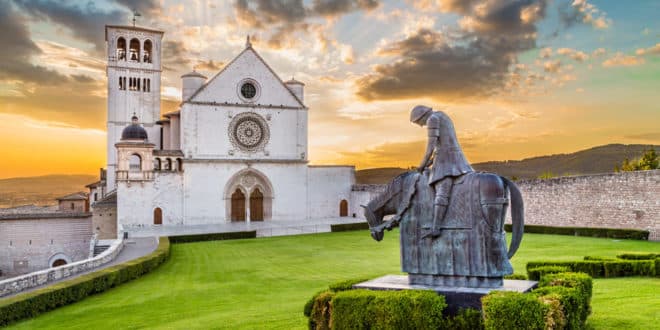
The Basilica of Saint Francis (La Basilica di San Francesco d’Assisi) in the town of Assisi is a renowned medieval structure—striking on the outside and majestic within. This dazzling white lacework church holds the status of a Major Catholic basilica and belongs to the Franciscan Order.
One of the basilica’s greatest treasures is a series of frescoes by Giotto di Bondone, depicting the life and deeds of Saint Francis.
Page Contents
Francis of Assisi (Francesco d’Assisi)
The saint for whom the basilica is named was born in Assisi in 1182 to a prosperous silk merchant. His birth name was Francesco di Pietro Bernardone.
As a young man, Francis had a lively, restless spirit that often led him on adventures. He took part in several wars between the fragmented Italian states. 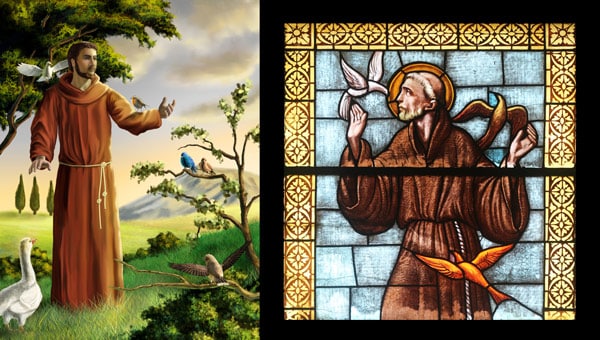
Over time, Francis began visiting Rome to pray at the tomb of Saint Peter. During one such pilgrimage, he heard a divine voice calling on him to restore God’s church. From that moment on, Francis dedicated himself to helping repair churches that had fallen into disrepair. He spent his own savings and even sold merchandise from his father’s shop. Enraged, his father tried to take him to court, which ultimately led the younger Bernardone to renounce worldly life and devote himself fully to God.
In the early 13th century, Francis was deeply moved by Christ’s words to His disciples, urging them to abandon attachment to worldly possessions and reject the pursuit of wealth, status, or material comfort. Leading by example, Francis inspired fellow friars and citizens of Assisi with his humble way of life and growing spiritual influence.
Francis himself walked barefoot, wearing only a simple robe tied with a rope.
Once, in this very state—unwashed and fresh from the road—the monk approached the Pope. The Holy Father reproached him for his uncleanliness and sent him to the pigs. Sometime later, Francis returned, “fragranced” with the scent of the sty. Just as the Pope was about to rebuke the friar again, he recognized the profound humility behind the act.
And so, the Franciscan Order—the Order of Friars Minor—was born, with a core vow of ascetic living. The Pope believed such an order would serve the Catholic Church well, encouraging modesty in both thought and action, not only among the faithful but also among clergy. Until his death, Francis remained faithful to the rule of the order, urging his followers to live in poverty and constant prayer.
History
Francis was canonized in 1226, and just two years later, construction began on the Church of San Francesco in Assisi.
The Franciscan Order received a generous gift from the city’s nobles—land atop a rocky cliff overlooking the Tescio Valley. Locals had long called this high ground the “Hill of Hell” (Collo d’Inferno) as it was often used for executions. The Friars Minor, in stark contrast to that legacy, renamed it the “Hill of Paradise.”
By 1230, the basilica’s first level, known as the Lower Church, was completed. This level is set into the hillside and hidden from view by the monastery buildings and the church’s upper tier. Construction of the Upper Church continued between 1239 and 1253.
While the Lower Church features a somber, ascetic style typical of crypts and catacombs, the Upper Church dazzles with vibrant frescoes by some of the greatest medieval painters: Giotto, Simone Martini, Cimabue, and Pietro Lorenzetti.
Architecture
The Church of San Francesco is designed as a classic single-nave basilica with a T-shaped layout. 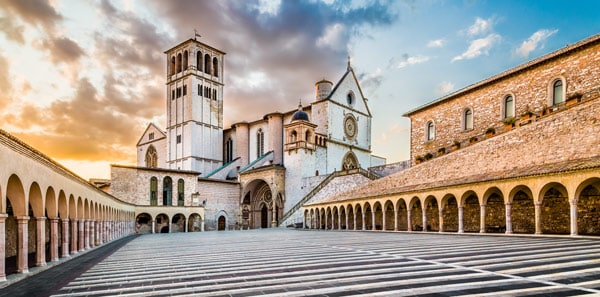
At the very bottom lies the crypt containing the remains of Saint Francis. Above it sits the Lower Church, and crowning the structure is the magnificent Upper Church. Entry terraces lead to both the upper and lower levels.
Crypt
The entrance to the tomb of Saint Francis is located in the nave of the Lower Church. The stone burial chamber lies beneath the central altar. Carved into the crypt walls are four niches containing the remains of the saint’s disciples: Angelo Tancredi, Masseo, Rufino, and Leone. A subterranean passage leads to the crypt, which was closed to the public for many years but has since been reopened.
The crypt itself remains modestly adorned, reflecting renovations made in 1932. Earlier attempts to give it a more elaborate appearance were eventually abandoned, as they contradicted the Franciscan ideals of poverty and simplicity.
Lower Church
The Lower Church took on its well-preserved appearance in the 1270s. Its underground layout includes a central nave surrounded by chapels. The nave was painted by an artist known today as the Master of Saint Francis. He created ten frescoes—five depicting Christ’s Passion and five illustrating the life of Saint Francis. The vaulted ceiling of the nave is truly mesmerizing, painted deep blue and studded with shimmering golden stars.
Chapel of Saint Martin
This chapel, dedicated to the early Christian bishop Martin of Tours (Latin: Martinus), who lived in the 4th century AD, was entrusted to the care of Simone Martini. Between 1317 and 1319, Martini painted a series of frescoes illustrating the miracles of Saint Martin, as well as four scenes depicting royal figures accompanied by saints.
Chapel of Mary Magdalene
The inspiration behind this chapel is credited to Theobald Pontano, the bishop of Assisi. Built in the early 14th century, its main treasures are six frescoes by Giotto. These panels show Mary Magdalene at the Resurrection, the raising of Lazarus, and in conversation with Bishop Pontano.
The most dramatic of the scenes is “Noli me tangere” (“Do not touch me”), where the risen Christ forbids contact, while Magdalene’s expression reveals anguish and disbelief.
Transept
The crossbar of the T-shaped Lower Church was decorated over time by several hands: an unknown Master of Saint Nicholas, Giotto and his followers, and Cimabue, all contributing during the 13th and 14th centuries. The frescoes depict the Nativity, Jesus’ early life, the Flight into Egypt, and the Crucifixion. Of special note is Cimabue’s “Madonna with Saint Francis,” widely regarded as one of his finest works.
Another key contributor to the church’s decoration was Pietro Lorenzetti. His frescoes can be seen in the south arm of the transept. Dated to 1320, the series—known as the Passion Cycle—portrays the suffering and execution of Christ with Lorenzetti’s signature expressiveness. The Crucifixion scene stands out for its emotional depth, masterful color use, and detailed expressions.
Chapel of John the Baptist
This small chapel adjoining the transept is famous for Lorenzetti’s fresco “Madonna dei Tramonti.” The image of the Madonna and Child is painted on a wall opposite a window. As the sun sets, the fresco glows with golden light, earning it the nickname “Madonna of the Sunset.”
Apse
The apse of the Lower Church is adorned with the main altar, carved from a single block of marble. The papal altar is surrounded by pointed Gothic arches. Wooden choir stalls were added in the 15th century, while the original frescoes decorating the vaults were badly damaged in the 17th century.
Despite the damage, the vault’s four ribs still display the “Heavenly Vault” frescoes. These ceiling wedges feature allegorical images of Chastity, Obedience, and Poverty. These three virtues were central to Saint Francis, who appears on the fourth wedge. The artwork is attributed to either Giotto or his pupil, known as the Master of the Vaults.
Upper Church
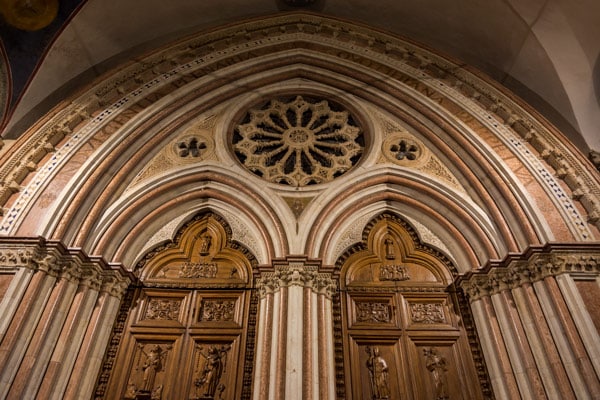
The interior of the Upper Church beautifully blends Gothic architecture with a wealth of frescoes adorning its walls and ceilings.
Rows of stained-glass windows allow natural light to flood the basilica, breathing life into the biblical imagery.
The Franciscan Cycle – Frescoes by Giotto di Bondone
The most ambitious decorative project in the Basilica of Saint Francis is the cycle of 25 frescoes created by Giotto and his assistants.
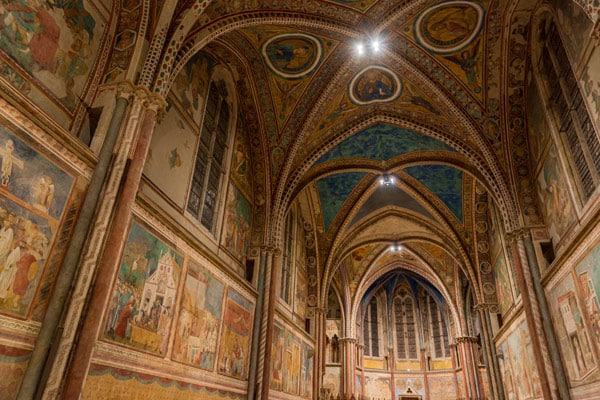
These New Testament scenes appeared gradually on the walls and ceilings of the basilica. Giotto began work in 1282 as a young apprentice to Cimabue. At just 25 years old, he breathed life into the long nave with his vivid and emotional frescoes.
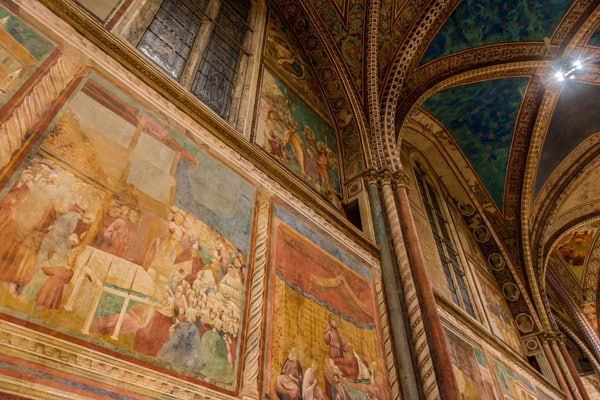
Inspiration for the frescoes came not only from the Bible but also from “Legenda Maior,” a biography of Saint Francis of Assisi. Scholars and visitors alike admire the extraordinary beauty and detail in Giotto’s work.
The young artist revolutionized fresco painting—developing new pigments and working directly on wet plaster. He rejected flat perspectives, breaking free from the two-dimensional norms of the era.
Giotto’s frescoes are known for their vibrant color and accessible narratives that continue to captivate visitors. Historians note that the scenes include real locations in medieval Assisi and portray people who likely existed.
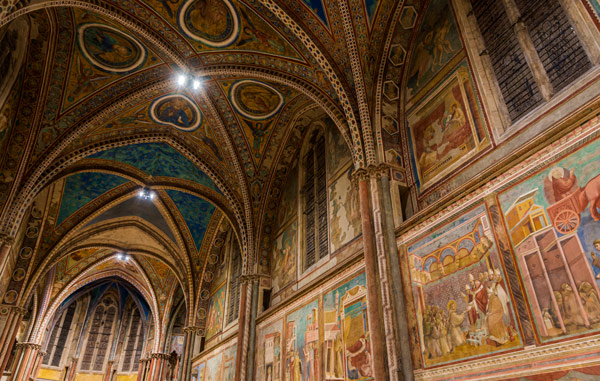
In the 1290s, Giotto and his workshop completed most of the Franciscan-themed frescoes. Giotto himself focused on key figures and also painted the wall and ceiling above the church’s entrance, depicting the Ascension of Christ and the Descent of the Holy Spirit.
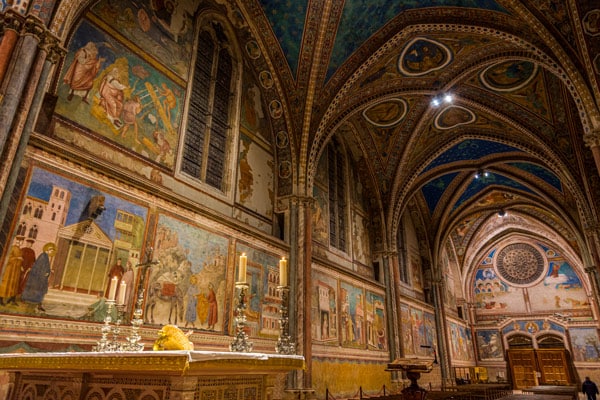
Vault of the Fathers
Around the year 1300, Giotto undertook the decoration of the church’s vault, painting the four Fathers of the Church: Gregory, Jerome, Augustine, and Ambrose. The saints are depicted with their assistants, engaged in various church duties. The artist’s love for fine detail and realistic rendering of surrounding objects is especially striking.
Transept
Most of the western transept is adorned with frescoes by Cimabue, created during the 1280s. The artist produced four large compositions using lead-rich pigments. Over time, the colors darkened, and the frescoes lost much of their original cohesion.
Nave
The Upper Church once featured a nave decorated with a cycle of 32 frescoes illustrating scenes from both the Old and New Testaments. These expansive works were painted by renowned church artists Jacopo Torriti and Pietro Cavallini. A powerful earthquake in 1997 damaged the Basilica of San Francesco in Assisi, resulting in the loss of many medieval masterpieces.
Bell Tower
On the southern side of the basilica stands a bell tower, approximately 200 feet (60 meters) tall, built in 1239. 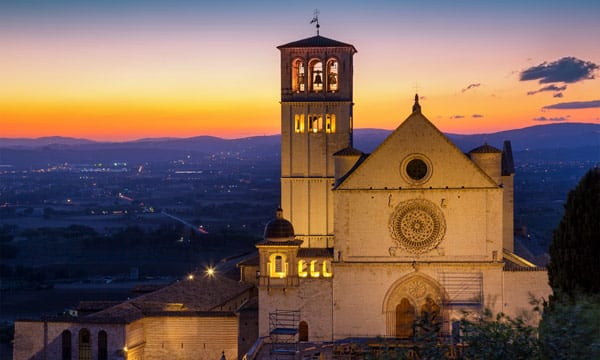
The white tower is crowned with an open belfry adorned with arches. Inside hang seven bells, the largest of which weighs over 112,000 pounds (51 tons) and is named in honor of Francis.
All the bells are electrically operated, as even the smallest weighs nearly 9,000 pounds (4 tons). The mighty chimes of the Basilica of San Francesco echo across Assisi, calling the faithful from even the most distant corners of the city.
Visitor Information
Address: Piazza S. Francesco, 2
Assisi is so compact that finding your way to the Basilica of Saint Francis is remarkably easy.
- Opening hours: 7:00 AM – 6:30 PM
- Admission: Free
- Photography and video recording are prohibited.