 Italy for me From Italy with love


Etna is the hottest spot in Sicily—and possibly all of Italy. Today, it is the highest active volcano in Europe. If you’re wondering where Mount Etna is located, it’s easy to find on the island’s eastern coast, nestled between the cities of Catania and Messina. Lava and ash eruptions regularly burst from its 3-kilometer-wide crater. During quieter times, Etna simply “puffs” white smoke into the bright blue Italian sky, as if from an invisible chimney.
Page Contents
History
In scientific terms, Etna is classified as a “stratovolcano.” The Latin word “stratum” means “layer,” referring to Etna’s stratified structure. In practice, this means its cone is built from numerous layers of solidified lava, volcanic ash, and other lighter materials from past eruptions.
Repeated eruptions help shape the volcano’s distinct conical form while also constantly altering its height.
Etna is a geological giant that began forming about 500,000 years ago. The United Nations has even named it a “Decade Volcano” due to its frequent and intense activity. The eruptions are caused by the collision of two tectonic plates: the African plate is slowly subducting beneath the Eurasian plate. This centuries-old geological process has blessed Sicily with its dramatic mountainous terrain and its ever-awake volcano.
Eruptions
On May 31, 2019, Etna erupted once again—watch the video below:
Throughout its lengthy history, Etna’s shape and structure have changed countless times. There is evidence of significant damage to its crater dating back some 6,000 years.
Today, Mount Etna covers 483 square miles (1,250 km2) of land, and its height reaches 3.33 km (10,925 ft), making it the largest active volcano on the European continent.
Etna has erupted more than 200 times in recorded history. One of the most powerful eruptions occurred in October 2013. Visitors and locals alike will also remember August 2014, when a smaller but highly visual eruption lit up the summer night sky with dazzling sound and light effects.
Name
Mount Etna holds deep roots in Greek mythology. According to one legend, the warrior goddess Athena trapped the giant Enceladus beneath the mountain. From time to time, the imprisoned giant tries to escape, sending fiery breath through the volcano’s cone. The name “Etna” comes from a nymph (Αἴτνη) believed to dwell at the mountain’s base.
Other myths claim rebellious giants who once challenged the gods of Olympus are imprisoned within the volcano, and their fury sparks the eruptions. The ancient Greeks even believed Etna’s crater served as a forge for Hephaestus, god of fire and blacksmithing.
In addition to its ancient name, Etna is also known by its Sicilian name, Muncibeddu, and to Italians as Mongibello. The latter blends the Arabic word “gibel” and the Latin “mons,” both meaning “mountain.” Arabs also simply referred to it as the “Mountain of Fire.”
Modern Life
Throughout the 21st century, Etna has unleashed lava flows so intense they’ve darkened the sky for days at a time. In 2011, the volcano forced the temporary closure of the Catania-Fontanarossa Airport twice. Yet despite its fiery temperament, the volcano enriches surrounding soils with minerals and nutrients.
Its slopes support flourishing gardens and crops, including olives, pomegranates, citrus fruits, and bay laurel. Remarkably, Etna is also home to celebrated vineyards. Vines that grow in this volcanic soil produce wines with an intense, distinctive flavor.
Most farmland is located on terraces between 1,600 and 4,300 feet (500–1,300 m), known as the “cultivated region” (regione coltivata). Above that, extending up to 7,200 feet (2,200 m), lies the “forested region” (regione boscosa), where birch, oak, beech, and larch trees grow. The summit area has sparse vegetation due to the extreme conditions and lack of water, earning it the name “desert region” (regione deserta).
Etna’s surreal landscapes combine black lava fields with lush forests and otherworldly craters. You can circle the volcano aboard the narrow-gauge Circumetnea Railway (Circumetnea). This charming train route travels from Catania Borgo station to Riposto, tracing a scenic loop around Italy’s mightiest volcano.
Tourist Routes and Excursions
Mount Etna’s exact geographical coordinates are: latitude 37°45′18″ N and longitude 14°59′43″ E.
That’s useful information for hikers with GPS devices and full climbing gear. For everyone else, there are three well-established routes that make it possible to reach the volcano’s summit.
Southern Route
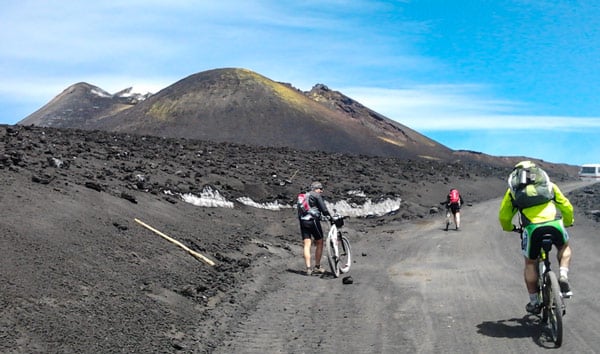
The starting point for the Southern Route (Etna Sud) is in Catania. From the city, a daily bus runs to the town of Nicolosi, located right at the foot of the volcano. To ascend to 8,366 feet (2,550 meters), a cable car system is in place, connecting the tourist stations of Rifugio Sapienza and La Montagnola.
The trip costs approximately €90. For updated pricing and details, visit: www.etnatracking.com/it/rifugio-sapienza.
To reach the summit, you can hike or opt for a thrilling off-road jeep ride—an exciting alternative to the cable car.
Car rentals at Catania Airport start at just €50 per day. Find the best value using the auto.italy4.me service.
Eastern Route
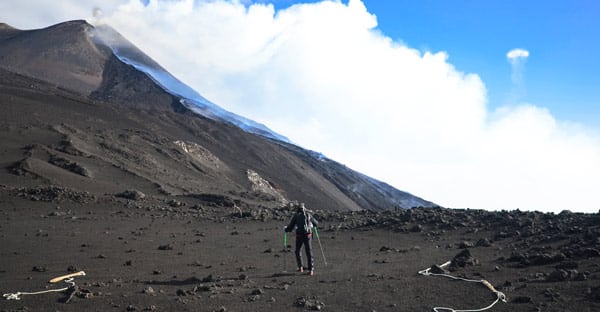
The Eastern Route (Etna Est) passes through the quaint town of Zafferana Etnea, a hub for tourists and winter sports enthusiasts. The Eastern and Southern routes merge at 6,230 feet (1,900 meters) at Rifugio Sapienza. Etna offers around 10 kilometers of ski runs—though only 1 km is marked as “easy.” A 700-meter vertical drop provides a great setup for adventurous descents.
Northern Route
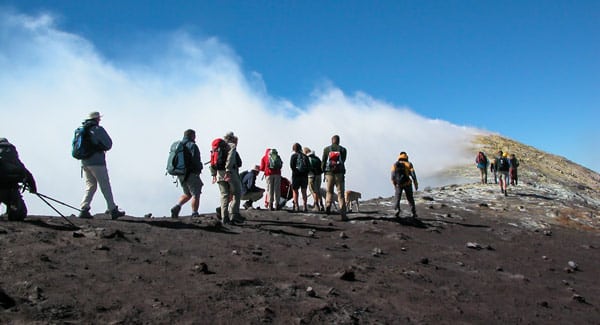
The Northern Route (Etna Nord) is more rugged and less tourist-friendly than the Southern path. A winding mountain road leads travelers through the villages of Piedimonte Etneo and Linguaglossa to the tourist base at Piano Provenzana. This side of the volcano paints a vivid picture of a dormant giant, with sunken craters and scorched earth. Walks through these “Martian” landscapes gradually transition into verdant forest zones.
Of course, the most unforgettable highlight of visiting Etna is the view from the top. From several kilometers above sea level, the Catania Valley spreads out like a map. The winding coastline, vibrant greenery, and terracotta rooftops create a kaleidoscope of color. As you take in the beauty of Sicily, don’t forget to fill your lungs with the crisp mountain air!