 Italy for me From Italy with love

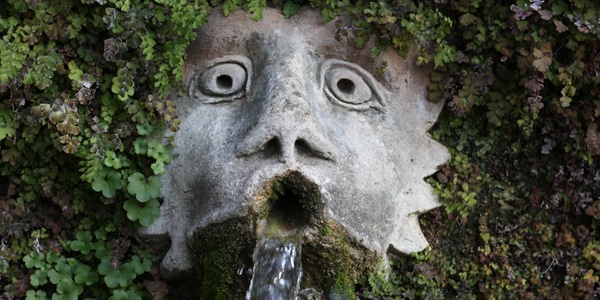
Villa d’Este is located in the town of Tivoli, just 15 miles (24 km) northeast of Rome. Once a simple monastery, it was transformed over several decades by master craftsmen into a true architectural masterpiece. With its breathtaking gardens, countless fountains, grottos, and reflecting pools, it is considered not only the top attraction in Tivoli but one of the most beautiful sites in all of Italy.
Page Contents
History
Villa d’Este belonged to Cardinal Ippolito II d’Este, who, after being pushed aside from the papal seat by Julius III, was sent to Tivoli as governor.
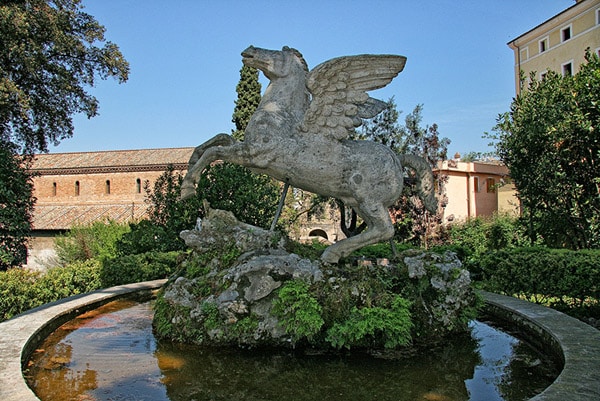
A true patron of the arts, Ippolito II was unimpressed by the modest residence he inherited. The former monks’ quarters seemed dull and colorless to a sybarite accustomed to luxury. He decided to transform the space by creating a park of unmatched beauty around the estate.
The design phase began in 1550, but the final plan was only approved by the cardinal ten years later. The project was led by Pirro Ligorio—a renowned architect who had previously served the papal court and worked on masterpieces such as the Sacred Grove of Bomarzo (Parco dei Mostri) and the Papal Palace in the Vatican (Casino di Pio IV in Vaticano). Still, Villa d’Este remains his greatest achievement.
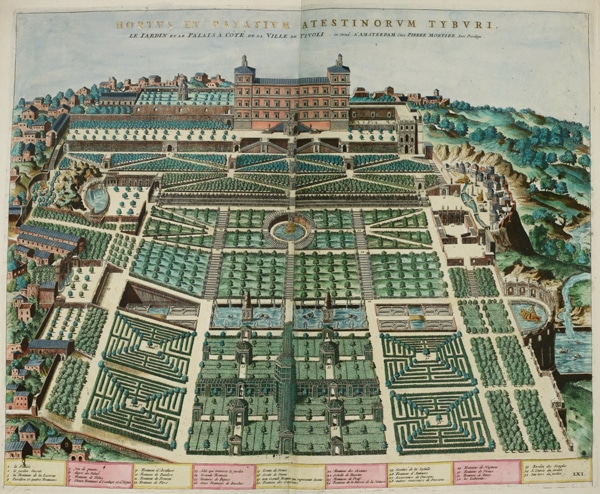
The lavish interior and exterior were designed to emphasize the villa’s status as a cultural hub, ideal for hosting gatherings of artists and intellectuals. Interior decoration began in 1563 and was nearly complete by the time of the cardinal’s death in 1572.
In 1605, the gardens were further enhanced by Ippolito’s successor, Alessandro d’Este, who brought in the great architect Gian Lorenzo Bernini. However, by the 18th century, the villa fell into disrepair due to neglect. The hydraulic system that powered the fountains became outdated, statues and structures deteriorated, and the once-immaculate park lost its luster.

The estate passed into the hands of Franz of Habsburg (Franz Habsburger), and shortly before World War I, it became the property of Archduke Franz Ferdinand (Franz Ferdinand). After the war, the villa was nationalized by the Italian government. The most recent restoration took place after the end of World War II.
What to See?
The main entrance to Villa d’Este leads visitors directly into the former cardinal’s apartments, specially designed for Ippolito II. These rooms still preserve exquisite frescoes and stucco work, capturing the timeless elegance of Renaissance style.
Like all architectural masterpieces from the Renaissance era, the garden at Villa d’Este carries a deeper philosophical and political message. At its heart stands a statue of Hercules—believed in some legends to be the mythical ancestor of the d’Este family. From this statue, two paths diverge: one symbolically leads to virtue, the other to vice. Nearby, a statue of the goddess Venus reflects a similar allegory—offering a choice between earthly love and divine love.
Because Ippolito II was denied the papacy, he commissioned his architects to create a miniature version of Rome in the garden, featuring symbolic representations of the Eternal City’s most iconic landmarks. The villa’s main entrance also impresses with its design: a semi-circular loggia flanked by staircases. The central arch is adorned with fountains and leads down into a beautifully designed grotto.
Fountains
The greatest treasure of Villa d’Este is its fountains, which cast a near-magical spell over everyone who enters their domain.
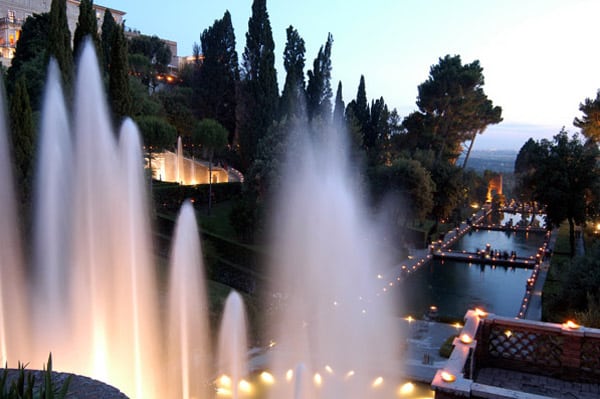
To bring life to Ippolito II’s grand garden, a vast hydraulic system was created—cascades, canals, pools, and fountains, each crafted not only for function but also for beauty.
Today, the villa features over 500 fountains, each one intentionally designed with artistic and philosophical meaning.
Fountain of Neptune (Fontana di Nettuno)
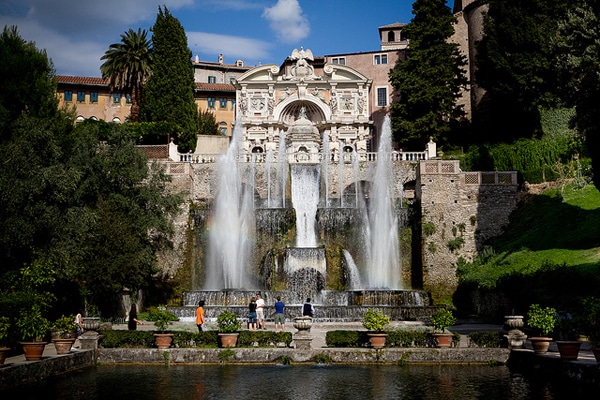
The Fountain of Neptune was built later than the others—in 1927—but fits perfectly within the overall harmony of the park. It marks the beginning of a series of rectangular pools, often called fishponds, which are still used today for breeding fish. This area also forms the central axis of the garden.
Fountain of the Bicchierone (Fontana del Bicchierone)
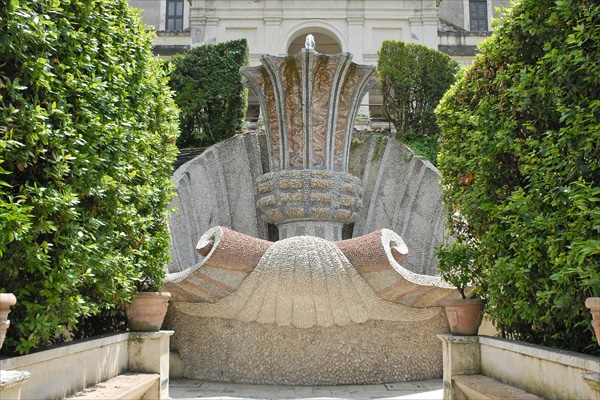
The Fountain of the Bicchierone resembles a large goblet resting inside a giant seashell. Built about a century after the main construction, this fountain is the work of renowned sculptor Gian Lorenzo Bernini.
Fountain of Rometta (La Rometta)
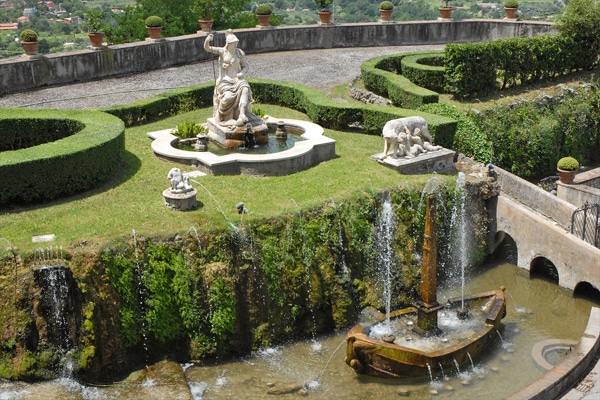
“La Rometta” translates as “Little Rome.” At its center stands a statue of Victorious Roma, with the legendary she-wolf nursing Romulus and Remus positioned just below. The fountain is surrounded by stylized Roman elements such as arches, obelisks, and columns—symbolizing the grandeur of ancient Rome.
Alley of One Hundred Fountains (Le Cento Fontane)
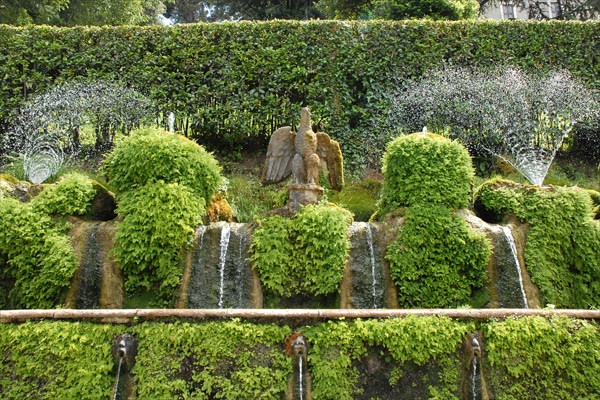
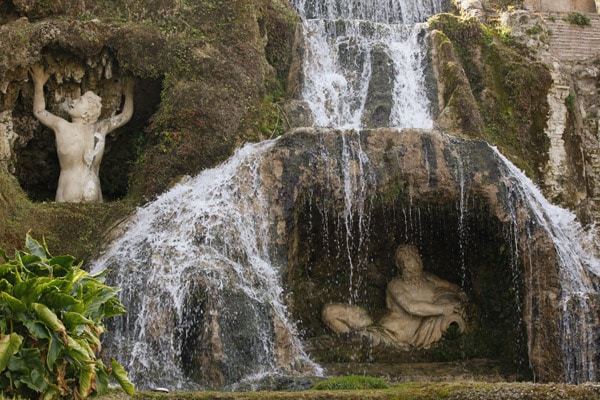
The Alley of 100 Fountains has an enchanting, almost hypnotic quality. Along the path, small fan-shaped fountains alternate with cascading water walls covered in lush green moss. To reach this magical walkway, visitors pass the famous Fountain of the Dragons.
Fountain of the Dragons (Fontana dei Draghi)
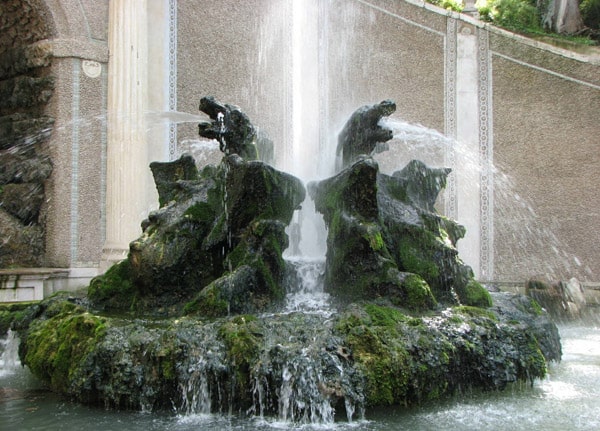
The Fountain of the Dragons features four dragons positioned back-to-back, their fierce faces spewing jets of water outward toward visitors.
Organ Fountain (Fontana dell’Organo)
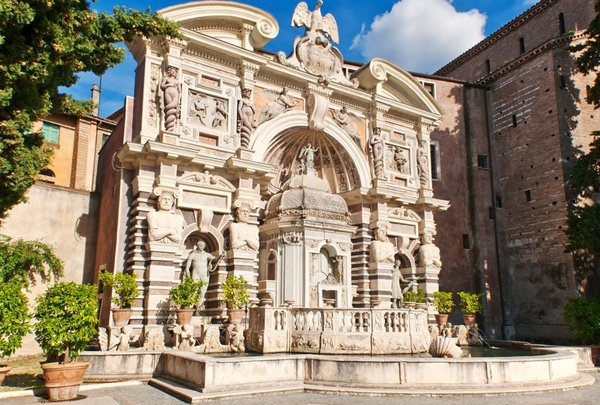
The Organ Fountain is a true marvel of hydraulic engineering. Its ingenious design allows cascading water to generate harmonious music through a system of organ pipes. For a time, the fountain fell silent due to mineral buildup inside the tubes. Thankfully, British specialists restored its function, and now the fountain plays again.
How to Get There
The best way to reach Villa d’Este is from Rome.
Buses depart regularly from the station next to the Ponte Mammolo metro station. Buses run every 30 minutes, and tickets cost €3. The bus takes you to Tivoli’s main square—Piazza Cimitero. From there, it’s a short walk to the villa, located at Piazza Trento, 5.
You can also take a train from Roma Tiburtina station to Tivoli. Be careful not to confuse the stop with Bagni di Tivoli, which is a few stations before your destination. Once in Tivoli, finding the villa is easy—just follow the signs.
- Step-by-step guide: how to get to Tivoli from Rome for €3
Opening Hours
From May to August, Villa d’Este is open from 8:30 AM to 7:45 PM. During the rest of the year, opening time remains 8:30 AM, but closing time varies with daylight hours. Closed on Mondays.
Allow at least two hours to explore the villa and gardens at a relaxed pace. Some fountains operate on a schedule. For example, the Organ Fountain begins playing at 10:30 AM and then activates every two hours. Be sure to plan your visit—and your return trip—accordingly.
- Admission: €15 regular, €8 reduced. Special exhibitions and events may increase the price to €10–11.