 Italy for me From Italy with love

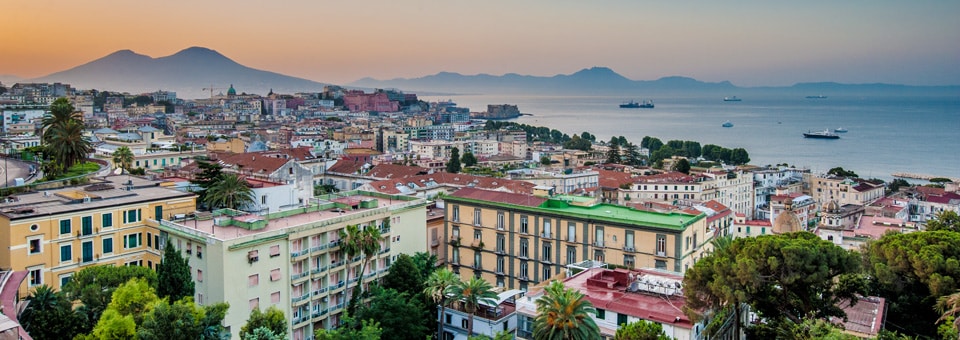
Naples (translated from ancient Greek as “new city”) is a city in southern Italy, located on the shores of the eponymous bay of the Tyrrhenian Sea. Naples is the administrative center of the Campania region and is the third-largest city in Italy after Rome and Milan.
The city has a population of about one million, and together with its suburbs, it reaches three million residents. Naples is home to an international airport (Aeroporto di Napoli Capodichino) and a seaport. Relative to Rome, Naples is situated 137 miles (220 km) to the southeast.
Naples was founded by ancient Greeks in the 8th century BC and was originally known as Parthenope. In 327 BC, the city was conquered by the Romans and remained part of the Roman Republic and later the Roman Empire for many years.
By the 6th century, the city came under Byzantine control. From the 7th to the 12th century, Naples served as the capital of the virtually independent Duchy of Naples. In 1139, Naples became part of the Kingdom of Sicily, and in 1266, it became its capital. The University of Naples was established in 1224. By the 17th century, Naples had become the second-largest city in Europe after Paris, with a population reaching 300,000. In 1860, the city became part of the Kingdom of Italy.
See the guide: how to get from Rome to Naples
Naples is home to the Stadio San Paolo, which serves as the home ground for the Napoli football club, the strongest team in southern Italy. Napoli was founded in 1926 and, over its nearly century-long history, has won the Italian championship twice, claimed the Coppa Italia four times, and secured one UEFA Cup victory. 
In 1984, Napoli’s president signed a contract with the famous Diego Maradona. Barcelona received $12 million for the Argentine star, setting a record for a football transfer at the time. In 1990, Maradona was suspended for 15 months after a doping test revealed cocaine use.
Page Contents
What to See and Where to Go
For centuries, Naples has been influenced by the cultures of various nations, and the city’s landmarks are vivid evidence of this rich history. Below is a description of the main attractions.
Castel dell’Ovo (Egg Castle)
One of the city’s top attractions is the Castel dell’Ovo (Egg Castle). The fortress stands on the small island of Megaride in southern Naples. According to legend, the poet Virgil enchanted an egg, placed it in an amphora, sealed it in an iron cage, buried it, and built the castle above it. 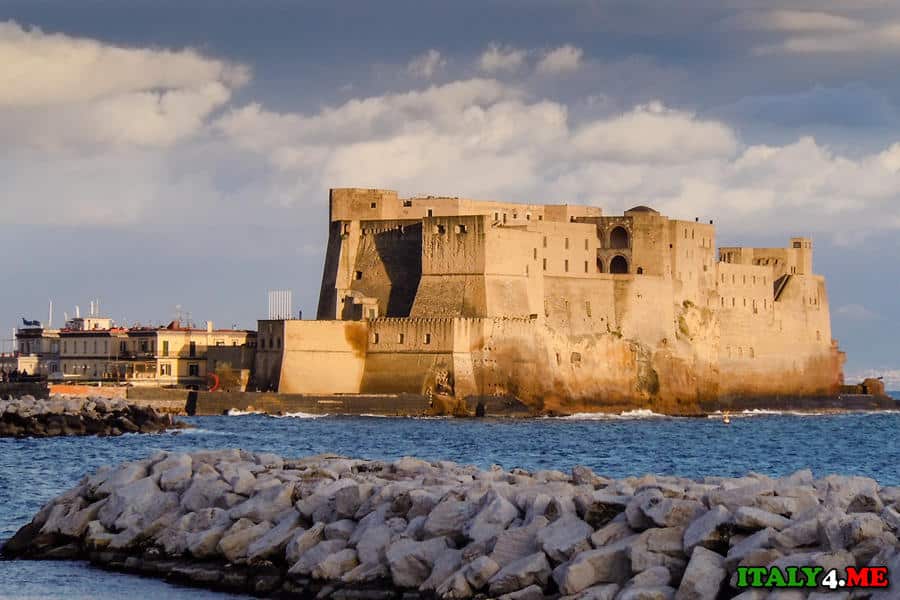 According to Virgil’s claim, neither the castle nor the city could be destroyed as long as the egg remained intact. This legend gave the castle its name. The fortress itself is a collection of towers from various eras that have been integrated into a single complex.
The existing castle was built in 1139 to protect Naples from seaborne threats. At one time, it even housed a royal court. In the 17th century, the castle became a prison. Today, it is open daily for guided tours from 8:00 AM to 7:00 PM on weekdays and from 8:00 AM to 2:00 PM on weekends.
Castel Nuovo (New Castle)
Another fascinating fortress is the Castel Nuovo (New Castle). The fortress is also known as Maschio Angioino (Angevin Keep). After the capital of the Kingdom of Sicily was moved from Palermo to Naples, Charles of Anjou decided to build a residence for the royal court.
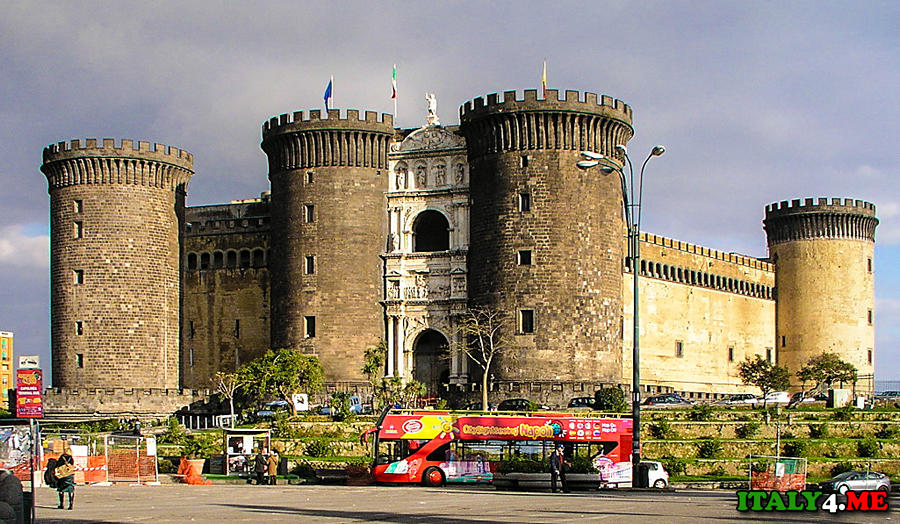
Construction began in 1279 and lasted five years. Castel Nuovo features a trapezoidal fortress with large round towers at the corners. The tops of the towers are equipped with battlements and machicolations. The towers rise to a height of 180 feet (55 m). The fortress is surrounded by a moat on three sides, while the fourth side once bordered the sea. The entrance is located on the eastern side, where a marble portal between two towers is adorned with statues and bas-reliefs.
Cathedral of Saint Januarius
The heart of religious life in Naples is the Cathedral of Saint Januarius. This church, dedicated to Naples’ heavenly patron, was originally commissioned by Charles of Anjou. Its foundation rests on two ancient basilicas. The construction and consecration of the cathedral were completed during the reign of Charles’ grandson, Robert.
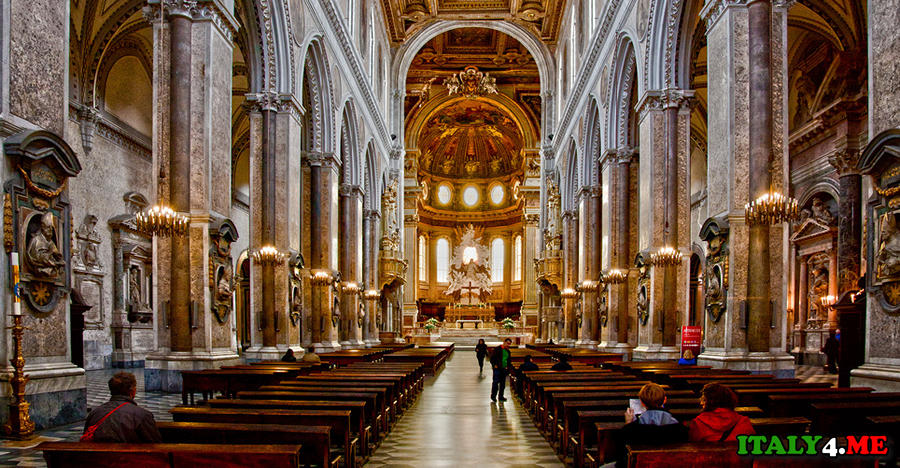
The chapel of Saint Januarius is particularly stunning, having been crafted by renowned Italian masters of the 17th century.
The church houses paintings by Luca Giordano and Perugino. The cathedral’s most treasured relic is a vessel containing the blood of Saint Januarius, sealed 17 centuries ago. The vessel is displayed twice a year to throngs of faithful pilgrims who travel from afar. During these moments, the solidified blood miraculously liquefies. On May 19, 2005, Professor Hack reported that the liquefaction is not a miracle but a simple chemical reaction. This led to accusations from some believers, who blamed the scientist for defaming the church.
Royal Palace
Since the 17th century, the Palazzo Reale di Napoli (Royal Palace of Naples) has served as the residence of monarchs. Construction began in 1600 and lasted for more than fifty years. The large, three-story building was erected in the late Renaissance style. Its façade, made of dark stone and brick, features decorative elements reminiscent of Ancient Roman structures with granite columns and Latin inscriptions.
Royal Palace in Naples
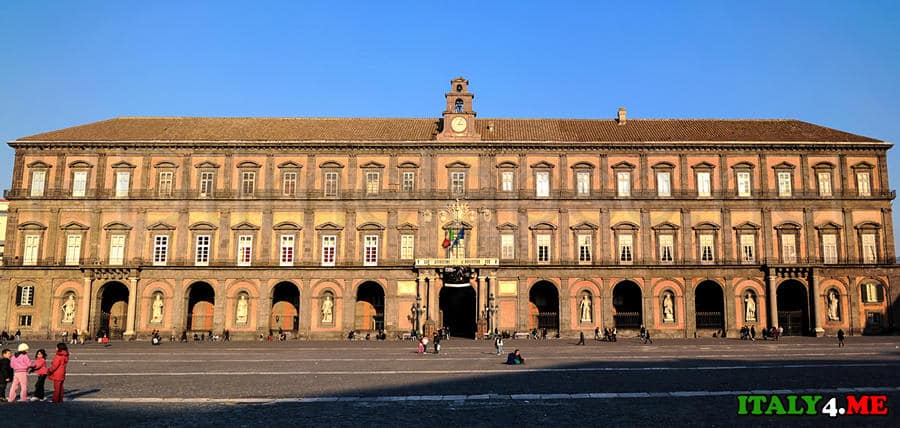 Anichkov Bridge in Saint Petersburg. The horses were a gift from Nicholas I to King Ferdinand II of Bourbon. Behind the outer façade lies the inner Courtyard of Honor, surrounded by a colonnade forming a series of stone arches. Above the colonnade is a loggia—a covered arcade connecting all the rooms on the second floor.
The palace contains 30 rooms that preserve the authentic interiors of their aristocratic owners. Most of the building now houses the National Library, which holds thousands of books and a collection of unique papyri from the city of Herculaneum (Ercolano). Among the many rooms, the Hall of Hercules, the Throne Room, and the Central Hall stand out and, together with other chambers, form the Museum of the Royal Palace’s Historic Apartments.
Basilica of San Francesco di Paola
Opposite the Royal Palace stands the Basilica of San Francesco di Paola. The building was designed by architect Pietro Bianchi. Modeled after the Roman Pantheon, the basilica was commissioned by Ferdinand I to celebrate the restoration of his lost kingdom. Construction began in 1817 and was completed 29 years later. The church has a circular layout, and its interior features numerous frescoes, paintings, and statues. 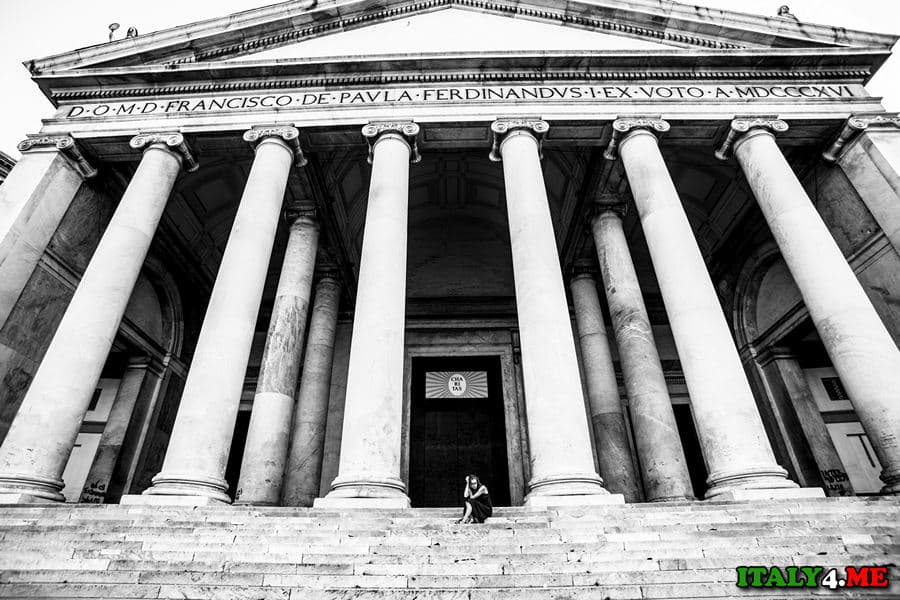
At the center of the basilica stands the main altar, made of solid stone. The portico bears a dedicatory Latin inscription and is crowned with three sculptures of saints: Francis of Paola, Ferdinand of Castile, and Vera. The façade is adorned with equestrian statues of Kings Charles III and Ferdinand I.
Galleria Umberto I
Opposite the San Carlo Opera House is the Galleria Umberto I, a grand and opulent shopping arcade with a glass roof. Built in Naples at the end of the 19th century, it was designed in the neoclassical style. The arcade was originally constructed to cover numerous alleys and streets around Toledo Street that had developed a bad reputation.
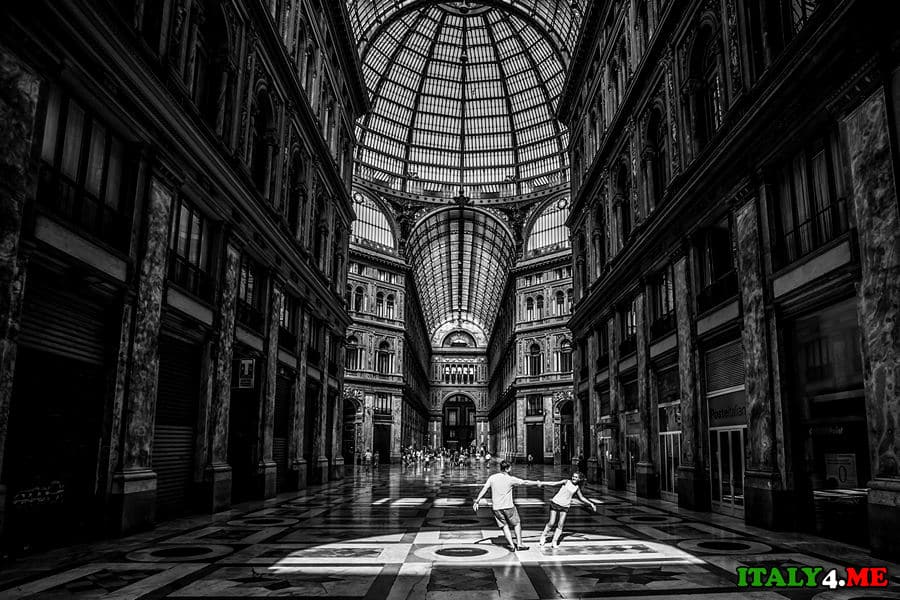
See a beautiful photo session in Naples
The project was initially designed by Emanuele Rocco and later modernized between 1887 and 1890 by architects Antonio Curri and Ernesto Di Mauro, adding neo-Renaissance elements. The structure is laid out as an octagonal cross with chapels of varying lengths. The central area is topped by a cylindrical dome featuring a large depiction of the Compass and the Zodiac circle. The tall windows with ornate stained glass and the enormous dome create a striking impression. The glass ceiling rises to a height of 184 feet (56 m).
The Galleria Umberto I strongly resembles the Galleria Vittorio Emanuele II in Milan.
National Archaeological Museum of Naples
Located in the city center, the National Archaeological Museum of Naples is renowned for its vast collection of ancient Greek and Roman artifacts. This museum holds a prestigious position among the world’s leading cultural institutions. 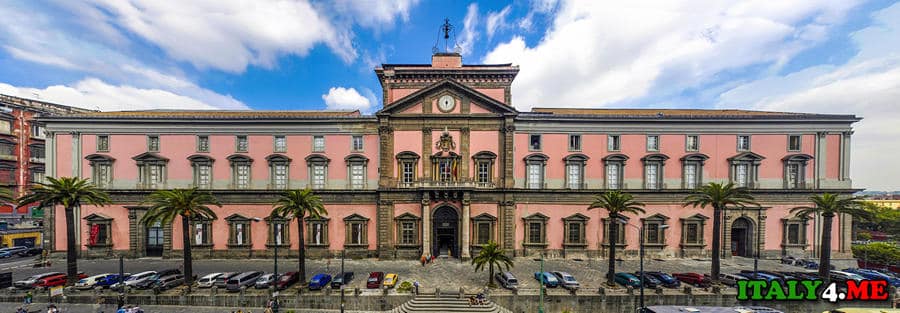
The museum building was constructed in 1586 under Don Pedro Girón, the Spanish viceroy. On the first floor, fifteen of the forty galleries display a collection of ancient sculptures. Among the most famous are the statues of Aphrodite, Athena, the Farnese Hercules, and the Farnese Bull. Between the first and second floors are the renowned mosaics unearthed during excavations in Pompeii. The second floor is equally impressive, featuring the Hall of Frescoes with works from Pompeii, Stabiae, and Herculaneum, as well as the Hall of the Temple of Isis, which recreates the temple’s interior in Pompeii using authentic artifacts.
Catacombs
The Catacombs of Naples are a “realm of Hades,” offering a stark contrast to the relentless pace of modern Naples. This is a kingdom of silence, mystery, and secrets. Beneath the Neapolitan streets and houses lies an entire city of catacombs, containing more than 700 caves, long galleries, and tunnels. For centuries, the city’s residents quarried tuff from these underground spaces to build homes, churches, squares, and even city walls.
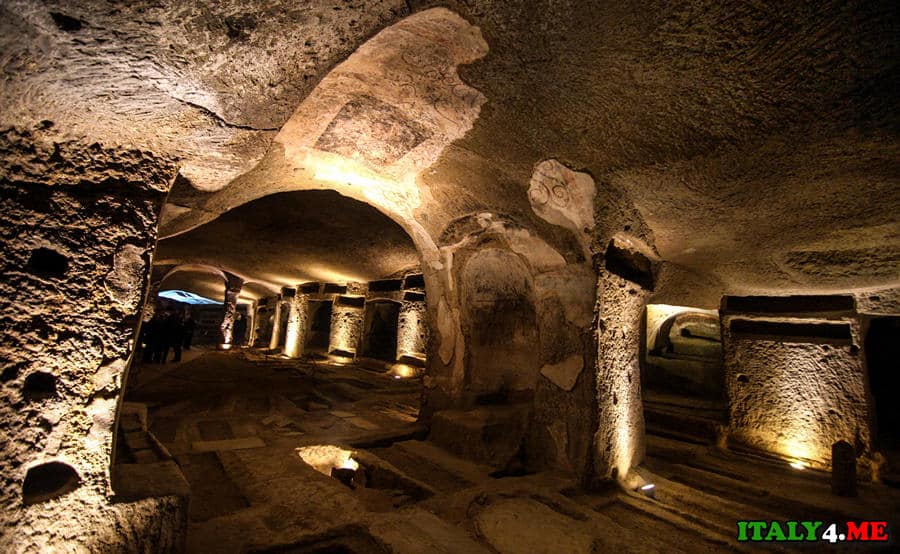
Here, visitors will find ancient ritual crypts, underground shrines (hypogea), Roman aqueducts, Greek caves, medieval tunnels, Bourbon secret passages, and subterranean corridors. Artifacts discovered during excavations include items up to 5,000 years old. The ancient Greco-Roman underground aqueduct system was integrated in some areas with a later system built in the 17th century, which served the city’s residents until about 1885.
Today, the pipeline laid in the ancient tunnels is still in use, though it is in a poor state of repair. Since 1989, the “Underground Naples” association, led by speleologist Enzo Albertini, has been offering tours of the Greco-Roman catacombs.
The entrance to the catacombs is located near the Basilica di San Paolo Maggiore. The first Christians secretly gathered in these dark underground chambers for communal prayer.
The Catacombs of San Gennaro, dating back to the early Christian period (entrance on Via di Capodimonte), contain several bishops’ tombs. Saint Januarius, whose remains now rest in the cathedral, was originally buried here. The catacombs also feature numerous frescoes, including the earliest depiction of Saint Januarius, as well as images of Adam and Eve and the Good Shepherd. An intriguing stele dedicated to the cult of Priapus, son of Dionysus, and an 8th-century baptismal font can also be found here.
Transportation
Naples boasts a well-developed transportation infrastructure. Public transport in the city includes buses, trolleybuses, trams, water transport, the metro, taxis, and car rentals.
The city’s metro system features four funicular lines: Montesanto, Chiaia, Centrale, and Mergellina. Since Naples is situated on hills, the funicular plays a vital role in the city’s transport network. The funicular has 16 stations and serves approximately 60,000 passengers daily.
Naples is not only the administrative center but also the tourist hub of Campania. Excursion buses regularly depart from the city for tours to the archaeological site of Pompeii and the slopes of Mount Vesuvius. From the port, pleasure boats cruise across the Gulf of Naples to the islands of Ischia and Capri.
Tourists looking to escape the hustle and bustle of the big city can stay in one of the quiet towns along the Tyrrhenian Sea coast, such as Sorrento, Amalfi, or Salerno.