 Italy for me From Italy with love


Herculaneum (Ercolano) is an ancient Roman resort city on the shores of the Bay of Naples (Golfo di Napoli), in the province of Naples (Napoli). Today, the modern city of Ercolano (Ercolano) is partially located on the site of ancient Herculaneum.
Page Contents
History
According to legend, Herculaneum was founded by Hercules (Ercole) himself. In reality, it is more likely that the first settlements in the area belonged to the Oscans, an ancient Italic people. Later, the lands came under Greek control. Historians believe that it was the Greeks who gave the city its name. The philosopher Theophrastus (Teofrasto) referred to it as Herakleion (Heraklion) in his works.
In the 4th century BC, the city was captured by the Samnites. Eventually, it became part of the Roman Empire (l’Impero Romano), between the 3rd and 1st centuries BC, depending on different sources. From around 89 BC, Herculaneum thrived, gaining the status of a municipium, a city where residents were granted varying degrees of Roman citizenship and self-government. The population reached about 4,000, with locals engaged in crafts and the arts, producing artistic goods for other cities. However, in AD 62-63, the city was severely damaged by a strong earthquake.
The Destruction of the City
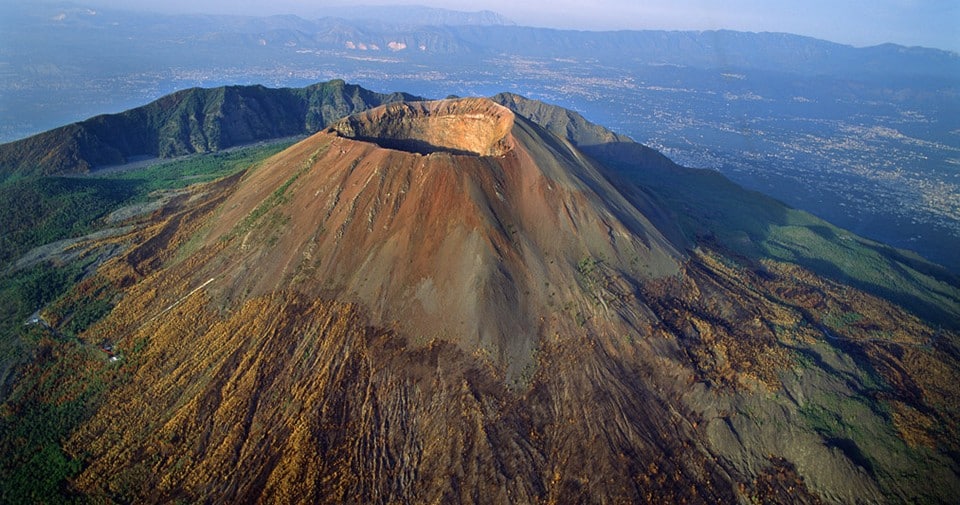
On August 24, AD 79, Herculaneum was consumed by the eruption of Mount Vesuvius (Vesuvio). Volcanic ash quickly covered the cities of Pompeii and Stabiae (Stabiae), but Herculaneum was initially spared. However, most of the residents fled the city in panic. After midnight, flows of molten lava descended on the town. Poisonous gases, layers of ash, and pyroclastic flows instantly killed those hoping to shelter in the city’s buildings. Lava filled the streets and houses, evenly and hermetically sealing all open spaces. This helped preserve the remains of the dead, buildings, furniture, papyrus scrolls, and even food.
Excavations
In the early 18th century, local resident Ambrogio Nucherino (Ambrogio Nucherino) dug a well and stumbled upon fragments of the ancient city. Upon learning of the discovery, Duke Emmanuel Maurice of Lorraine (Emmanuel Maurice Lotarinsky) purchased the site and funded the excavations. Workers dug tunnels for nine months, uncovering nine statues. The fragments discovered by Nucherino turned out to be the remains of the Herculaneum theater.
In 1738, excavations resumed under the orders of Charles III (Carl III). The most valuable artifacts were displayed in the Royal Palace in Portici (Reggia di Portici). From the 1750s to 1765, the Villa of the Papyri (Villa dei Papiri) was unearthed. However, in 1765, gas began to seep into the tunnels, forcing a halt to the excavations, and the entrances were sealed.
Excavations between 1828-1855 and 1869-1875 stopped due to high costs. Archaeologists returned to Herculaneum in 1924. Until the 20th century, it was believed that all residents had escaped the disaster. However, in 1982, archaeologists discovered about 250 skeletons in the boat sheds. Due to the proximity of modern Ercolano, excavations remain challenging.
Early excavations, carried out with little professionalism, resulted in the discovery of ancient works of art, many of which ended up in private collections. Today, it is impossible to trace their original locations. Many objects deemed worthless at the time were lost. Medieval excavation methods caused severe damage to the ancient city. Today, tourists continue the destruction, taking small pieces of the monuments as souvenirs. Graffiti now marks the surfaces of the city.
Architecture
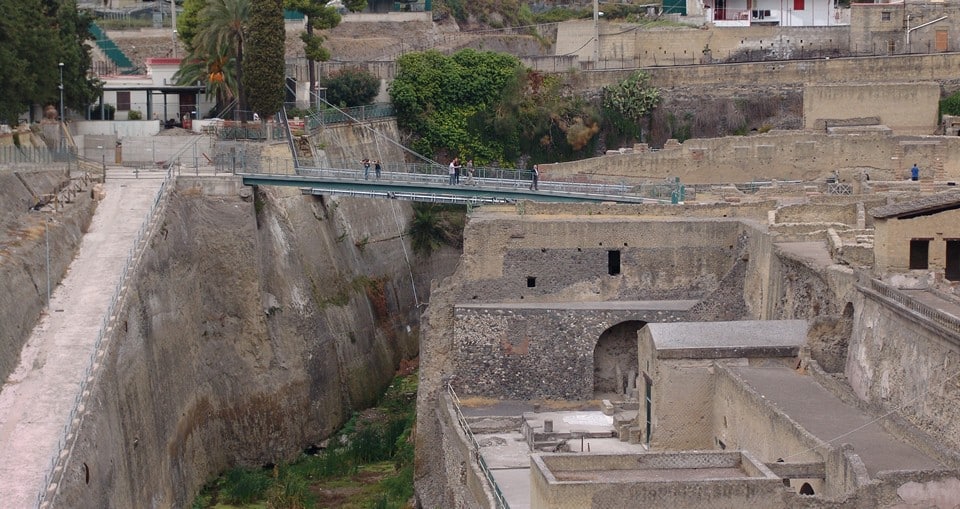
Herculaneum is dominated by Greek architecture. Sidewalks shaded by loggias, porticoes—covered galleries protecting against rain and sun, and guest rooms—these were not typical in Italy. The city’s sewage system led to the sea, and freshwater was supplied to homes and fountains. The roads were paved with volcanic stone, and the sidewalks were elevated, separated by curbs, and laid with red tuff.
The buildings were adorned with vibrant mosaics and frescoes. The scenes depicted were often humorous and, by modern standards, sometimes explicitly pornographic. The finest artifacts are displayed in the Secret Cabinet (Gabinetto Segreto) in the National Archaeological Museum of Naples (Museo Archeologico Nazionale di Napoli).
Herculaneum’s layout is relatively simple. The open part of the city was divided into eight districts. Districts two through seven were numbered, while the first and second were called East I and East II, respectively. In some sources, you may encounter the term “insula” (Insula) instead of “district.” Three streets ran north to south, and one street ran east to west. Villas belonging to Roman nobility lined the city and the bay. The beautiful scenery and mild climate made Herculaneum a true resort.
Attractions
District 2
The House of Argus (Casa d’Argo) was considered one of the most beautiful villas in the city. It was named after a fresco depicting Io and Argus (Io e Argus), ancient mythical characters. The fresco is now lost. Other notable attractions in Insula II include the House of Aristides (Casa di Aristide) and the House of the Genius (Casa del Genio).
District 3
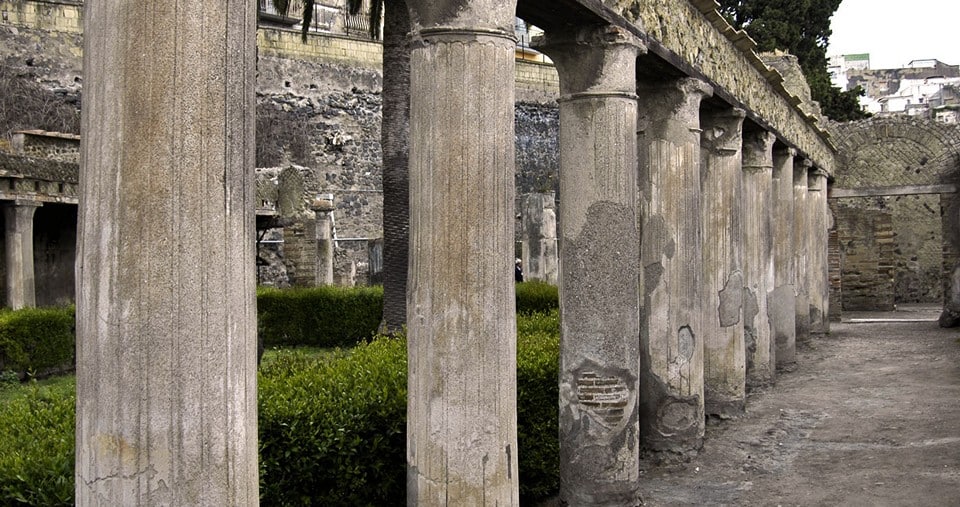
The Inn (Casa dell’Albergo) covered a massive area—2,150 m² (23,142 ft²). This was a private villa with a sea view. The building was severely damaged by the volcano and early excavations. Inside, there are baths, rooms, a terrace, an atrium, and a peristyle—an open space surrounded by a covered colonnade. However, at the time of the eruption, the house was being used as a hotel by its new owners.
The House with a wooden partition (Casa dell Tramezzo di Legno) dates back to the Samnite period. The partition, made of reeds covered in clay, has survived. This wall separated the internal courtyard from the tablinum, a kind of study or dining room. This wall construction technique was inexpensive but visually appealing. The frescoes and mosaics in the house date back to the 1st century AD.
District 4
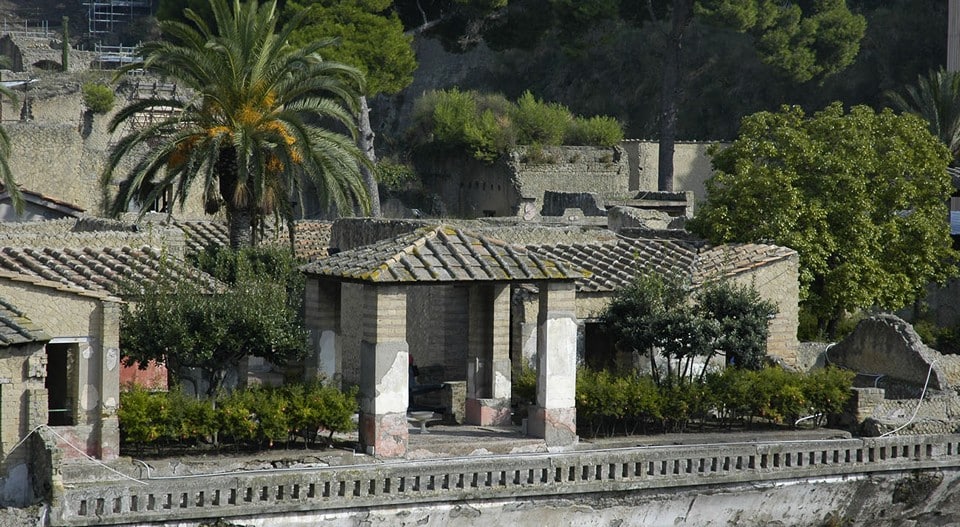
In District 4, you’ll find a house with an Alcove (Casa dell’Alcova
), where a modest building coexists with a wealthier family’s home. Another well-preserved luxury residence is the house with a Mosaic Atrium (Casa del’Atrio a Mosaico). The floor is paved with black and white mosaics. The bedrooms and alcoves are decorated with magnificent frescoes. The covered gallery is next to observation terraces. Some furniture has also survived.
Another opulent building is the House of the Deer (Casa del Cervi). Inside, a loaf of bread bearing the name of the house’s owner was preserved. The house features a multicolored marble floor, marble tables, and sculptures of deer—just a small part of its surviving history.
District 5
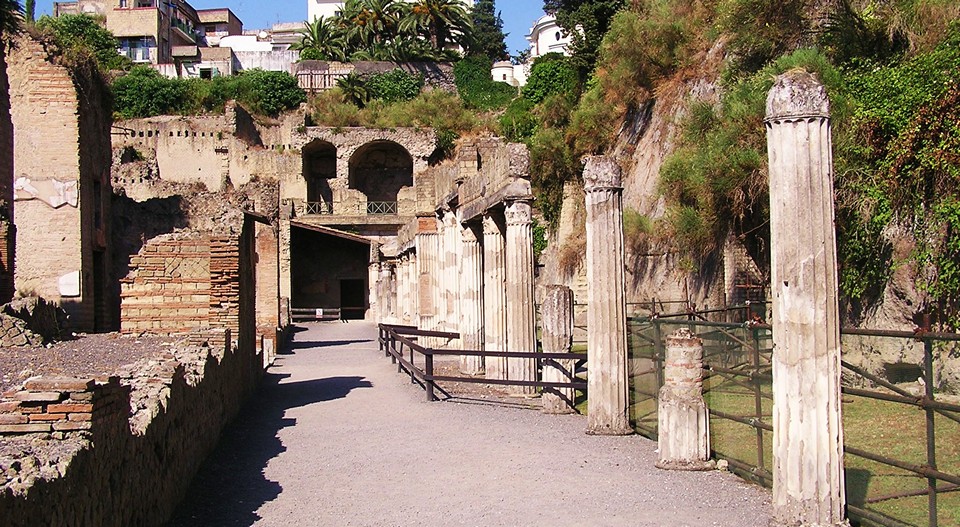
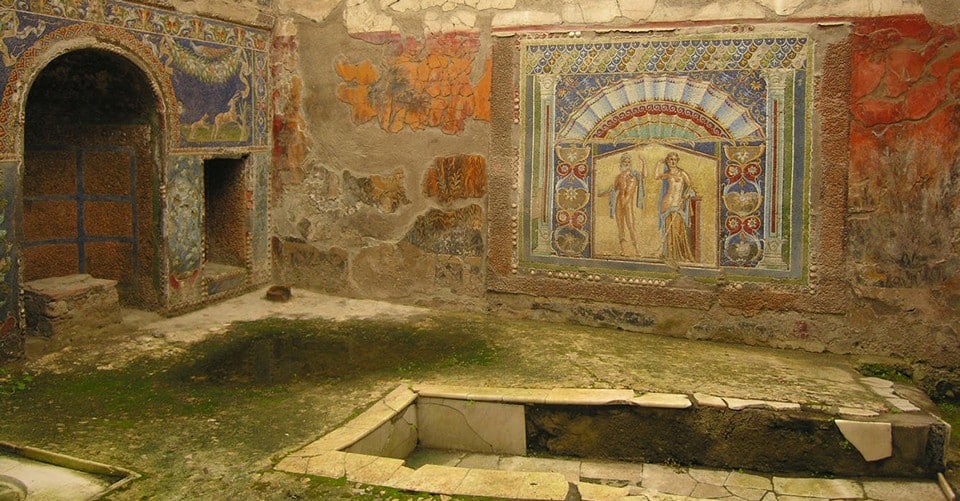
In District 5, visit the house with a Beautiful Courtyard, the Samnite House (Casa Sannitica), and the House with Carbonized Furniture (Casa del Mobilio Carbonazzato). The house with the Grand Entrance (Casa del Gran Portale) is named after its massive entrance, framed by semi-columns with figures of winged goddesses of victory on the capitals. The house lacks an atrium, and the rooms branch off from a corridor. The House of the Neptune and Amphitrite Mosaic (Casa di Nettune e d’Anfitrite) likely belonged to a successful wine merchant. One wall is adorned with a mosaic depicting two sea deities, and amphorae used to store wine have been preserved.
District 6
In the house with the Black Hall (Casa del Salone Nero), the hall is decorated with frescoes on a black background. The wooden doors have been well-preserved. The Augustales Hall (Sacello degli Augustali) was built in honor of Emperor Augustus for curial meetings. The walls are adorned with splendid paintings, including a fresco of Hercules, Juno, and Minerva. The Augustales Hall contained a shrine dedicated to the emperor.
The Urban Baths (Terme Urbane) date back to the period of Greek influence. The baths were divided into male and female sections. The men’s section had access to an exercise area, followed by an apodyterium (changing room), a tepidarium (warming room), and rooms for cooling off. The caldarium had pools of hot and cold water for warm baths. The floors and walls were decorated with images of fish, tritons, dolphins, and octopuses. The women’s baths were cozier and better preserved.
District 7
The only building in District 7 is the House of Galba (Casa di Galba). It is located close to the modern city, so it is not fully excavated.
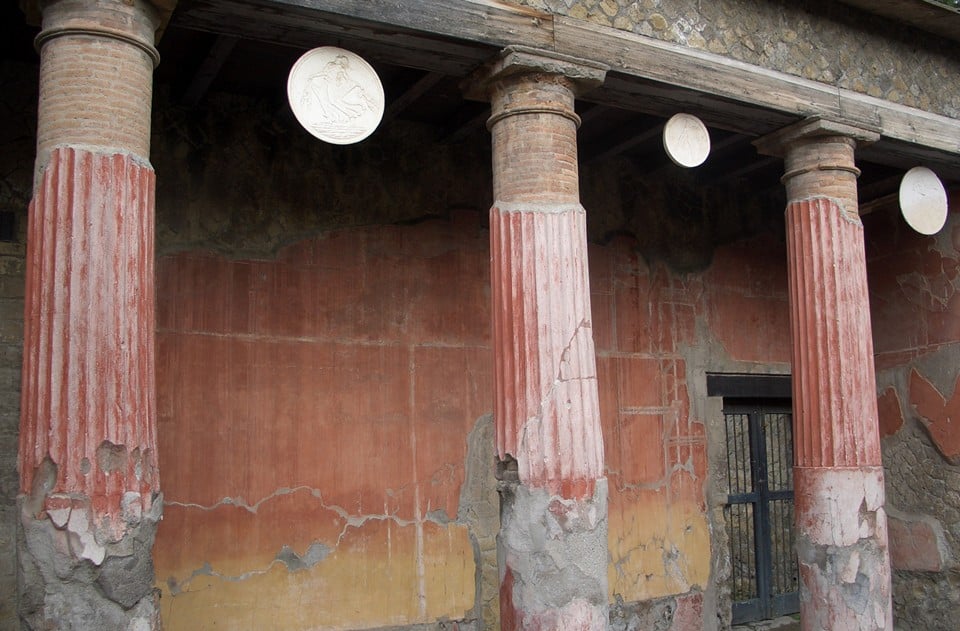
One of the largest houses in the city is the house with the Telephus Relief. Its uniqueness lies in the fact that it follows the contours of the land. The house consists of two parts, with a corridor leading to the second part at an angle. The walls are adorned with relief masks of satyrs and theatrical characters. Expensive marble cladding is seen throughout. One room is decorated with scenes from the myth of Telephus.
A few hundred meters from Herculaneum, the Villa of the Papyri was discovered. This building covers 2,790 m² (30,021 ft²). During excavations, statues of many prominent figures in the arts and politics were found. The most unique discovery was the only library preserved from antiquity. It is believed that the surviving scrolls contain works by Sophocles, Euripides, Aristotle, and other ancient thinkers that were lost. A replica of the building now exists in Malibu, California. The American businessman J. Paul Getty constructed the villa based on the designs of the ruins, following the principles of ancient architecture.
As mentioned earlier, the first building discovered in the city was the theater. Unfortunately, amateur excavation methods caused irreparable damage to the once-luxurious structure. The theater, which once held almost 2,000 spectators, has lost its rich decor, bronze statues, and marble stage, all of which are now gone forever.
Visitor Information
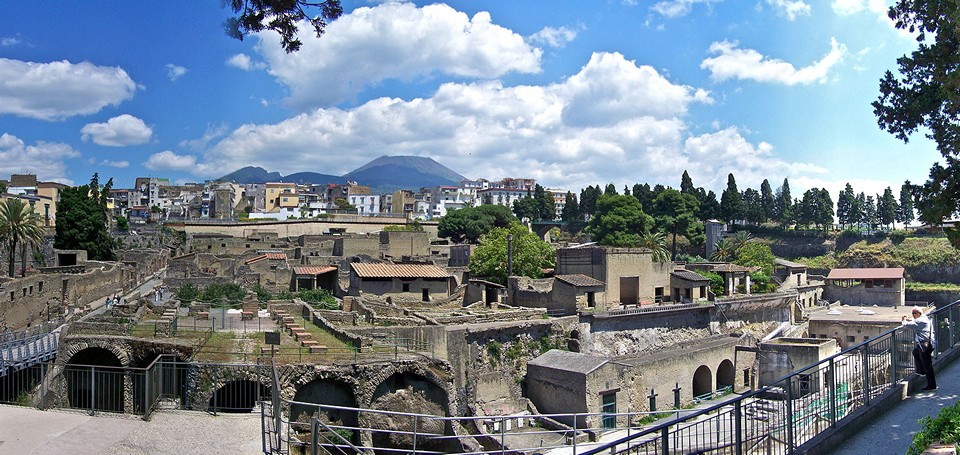
Apart from those mentioned above, many more preserved buildings in Herculaneum, such as the Villa of the Papyri and the theater, are present. You can explore everything in one day.
Guided Tours
You can book a tour from Naples to visit Herculaneum, Pompeii, or both. You can also visit the ancient cities independently.
Opening Hours
- April 1 – October 31: 8:30 AM – 7:30 PM (last entry 6:00 PM);
- November 1 – March 31: 8:30 AM – 5:00 PM (last entry 3:30 PM);
- Closed: December 25, January 1.
Ticket Prices
- Single-day visit to Herculaneum: €16;
- Combined ticket for Pompeii, Herculaneum, Oplontis, Stabiae, and Boscoreale (valid for 3 days): €22; reduced price: €12 (EU citizens only).
You can order tickets in advance online at the official website www.coopculture.it.
How to Get to Herculaneum from Naples
By Train
Take the Napoli-Sorrento or Napoli-Poggiomarino route on the CIRCUMVESUVIANA train, which stops at Ercolano.
The ERCOLANO-SCAVI station is 700 meters (765 yards) from the ruins. From the station, you can walk to Herculaneum. After disembarking, head toward the sea.
Cross the intersection and walk down Via IV Novembre to Corso Resina, where you will find the entrance to the ruins.
See instructions: How to buy train tickets in Italy.
By Car
Take the A3 Napoli-Salerno highway. Exit at Ercolano and follow the signs. Parking is available in Herculaneum. You can compare prices and rent a car in Italy using www.rentalcars.com
Useful Tips
- There is only one café on the site, and the prices are high. Bring your own food;
- Bring a water bottle – you can refill it on the site;
- To fully appreciate the landmarks, rent an audio guide. It is available at the information desk near the ticket office;
- At the entrance, you will be given a map and an information booklet;
- If you speak Italian, you can hire a guide. This can be arranged directly at the entrance. The price for this service varies: €20-25.