 Italy for me From Italy with love


The Tiberius Bridge (Ponte di Tiberio) is one of the outstanding architectural monuments that has retained its function since the days of Ancient Rome and has seamlessly integrated into the life of the famous resort city of Rimini in the Emilia-Romagna region.
The bridge connects the historic center with the San Giuliano district and, together with the Arch of Emperor Augustus (Arco di Augusto), serves as a symbol of the city. The Ponte di Tiberio is even featured on the municipal coat of arms.
Page Contents
Who Built It, When, and Where
Two emperors were involved in the construction of the bridge in Rimini: work began in 14 AD under Octavian Augustus and was completed in 21 AD by his successor, Tiberius (Tiberius Iulius Caesar Augustus), whose name the famous structure bears.
The project was designed by engineer and architect Marcus Vitruvius Pollio, renowned for his treatise *Ten Books on Architecture*, an encyclopedia of the technical knowledge of the time.
Description
The Tiberius Bridge in Rimini spans the Marecchia River, formerly known as the Ariminus, which gave the city its name. This created a strategically important link between the northern and central territories of the empire, connecting two vital roads—the Via Aemilia and the Via Popilia-Annia.
\
The structure’s reliability is enhanced by massive piers set at a slight angle to improve stability against what was once a strong current in the Marecchia. Stone breakwaters were attached to the bridge supports to slow the water flow.
The ancient structure’s wooden piles, remarkably, have been preserved underwater and continue to serve their function to this day.
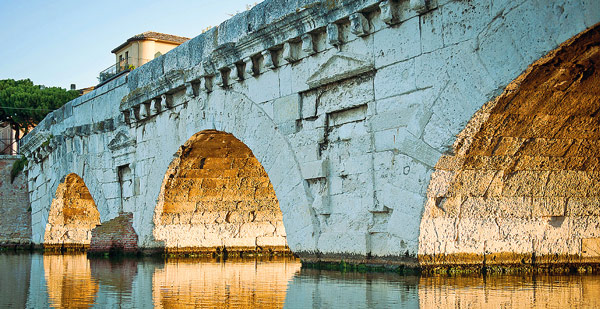
The builders used natural travertine stone from Istria. Laid in large squares, it gives the bridge an imposing and monolithic appearance. For structural reinforcement, the Romans employed a type of early concrete—a mixture of volcanic ash and lime—making them the first to use such a material in bridge construction.
Destruction and Restoration
Every visitor to Rimini is amazed by the durability and longevity of the Tiberius Bridge. Even today, it can support both pedestrian and vehicle traffic. The stone crossing has withstood serious challenges from floods, earthquakes, and wars, yet it has always been restored and reinforced.
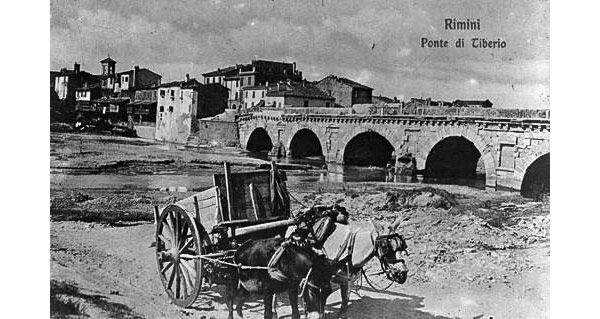
In 580 AD, the bridge was severely damaged during a battle between the Goths and Byzantines and remained in ruins for several centuries. It wasn’t until 1680, under Pope Innocent XI (Innocentius PP. XI), that restoration work made the bridge functional once again.
A plaque on one of the bridge’s piers recalls the military conflict of 1742, when Spanish troops damaged the structure, which was then restored in 1782.
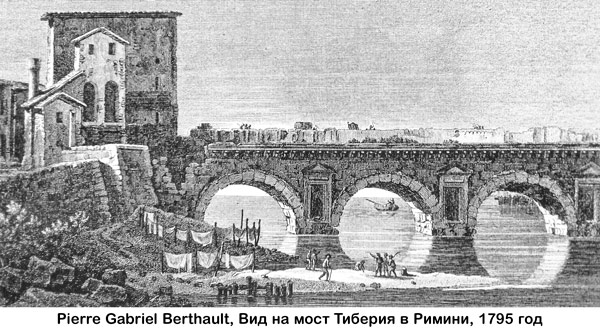
Watch the light show celebrating the bridge’s 2000th anniversary:
[https://youtu.be/a5GNvsyWvN8](https://youtu.be/a5GNvsyWvN8)Legends
Italians cherish the legends surrounding their landmarks. The history of the Tiberius Bridge is shrouded in mystery. Locals also call it the “Devil’s Bridge.”
Despite prayers to the gods, construction mysteriously stalled for almost seven years.
\
During World War II, Rimini suffered heavy bombing by American aircraft and destruction by German occupiers. The fascists had planned to demolish the Tiberius Bridge as a key crossing point. However, whether by miracle or the hesitation of the German officer ordered to blow up the ancient structure, the centuries-old Roman bridge survived.
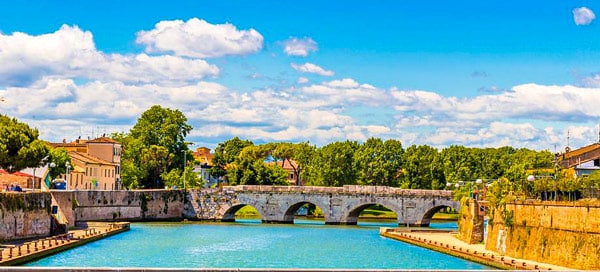
The Tiberius Bridge remains a major attraction in Rimini, drawing tourists with its scenic views and the timeless spirit of Ancient Rome.
Millennia have passed, but today anyone can still walk across the bridge and feel connected to history, treading the very stones once walked by a great Roman emperor.