 Italy for me From Italy with love

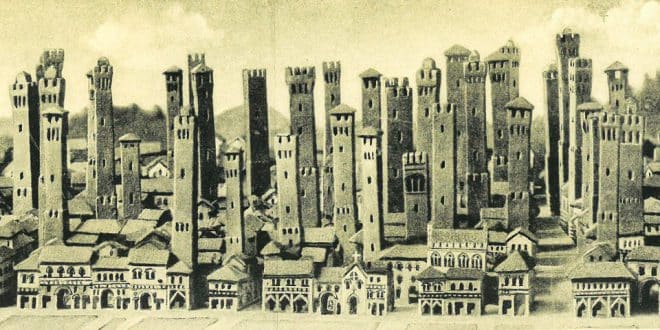
Medieval towers transformed the skyline of Bologna in the 12th and 13th centuries so dramatically that many today compare the capital of Emilia-Romagna in that era to Manhattan.
The skyward-reaching towers stood in striking contrast to the brick rooftops of modest homes, creating a unique atmosphere within this Italian provincial cityscape.
Page Contents
History
The towers were built exclusively by wealthy families, each striving to prove their superior status and wealth through construction. By the end of the 13th century, the city boasted around 180 towers, although some historians argue that the total number may have exceeded 200. 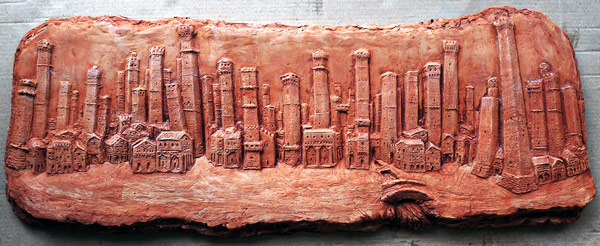
Count Giovanni Gozzadini, a 19th-century senator of the Kingdom of Italy, was the first to seriously study the history of Bologna’s medieval towers. He frequently cited his desire to elevate the city’s prestige within the newly unified nation as his motivation. Gozzadini’s analysis relied heavily on civil property records in an attempt to calculate the exact number of towers that had existed in the Middle Ages. He was the first to propose the figure of 180, which many historians accepted for a time.
Unfortunately, not all of Bologna’s medieval towers have survived. Some were destroyed, while others were repurposed as prisons, shops, or even homes. The most recent demolitions occurred in 1917, during a planned but never completed urban renewal project. As a result, the Artenisi and Riccadonna towers near Mercato di Mezzo were lost unnecessarily. The Torre Conforti had also been torn down a year earlier.
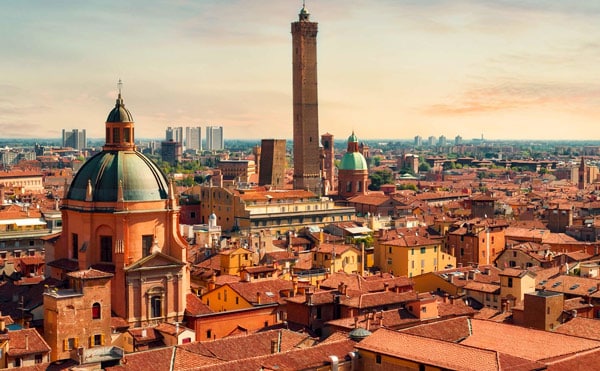
In addition to the towers, visitors can still see fortified gates (torresotti), remnants of the 12th-century defensive walls (Mura dei torresotti or Cerchia dei Mille), which are now mostly destroyed.
Also worth reading: the tallest towers and bell towers in Italy.
Construction Technology
Although the towers were built using the labor of serfs, the process itself was grueling and meticulous. From start to finish, construction could take anywhere from 3 to 10 years.
Typically, the outer walls had small openings, and recesses were carved into the selenite blocks to support scaffolding and future wooden structures and cladding.
Torre Azzoguidi
The Torre Azzoguidi, also known as Altabella (Torre Azzoguidi detta Altabella), is located in the heart of Bologna, just 100 meters north of Piazza Maggiore, at Via Altabella 7.
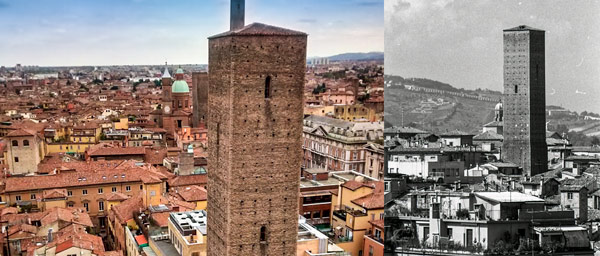
Built in the 12th century, it stands 200 feet (61 meters) tall, making it the second-tallest tower in Bologna after the Asinelli Tower. Based on window placement, historians believe that the tower was once even taller in the Middle Ages, as indicated by a small ledge at about 92 feet (28 meters). It originally belonged to the noble Azzoguidi family, who gave the structure its name.
The Azzoguidi family is recorded in city chronicles dating back to 1228 and was heavily involved in political conflicts, siding with the Guelphs. Many family members were prominent citizens, and records suggest they may have owned another tower in Bologna, which has not survived. There are no definitive historical records of this second tower’s location or height.
The base of Torre Azzoguidi forms a perfect square. The tower stands perfectly upright, showcasing remarkable balance and near-perfect proportions. Above the ledge, the structure begins to taper, and its ancient selenite doorway features a pointed Gothic arch adorned with a decorative border. Today, a modest watch shop occupies the ground floor at the base of the tower.
Also see: top attractions in Bologna
Torre Torresotto San Vitale
Little is known about the Torre Torresotto San Vitale (Torresotto di San Vitale).

During the Middle Ages, as Bologna expanded, successive walls and gates were constructed around the city. If you follow Via San Vitale toward the city center, you’ll come across this tower, which splits the street into two sections. A short walk straight ahead—without turning—toward Palazzo Fantuzzi will lead you to the city’s iconic leaning towers.
The structure was part of Bologna’s second ring of defensive walls. At its base is a small arch, now used by cars, cyclists, and pedestrians.
Torre Strada Castiglione
The Torre Strada Castiglione (Torresotto Di Strada Castiglione) is an impressive structure that cuts across Via Castiglione in the city center, featuring an arched base similar to that of the San Vitale tower.
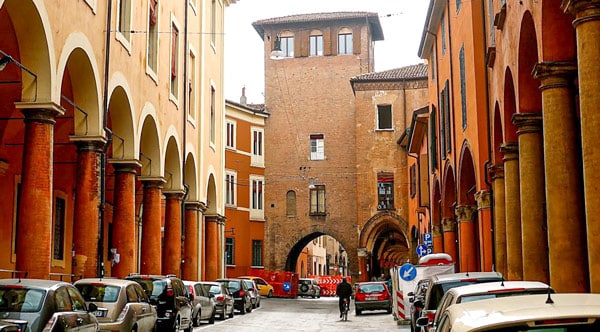
Built in the early 13th century, it formed part of Bologna’s second defensive wall ring. Nearby is the elegant Casa Dolfoli, distinguished by arched windows and terracotta ornamentation. Both the tower and the adjacent house are currently used as private residences.
Prendiparte Tower
The Prendiparte Tower (Torre Prendiparte), also known as Coronata, was built in the 12th century. 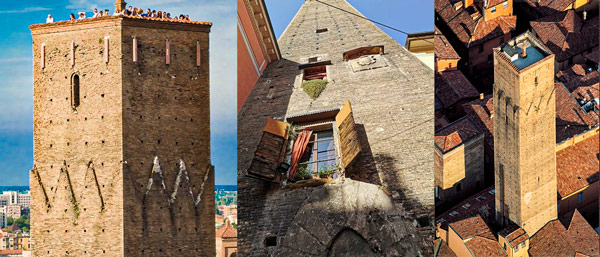
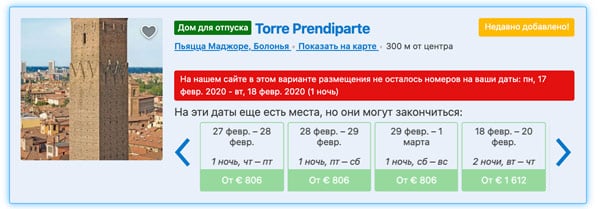
Standing 197 feet (60 meters) tall with lower walls measuring 5 feet (1.5 meters) thick, it is now one of the most unique and extraordinary hotels in the world—offering a single suite.
The tower’s current owner, Matteo Giovanardi, personally welcomes guests and provides a guided tour. Portraits of the Prendiparte family’s previous owners adorn the walls.
Living quarters occupy the lower level, featuring an entrance hall, bathroom, bedroom, and kitchen. A separate shower room had to be carved out, as such amenities did not exist in medieval times. On the second floor, there’s a cozy room designed for romantic dinners. Hidden nooks throughout the tower contain stashed bottles of fine spirits.
The most fascinating area of the tower is the preserved medieval prison. The inscriptions and drawings in the cells are entirely original and untouched for decades.
You may also find my guides on the best hotels and hostels in Bologna helpful.
Above the second floor are technical rooms, but they’re worth passing through to reach the rooftop, which offers panoramic views of Bologna. Up top, a small red-and-yellow flag flutters on a brick chimney, while a bench and a table sit perched at the edge of the tower.
Climbs to the top were available Saturdays at 3:30 PM for €15. Whether tours will resume this year is currently unknown—check for updates at the official site: www.bolognawelcome.com
Galluzzi Tower
Construction of the Galluzzi Tower (Torre dei Galluzzi) began in 1257. It is located at Corte de Galluzzi, 13. 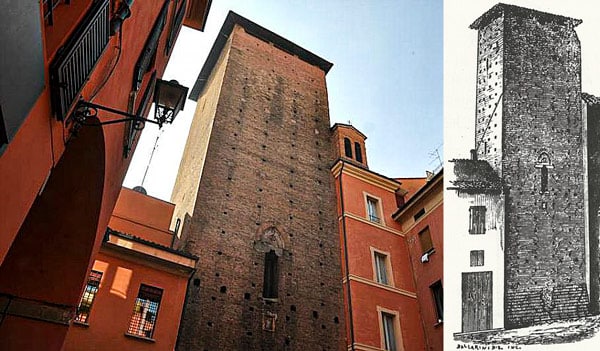
Today the tower reaches a height of 98 feet (30 meters), but in the Middle Ages it stood even taller; its walls are about 10 feet (3 meters) thick. Access to the tower was originally via a doorway located 33 feet (10 meters) above ground level from the surrounding wooden houses, or via a bridge connecting it to a neighboring unnamed tower.
It was called the “new” Galluzzi to distinguish it from the “old” one that once stood in Piazza Maggiore but has not survived to the present day. The Galluzzi were a wealthy and influential noble family first mentioned between 1174 and 1189. Family members served as city consuls seven times in succession. By the early 13th century, the Galluzzi had joined the ranks of the city’s magnate families.
In 1295, Antonio Galluzzi—who was podestà (chief magistrate) in Florence—was accused of failing to prevent a feud between the Cherchi and Donati families. The Florentines were outraged and sought to fine him 8,000 lire, an enormous sum at the time. Around the same period, his brother Comazzo, who served as podestà in several Umbrian towns, was ordered by the court in Todi to pay 1,000 lire but soon departed due to ongoing clashes between Guelphs and Ghibellines.
Today, only twenty of Bologna’s medieval towers remain. Many have lost their histories over time, and for some, only basic information survives.
Guidozagni Tower
The Guidozagni Tower (Torre dei Guidozagni) is located at Via Albiroli, 1.
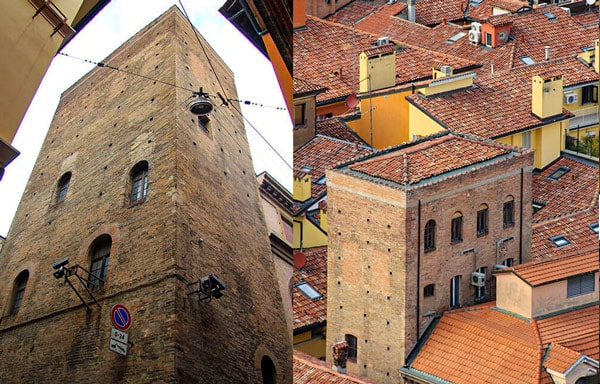
This rectangular structure stands 66 feet (20 meters) tall. Originally much higher, the upper part collapsed in 1487, damaging a neighboring building. The Guidozagni were a noble family and strong supporters of the Ghibellines. One family member, Alberigo, joined the First Crusade in 1096 at the call of Pope Urban II. The family owned four towers in Bologna, one of which once stood near the Asinelli and Garisenda towers but was demolished in the 20th century.
Uguzzoni Tower
The Uguzzoni Tower (Torre degli Uguzzoni) is located at Vicolo Mandria, 1.
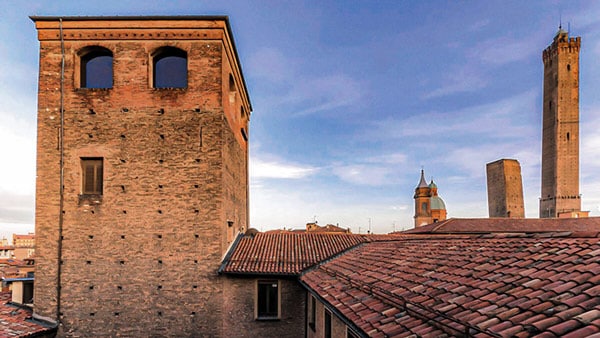
Built in the late 12th or early 13th century, the tower reaches a height of 105 feet (32 meters). In the 17th–18th centuries, its roof was converted into an open terrace. The lower window conceals small holes once used to connect wooden beams to an adjacent house. A small doorway with a double arch has since been sealed. The noble Uguzzoni family also supported the Ghibellines. In 1180, a family member named Guido served as one of Bologna’s consuls.
Scappi Tower
The Scappi Tower (Torre degli Scappi) stands at Via dell’Indipendenza, 3.
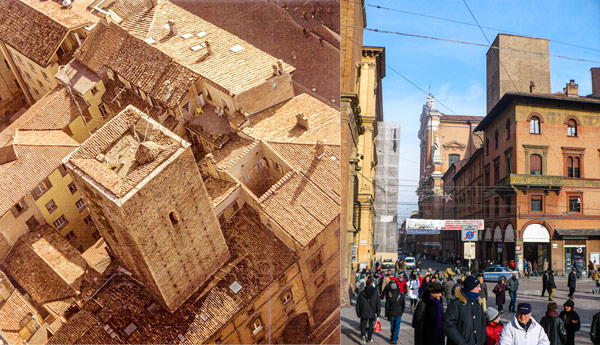
Erected in 1220, the tower now rises to 128 feet (39 meters). Today, only the top section is visible. In the 16th century, it became part of the Coccapani Palace and is now attached to a neighboring structure.