 Italy for me From Italy with love


Writers and famous figures of the past spoke only positively about Taormina. For example, the Frenchman Guy de Maupassant once exclaimed that this resort deserves exceptional attention.
“Even if fate grants you only one day in Sicily, spend it in Taormina!”
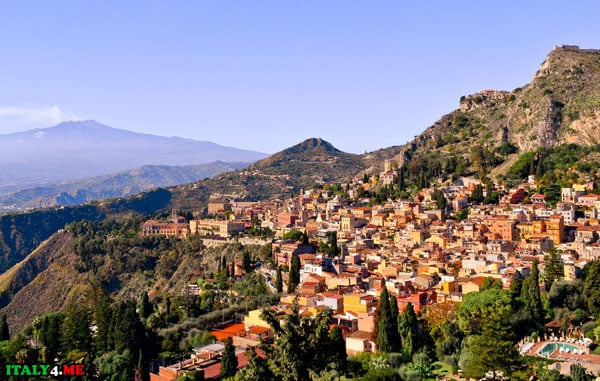
The writer was undoubtedly right—just getting to the heart of the town along the winding mountain road to its main attractions is an adventure in itself. The incline isn’t steep, and the destination sits at around 660 feet (200 meters) above sea level. The lush greenery, splashed with colorful blossoms, makes a vivid impression—just like the sunbeams reflecting off the azure waters of the Ionian Sea.
What should you absolutely see in Taormina?
Page Contents
Churches and Cathedrals
In the town center, visitors will come across the local Duomo—the Cathedral. Built in the 15th century, it replaced a smaller early medieval church dedicated to Saint Nicholas the Wonderworker. Saint Nicholas became the patron of the new Duomo, hence its full name: Cathedral of Saint Nicholas (Dom San Nicolò). Compared to the renowned cathedrals of Florence and Rome, it makes a modest impression—but for the townspeople, it remains a powerful symbol of faith and spirituality.
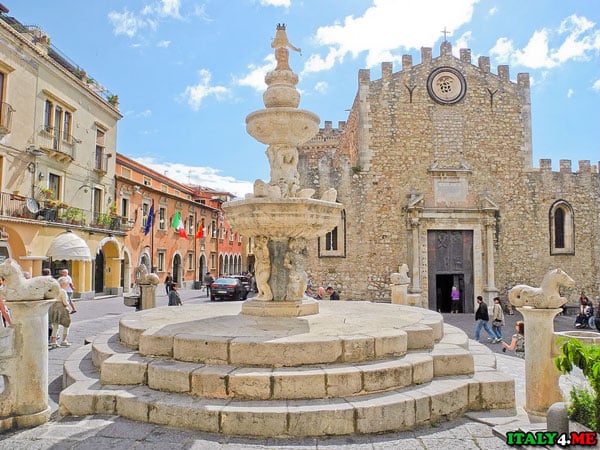
A picturesque fountain stands in front of Dom San Nicolò on Cathedral Square. The three-tiered pedestal is topped by a crowned centaur—an unusual figure that symbolizes Taormina.
A leisurely walk through the town leads to Piazza IX Aprile. Against the backdrop of this open square paved with multicolored tiles, the surrounding mountains rise majestically. If you can tear your eyes away from the breathtaking view, you’ll be surprised to find medieval buildings in the foreground.
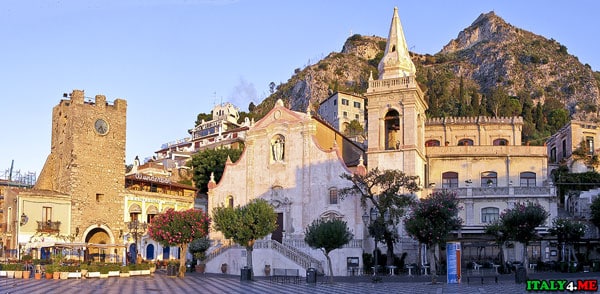
The Clock Tower Torre dell’Orologio</strong), standing to the side of the square, emanates a powerful sense of antiquity. Built in the 12th century in classic fortification style, its austere look is now softened by the décor of the adjacent restaurant. Not far from it, the Church of Saint Augustine (San Agostino) appears more ornate. Constructed in the early 15th century as a symbol of the town’s deliverance from the plague, the church has long since ceased its religious function and now serves Taormina as a public library. Opposite it stands another small church dedicated to Saint Joseph (San Giuseppe).
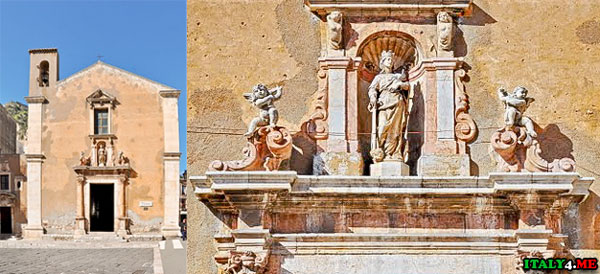
Near the Roman Odeon, tourists can admire the Church of Saint Catherine of Alexandria. Built in the 17th century, it is most famous for the statue of the martyred saint placed above its entrance. Fitting beautifully into Taormina’s landscape is the Anglican Church of Saint George, constructed in the early 20th century. Dedicated to Saint George the Martyr, this church stands at the edge of a terrace that offers a sweeping view of the sea and surrounding mountains.
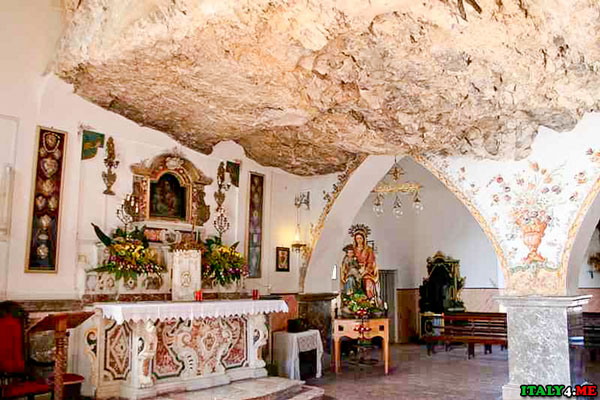
Another fascinating religious site sits high in the mountains. The Church of the Madonna della Rocca is partly built into a natural rock niche on Mount Tauro. Constructed in the mid-17th century, it has since drawn the attention of both pilgrims and curious travelers.
Palaces
It’s worth noting that most of Taormina’s architectural landmarks are modest in size. This holds true for both its religious and secular buildings. The entire town exudes a sense of serenity and unmistakable charm. Any attempt to overwhelm with scale would be lost against the backdrop of the Apennine mountain range. The people of Taormina understood this instinctively and never tried to impress with grandeur—instead, they captivate with simplicity and elegance.
Palazzo Corvaja
Palazzo Corvaja is located in the heart of town and stands as one of Taormina’s most iconic landmarks. The building’s origins trace back to the Arab period in the 10th–11th centuries. It underwent major reconstruction in the 15th century to accommodate the Sicilian Parliament. The palace is named after one of the town’s oldest and most prominent families, which played a key role in local governance. Architecturally, it’s difficult to define the structure in a single term—it’s a distinctive blend of Arab, Romanesque, and Norman styles, each contributing unforgettable character.
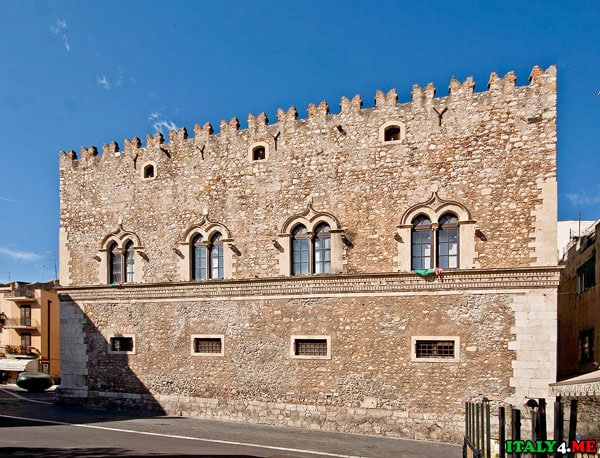
The central tower of Palazzo Corvaja is a rare example of Arab architecture in modern Europe. The eastern arches of its doorways and windows instantly conjure images of “One Thousand and One Nights.” The tower’s ornate crown, typical of Arab design, appears delicate compared to the building’s later additions.
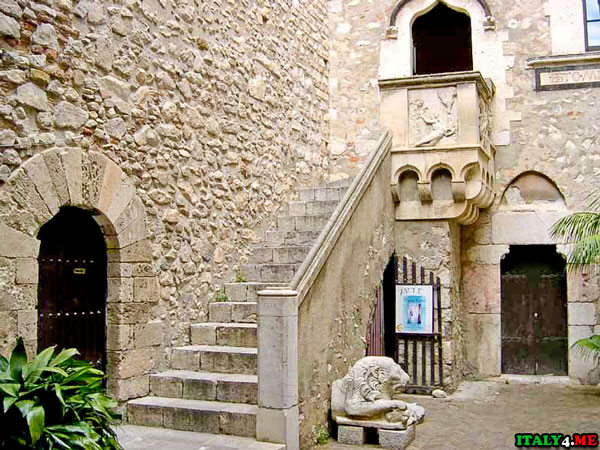
The left wing of the palace dates back to the medieval era and features a staircase decorated with carved biblical scenes. The right wing is the most modern section of the palazzo and once served as the seat of Parliament. In the mid-20th century, this part of the castle was repurposed to house the headquarters of several travel agencies.
Palazzo Duca di Santo Stefano
Palazzo Duca di Santo Stefano served as the residence of the Spanish Duke of Santo Stefano in Taormina. The palace was built in the 14th century by order of Duke De Spuches. While its structure reveals traces of Romanesque influence, its defining character comes from its Gothic features. The twin arched windows are designed in classic Gothic style—tall, pointed arches adorned with symbolic heptagrams. Just beneath the roof, a layered frieze made from contrasting stone creates a striking effect. Chains of black lava stone and white limestone lend the Duke’s palace a solemn, noble appearance.
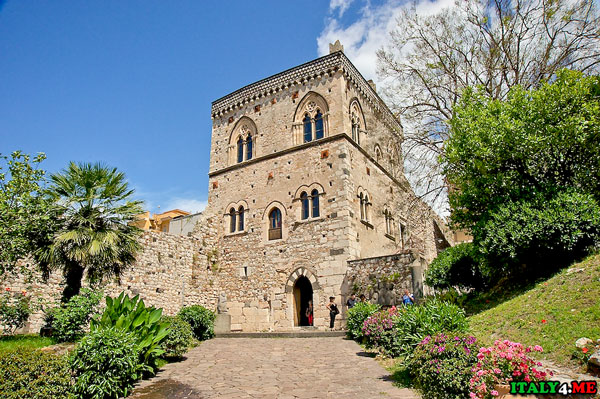
This building suffered extensive damage during World War II, but thanks to the efforts of the Catholic Church, which took the palace under its care, it was fully restored to its original beauty.
Palazzo Vecchio
Like Florence, Taormina also boasts its own “Old Palace” (Palazzo Vecchio). This title belongs to the city’s oldest palace—Palazzo Ciampoli. A commemorative plaque on the palace wall states that construction began in the 15th century. However, the true origins of the building trace back to the 13th century.
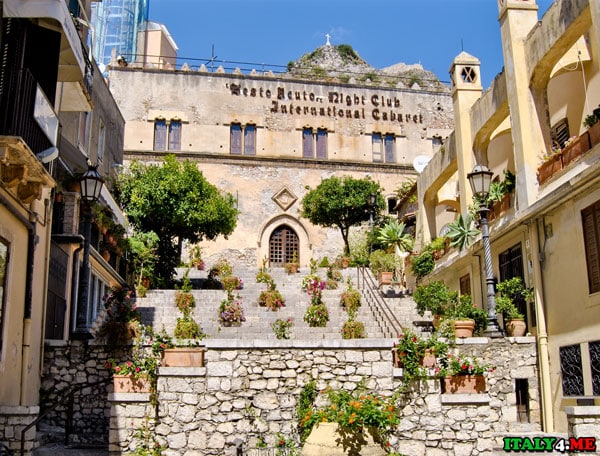
Subsequent additions expanded the initially modest castle and significantly changed its appearance. Some sources suggest that the original owners were the Corvaja family, who later handed the residence over to the Ciampoli family. In the early 20th century, Palazzo Ciampoli housed a hotel, which has not survived to the present day.
Palazzo Badia Vecchia
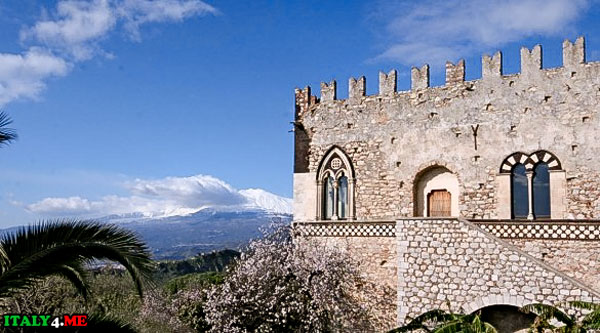
Rounding out our tour of Taormina’s palaces is the so-called “Old Abbey Palace” (Palazzo Badia Vecchia), dating back to the 14th century. Today, this small building houses a museum dedicated to archaeological discoveries. In earlier times, it served the needs of a Catholic abbey. Architecturally, it resembles a medieval defensive tower, animated by the presence of Gothic twin windows. A popular medieval feature, the contrast of lava stone and light Syracuse tiles forms an elegant decorative band that encircles the structure.
Ancient Monuments
Taormina’s municipal authorities have carefully preserved the city’s Greek and Roman heritage, making these ancient relics accessible to all. The remains of the Greek Theater (Teatro Greco) evoke mixed emotions. What survives today still allows visitors to appreciate the sheer scale achieved by its builders back in the 3rd century BC. With a diameter of 358 feet (109 meters), the open-air theater once seated up to 10,000 spectators.
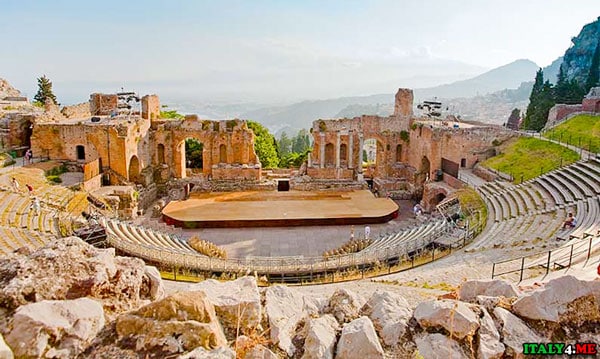
Building such a massive theater on a mountainside required tremendous effort, including the excavation of 100,000 cubic meters of limestone. Though time has eroded much of the structure, the breathtaking view over the sea and surrounding landscape remains as powerful as ever.
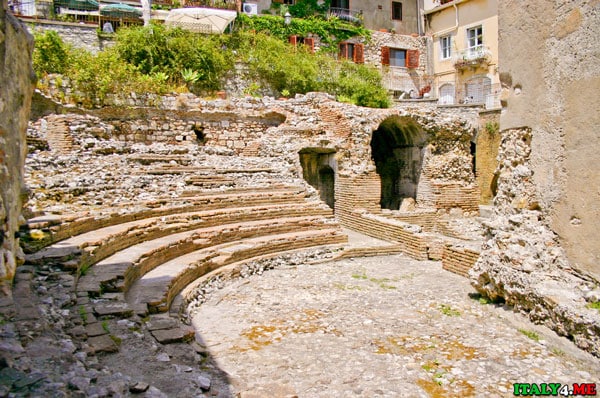
In contrast to the Greek giant, the Roman Odeon is remarkably small, seating only about 200 people. It likely served as a venue for city council meetings. According to Taormina’s historical records, it was built in the 1st century BC by the Roman consul and political figure Octavian Augustus.
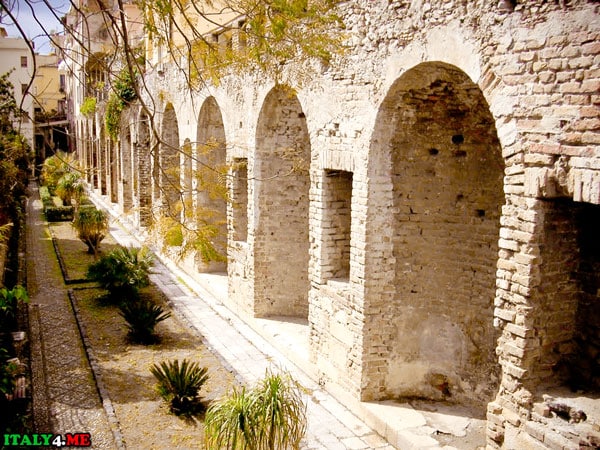
Another testament to the grandeur of the Roman Empire is the Naumachia ruins. In ancient Rome, a “naumachia” was an arena for staging naval battles between gladiators. This one featured a basin nearly 400 feet (122 meters) in diameter and 16 feet (5 meters) deep, designed for thrilling aquatic spectacles.
Nature and Climate
And finally, let’s highlight Taormina’s greatest attraction—one that’s free and accessible to all: the breathtaking beauty of its natural surroundings. From the town’s high vantage points, visitors enjoy sweeping views of rugged mountain ridges and the silky expanse of the sea. In clear weather, you can even admire the majestic, active Mount Etna in the distance. Don’t forget the invigorating air, infused with the crispness of the mountains and the salty breeze of the Mediterranean. During the flowering season, the streets are filled with heady, enchanting aromas.
Be sure to visit the city’s gardens or one of the many exhibitions and cultural events regularly held in Taormina. You’ll be swept away by a wave of vibrant and unexpected impressions. After all, isn’t that what travel is all about—exchanging the routine of daily life for moments filled with wonder and celebration? Wishing you an unforgettable trip!