 Italy for me From Italy with love


Giardini Naxos – one of the most popular resorts on the eastern coast of Sicily (Sicilia) – is surrounded by sea, mountains, and rugged cliffs rising from the water. From nearly every point in the town, visitors can enjoy a clear view of Mount Etna (Etna), located about 25 miles (40 km) to the southwest.
Page Contents
Geography
Giardini Naxos is a small municipality covering just over 2 square miles (5 km²). Its eastern coast is washed by the Ionian Sea (mar Ionio). To the north and west, it borders the municipality of Taormina (Comune di Taormina). The southern border connects to Calatabiano (Calatabiano), with the Alcantara River (Alcantara) flowing between the two. The regional capital, Messina, lies 34.5 miles (55.5 km) northeast.
The terrain is mostly flat, with an average elevation ranging from 16 to 128 feet (5 to 39 meters) above sea level. The highest point, located in the Mastrissa (Mastrissa) area, reaches 689 feet (210 meters).
Population
Naxos is a densely populated area, with around 3,743 residents per square kilometer. The total population exceeds 9,000 people.
Weather
Average winter temperatures hover around 54°F (12°C). December is usually sunny, while January and February are slightly cooler, though temperatures rarely fall to freezing. Snow and frost are extremely rare.

Spring brings milder days, with temperatures climbing to 64°F (18°C). Summers are hot, often reaching 82°F (28°C). Autumn sees more rain than spring, but temperatures remain similar.
History of Giardini Naxos
The land of Giardini Naxos has been inhabited since the Neolithic era. Archaeologists have uncovered remnants of Bronze Age huts and Iron Age tools here.
During the Peloponnesian War, the local population sided with Athens. In 413 BC, when the Athenians attempted a landing in Sicily, they were defeated. Their opponent, Dionysius I of Syracuse (Dionisio I di Siracusa), destroyed Naxos and built Tauromenion (now Taormina) on a nearby hill. The land was handed over to the Siculi people, and the inhabitants of Naxos were sold into slavery. Under Roman rule, Naxos became a station where horses were changed en route to Syracuse.
In the 15th century, the village began to grow. Locals lived mainly off fishing. By the 19th century, they were actively engaged in agriculture, especially citrus cultivation, sugarcane farming, and the production of ceramics and wrought iron goods.
The photo below shows what the town’s seafront looked like in the 1960s:
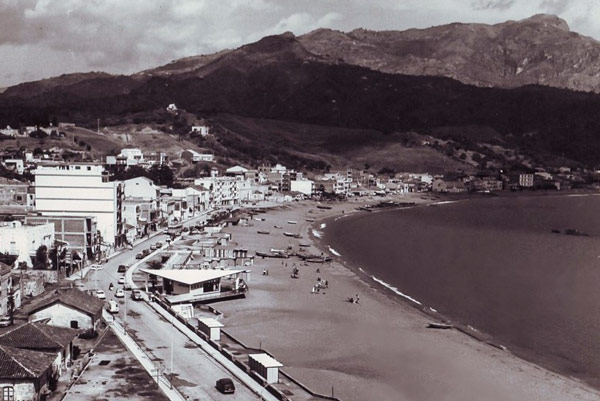
Today, the main source of income is tourism.
You may find this article useful: best hotels in Giardini Naxos and top beaches near Taormina for a seaside holiday.
Beaches in Giardini Naxos
The beaches of Giardini Naxos are wide and sandy, though some areas include pebbles and bits of lava. The sea is clean but not crystal clear—you won’t be able to see the bottom.
There’s only one public beach, and its condition reflects that. The shore is rarely cleaned, you may find trash or driftwood in the sand. There are usually no umbrellas or sunbeds, but access is free for everyone.
If you can, opt for a private beach or your hotel’s beachfront. Private areas are fenced off, well maintained, and the sand is cleared of pebbles.
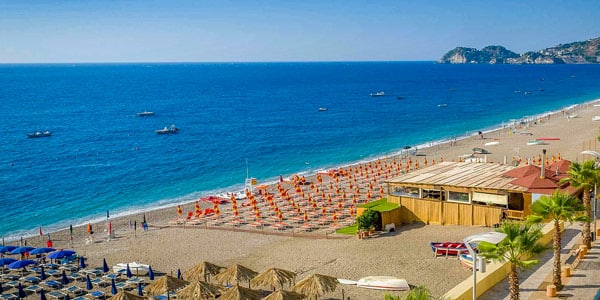
Private beaches offer a range of services. Pricing is posted at the entrance to each section. If you only pay for entrance, you won’t have access to sunbeds or umbrellas, but you can use the changing cabins and showers.
Top private beaches:
- Lido Europa and Lido Bonday Beach – sandy beaches along via Tysandros San Giovanni.
- Lido l’Aurora Celeste – a pebbly beach on Viale Strascina with a rocky entrance, but very clear water.
See also: the best beaches in Sicily
Достопримечательности – что посмотреть?
In the lower part of Giardini Naxos, you’ll find the seafront promenade, restaurants, hotels, villas, churches, and beaches. The upper part is home to the archaeological park and the Archaeological Museum. The main pedestrian street in town is Lungomare Tysandros, which winds along the coastline.
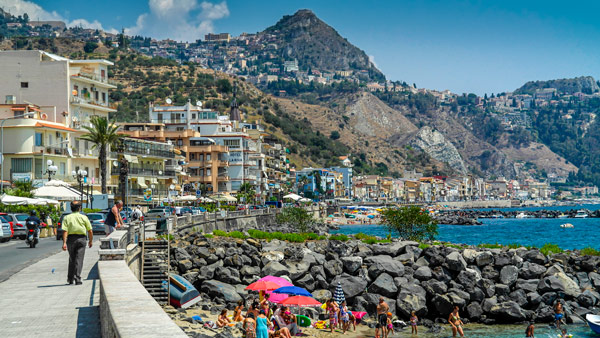
Schisò Castle
Schisò Castle (Castello di Schisò) was built at the turn of the 13th and 14th centuries.
The castle walls offer panoramic views over the bay of Giardini Naxos. In the 16th century, the Torre Vignazza tower was added to the structure. It served as a lookout point, where guards would raise an alarm upon spotting enemy ships. Today, the fort is uninhabited and in a state of neglect, but its exterior still impresses. Visitors can explore the courtyard and several rooms inside. Address: Via Lungomare Schisò, 28.
Church of the Blessed Virgin Mary
The Church of the Blessed Virgin Mary (Chiesa madre: S. Maria Raccomandata) is the main parish church of the commune.
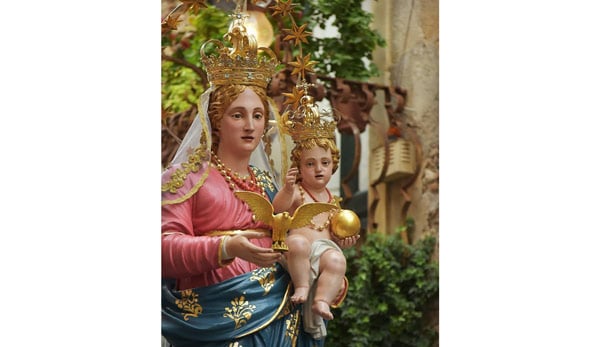
Its history is closely tied to the town’s seafarers, who prayed to the Madonna before setting out to sea. Inside the church is a marble baptismal font from 1703 and a statue of the Virgin Mary. The central panel of the 16th-century altar features an image of Madonna di Porto Salvo holding the Christ Child. Address: Via Umberto, 97.
Official website: www.santamariaraccomandata.it
Church of Saint Pancras
The Church of Saint Pancras (Chiesa San Pancrazio) is located near the seafront on Via Pietragoliti.
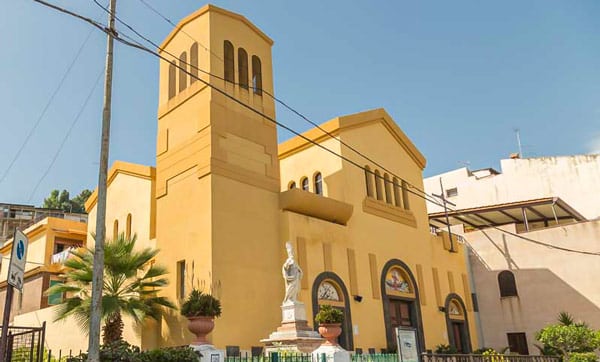
This well-maintained building is kept in excellent condition. Above its arched doors are frescoes depicting scenes from the life of Saint Pancras, who traveled from Antioch to the island to preach Christianity. Inside, you’ll find a statue of the saint. During mass, the sound of bells and the church organ resonates throughout the area.
Archaeological Park
The Naxos-Taormina Archaeological Park (Parco archeologico di Naxos-Taormina) was established in 2001.
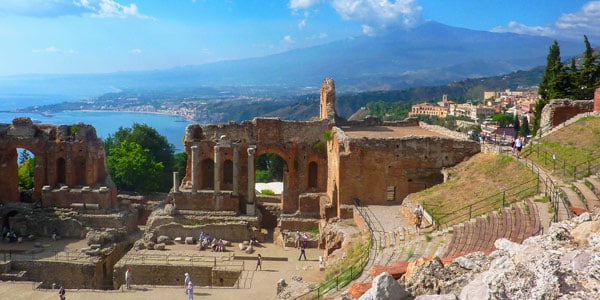
It covers a vast area where you can explore the remains of ancient buildings. Inside the park, there’s a museum showcasing ceramic artifacts and Roman mosaics. Unfortunately, the site is poorly maintained and appears neglected. To make the most of your visit, consider renting an audio guide or booking a private tour.
Official website: www.parconaxostaormina.com
Statue of Theocles
The Statue of Theocles (Statua di Teocles), the founder of Naxos, stands on the seafront promenade.
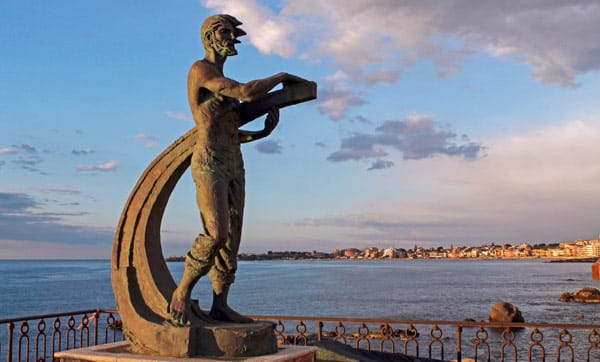
It’s a must-visit spot at sunset—perfect for scenic photos of the area.
Olympic Temple
In 1960, the Olympic flame passed through the commune. A ceremony was held in honor of Tisandros, an ancient Naxos boxer who won four consecutive Olympic victories.
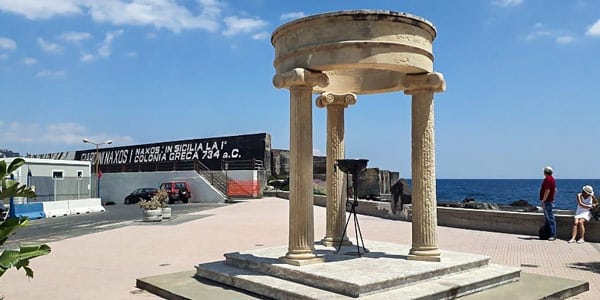
After the ceremony, the torch continued to Rome, and a monument was erected on Via Calcide Eubea, now known as the Olympic Temple (Il tempio olimpico di Giardini Naxos). The structure is engraved with inscriptions commemorating the importance of Olympic victory, Tisandros, and the founding and fall of ancient Naxos.
Monument to the Fallen of World War I
The Monument to the Fallen Soldiers (Monumento ai caduti della prima guerra mondiale) stands in Piazza Roma.
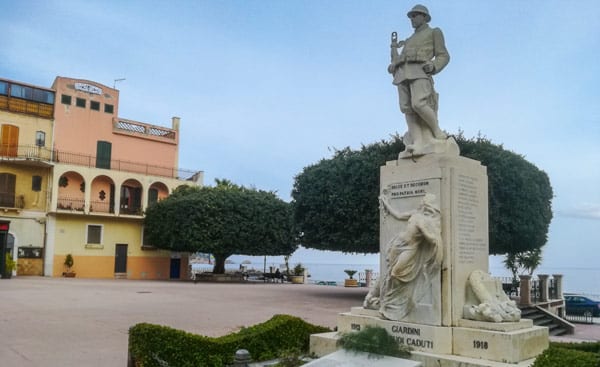
Carved from white marble by sculptor Anacleto Brunetto, it features the figure of an infantryman standing on a tall pedestal. Two laurel wreaths flank the base, with the dates of World War I engraved nearby. Behind the statue stands a female figure holding a laurel branch, symbolizing victory. The monument bears the names of 54 local soldiers who lost their lives in the war.
Festivals
If you find yourself in Giardini Naxos in September or June, consider yourself lucky. These months mark two major festivals celebrating the Virgin Mary and Saint John the Baptist.
Feast of the Blessed Virgin Mary
The town’s most important celebration is the Feast of the Blessed Virgin Mary (Festa della Madonna: S. Maria Raccomandata), held from September 7 to 9. The festival was first celebrated in 1849, when local sailors wrote a letter asking the Madonna to protect them at sea. From that point on, she became the patroness of the town.
Preparations begin on August 25, when the sailors’ letter is read aloud in the church. On September 7, the statue of the Virgin Mary—normally housed in a niche by the pier—is placed onto a fishing boat. Accompanied by hymns, it is taken to the dock, where devotees gather to greet it. A special blessing ceremony for the boats and the sea is held.
On September 8, a procession carries the statue through the streets of the town. Festivities take place throughout the area, with celebrations on every corner. The statue is then brought to the church, where the faithful can venerate it and kiss its feet in a sign of devotion. On September 9, the statue is returned to its original location.
Feast of Saint John the Baptist
The Feast of Saint John the Baptist (Festa di San Giovanni Battista) is celebrated on June 24, which commemorates his birth. Churches hold special services and solemn Masses. The town comes alive with music and festive activities. In the evening, a statue of the saint is carried in procession through the commune and then returned to the Church of the Immaculate Virgin Mary (Chiesa Santa Maria Immacolata).
How to Get to Giardini Naxos
Located about 60 km south of Giardini Naxos is the international Catania Fontanarossa Airport (Aeroporto di Catania-Fontanarossa). It serves flights from Dublin, Paris, Amsterdam, and various domestic routes, with direct connections to Milan, Rome, Genoa, Bologna, and Verona.
If you’re not driving, take a bus from the airport to the city. Get off at the Catania stop near the central train station (Catania Centrale). From there, take a train to the Taormina-Giardini station (on the Messina-Siracusa railway line). Giardini Naxos is just 1 km from the station—you can walk, catch a bus, or take a taxi to the town center.