 Italy for me From Italy with love


Villa Medici in Rome (Villa Medici) takes its name from the famous Italian family and was among the first properties owned by the Medici dynasty in the Eternal City. The site boasts a rich history and today houses the French Academy of Fine Arts. The villa is open to tourists.
Page Contents
History
The First Gardens of Rome
On the Pincian Hill, where Villa Medici now stands, the first gardens in Roman history were once created. They were commissioned in the 1st century BC by Lucius Lucullus, a general and consul often credited as the founder of Italian horticulture. Lucullus’ gardens featured fountains, local and exotic plants, and alleys adorned with statues and vases. A spacious house stood shaded by the trees.
The Execution of Messalina
Emperor Claudius’ wife Messalina coveted these beautiful gardens. Due to her schemes, the property’s owner after Lucullus, Decimus Asiaticus, took his own life. But for Messalina, the gardens became her final resting place. She was executed here for betraying her husband and emperor.
The Construction of the Villa
The magnificent gardens fell into ruin and were eventually destroyed following the decline of the Roman Empire. The site was overtaken by vineyards. It wasn’t until the 16th century that Cardinal Giovanni Ricci purchased the land. He hired an architect and built a picturesque mansion. 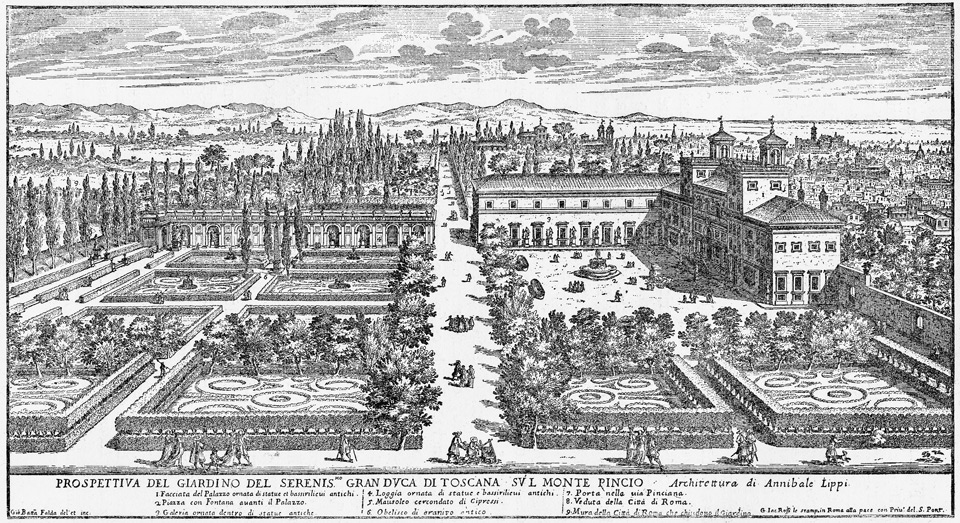 In 1576, the Ricci mansion was acquired by a member of the Medici family — Cardinal Ferdinando. A passionate collector and lover of antiquity, he purchased the land and house on the Pincian Hill to create a villa where he could display his collection.
Architect Bartolomeo Ammannati remodeled the main structure and added a right wing and gallery. Around the renovated mansion, a garden with shaded alleys of myrtle and boxwood was created. Classical statues from Ferdinando’s collection were placed throughout the garden.
By 1587, the villa began to deteriorate. Ferdinando Medici was forced to leave Rome when he became ruler of Tuscany after his elder brother’s death. In the first half of the 18th century, efforts were made to restore the villa, funded by the sale of ancient artifacts (bas-reliefs and column sections) from the home’s interior decor.
Status Change
The Medici dynasty came to an end in 1737 with the death of Gian Gastone Medici, who left no heirs. Afterward, the family’s Roman residence passed into the hands of the House of Lorraine. Ancient artworks from the villa were later moved to Florence by order of Leopold II. Today, replicas of the lost statues are displayed at the villa.
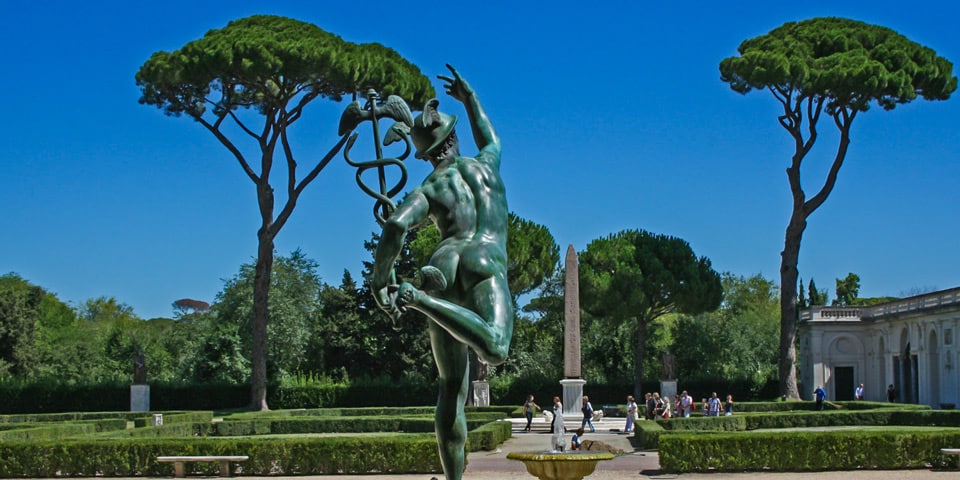
In 1803, the villa became a hub for creative minds — painters and sculptors. By decree of Emperor Napoleon Bonaparte, it became home to the French Academy in Rome. For the academy’s needs, the villa underwent renovations, including enlarging the windows to allow more light into the studios.
Exterior
The Palace
The luxurious Villa Medici building is adorned with bas-reliefs depicting mythological figures and scenes from ancient life.
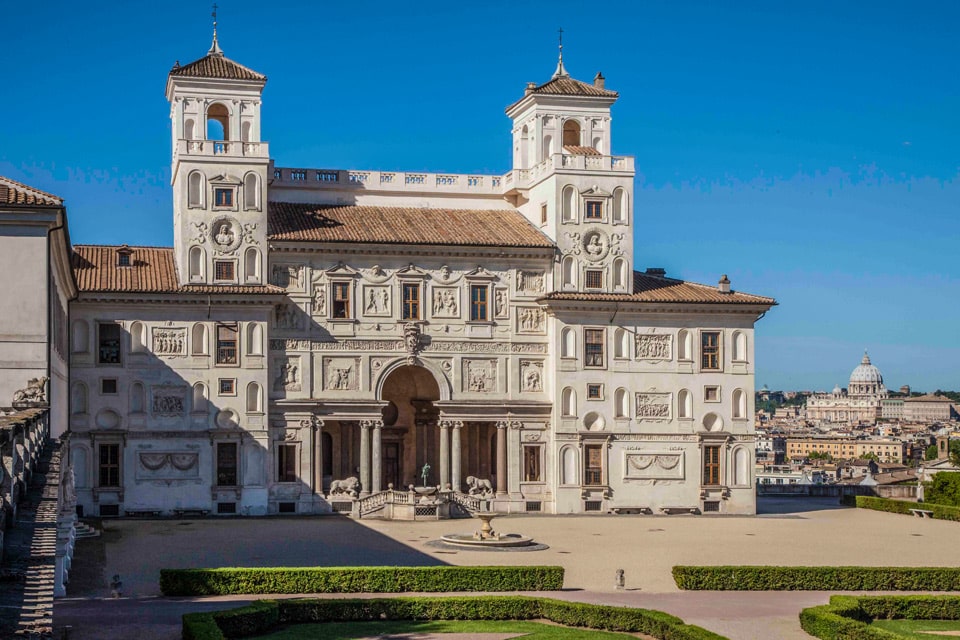
Busts and statues are set into niches throughout the façade.
Marble lion sculptures flank the main entrance, each placing a paw on a cannonball — a nod to the coat of arms of the villa’s former owner, Ferdinando Medici. Opposite the entrance stands a fountain, its basin decorated with a statue of Mercury, the fleet-footed youth. Two towers crown the building symmetrically, offering beautiful views from their open terraces.
Passing through the archway of the main entrance, visitors enter the vestibule. Its walls are decorated with paintings representing the seasons and illustrations of Aesop’s fables. Inside, many frescoes can be found, most of them painted by Jacopo Zucchi.
During recent restorations, the vestibule ceiling was stripped of plaster, revealing paintings of a pergola (lattice canopy), green trees, and birds.
Gardens
The gardens of Villa Medici have largely retained their 16th-century appearance. They cover an area of more than 7 hectares (17 acres). The garden’s development spanned many years, with rare plants cultivated specifically for it. Today, lawns and numerous flowerbeds have been restored to their original planned locations.
Many fountains and pools are scattered throughout the gardens, made possible by an irrigation system designed by engineer Camillo Agrippa.
Among the statues, visitors can see representations of Niobe and her children. The tragic tale of Tantalus’s daughter was a favorite theme in ancient art. At the edge of the park stands a sculpture of the goddess Roma, discovered during archaeological excavations at Monte Cavallo. In total, there are 170 statues within the grounds.
Since the early 1990s, continuous restoration efforts have been underway, returning the villa and its gardens to their historic splendor.
How to Get There
Visits to Villa Medici must be planned in advance. Guided tours are available by reservation only. Interestingly, several rooms at the villa can be rented for overnight stays, though reservations must be made at least four months ahead. Occasionally, slots become available a few days before the visit on www.tiqets.com.
Getting there is easy. The villa is located near the Spanish Steps and Villa Borghese, at the address: Viale Trinità dei Monti, 1.
You can reach it by metro or bus. Both the bus stop and metro station are named Spagna.
- Opening hours: 10:00 AM to 7:00 PM, closed on Mondays.
- Ticket price: from €14, free admission for children under 10. Roma Pass holders, students, and visitors over 60 pay €11.
- Official website: www.villamedici.it