 Italy for me From Italy with love

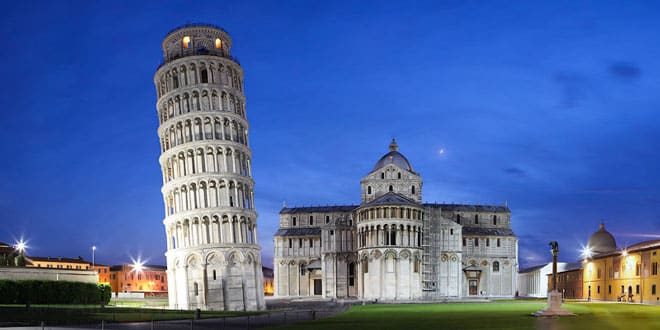
The most famous landmark of the Italian city of Pisa (Pisa, Tuscany region) is its Tower. It is primarily known for not standing perfectly upright, but leaning away from its central axis. After all, if not for this flaw, it’s unlikely that thousands of tourists would flock there each year just to see this globally iconic “leaning” attraction.
Not everyone realizes that the “leaning” tower is not a separate structure, but part of a larger architectural ensemble. In addition to the tower itself—which is actually a bell tower, or campanella (from the Italian word for “little bell”)—the complex includes the Pisa Cathedral (Duomo di Santa Maria Assunta), the Baptistery (Battistero di San Giovanni), the Camposanto Cemetery (Campo Santo), and the Piazza dei Miracoli (Piazza dei Miracoli), where all of this is located. The bell tower is situated near the cathedral’s northeast corner. The entire ensemble is considered a masterpiece of medieval Italian architecture and has had a profound influence on the development of Italian culture.
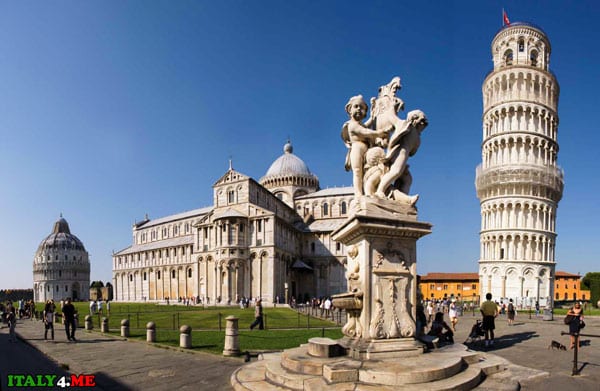
The Leaning Tower of Pisa has been tilting for over eight centuries. Because of this, Italians often call it the “long-lasting miracle.” The tilt increases by about one millimeter each year. In total, the building has shifted more than five meters (about 16.4 feet) from its axis—which is quite a bit. Nevertheless, the campanella has even survived an earthquake and remains open to visitors today.
Page Contents
How to Get Inside – Ticket Prices
Since tens of millions of euros have been spent trying to save the Leaning Tower of Pisa, the cost of visiting this landmark is understandably high. As of July 2026, tickets start at €20 and are expected to rise. If you decide to climb inside, remember that no more than 30–40 people are allowed inside at the same time.
Despite the price, it’s strongly recommended to book your ticket in advance. Tours are often sold out a day ahead. Even if you arrive early in the morning, you’ll likely only find tickets available for the evening. In summer, the situation becomes even more difficult.
Opening Hours
Due to structural concerns, visiting the bell tower was prohibited in 1990. It was reopened in December 2001.
Today, the Leaning Tower of Pisa welcomes tourists year-round.
- April to September: from 8:30 AM to 8:30 PM
- October to March: from 9:00 AM to 5:00 PM
From June 14 to September 15, special night visits are available—from closing time until 11:00 PM. This initiative was launched to give tourists a chance to enjoy sunset views from the Leaning Tower’s panoramic platform. At that time, the city is illuminated by thousands of lights, revealing a completely different side of Pisa.
Official website of the Leaning Tower of Pisa: www.opapisa.it/it/la-piazza-dei-miracoli/torre-pendente/larchitettura.html
What the Tower Looks Like Inside
Arrive early for your tour of the Leaning Tower of Pisa. This is because you’ll be required to check in all your belongings at the cloakroom (located in the adjacent building). Only photo or video cameras are allowed inside. Women’s handbags — even the smallest ones — are strictly forbidden.
Perhaps this rule exists to discourage visitors from stepping into Galileo’s shoes and tossing things from the top of the tower.
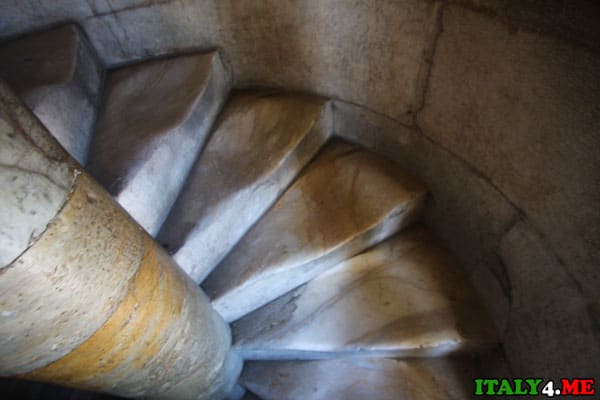
Upon entering, you’ll see that the staircase at the base is quite wide. It spirals up along the interior wall of the tower. Although the steps are fairly comfortable, many visitors feel dizzy as they ascend. The natural urge is to reach for both walls to keep balance. The stairs are made of natural marble, which, while decorative, isn’t particularly durable under heavy foot traffic. In places, the marble is heavily worn due to millions of visitors. As you climb higher, the staircase narrows. By the time you reach the final tier, it’s barely 16 inches (about 40 cm) wide.
The tower is hollow inside, and the staircase spirals around this cavity. Small observation windows line the inner wall, offering a peek into the dizzying void. From the fifth tier onward, visitors are allowed onto exterior observation decks, which are enclosed by safety nets and railings. Some stop at the bell chamber (second-to-last tier), skipping the final climb — but that’s a missed opportunity. The reward at the top is breathtaking. There are no nets, and the railing is only waist-high, leaving nothing to obstruct your panoramic view. From the summit, the cathedral’s cross looks close enough to touch. Only from up there can you truly feel how slanted the floor beneath your feet is.
The Descent
Once you’ve had your fill of the view, take a deep breath and prepare for your final challenge — the descent. Staff stationed on each level manage the one-way traffic flow. Movement alternates between ascending and descending groups. Going down is harder. The worn marble is smooth and slippery, making it easy to slip. Be very careful.
If you don’t feel up to reaching the top, consider visiting the “Fish Hall.” The room is named for a fish carved in bas-relief inside. It was closed to the public for a long time, as it housed equipment used to monitor the tower’s tilt. An opening in the ceiling lets you view the starry sky during nighttime visits.
Evening tours of the bell tower also include a visit to the Santo Campo Memorial Cemetery. It serves both as a resting place for the dead and a site for seminars on life. There you’ll find cycles of frescoes on the walls, illuminated with special lighting for quiet contemplation.
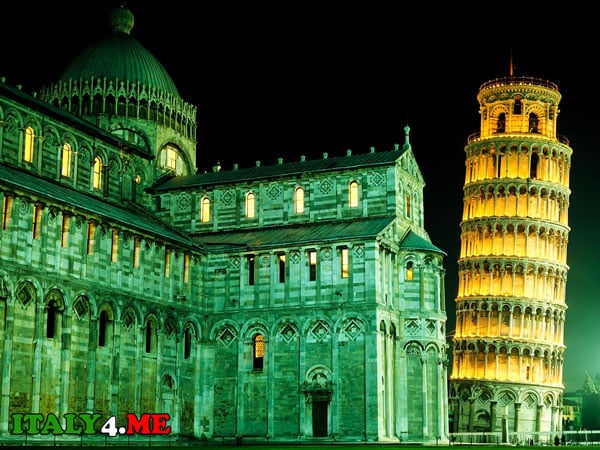
History of the Leaning Tower of Pisa’s Construction
From the moment it was built, the Leaning Tower of Pisa became virtually the symbol of the city. Construction began in August 1173 on a green meadow at the outskirts of Pisa, alongside the city’s cathedral and baptistery. With interruptions, the project spanned nearly two centuries. The bell tower was finally completed in 1370.
The original architect is still unknown, though historical sources suggest it may have been Bonanno Pisano (Bonanno Pisano). Today, it’s impossible to say whether the lean was part of the original design or caused by a later foundation shift—although the latter seems far more likely. Most agree the original blueprint had a critical flaw, and the tower was originally intended to stand upright.
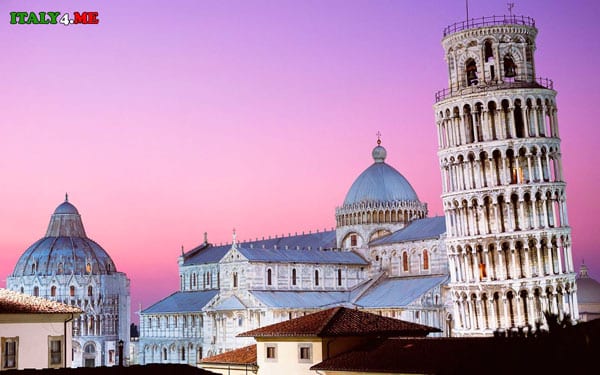
The tilt began almost immediately after construction of the first arcade level, which stands 11 meters (36 feet) tall. Initially, the lean was just 4 centimeters (1.6 inches). Work was halted and did not resume for another hundred years. By 1275, the tilt had increased to 50 centimeters (19.6 inches), and builders tried to compensate by adjusting the height of the upper stories—raising the leaning side by 10 centimeters (4 inches). Unfortunately, this did little to fix the problem, and construction was cut short, leaving the tower four stories lower than originally planned.
Architectural Features
The Leaning Tower’s Romanesque-Pisan style is admired for its elegance and beauty. Upon completion, its eight tiers reached a height of 58.36 meters (191 feet). The highest point stands at 56.70 meters (186 feet), while the lowest measures 55.90 meters (183 feet).
The tower has a cylindrical shape, with a base diameter of 15.54 meters (51 feet). Wall thickness at the base is 4.90 meters (16 feet), narrowing to 2.48 meters (8 feet) at the top. The lean measures 4 meters (13 feet) at the base and increases to 5.30 meters (17.4 feet) at the top. Visitors reach the summit via 294 steps, where they’re rewarded with stunning views of the Field of Miracles and its surroundings.
Constructed from stone and adorned with light gray and white marble, the tower’s entrance is flanked by bas-reliefs depicting mythical creatures. Above the lunette is a statue of the Madonna and Child, sculpted by Andrea Guardi (Andrea Guardi). The first tier features solid arches with 15 half-columns and is decorated with coffers holding rosettes—identical to those on the baptistery and cathedral. Six upper levels are ringed with decorative Romanesque arcades, reminiscent of Byzantine architecture. At the top is the belfry, with arched openings for seven bells, weighing from 300 kg to 3.5 tons (660 to 7,700 pounds). Each has a unique name and tone, and several were added in the 16th–17th centuries. Remarkably, all are still functional and ring out to this day.
The Bells
The first bell, Pasquereccia (Pasquereccia), tuned to G♭, was cast in the mid-13th century. The second, Terza (Terza), tuned to B♯, was added in 1473. The small Vespruccio (Vespruccio), tuned to E, was made in 1501. The Crocifisso (Crocifisso), tuned to C♯, was crafted by Vincenzo Posenti (Vincenzo Posenti) and later recast by Gualandi da Prato in 1818.
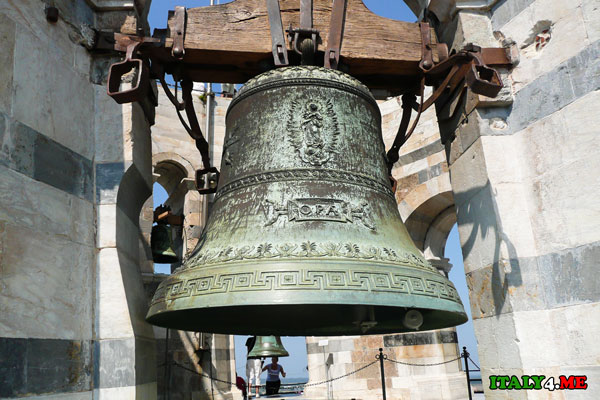
The Dal Pozzo (Dal Pozzo) bell, tuned to G, was created in 1606. It was destroyed during WWII bombings but later restored and moved to a museum. A perfect replica was installed in its place in 2004. The Assunta (Assunta), tuned to B, is the largest of the seven bells and was cast by Giovanni Pietro Orlandi. The final bell, San Ranieri, tuned to D♯, was added last and has been recast several times, most recently in 1735.
As the cathedral to which the Leaning Tower belongs is still active, the bells ring before every mass and at noon. In the Middle Ages, each bell rang at a specific liturgical hour rather than all at once.
Saving the Tower
After construction of the Leaning Tower of Pisa was completed, the city authorities faced a new challenge: how to prevent it from collapsing?
This issue became especially pressing after a storm swept through Pisa and caused the tower to shift by a fraction of a millimeter in just one day. A public competition was launched, inviting ideas from scientists, architects, and even ordinary citizens on how to save the tower. The main requirement was to stop the tilt while preserving the structure’s iconic lean. By that time, the “endless miracle” had become the city’s symbol and its top tourist attraction. The call brought in a flood of suggestions—some wild, some whimsical.
Ideas included building a statue of a distraught architect next to the tower to “hold up” his failed creation, or attaching a giant helium balloon to the top of the bell tower to keep it from leaning further. One proposal suggested installing a tramway around the tower to compact the ground and prevent further sinking. Others wanted to construct a second, identically leaning tower next to it—but tilted in the opposite direction so the two could support each other.
Of course, the most bizarre ideas were dismissed. Only those based on scientific research were taken seriously. In the late 20th century, tremendous efforts by experts finally paid off. They discovered that the soil beneath the southern side of the foundation was much softer than the northern side. Using steel cables to secure the tower and prevent collapse, engineers slowly and carefully removed soil from beneath the northern foundation. As the northern side settled, the tilt was reduced by about 50 centimeters (19.6 inches), effectively “rejuvenating” the tower by a couple of centuries. Once stabilized, the cables, counterweights, and supports were removed. Today, Pisa’s pride stands in an almost perfectly stable state.
How to Get to the Tower
- The Leaning Tower of Pisa is located at: Piazza del Duomo, 56126 Pisa
If you plan to visit the bell tower—which is slightly off the main tourist routes—set aside at least a day. This small city has more to offer than just the famous leaning structure.
From the train station, it’s about a 40-minute walk to Pisa’s most iconic landmark. If you prefer not to walk, you can take public transportation. It will take you to Pisa Rossore Station, which is just a short stroll from the tower.
See our guide: how to get from Pisa Airport to the city center
Interesting Facts About the Leaning Tower of Pisa
Why It Leans
There is an intriguing story connected to the Leaning Tower of Pisa. It describes how Pisan masters asked an architect to design and build a bell tower for the cathedral that was under construction. The architect did his best, erecting a graceful tower that stood as straight as an arrow. However, the Catholic clergy, who had commissioned the work, refused to pay the master. Feeling frustrated, the architect turned to leave. Yet before departing, he waved his hand at the tower and exclaimed, “Come with me!” Right before the astonished witnesses, the campanile tilted, as if attempting to take its first step.
Galileo Galilei
We also know for certain that in 1564, the future famous scientist – Galileo Galilei (Galileo Galilei) – was born in Pisa. Historical records tell us that, at that time, he was simply a physicist and philosopher who conducted various experiments with the Leaning Tower. He dropped objects of different weights and volumes from the top of the bell tower to prove his theory that a falling body’s weight does not affect its speed of descent.
By the end of 1986, UNESCO awarded World Heritage status to the entire architectural complex that includes the Leaning Tower of Pisa.
It Turns Out There Are Three
It’s surprising, but there are actually three “leaning” structures in Pisa, all of them bell towers. We’ve already discussed the first one in detail. The second is located amid the pine parkland of Le Piagge (le Piagge). This is the bell tower of the Church of Saint Michael (San Michele degli Scalzi). 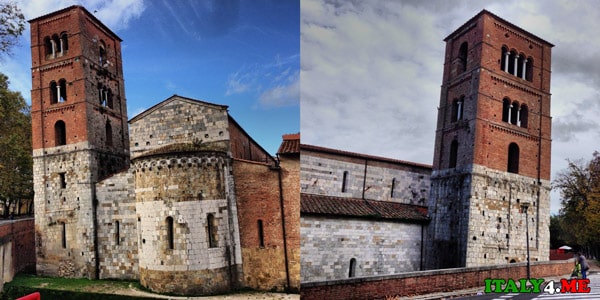
The third bell tower is tucked away on the oldest street in the city and belongs to the Church of Saint Nicholas (San Nicola). Its slant doesn’t stand out as much because it’s closely surrounded by other buildings. All of these structures began to tilt during construction in the distant past, caused by uneven soil and underground water.
Altogether, there are about 300 “leaning” towers in the world. Among them are the clock tower in Izmir (Turkey), Big Ben (England), the Towers of Bologna, and the Nevyansk Tower (Russia). However, the “Leaning Tower of Pisa” (Torre pendente di Pisa) has gained the greatest worldwide fame.
Photos in the Background
Finally, a reminder: don’t forget to take a picture with Pisa’s “leaning” beauty. Indeed, photos with this tower have practically become a classic. If you put in a little effort, you may even manage to straighten the tower in your shot. After all, its angle in the photo depends on which side you take the picture from. For instance, if you stand on the northern or southern side of the campanile, you’ll see a perfectly upright structure. However, the western and eastern sides give you a chance to observe the landmark’s “twist” in all its glory. By using your imagination—or even doing a quick online search first—you will undoubtedly come up with your own unique composition featuring Pisa’s bell tower.

How to Get to Pisa
- from Rome: the fastest way is by high-speed train from the central Roma Termini station, FRECCIABIANCA, for €37—travel time is 3 hours—or by regional train for €23—4 hours. If you plan your trip 2–3 months in advance, you can buy a high-speed train ticket for just €9. There is also a train costing €22 that leaves daily from Roma Trastevere station. Tickets can be purchased at the station up to 7 days in advance. Read the detailed instructions.
- from Florence: from the Firenze Santa Maria Novella station, there is a frequent train costing €8, taking about an hour. You can also travel by car.
- from Milan: from the Milano Centrale station, the quickest route is by FRECCIAROSSA train with a transfer to a local train in Florence at the Firenze Santa Maria Novella station. The journey takes just over 3 hours. The cost is €48–65 (€27–37 if purchased 3 months in advance), depending on the time of day. A slightly slower option is a regional train for €34 (€9 if purchased in advance), taking 4 hours. Read the detailed instructions.
- from Rimini: you will most likely have to travel with transfers in Bologna and Florence, as there is no direct connection. The journey takes about 4 hours, with one-way tickets costing €39–53. An alternative option is to rent a car at the airport for €50–60 per day and travel on your own, not relying on train schedules. Find the best car rental options in Italy.
- from Genoa: from the Genova Piazza Principe station by regional or high-speed train for €15–20. The journey takes about 2 hours.
You can check the current train schedule in Italy on the official website www.trenitalia.com in the TUTTI I TRENI section. See the instructions on how to buy tickets in Italy yourself without intermediaries.
Where to Stay in Pisa?
Most tourists come to Pisa for just one day. This option lets you check it off your list and take a picture against the backdrop of the Leaning Tower. However, to visit other equally significant attractions and truly immerse yourself in the city’s atmosphere, we recommend staying in Pisa for at least one day by booking a hotel on Booking.com.
The cost of decent accommodations ranges from €90 to €130. Use this special link to find a hotel near the tower. Here’s an idea: arrive in Pisa around midday, stroll around the city to get a feel for it, enjoy dinner in the evening, and then at sunrise, take a walk and snap photos at the most popular spots. Afterward, head back to your hotel for breakfast before going home.
We wish you pleasant travels and great photos!