 Italy for me From Italy with love

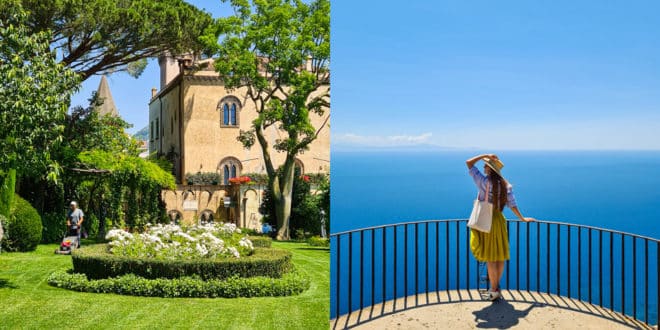
Villa Cimbrone is a historic estate located in the resort town of Ravello on the Amalfi Coast (Costiera Amalfitana). At the end of the 19th and beginning of the 20th century, it became a remarkable blend of English landscaping and Italian garden traditions.
The historical park spans approximately 6 hectares (15 acres) on the rocky promontory of Cimbronium, where the famous viewpoint, the Terrace of Infinity (Terrazza dell’Infinito), offers breathtaking views of the Amalfi Coast.
Page Contents
History
During the late Roman Empire, this land, known as Cimbronium from the ancient name of the rock, was a large estate with lush vegetation that produced high-quality timber for the naval fleet.
The first mention of the villa as a farmhouse appeared in the 11th century when the estate was owned by the noble Acconciagioco family. In the mid-14th century, the wealthy and influential Fusco family from Ravello, linked to the famous Pitti family in Florence (Firenze) and the D’Angio family in Naples (Napoli), became the new owners.
Owning the fertile lands of the promontory was prestigious, mainly due to the large plain, which was suitable for farming compared to the rugged terrain of Ravello.
While the Fusco family owned Cimbronium, a period that lasted more than five and a half centuries, the agricultural estate on the cliff was gradually transformed into an elegant park, reflecting the classical and Renaissance tastes of the Italian palaces.
This small rocky promontory has a new building, garden, panoramic terrace, open pavilions, pathways, statues, amphoras, and other landscape design elements.
Following a period of prosperity, the villa faced a decline in the 18th–19th centuries due to economic downturns, French occupation, brigandage, and an earthquake. Villa Cimbrone survived but fell into disrepair.
After this decline, the abandoned villa was rediscovered at the end of the 19th century by the famous English traveler Ernest William Beckett, Lord Grimthorpe. Following the death of his beloved wife, he came to Ravello upon the advice of friends to heal his soul.
An intellectual and aesthete, Beckett was so enchanted by the beauty of this magical place that, in 1904, he decided to purchase the unusual estate on the rocky promontory and transform it into “the most beautiful place in the world.”
The layout of the grounds was planned from the central avenue, running north to south, leading from the monumental entrance to the panoramic terrace, seemingly floating above the beautiful Gulf of Salerno.
The park’s design followed the aesthetic concepts of English architects and landscape designers like Harold Peto, Edwin Lutyens, and Gertrude Jekyll.
The combination of English and Italian styles successfully integrated local and exotic plants, introducing numerous decorative forms and elements, such as temples, pavilions, fountains, and statues.
The sophisticated selection of trees, flowers, and scents was advised by Vita Sackville-West, an English writer and gardener, who frequently visited the Beckett family.
The ancient “Roman villa,” influenced by European fashion and classical literature, acquired a new refined style and unique charm.
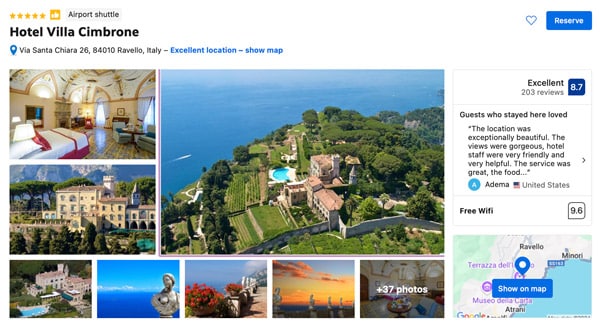
The estate also houses the Michelin-starred restaurant Il Flauto di Pan.
What to See Inside
Villa Cimbrone features 12 attractions, and all visitors receive a map with the route upon entry.
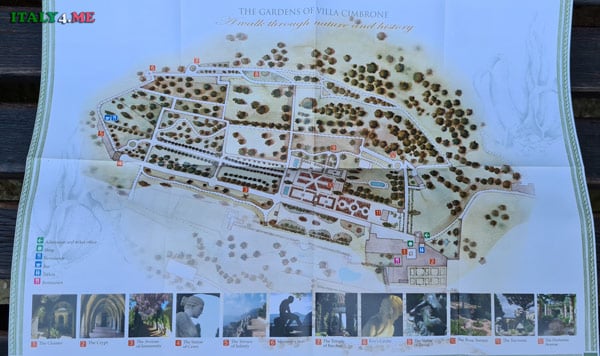
I recommend allocating at least 1.5 hours for your visit and ensuring enough space on your camera for photos.
The Monastery
At the villa entrance, to the left of the ancient 16th-century wooden doors, is the monastery, which has a charming small courtyard in an Arab-Sicilian-Norman style, featuring a magnificent covered well in the center.
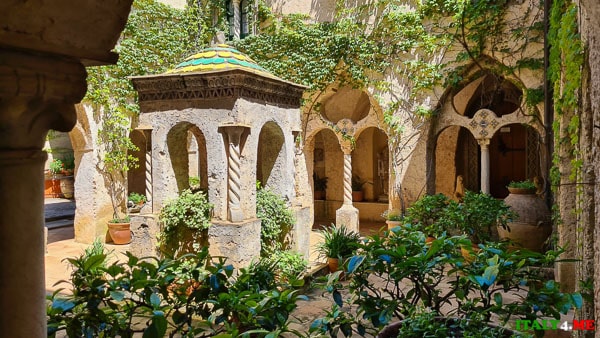
The walls of the monastery are decorated with tiles of ancient terracotta by the famous Florentine sculptor Luca della Robbia.
Above the arch, supported by two massive columns, are depicted two boar heads, an element of Lord Grimthorpe’s family crest. After collapsing, the composition was restored according to the original design and enriched with new secular and religious decorative elements.
The Crypt
To the right of the entrance, at a lower level, is the crypt—an open Gothic gallery with massive columns and complex arched vaults.
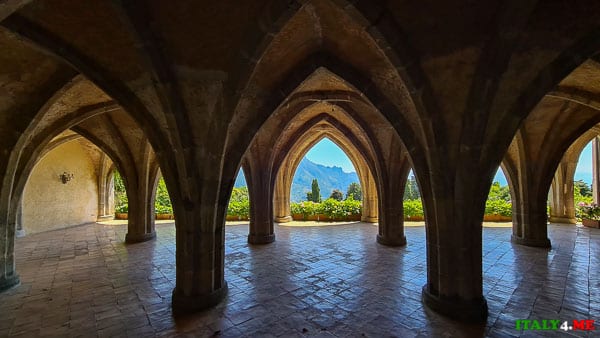
It was built between 1907 and 1911, modeled after the Fountains Abbey, near Malton, where Lord Grimthorpe was born.
One side of the gallery offers a magnificent view of the seaside town of Maiori. The shady interior is often used for social events and various functions. From its opening, the crypt became a meeting place for the famous London Bloomsbury Group of early 20th-century
intellectuals, including Virginia Woolf and Lytton Strachey.
Avenue of Abundance
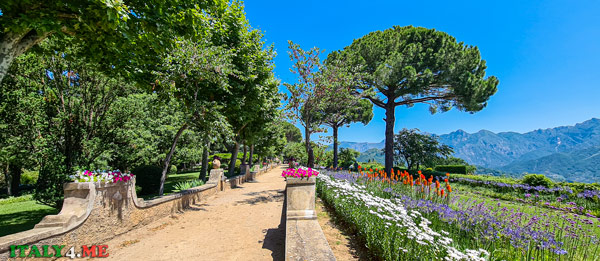
The main shaded Avenue of Abundance was laid out in the 16th century, leading deep into the park to the main viewing point.
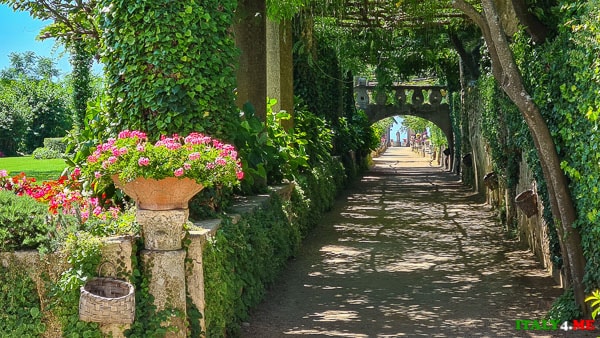
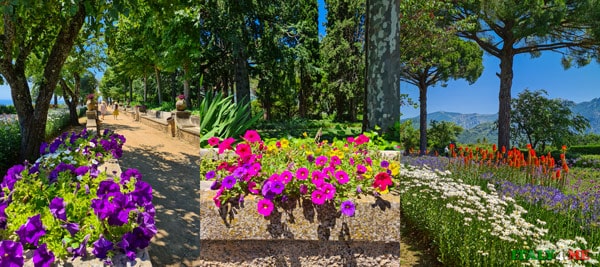
A leisurely stroll offers the chance to enjoy the cool shade and marvel at the endless variety of exotic plants, some over 150 years old.
The floral arch is formed by fragrant wisteria vines reaching up to six feet long. Along the avenue are magnificent 18th-century ceramic vases and bronze statues of Greek warriors.
Temple of Ceres
The picturesque Avenue of Abundance ends at the Temple of Ceres—the Roman goddess of harvest and fertility, whose statue stands in the center on a circular pedestal.
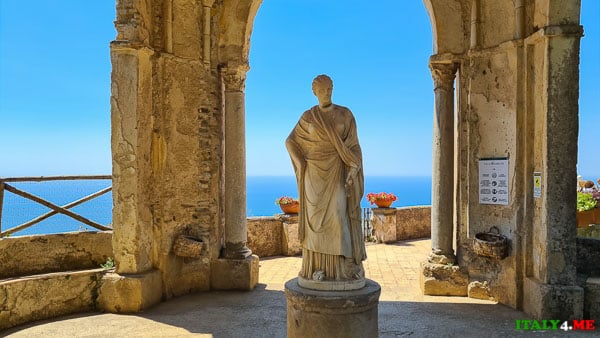
The temple resembles an open pavilion with a spherical dome supported by arches resting on slender, graceful columns. The Temple of Ceres is also the entrance to the famous Terrace of Infinity.
Terrace of Infinity
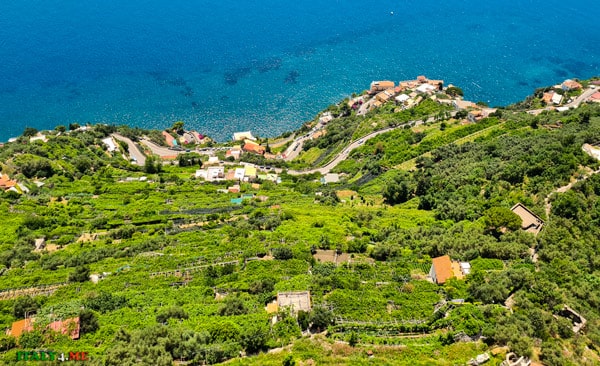
The view from the Terrace of Infinity is simply incomparable. Its location has earned it the name “The Doorway of the Sun.”
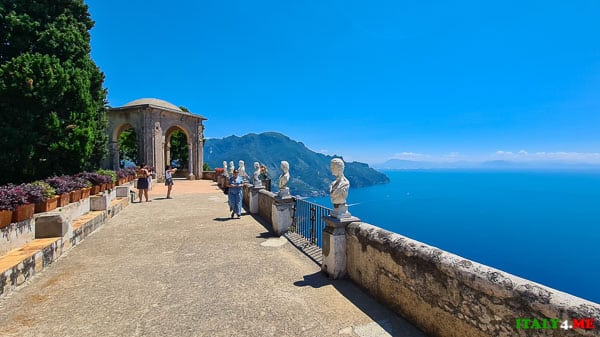
This natural balcony, adorned with 18th-century marble busts, appears to float in the sky, offering each visitor an indescribable experience. The breathtaking mountains, sparkling sea, and vibrant colors of the Amalfi Coast leave an unforgettable impression.
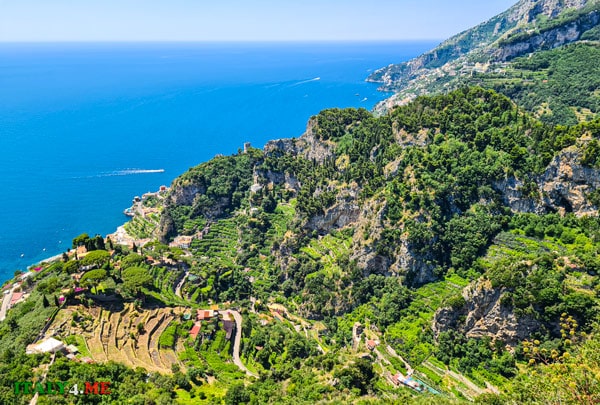
Here, time seems to lose its meaning, dissolving in the endless divine beauty of nature.
Mercury’s Bench
Descending from the Terrace of Infinity, the path leads to a small square with a statue of Mercury—the winged messenger of the gods.
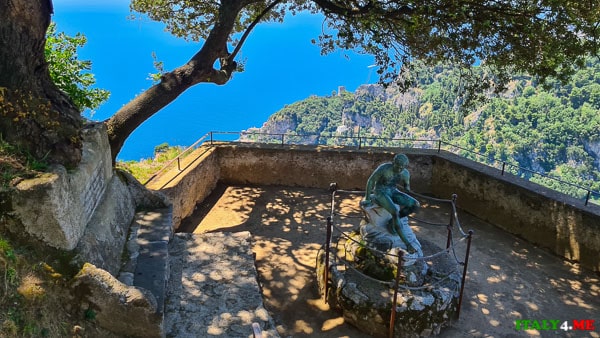
The Romans identified Mercury with the Greek god Hermes. On display is an 18th-century bronze statue—a replica of the ancient “Resting Hermes” from the school of Lysippos, the original of which is housed in the National Archaeological Museum of Naples.
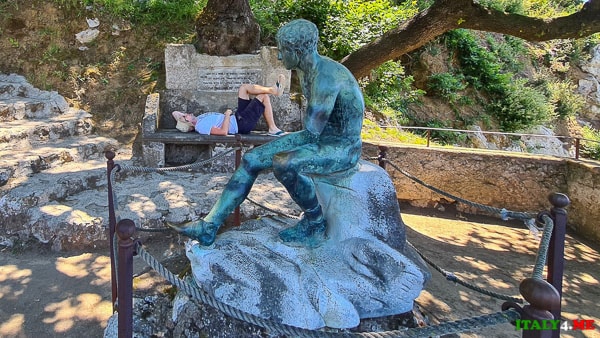
An inscription on the pedestal invites visitors to sit in the shade and reflect: “Lost to the world where I do not wish to exist, I sit alone and speak to my heart, content with my little corner of the world and happy no longer to feel sorrow about death.”
Temple of Bacchus
Among the evergreens and fragrant lavender bushes, visitors encounter the Temple of Bacchus, designed in a classical style with a ring of Doric columns.
At the center stands a beautiful bronze statue of a Satyr holding Bacchus with his customary grapes.
The temple was intended by Grimthorpe as his burial place. Lord Grimthorpe died in London in 1917, and his ashes were brought to Ravello and buried at the base of the statue’s pedestal.
Eve’s Grotto
Descending further, the path winds through oak, alder, and chestnut trees to a cave where visitors are greeted by a surprising sight: the statue of Eve.
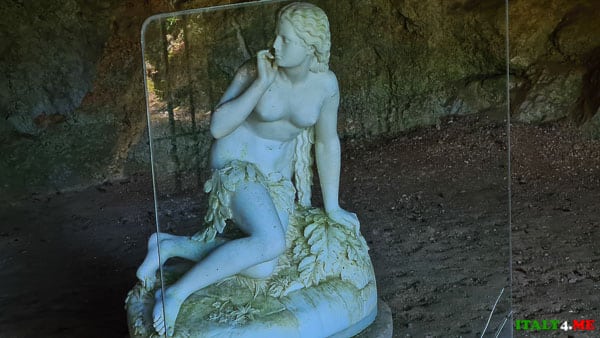
The statue, crafted by Bolognese sculptor Adamo Tadolini, skillfully captures the softness of the body, the flowing locks of hair, and the grace and modesty of the nude figure in a shy pose.
As the setting sun’s rays enter the cave, the marble seems to glow with the warmth of living flesh.
Statue of David
To the left of the path leading to the Temple of Bacchus, amidst an alpine garden full of cacti and exotic plants, is the bronze statue of David, created by Neapolitan sculptor Gioacchino Varlese, modeled after the Andrea del Verrocchio statue in Florence.
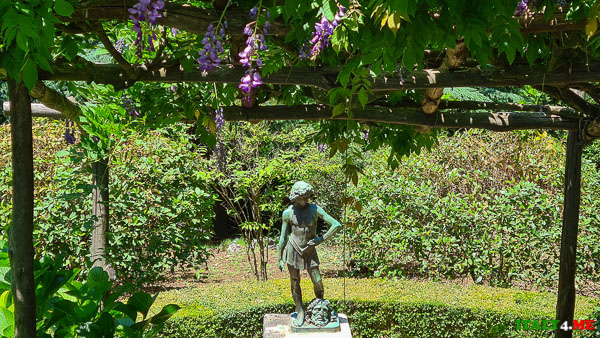
Take note of the abundance of rare orchid species blooming in the spring in the garden’s open spaces, deliberately left wild.
The Rose Garden
From David’s Statue, a wisteria-covered avenue leads to the rose garden, surrounded by stone walls adorned with majolica ornamentation.
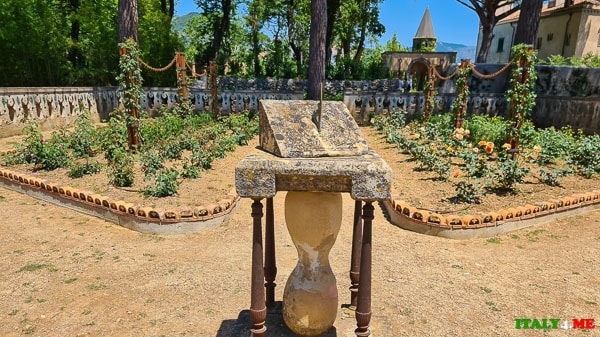
From May to October, the geometric flower beds are filled with heirloom French and English roses, admired for their beauty and fragrance. In the center is a charming small fountain with cherubs and a sundial.
The Tea Pavilion
Near the rose garden, an open-air pavilion serves as the Tea Room.
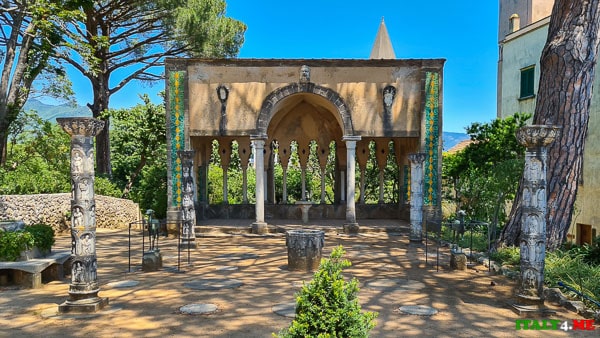
This spot was designed by the villa’s owner as an architectural space in close harmony with the surrounding nature, often enjoyed by the intellectuals of the Bloomsbury Group.
In front of the pavilion, there is a stone well, four Roman-era stone columns, bronze deer, a square seat with small columns, and a stone shell adorned with sea creatures.
Hydrangea Avenue
Behind the tea pavilion, surrounded by lush greenery, stands a replica of Donatello’s naked statue of David.
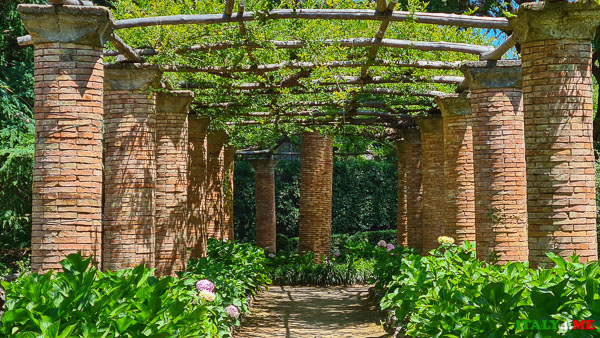
The avenue, lined with large round ceramic columns and bordered by blooming hydrangeas, resembles the gardens of the Medici villas. At the end stands an ornate iron well.
The splendor and historic ambiance of Villa Cimbrone create an unparalleled ensemble of original architectural elements and nature’s decorative designs.
Be sure to read about Michelangelo’s David.
Hours, How to Get There
Villa Cimbrone is open to visitors daily from 9:00 AM to 8:00 PM. The entrance fee is €7 for adults and €4 for children under 12. The ticket office is located to the left of the entrance.
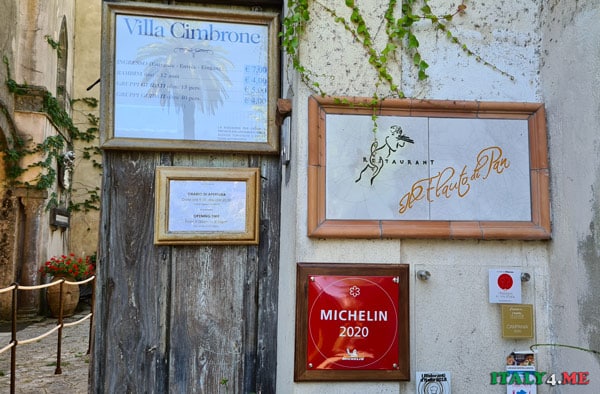
Because the streets in Ravello are very narrow, the villa can only be reached on foot from the town center, a 15-minute walk.
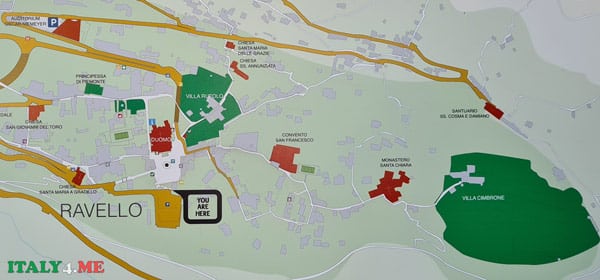
Finding the villa is easy—follow the signs.
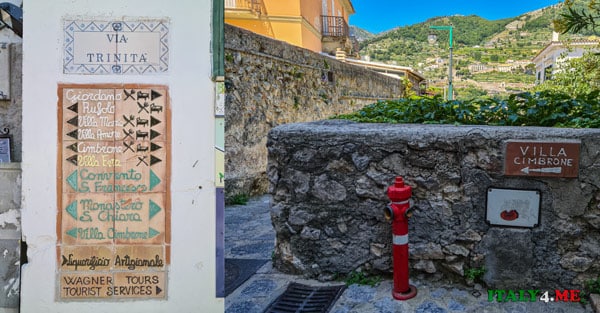
Along the way, you’ll encounter stunning sights.
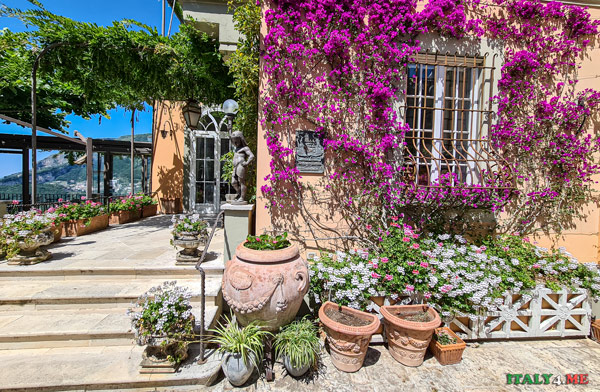
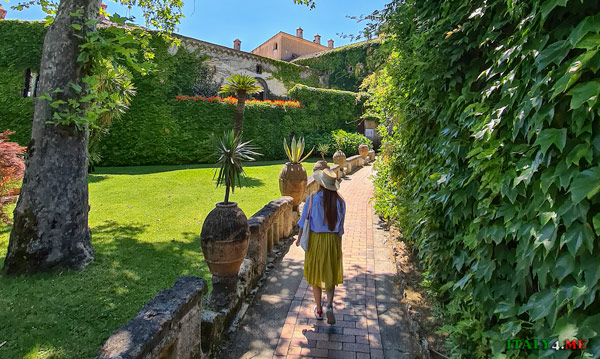
Below is a beautiful pathway leading to the villa’s entrance.
The official website of the villa is www.hotelvillacimbrone.com.