 Italy for me From Italy with love


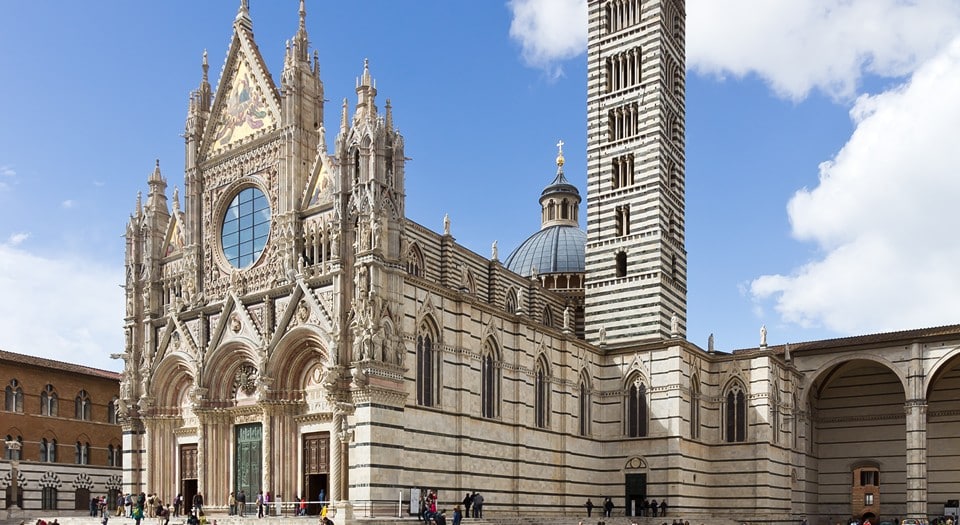
The Cathedral in Siena (Duomo di Siena) is a history of the city carved in marble—a magnificent jewel of Tuscany and indeed all of Italy. For nearly eight centuries, the people of Siena have spared no effort or expense in adorning their beloved masterpiece. Every traveler who steps into Piazza del Duomo finds themselves awestruck by the ethereal beauty of its lace-like stonework suspended in the air. And it all began in the turbulent 13th century.
Page Contents
History of the Cathedral
In the 13th century, Italy was a battlefield of warring city-states vying for power, territory, and prestige. Wealthy Florence was the eternal rival of proud Siena, whose citizens placed their fervent hope in the protection of the Virgin Mary. They dedicated to Her a temple greater than any Florentine structure—the Cathedral of the Assumption of the Blessed Virgin Mary (Cattedrale di Santa Maria Assunta). Construction began in 1215 and was nearing completion when, in 1260, Florence issued Siena an ultimatum: surrender the city and tear down its walls wherever the Florentine army commanded.
There was no time to prepare a defense. In an act of pure faith, the citizens gathered the keys to all the city gates and placed them on the altar before the Virgin’s image, entrusting their fate to Her. A miracle followed: at the Battle of Montaperti (September 4, 1260), Siena’s small militia defeated the vastly larger Florentine mercenary forces. From that day forward, nothing mattered more to the people of Siena than honoring the Virgin by beautifying the Duomo.
In 1263, the cathedral’s dome was completed, and 40 years later, its bell tower rose. But Siena’s ambitions had grown: around the Duomo di Siena, they began constructing a new, even grander cathedral—Duomo Nuovo—intended to surpass even St. Peter’s Basilica in the Vatican. For ten years, towering walls took shape, until the Black Death of 1348 devastated the city, wiping out four-fifths of its population. Crippled and diminished, Siena eventually submitted to Florence.
The unfinished wall, still standing beside Siena’s cathedral, serves as a solemn reminder of the price of pride—and the grace of divine mercy.
To embellish their cathedral, the citizens of Siena invited renowned artists, generously funding their work. Interior and exterior decoration continued well into the 19th century, when golden mosaics were added to the pediments. In the 20th century, the bronze central door was cast with a relief titled “Glorification of the Virgin.” The 2006 restoration meticulously revived decorative elements crafted over centuries. Today, Siena Cathedral is both an active place of Catholic worship and a world-class museum complex with eight main exhibitions.
- Be sure to check out our guide to the best hotels in Siena
Exterior Overview
The Siena Cathedral is the earliest of Europe’s great Gothic landmarks. Its western façade brilliantly showcases the harmonious transition from Romanesque to Gothic architecture. Semicircular Romanesque arches and three entry portals are crowned by triangular pediments that lead the eye upward in a soaring composition, culminating in sharp spires. This masterful blend of styles could only have been achieved by true geniuses—namely, Niccolò and Giovanni Pisano, a father-son duo from Pisa brought in by Cistercian monks to oversee the construction. 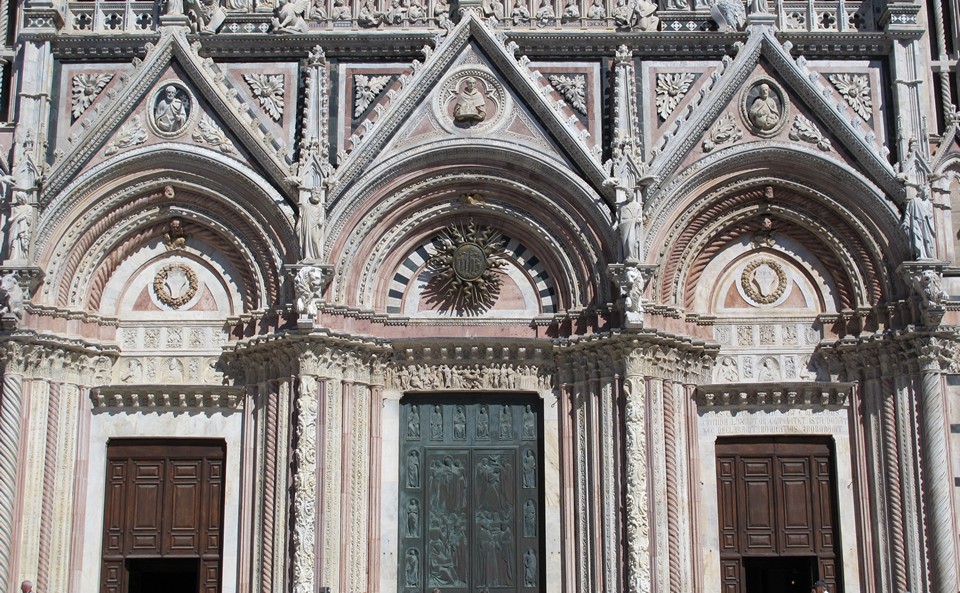
Giovanni Pisano created the lower façade between the 1280s and 1290s. In the tympanums above the three portals are reliefs of Siena’s three patron saints, placed without labels. Sculpted lions at the central entrance support statues of the biblical kings David and Solomon. Figures above the left portal include Isaiah, Balaam (shown holding the prophecy “A star shall come out of the East”), Plato, Daniel, and one of the Sibyls. On the right side are Moses, Simeon the God-receiver, Miriam (Moses’ sister), and Aristotle. Thus, Siena’s façade unites Christian prophets with ancient philosophers and pagan oracles—a powerful visual symbol of divine wisdom and human inquiry. Their statues rest upon carvings of horses and oxen.
The upper façade was completed in the early 14th century. Two pairs of Evangelists stand at the base of the central spires, between which is a stained-glass window of the Last Supper by Pastorino de’ Pastorini (mid-16th century). At the top is a golden mosaic of the Coronation of the Virgin Mary, created by Venetian artists Luigi Mussini and Alessandro Franchi in the 19th century. The side pediments are decorated with their additional works: the Adoration of the Magi and the Presentation of the Virgin in the Temple.
The western façade of Siena Cathedral is a lasting expression of the city’s devotion to the Virgin Mary—carried through the centuries with pride and reverence.
One of the cathedral’s most unique design elements is its striped marble cladding—alternating white and dark greenish-black layers—an idea conceived by Giovanni Pisano. The color scheme references the legendary black and white horses of Siena’s mythical founders, Senius and Aschius. Fleeing persecution by their uncle Romulus, who had killed their father Remus, the brothers arrived in Siena on one black and one white steed. These colors became the heraldic symbol of the city.
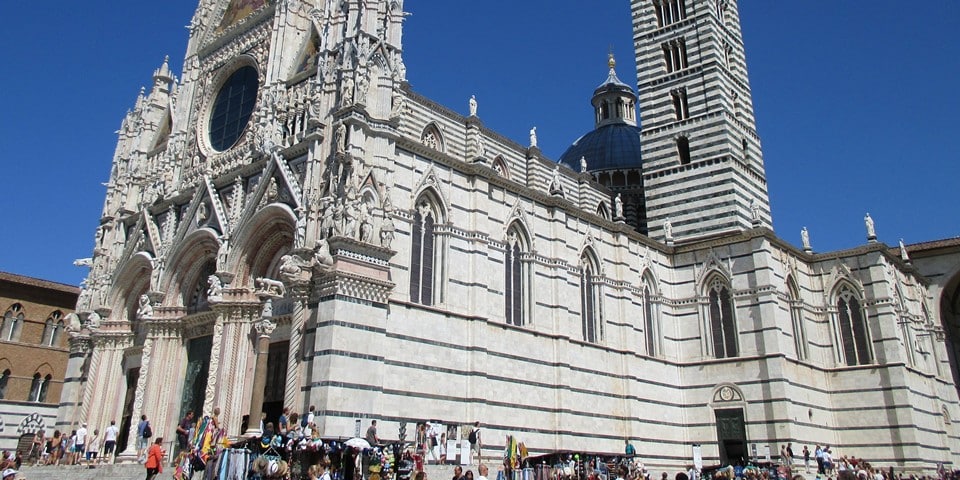
The side walls, eastern façade, and bell tower are all clad in this symbolic striping, giving the cathedral a vibrant and celebratory look. Touches of red marble are artfully added for contrast and warmth.
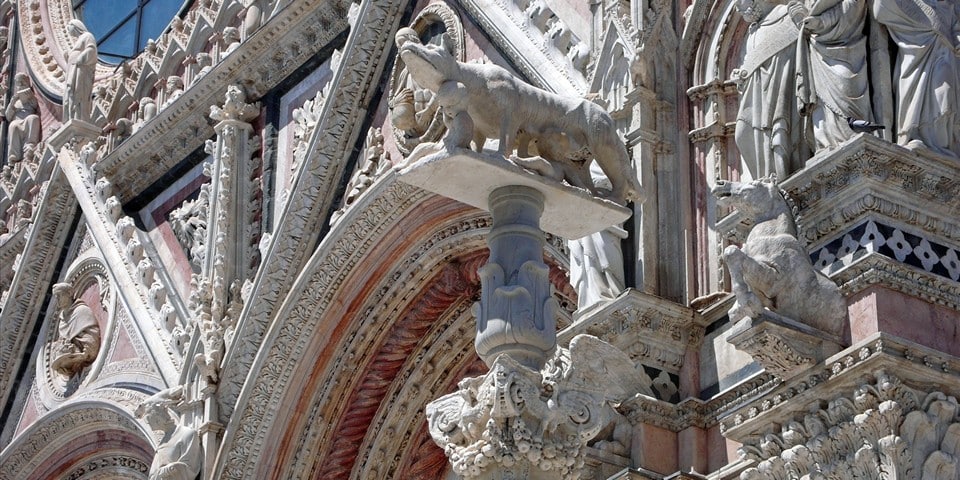
The bell tower, with its square base, octagonal spire, and corner turrets, was completed in 1313 by brothers Agnolo and Agostino Ventura. It dominates the city skyline. To the left of the cathedral lies the tomb of its brilliant creator, Giovanni Pisano, inscribed in the 14th century. On the right stands a statue of the legendary she-wolf nursing Romulus and Remus—symbols of the city’s ancestral roots. The people of Siena embraced this symbol as their own.
The cathedral is especially stunning at the end of the day, bathed in the golden slant of the setting sun. This is the perfect time for photography, when even the stained glass of the rose window becomes fully visible.
Interior
The layout of Siena Cathedral follows the shape of a Latin cross. Inside, it is divided into three longitudinal aisles (naves) and a transverse crossing—the transept. Between the naves are arcades supported by 59-foot (18-meter) columns made of alternating black and white marble, creating a dizzying impression of rhythmic beauty.
Central Nave
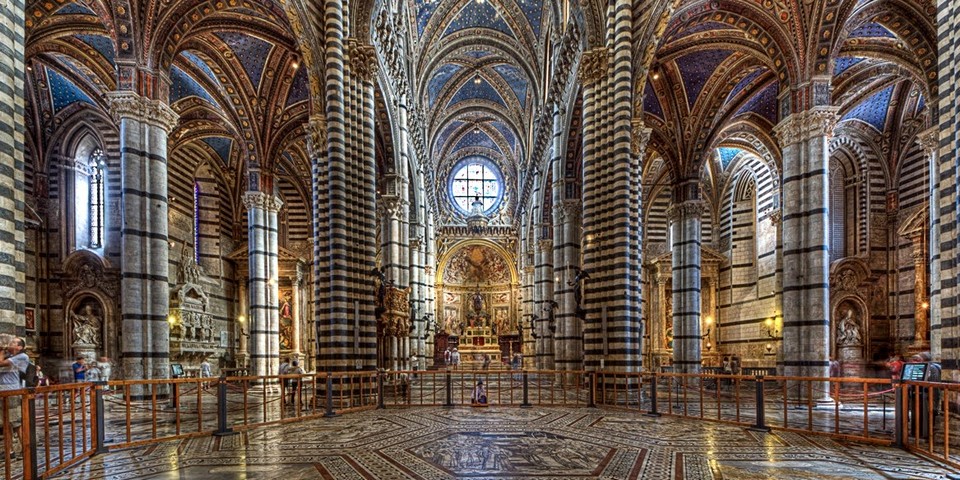
The semicircular arches between the massive nave columns are a hallmark of Romanesque architecture—powerful and austere. The Corinthian-style columns support the vaulted ceiling. From high above, 172 busts of Roman Popes and 36 emperors gaze down from the cornices. Most share similar features, as they were crafted using only 4–5 templates; their individuality is preserved in the engraved nameplates below each bust. This cornice gallery was created during the Renaissance in the early 16th century.
Where the central nave crosses the transept, the interior opens up into the grand dome—177 feet (54 m) tall and 52 feet (16 m) in diameter. The dome’s deep blue Romanesque background is studded with painted stars, and the illusion of depth is masterfully rendered. A ring of 12 stained-glass windows (19th century) around the drum floods the interior with colored light.
Pulpit
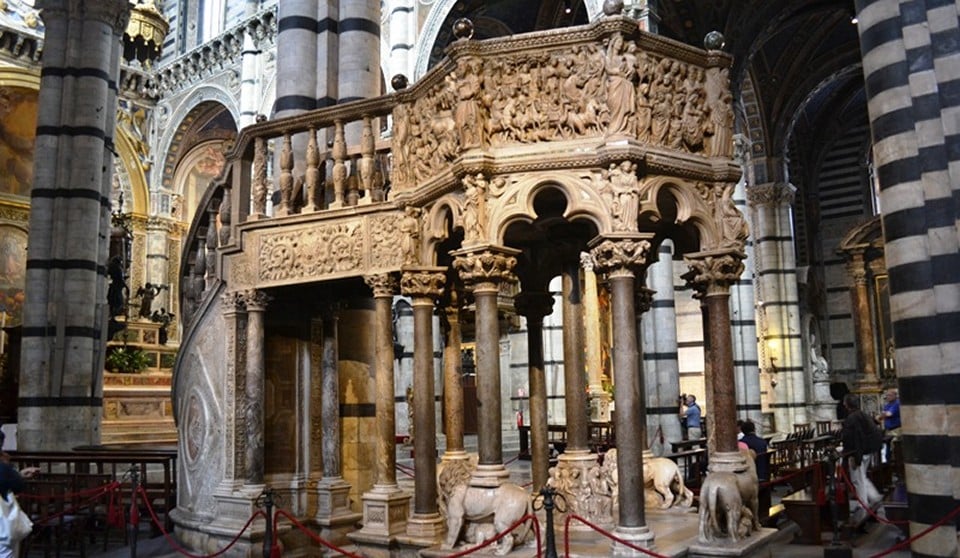
One of the cathedral’s greatest sculptural treasures is the 13th-century pulpit-tabernacle by Nicola Pisano. This octagonal structure, carved from radiant Carrara marble, rests on columns of dark granite and porphyry. Four columns stand on pedestals, while the others are supported by crouching lions and lionesses. The central column is held aloft by allegorical figures representing the Seven Liberal Arts—Grammar, Dialectic, Rhetoric, Arithmetic, Geometry, Music, and Astronomy—accompanied by Philosophy.
The pulpit’s main highlight is a series of marble reliefs depicting seven biblical scenes:
- The Nativity of Christ
- The Adoration of the Magi
- The Flight into Egypt
- The Massacre of the Innocents by Herod
- The Crucifixion
- The End of Days
- The Last Judgment and the punishment of sinners
This masterfully composed narrative includes over 400 human and animal figures and can be found in the cathedral’s left transept, just beyond the dome. Nearby, visitors will find an impressive full-scale Nativity scene with life-sized figures.
Left Nave
Along the left aisle of the cathedral, visitors will encounter masterpieces by Michelangelo, Donatello, and the magnificent Piccolomini Library. 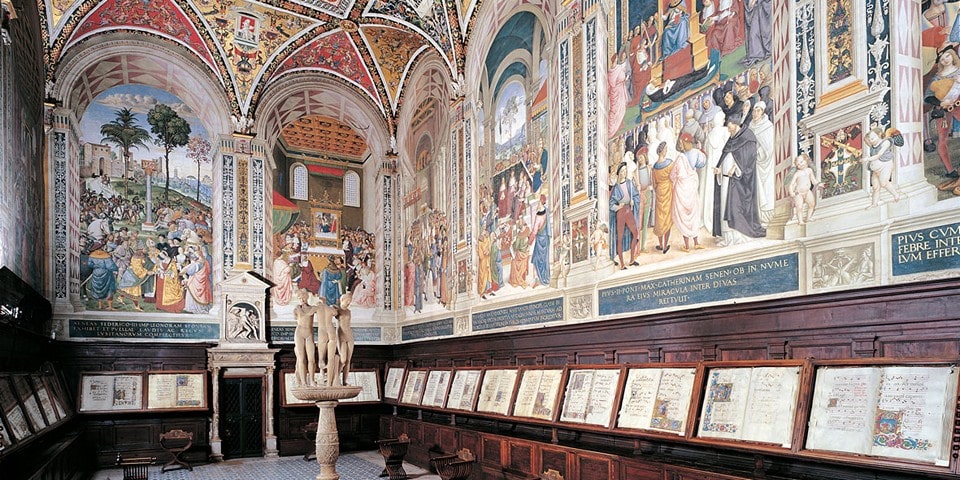
The Piccolomini Altar, dedicated to Pope Pius II, was created in the late 15th century by Andrea Bregno. Framing the altar are statues of Saints Peter and Paul, Gregory, and Pius—works of the young Michelangelo. The artist never completed the commission: the niche intended for Saint Matthew remains empty. During 1501–1504, Michelangelo was fully immersed in his defining masterpiece—the statue of David. The altar also features the icon “Madonna and Child” by Paolo di Giovanni Fei (1385).
The Piccolomini Library
The Piccolomini Library (Libreria Piccolomini) captivates with its vibrant, joyful palette.
From 1503 to 1509, painter Pinturicchio (born Bernardino di Betto di Biagio) transformed the library walls into a visual chronicle of Pope Pius II—Siena’s beloved son. Ten frescoes narrate the pope’s literary, diplomatic, and religious achievements. The final scene depicts his attempt to rally Christian Europe against the Turks after the fall of Constantinople. He dies in the port of Ancona, learning that no one will come.
At the center of the hall, the Three Graces—nude and elegant—are symbols of classical antiquity that inspired Renaissance humanists. Though occasionally removed for being “indecent,” they have always returned to their rightful place.
The Chapel of Saint John the Baptist was created to house the saint’s right hand, which arrived in Siena in the 15th century. Its centerpiece is a bronze statue of John the Baptist by Donatello, with surrounding frescoes also by Pinturicchio. Donatello also sculpted two other cathedral relics: the statue of Mary Magdalene and the tomb of Bishop Giovanni Pecci.
Icons of the Virgin Mary
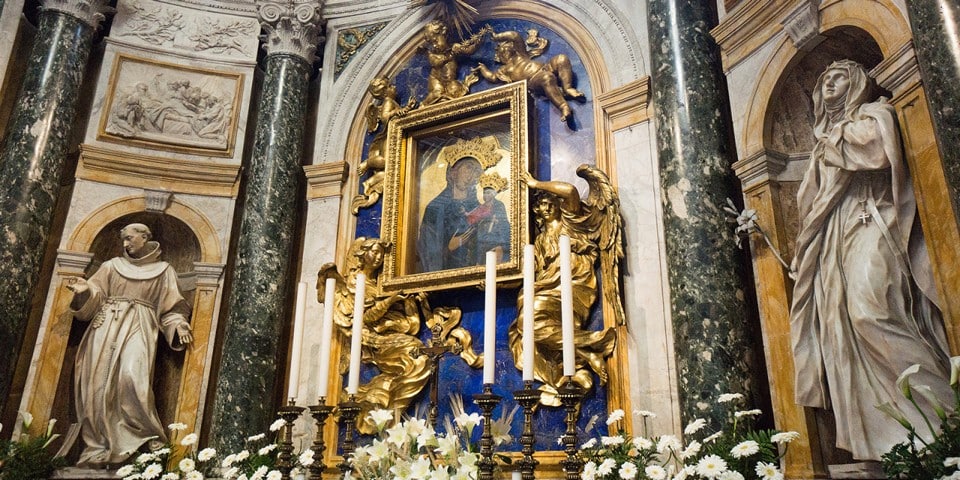
After Siena’s victory over Florence in 1260, the grateful citizens built a new altar for the Virgin Mary. The icon, painted by Dietisalvi di Speme, became known as the “Madonna del Voto” (Madonna of the Vow). Inspired by the Byzantine Hodegetria icon, it resonated deeply with the people of Siena. Five times in the city’s history, during moments of great danger, a solemn procession and ritual offering of the city’s keys were held before this image. The Chapel of the Madonna del Voto (Cappella della Madonna del Voto) is located in the cathedral’s right transept.
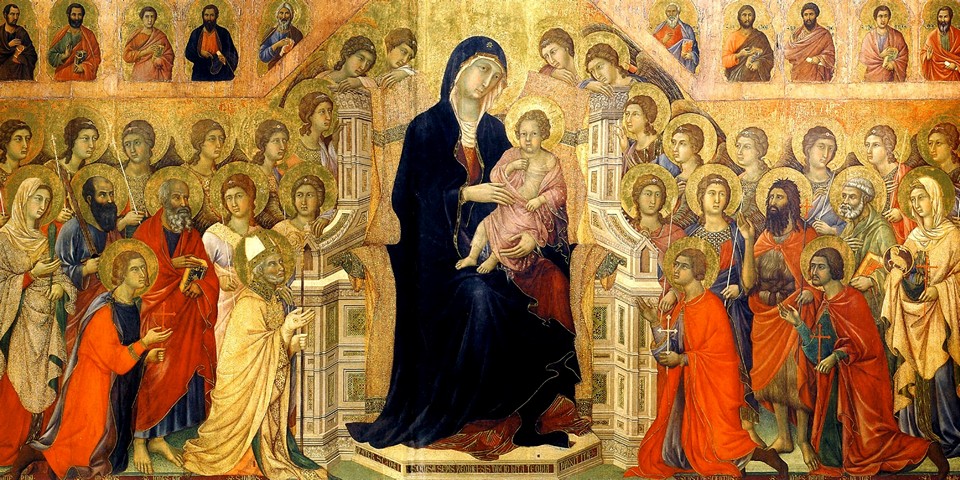
The most important image in the cathedral is the Madonna Maestà (1311)—the Virgin in Majesty. Painted by the legendary Duccio di Buoninsegna, the pride of Siena’s school of painting, it is considered a pinnacle of Gothic art. The Virgin is shown enthroned, surrounded by angels and saints, with miniature scenes from the lives of Christ and the Virgin surrounding the central image. Originally created for the cathedral’s high altar, the work is now housed in the cathedral museum, while the altar itself remains empty.
The Cathedral Floor
The inlaid marble floor of the cathedral is a collective masterpiece by Sienese artists, created over a span of 600 years. The earliest scenes appeared in 1369, and the entire work was completed in the 19th century. As visitors move deeper into the cathedral, the thematic focus shifts: beginning with pagan imagery, followed by philosophical miniatures on the meaning of life, then stories from the Old Testament, and finally Christian parables. The technique resembles engraving: outlines of the images were etched and filled with colored marble dust.
Pagan and Philosophical Scenes
The pagan themes stretch from the entrance to the dome area in the central nave and both side aisles.
Hermes Trismegistus
Hermes Trismegistus—the thrice-greatest sage, founder of occultism, and a contemporary of the prophet Moses—is honored with a depiction in the cathedral because Hermeticism anticipated the concept of a single divine being as the foundation of all existence.
The She-Wolf of Siena
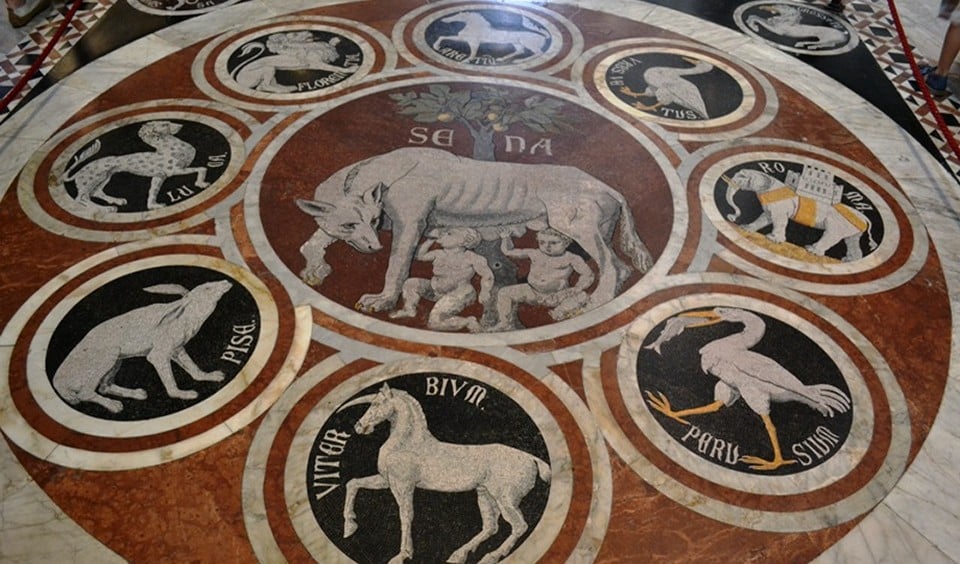
The sons of Remus—Senius and Aschius—brought a statue of the she-wolf, who had nursed their father, to their new city. The people of Siena embraced her as their symbol. Surrounding the She-Wolf of Siena are the emblems of 12 cities subordinate to Siena, including Florence (the lion), Volterra (the eagle), and even Rome (represented by an elephant). This scene reflects Siena’s bold ambition. Today, it is the only section of the floor that is never covered and always visible to visitors.
The Ghibelline Eagle
This image echoes the political conflict between the Roman popes and the German emperors in the 12th–13th centuries, during which the citizens of Siena sided against the papacy. Their allegiance to imperial authority is symbolized by the imperial eagle depicted in the rose window.
Wisdom and Fortune
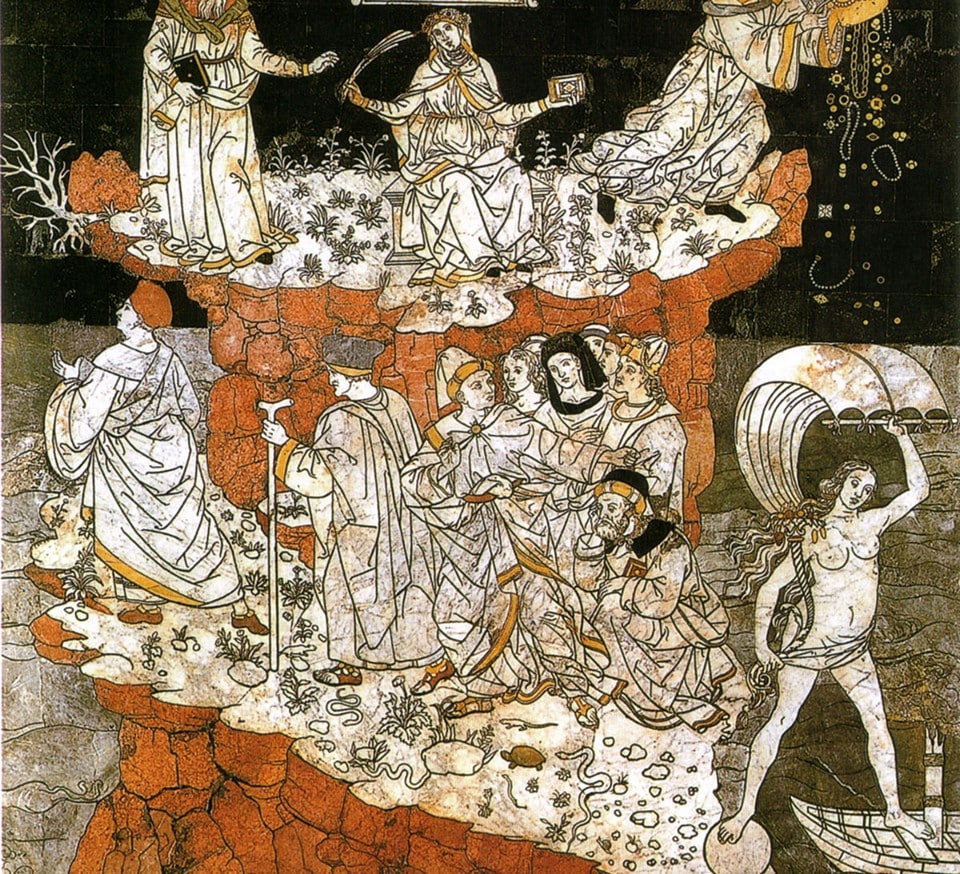
Fortune, portrayed as a fickle woman, appears in the painting’s right corner. She tramples a ship with a broken mast and gestures enticingly with a sail of hope. The wise abandon the vessel and ascend the mountain toward Wisdom, who sits with a book, flanked by the martyr-philosopher Socrates and Crates, who tosses useless jewels into the sea. The allegorical message is clear: those who attain wisdom no longer rely on luck and hold earthly life and its riches in contempt.
Wheel of Fortune
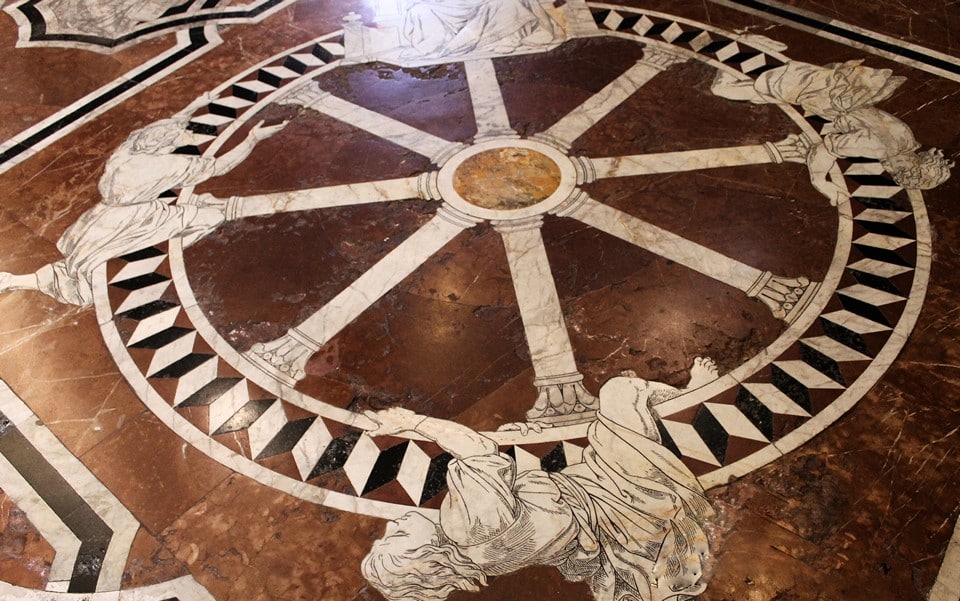
This inlay depicts a king seated on his throne, unaware that with the next turn of the wheel, his seat will collapse and he will become one of the unfortunate souls straining to turn the Wheel of Fortune. Reflections on the fickleness of fate are offered by Aristotle, Seneca, Euripides, and Epictetus, positioned in the corners of the scene.
On both sides of the central nave are ten images of Sibyls—prophetic women of antiquity.
Biblical Scenes
Beneath the dome lies the story of the prophet Elijah and his ascent to heaven in a fiery chariot. As visitors approach the altar, they encounter scenes from the Old Testament:
- Moses striking water from the rock in the desert;
- Receiving the Tablets of the Covenant on Mount Sinai;
- The Sacrifice of Isaac.
These inlays were created in the 16th century by Domenico Beccafumi (Domenico di Giacomo di Pace Beccafumi), who refined the marble inlay technique and skillfully conveyed the effects of light and shadow.
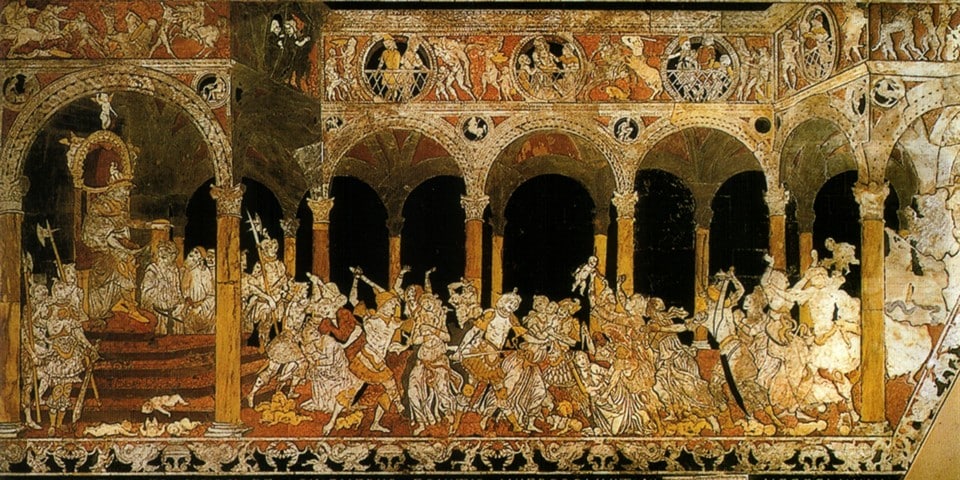
The “Massacre of the Innocents” by Matteo di Giovanni is the most famous parable depicted on the floor of the Siena Cathedral. A disturbing impression is created by the joyful smiles of the mothers whose infants are being slain by savage soldiers.
To preserve these precious inlays, portions of the floor are covered with wooden panels, and only part of the artwork is visible to the public.
Viewing the floor of the Siena Cathedral is so popular that the year is divided into two visiting seasons:
- “High Season of the Uncovered Floor” (from early March to the end of October) – long lines and higher prices (€15 admission);
- “Low Season of the Covered Floor” (November and all winter months) – quieter halls and reduced admission (€8).
The full cathedral floor is unveiled during the Palio horse races in Siena, which are dedicated to the Virgin Mary and held annually on July 2 and August 16.
Visiting the Museum Complex
The cathedral is open daily from 10:30 AM to 7:00 PM during the main season, and until 5:30 PM in winter.
Admission prices:
- Cathedral including the floor and library: €15 during the main season; €8 in winter;
- Museum and panoramic view from the rooftop of the Duomo Nuovo: €8;
- Crypt – the underground space featuring a cycle of vivid 13th-century frescoes: €8;
- Baptistery – the baptismal building with fonts by Donatello and other Renaissance masters: €4.
A combined ticket costs €20–25 depending on the season. For those who love to “gather nectar from Italy,” exploring the Siena Cathedral is an absolute must.