 Italy for me From Italy with love


The sights of Siena are especially fascinating because many homes, palaces, and churches have been preserved in their original form. Even the bombings of World War II, which destroyed countless architectural masterpieces, spared many of them. That’s why you can be certain that every stone in Siena’s historic center, every house and church, is not a product of skillful restoration, but a true medieval relic that has survived through the centuries.
Page Contents
Location
Siena is the administrative center of the Tuscany (Toscana) region. It lies northwest of Rome (Roma), the capital of Italy, about 114 miles (184 km) in a straight line. On a map, you can locate it by the following coordinates: 43°19′07″ N latitude, 11°19′54″ E longitude.
Siena covers an area of 45.6 square miles (118 km²) and consists of seventeen districts (contrade), each named after an animal, with its own emblem and legend. The historic center spans 2.3 square miles (6 km²). Since the Middle Ages, the city has maintained its air of inaccessibility, thanks to the hills and protective walls that surround it. The narrow streets of Siena are almost entirely without greenery, but the air feels fresh due to the car-free zone in the city center.
See the guide: how to get to Siena
Main Square
Siena’s main square is Piazza del Campo, located where the city’s three hills converge. What sets it apart from other squares is its unique shape: when Piazza del Campo was laid out, it was designed in the form of a shell, with a perimeter measuring 1,093 feet (333 meters).
This original layout is largely thanks to rainwater streams, which carved the terrain as they flowed down from the hills. During the square’s development, the city’s authorities were careful to ensure that no buildings disrupted its planned symmetry. For example, the Church of Saints Peter and Paul (chiesa dei Santi Pietro e Paolo) was demolished simply because it extended slightly beyond the line of the surrounding aristocratic buildings.
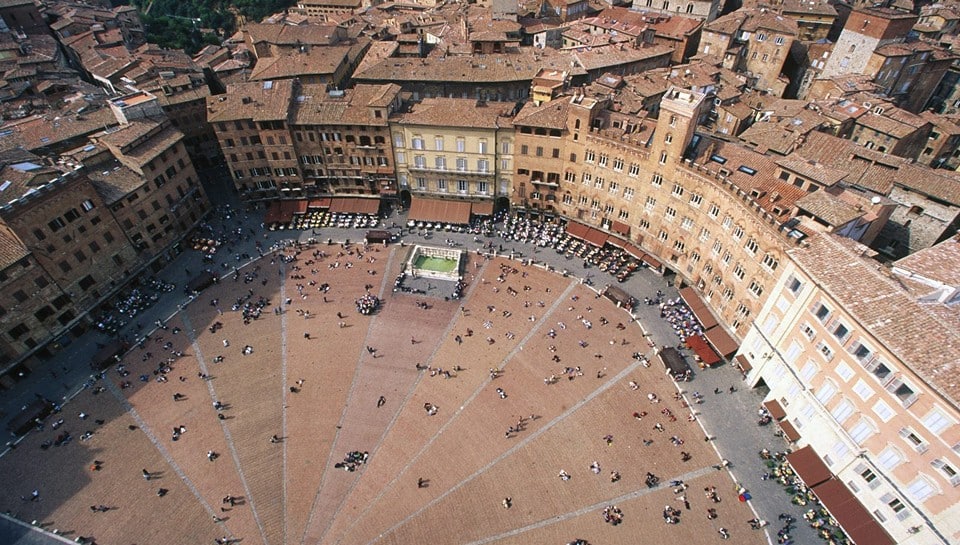
The first documented reference to Piazza del Campo dates back to 1169, when efforts began to organize the area now occupied by the square. Originally, it was part of a larger space that included the nearby Piazza del Mercato. However, over time, a wall was built to separate them and help manage the runoff from rainwater.
Until the late 13th century, the square hosted markets and fairs. In 1287, during the era of the “Tyranny of the Nine” (when nine merchants ruled the city), a new city hall was needed.
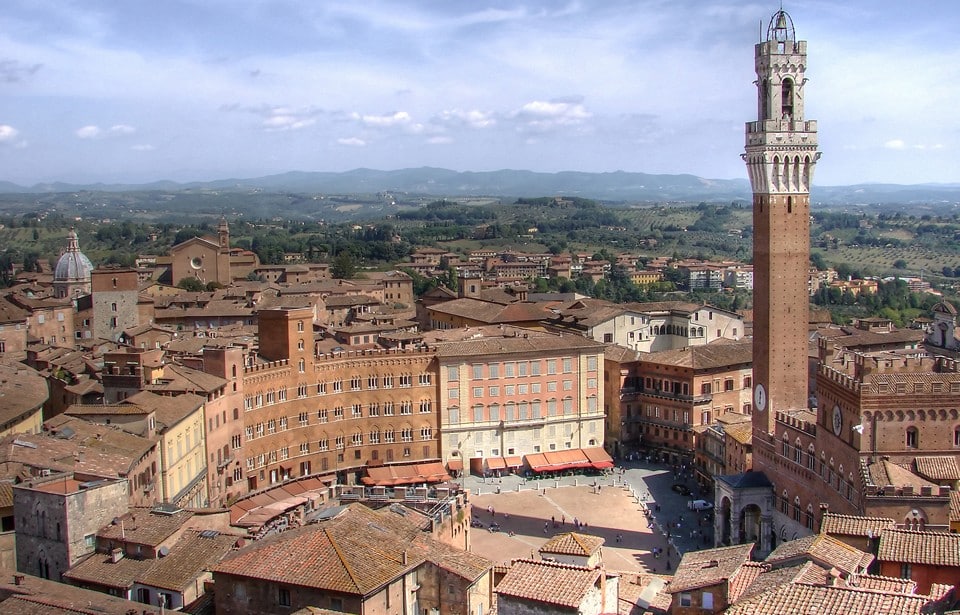
The construction of the Palazzo Pubblico on the square marked the beginning of a new civic center. The most prominent landmarks here include the Torre del Mangia (Tower of the Glutton), the Cappella di Piazza (Chapel of the Square), the Fonte Gaia (Fountain of Joy), the Palazzo Sansedoni, and the Chapel of the Square.
Palazzo Pubblico
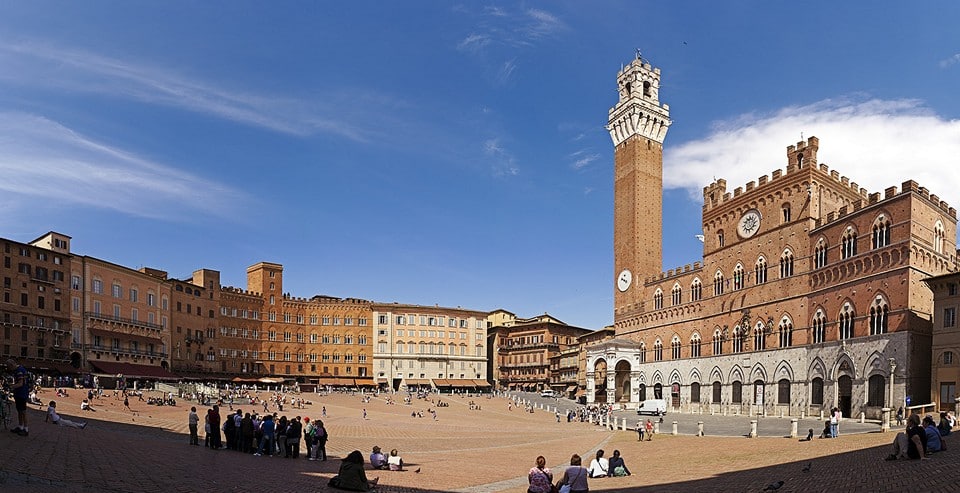
Palazzo Pubblico is the central building of Piazza del Campo. It was originally the site of the old city hall known as “Bolgano” (palazzo del Bolgano), which was later expanded and rebuilt. Initially, the main façade faced Piazza del Mercato, but after renovation, it was reoriented toward the opposite side of the square.
Although construction was completed in the 14th century, three centuries later the Palazzo Pubblico was expanded with additional wings and a newly decorated façade.
The architects followed the natural curve of the square in the building’s design. The central section has four floors and rises one level higher than the side wings. In the center of the fourth floor is a white circle with the monogram of Christ. The roof resembles a fortress, topped with rectangular crenellations.
The ground floor is clad in white stone, while the upper floors are faced in brick. Each window is divided into three parts, framed by two small columns and three pointed arches. Above each window is a vaulted arch decorated with Siena’s coat of arms. The numerous holes seen across the façade once held scaffolding during construction.
For centuries, Palazzo Pubblico served as Siena’s city hall, occupying all its rooms. Today, the municipal offices are located only on the second floor. The lower levels house the Civic Museum (Il Museo Civico), home to frescoes and artworks by local masters. Plans are underway to expand the museum to the third floor. The Teatro dei Rinnovati, a performance hall, is located in the former Grand Council chamber on the ground floor.
Read tips here: where to stay in Siena
Torre del Mangia
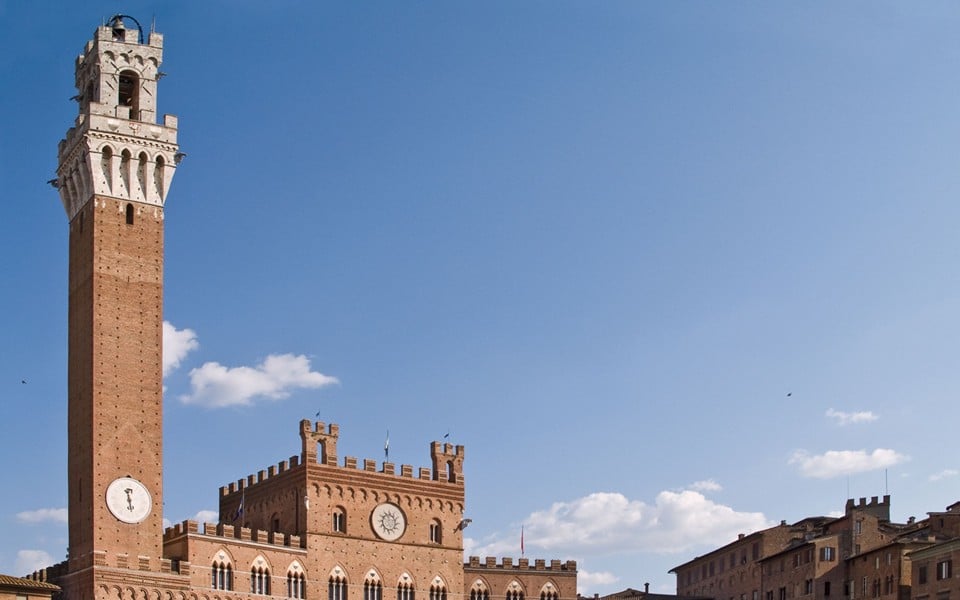
The Torre del Mangia stands adjacent to the Palazzo Pubblico, positioned on its left side. This unusual name—“Tower of the Glutton”—was inspired by the tower’s first guardian, Giovanni di Balduccio, who was famous for his insatiable appetite and spent all his wages on food.
The Torre del Mangia is one of the tallest medieval towers, rising to 335 feet (102 meters) including lightning rods. The viewing platform at 289 feet (88 meters) can be reached by climbing 400 steps, offering panoramic views over Siena and its surroundings.
Construction began in 1338 and finished ten years later. To protect it from lightning, storms, and other disasters, lucky tokens and stones inscribed with Latin and Hebrew blessings were buried in its foundation. The tower was also oriented so that its sides face precisely west, south, north, and east.
The first bell was installed in 1349, but it had poor sound quality and was replaced in 1634. That replacement, too, proved unsatisfactory, and thirty years later it was exchanged for the current bell. Due to its immense weight—over 14,000 pounds (6.5 tons)—the bell was installed above the belfry. Its sound can vary depending on the angle of the clapper’s strike.
For many decades, the bell was rung manually by a watchman. Eventually, it was replaced by a wooden mechanism, and later an automatic system, which still chimes the hours today. The main bell sounds only on special occasions.
A clock was added to the tower in 1360. Its face was first painted on the façade some 50 years later, then carved from stone in the late 18th century and adorned with a fresco and canopy—both of which were lost during 20th-century restoration.
Cappella di Piazza
The Cappella di Piazza sits at the base of the Torre del Mangia. Clad in white marble, it stands out strikingly against the terracotta tower behind it. The structure is built in the Gothic style.
Construction began in 1352 and was dedicated to the Virgin Mary, who was credited with ending the outbreak of bubonic plague that devastated Siena in 1348.
The building took over 20 years to complete and was finished in 1376. Later, the façade was embellished with sculptures and a Renaissance-style canopy. In the 16th century, a fresco by Giovanni Antonio Bazzi (also known as Il Sodoma) was added, depicting the Infant Jesus, the Virgin Mary, and God the Father. The fresco is now housed in the Palazzo Pubblico museum.
Palazzo Sansedoni
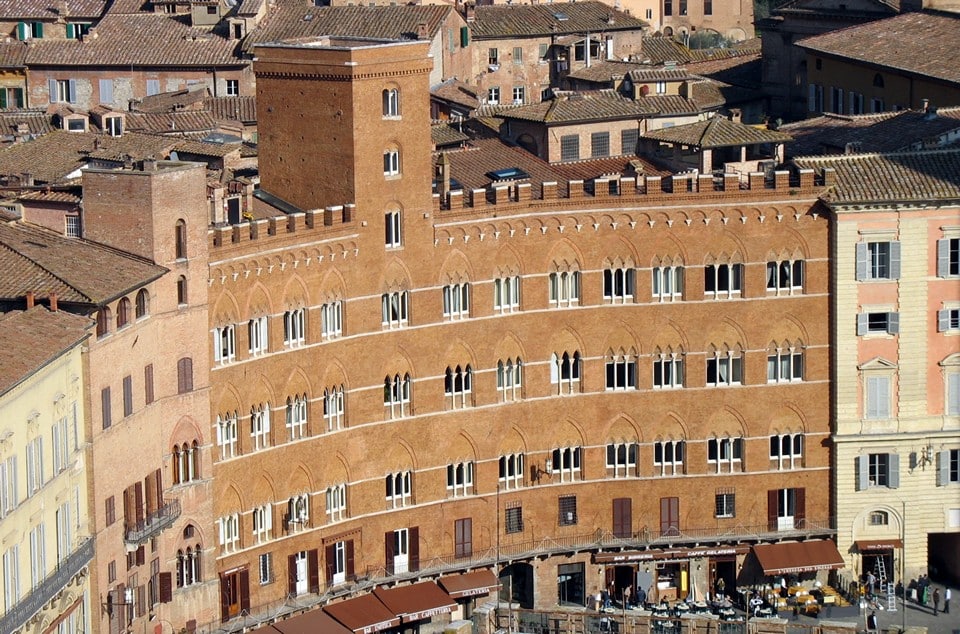
The most prominent private building on the square is Palazzo Sansedoni, located directly across from City Hall, to the right of the Fonte Gaia fountain.
This terracotta-colored Gothic building was erected at the end of the 13th century on the orders of Goro Sansedoni. To construct it, five aristocratic houses were joined into one. At the heart of the structure is a tall tower that was significantly shortened in the 18th century after an earthquake, for fear it might collapse.
Between the 17th and 18th centuries, the palace was restored and expanded, though the façade retained its original features: its curved shape mirrors the arc of Piazza del Campo. The interiors were remodeled and embellished with statues and frescoes. The family chapel, dedicated to Ambrogio Sansedoni—a 12th-century monk—was preserved.
Today, the building houses the offices of Fondazione Banca Monte dei Paschi.
Fonte Gaia
The Fonte Gaia (“Fountain of Joy”) stands in front of the Palazzo Pubblico. At first glance, it may go unnoticed—it resembles a white marble basin that can be viewed clearly only from one side of the square. This is because the fountain is enclosed on three sides by marble walls. These panels feature bas-reliefs depicting biblical scenes and the Madonna with the infant Jesus. On the front pilasters are two women: one is the mother of Romulus and Remus, founders of Rome; the other, according to legend, raised Senius, son of Remus and founder of Siena.
The Fonte Gaia was built in the early 15th century and originally served as a basin to collect water channeled in from underground aqueducts.
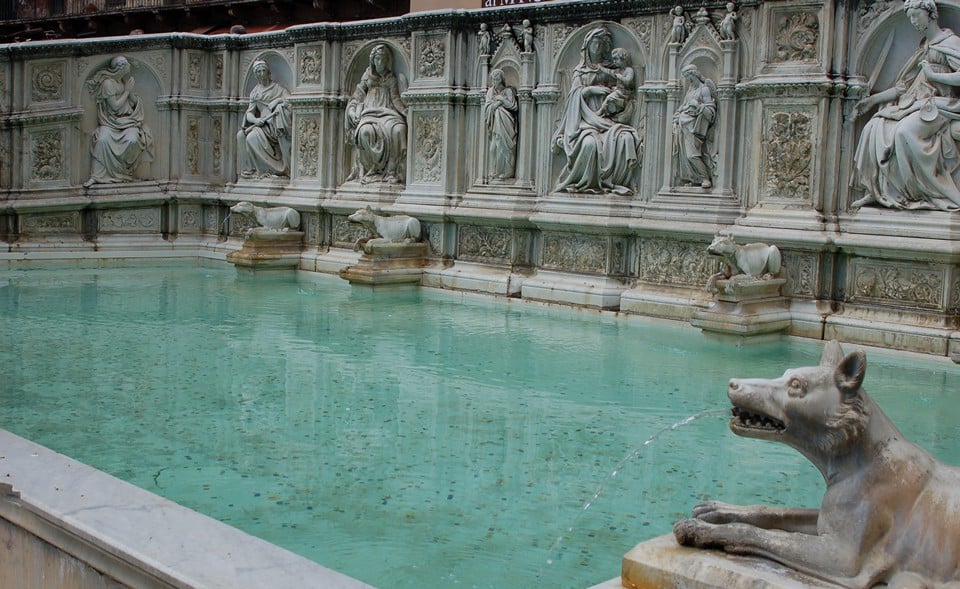
Water flows into the basin from spouts held in the mouths of wolf sculptures, positioned on either side of the fountain. Visitors are often captivated by the clear, bluish water gently rippling in the pool. The fountain’s name comes from the joyous celebration of the townspeople when water first gushed from the ground in this spot.
In the 19th century, the statues and panels were replaced with replicas, and the basin was enclosed by a fence. The original sculptural elements are now preserved at the Complesso Museale di Santa Maria della Scala.
Churches
The most prominent and lavish place of worship in Siena is the Cathedral (Duomo di Siena), located on the Piazza del Duomo. While the city’s other churches appear more modest, they are equally fascinating, having been shaped by some of Italy’s most renowned painters, architects, and sculptors.
Siena Cathedral
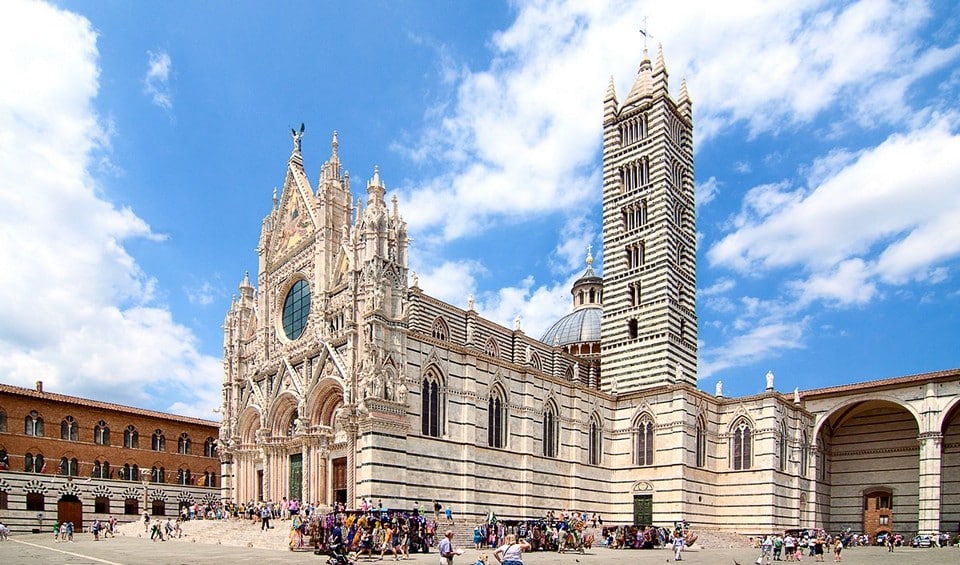
Siena Cathedral (Cattedrale di Santa Maria Assunta or Duomo di Siena) is the city’s main church, built on the Piazza del Duomo. In ancient times, a pagan temple stood on this site. The Romans demolished it and erected a fortress, with four towers along its perimeter. One of these towers was later transformed into the bell tower during the cathedral’s construction. Until the early 10th century, the site served as the bishop’s residence.
Construction of the cathedral began in 1220 and continued for a century and a half. The layout follows the shape of a Latin cross. The front façade is clad in white marble and adorned with sculptural compositions, reflecting a harmonious blend of Gothic styles. The lower section is Romanesque, the upper part Late Gothic, and the portals reflect French Gothic influence. The mosaics crowning the structure were added in the 19th century. Above the central portal is a massive rose window flanked by sculptures of prophets and apostles. On either side of the window, elegant galleries frame the façade.
The rear façade and side walls are clad in white marble with horizontal bands of dark green marble. Above the crossing rises a twelve-sided dome, its interior decorated with frescoes of saints.
The cathedral’s painted interior is mesmerizing. The altar is divided into three niches: the lower holds statues of the apostles sculpted by Michelangelo, while the upper features Jacopo della Quercia’s “Madonna and Child”. The left aisle houses the Piccolomini Library (Biblioteca Piccolomini).
The old fortress tower was converted into a bell tower in 1333, reaching a height of 253 feet (77 m). Like the church’s outer walls, the tower is decorated with alternating bands of white and green marble. The bell tower features six tiers of windows, each level taller than the one below. The spire crowns the tower.
Crypt
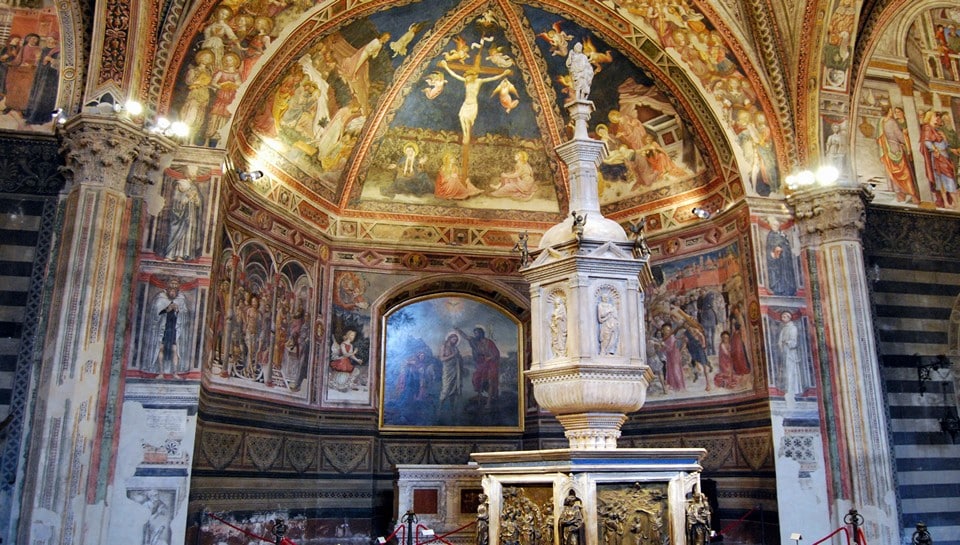
The Crypt of Siena Cathedral (Cripta del Duomo di Siena) is located within the cathedral complex. Despite the name, it doesn’t house any relics, although legend holds that an undiscovered burial chamber may still exist within the church.
The crypt was likely built in the late 13th century and was sealed off during a later expansion of the cathedral. As a result, its existence remained unknown until 1999, when it was accidentally uncovered during restoration works. Today, visitors can admire a complete cycle of 13th-century frescoes that once adorned the earlier church that stood on this site before the current cathedral. These frescoes are notable for their vivid colors and well-preserved depictions of saints.
Baptistery of Saint John the Baptist
The Baptistery of Saint John the Baptist (Battistero di San Giovanni) is located near Siena Cathedral. To fully appreciate its impact, it’s best visited before entering the Duomo di Siena. This landmark sits on Piazza San Giovanni.
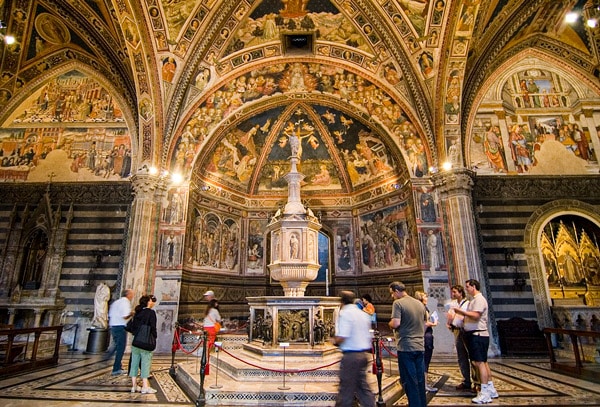
Construction of the baptistery began in 1325, and from that year on, it served as the place where all citizens—from nobles to commoners—were baptized. Though the upper level was never completed, the façade is a true Gothic masterpiece. Like the cathedral, it is clad in white marble with dark green inlays and adorned with floral and geometric motifs. The building features three arched portals.
The hexagonal baptismal font was created in 1430 from marble and bronze. The panels and sculptures were crafted by Donatello, Lorenzo Ghiberti, Giovanni di Turino, and Jacopo della Quercia.
Frescoes were added in the mid-15th century. The artists included Il Vecchietta, Michele di Matteo Lambertini, Benvenuto di Giovanni, and Pietro degli Orioli.
Today, the baptistery is part of the Museo dell’Opera Metropolitana. Entry is ticketed.
Basilica of Saint Dominic
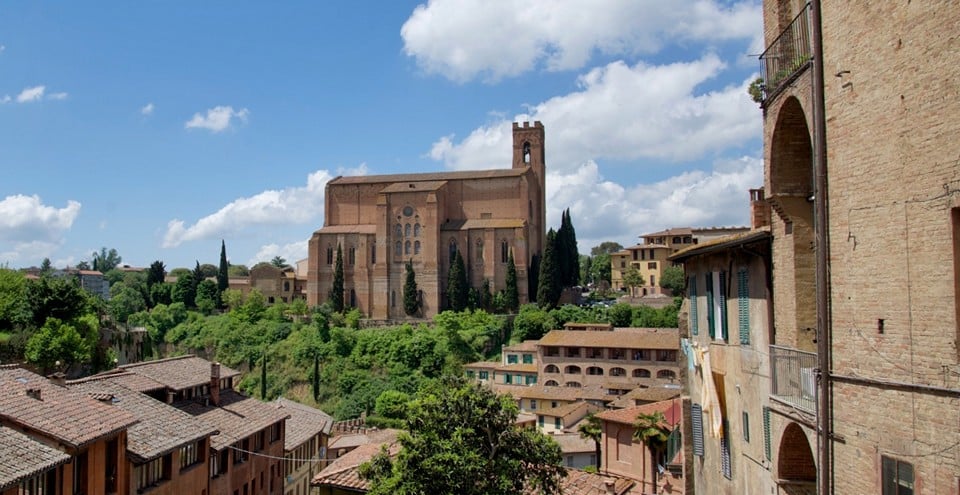
The Basilica of Saint Dominic (Basilica di San Domenico) is located on Piazza San Domenico, just 1,000 feet (300 m) from Piazza del Campo. This landmark sits atop a hill and is visible from many points across Siena. From the basilica’s terrace, visitors enjoy sweeping views of the city center, including the cathedral.
The church was founded by the Dominican order in 1226, and construction continued for nearly 200 years. The structure is built entirely from red brick. Its austere exterior exemplifies the strict Gothic style typical of buildings commissioned by mendicant orders. The bell tower was added in the 14th century but was damaged during an earthquake two centuries later and reduced in height.
The main entrance is missing, so visitors enter from the side. Inside the church is a richly decorated chapel that holds a reliquary containing the head and a finger of Saint Catherine (Caterina Benincasa), who spent much of her life in this church. The basilica draws many pilgrims, and the walls are adorned with paintings depicting key events in the life of Caterina Benincasa.
Basilica of Saint Francis
The Basilica of Saint Francis (Basilica di San Francesco) is located on Piazza San Francesco, about 0.3 miles (0.5 km) from Piazza del Campo. It’s best to visit this church before the Siena Cathedral—its plain Gothic design may seem underwhelming after the grandeur of the Duomo.
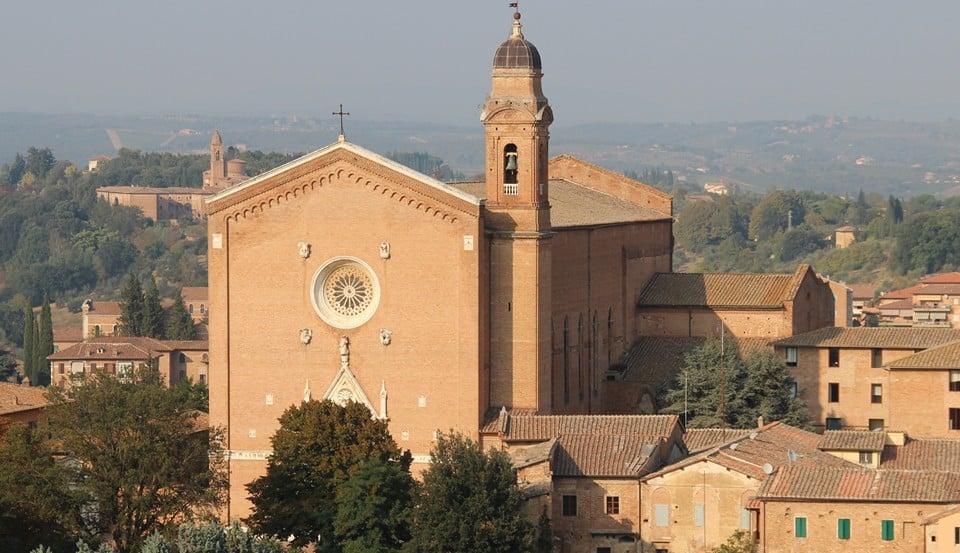
The basilica was built in the mid-13th century outside the city walls. It wasn’t incorporated into the city proper until two centuries later. The church was expanded, modified, and rebuilt several times over the years. The bell tower was added in the 18th century, and the Neo-Gothic façade was completed in the late 19th century.
In one of the chapel’s side rooms is preserved the “Eucharistic Miracle of Siena.” In 1730, two hundred consecrated Hosts (communion wafers) were stolen from the basilica. They were later found in the Church of Santa Maria di Provenzano and returned to San Francesco. It is said that the wafers remain miraculously intact to this day.
Basilica dell’Osservanza
The Basilica dell’Osservanza (Basilica dell’Osservanza) stands atop Colle della Capriola, on the northeastern outskirts of Siena. It’s one of the city’s most important churches located outside the medieval walls.
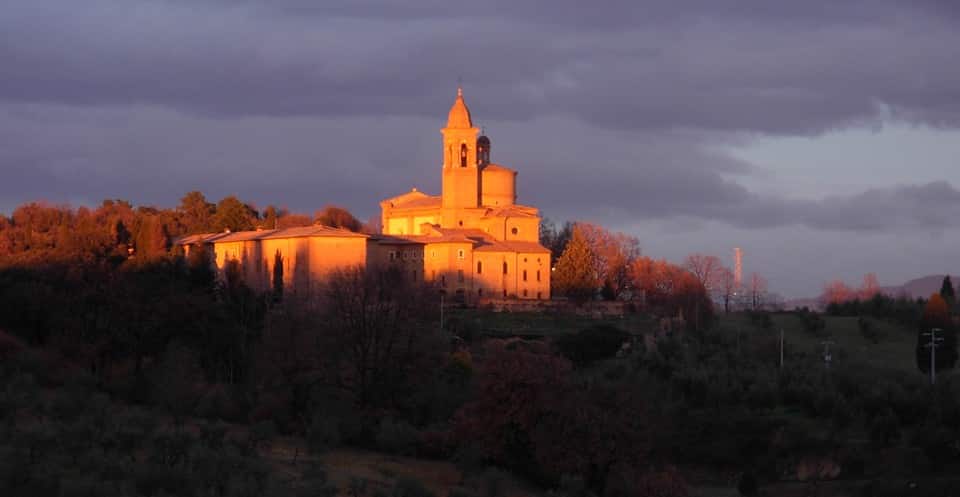
The basilica was built in 1490 on the site of a 12th-century hermitage. It was dedicated to Saint Bernardino of Siena (Bernardino da Siena), who had passed away fifty years earlier and had lived on this very hill. Five years after its construction, the church was enlarged by order of Pandolfo Petrucci, who intended to use it as his family tomb and commissioned the addition of a monastery.
During the 1554 siege of Siena, the entire monastic complex was destroyed, but the citizens soon rebuilt it. In the 1920s, the church underwent further restoration. After being heavily bombed in World War II, it was left in ruins. Thanks to blueprints preserved by the monks, the church was reconstructed ten years later and now appears exactly as it did before the war.
Museums
Siena is home to a large number of museums, many of which are located near the Cathedral Square and Piazza del Campo. While the city doesn’t offer a museum pass, there are still ways to save. Combined tickets are popular in Siena, allowing visitors to access multiple exhibits at a discounted rate.
That’s why it’s wise to inquire at the ticket office about such options before purchasing an individual ticket. For instance, a ticket to the Museo dell’Opera Metropolitana also includes access to the Cathedral, the Crypt, and the Baptistery.
If you’re not planning to join a guided tour, be sure to ask about an audio guide—it will make your visit more engaging.
Civic Museum
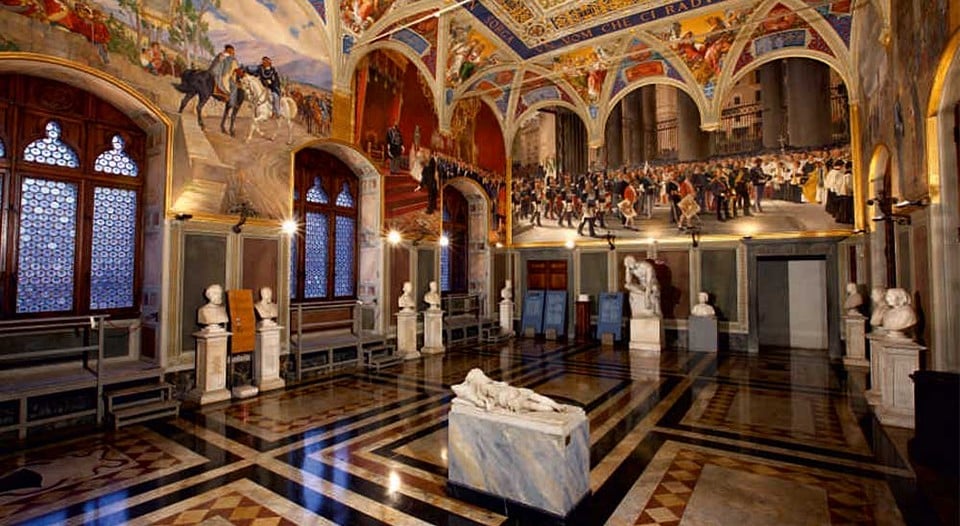
The Civic Museum (Museo Civico) is located on the ground floor of the Palazzo Pubblico in Piazza del Campo. It was founded in the 1930s.
Visitors can explore the halls of the old town hall, decorated by renowned Sienese artists. Among them is the Hall of the Globe (Sala del Consiglio), once used for sessions of the Sienese Republic’s council. The room was named after a rotating globe that once depicted the republic’s territories. The Hall of the Nine (Sala dei Nove), where the government held meetings, is also a highlight.
The museum offers insight into Siena’s history and the works of famous local masters. The frescoes adorning the town hall’s walls were painted by Simone Martini and Ambrogio Lorenzetti. What makes them remarkable is their focus on secular themes. These frescoes illustrate different methods of city governance, showing how leadership can either elevate or ruin a society.
Museo dell’Opera Metropolitana
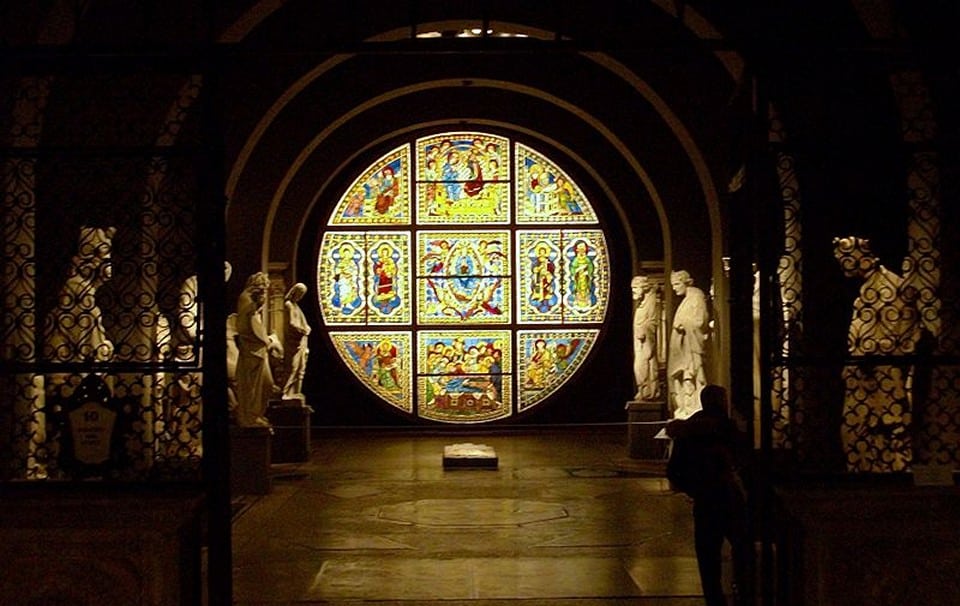
Museo dell’Opera Metropolitana is located at Piazza del Duomo, 8. It’s best to visit this museum after touring the Siena Cathedral on the same square.
The museum houses original artifacts, whose replicas are displayed inside the Duomo di Siena. You’ll also find copies of statues and mosaics from the cathedral, giving you the rare chance to admire them up close.
The museum features marble sculptures by Donatello, Jacopo della Quercia, and Francesco di Giorgio Martini. One standout is the altarpiece “Maestà” (La Maestà) by Duccio di Buoninsegna. It took the artist three years to complete the masterpiece. He signed a special contract with the city, allowing him unlimited expenses as long as he worked alone.
Alongside religious artifacts and artworks, the museum also showcases the domestic items of Siena’s aristocracy, including carpets, tapestries, tablecloths, and hand-crafted curtains.
From the museum, visitors can ascend the unfinished façade of the new cathedral—a colossal project that was abandoned due to the plague and the city’s economic decline. This vantage point offers spectacular views of the square and surrounding hills. Unlike the cathedral bell tower, which lacks an observation deck, this museum provides an excellent panoramic experience. The exit leads through a beautifully decorated small Baroque-style chapel.
It’s recommended to purchase a combined ticket for this museum. It’s more cost-effective and includes access to the cathedral, baptistery, and crypt.
Santa Maria della Scala Hospital Museum
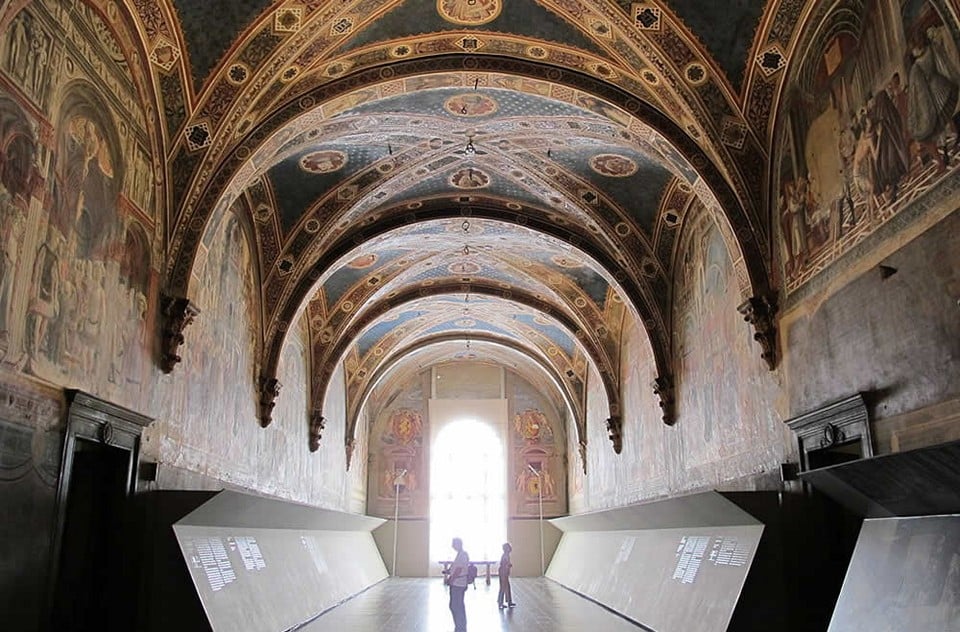
The Santa Maria della Scala Hospital Museum (Complesso museale di Santa Maria della Scala) is located at Piazza del Duomo, 2. The museum is housed in a 9th-century hospital and refuge originally built for the poor, known as Ospedale di Santa Maria della Scala.
The museum opened in 1995 and spans over 13,000 square meters. It’s a unique and diverse space where every room offers something different: frescoes in one hall, a chapel in another, relics of saints nearby, underground tunnels, narrow corridors, and historical chambers. The large former hospital hall is decorated with 15th-century frescoes depicting daily life in the hospice. At the center stands the Church of the Most Holy Annunciation (Chiesa della Santissima Annunziata), which dates back to the 13th century.
Additionally, the museum complex includes Siena’s National Archaeological Museum (Museo Archeologico di Siena), and there are also exhibits of contemporary art.
It’s more economical to buy a combination ticket, which includes access to several other landmarks.
National Picture Gallery
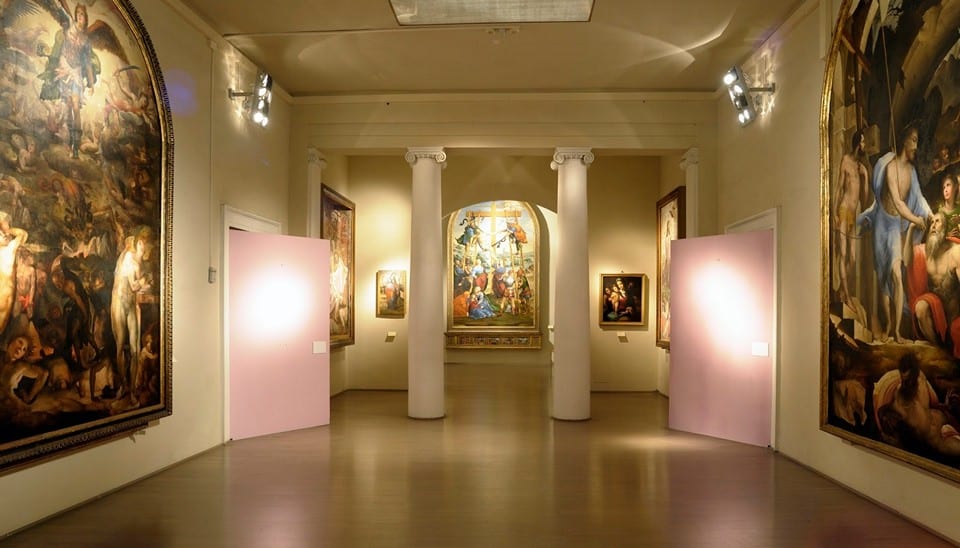
The National Picture Gallery (Pinacoteca Nazionale) is located at Via San Pietro, 29. This museum will appeal to those interested in medieval religious painting. It contains numerous icons and religious artworks, while secular paintings can be found only on the fourth floor.
The collection is housed in two palaces: Palazzo Brigidi and Palazzo Buonsignori, built in the 14th and 15th centuries respectively. The Pinacoteca opened in 1932. Its core collection came from Abbot Giuseppe Ciaccheri, who lived in the late 18th century. Later, it was enriched with donations from noble citizens. Most of the museum’s works belong to Siena’s painting school of the 13th–17th centuries, with occasional pieces from the 18th century.
The fourth floor features the Spannocchi collection, which was added to the museum in 1977. It includes works by Flemish, Dutch, German, and Northern Italian artists. That same year, the gallery also opened a sculpture hall featuring pieces from the 14th and 15th centuries.
Museum of Torture
The Museum of Torture (Museo della Tortura) is not for the faint-hearted. It’s not recommended for children. It is located just a few meters from Piazza del Campo, at the lower part of the square on Chiasso del Bargello, 6.
The museum displays around two hundred types of torture instruments across two floors. There are only a few mutilated mannequins, so the overall impression is not overly disturbing. However, for visual impact, several models of tortured bodies, human skeletons, and skulls are exhibited. Descriptions of the items are available in both Italian and English. Guided tours are also available.
Historic Homes
Siena is filled with fascinating palaces and historic homes. Among them is the house where Saint Catherine, Siena’s patron saint, spent her childhood, the building where the city council met before the Palazzo Pubblico was built, and the historic trading loggia.
Although these buildings are generally closed to the public, they still leave a striking impression from the outside. Visitors will also be intrigued by the Medici Fortress, constructed by the Florentines as a symbol of their final conquest over Siena.
House of Saint Catherine
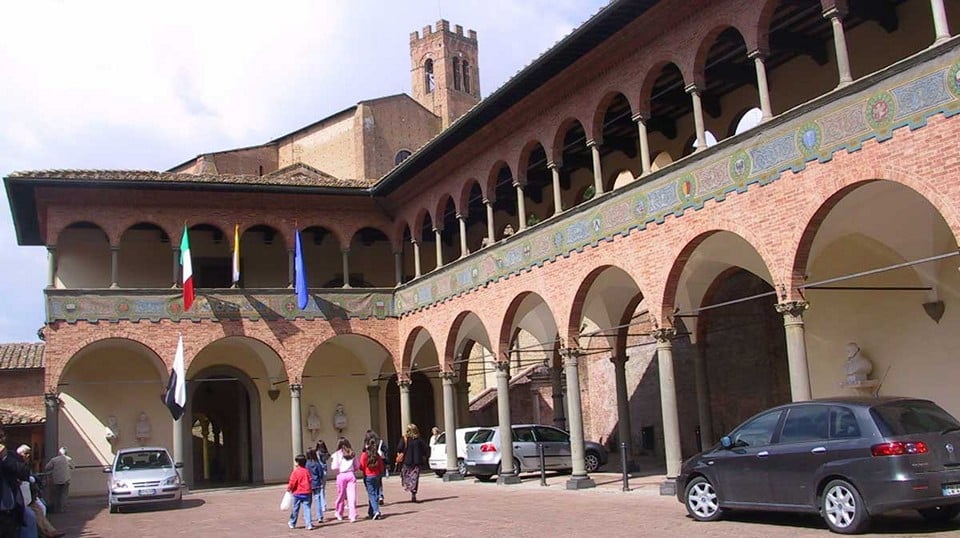
The House of Saint Catherine (Santuario Cateriniano), Siena’s patron saint, is located on Costa di Sant’Antonio street. Today, the site is a sanctuary complex comprising loggias, galleries, arcades, and chapels.
She was born in the second half of the 14th century and lived in this home until she entered religious life. In 1466, the city purchased the house and transformed it into a sanctuary, with chapels built over the former dye room, kitchen, and other spaces.
A chapel was created in the old dye room, which later became the Church of the Crucifix (La chiesa del Crocifisso). Services are still held here. The walls of the church are decorated with frescoes depicting scenes from Catherine’s life. A wooden statue of the saint is also on display.
Near the upper chapel, which once served as the kitchen and now forms the front of the Church of the Crucifix, are the Oratory Rooms (Oratorio della Camera). Adjacent is the saint’s room, where some of her personal belongings are preserved. A stone ledge she used as a pillow can still be seen on the floor.
Palazzo Chigi-Saracini
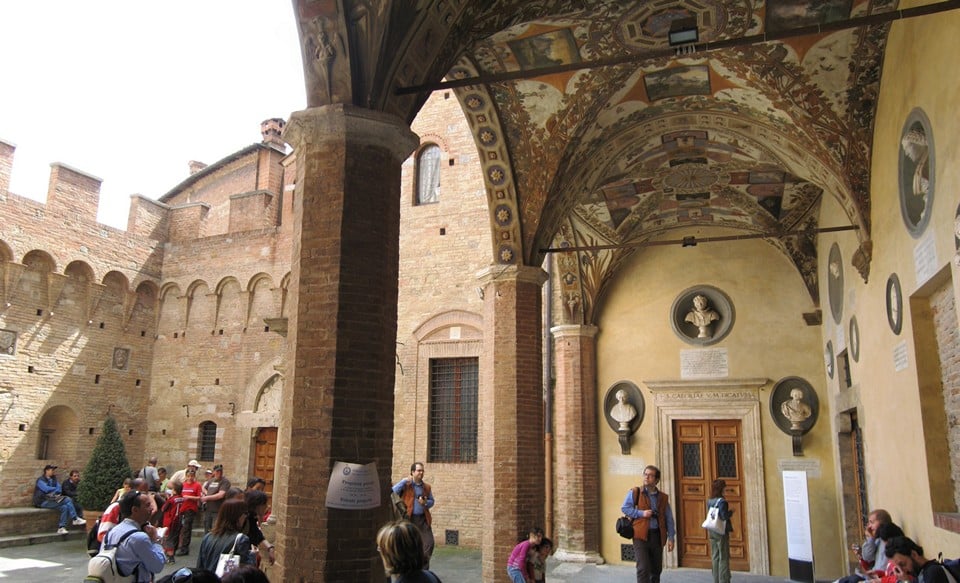
Palazzo Chigi-Saracini is located at Via di Città 89. This 12th-century building was commissioned by the influential Marescotti family. On the left side of the building, you can see a tower, which in the Middle Ages signaled the family’s financial prosperity. In the palace’s inner courtyard, there is a well, a chapel, and a portico decorated with various frescoes.
Before the Palazzo Pubblico was built, this palace hosted the Council of the Republic of Siena. In the 16th century, the building was purchased by the Piccolomini del Mandolo family. Two centuries later, it passed into the hands of the Saracini family, who expanded it and redesigned the façade to follow the curve of the street.
In the late 19th century, Fabio Chigi inherited the palace. In 1932, Count Guido Chigi Saracini established the Chigiana Music Academy (Accademia Musicale Chigiana) within the building, welcoming students from around the world.
The academy also houses a museum, featuring works by renowned Italian painters and sculptors. Among the artists represented are Sandro Botticelli, Il Sassetta, and Domenico Beccafumi (Domenico di Giacomo di Pace Beccafumi). The museum also showcases jewelry, ceramics, and a collection of musical instruments.
Loggia della Mercanzia
The Loggia della Mercanzia is located near Piazza del Campo, at the junction of three streets: Banchi di Sopra, Via di Città, and Banchi di Sotto. It once served as Siena’s commercial court. Since the 18th century, it has been home to the private club Circolo degli Uniti, so access inside is limited.
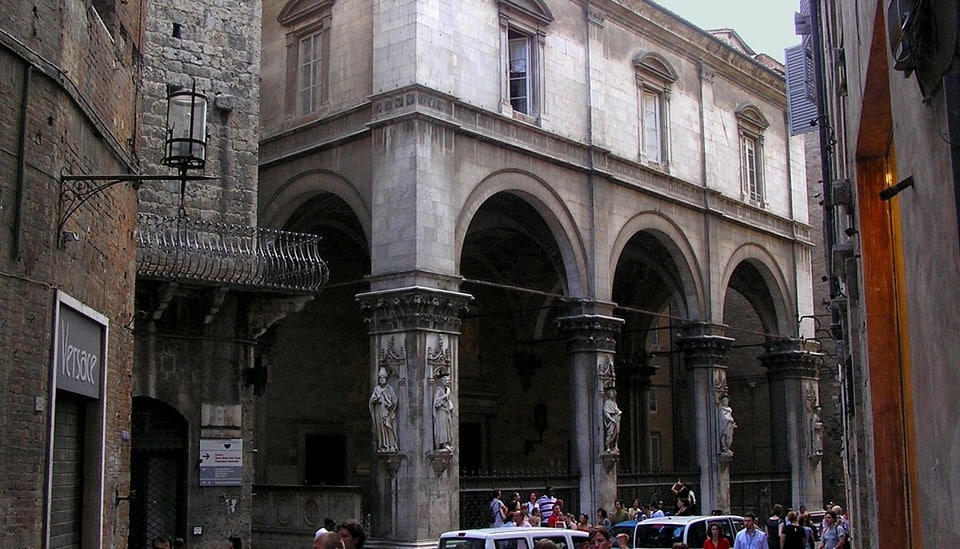
The loggia was built in the early 15th century, blending Gothic and Renaissance architectural elements. The building sits behind a gated portico with large, high arches and an iron railing. The columns between the arches are adorned with bas-reliefs and statues of Siena’s patron saints, as well as Saints Peter and Paul. The vaulted ceilings are decorated with stucco and frescoes, dating to the 16th century. The second floor was added in the 18th century. In the courtyard in front of the building, there are two marble benches—one decorated with reliefs symbolizing virtues, the other with images of famous Romans.
Medici Fortress
The Medici Fortress (Fortezza Medicea), also known as the Fortress of Saint Barbara (Forte di Santa Barbara), is located on Piazza della Libertà, about 800 meters from Piazza del Campo.
The citadel symbolizes the fall of the Republic of Siena and the city’s ultimate conquest by the Florentines. Construction was ordered in 1561 by Florence’s ruler, Cosimo I de’ Medici. The site was not chosen by chance: an earlier Spanish fortress once stood here, demolished by the townspeople a few years prior. Construction of the new citadel was completed in 1563.
The result was a powerful rectangular brick structure. It measured 200 meters wide and 270 meters long on the exterior. Bastions rose at each corner, and three of them were adorned with the coat of arms of Siena’s new ruler. Strategic platforms were built to allow artillery to fire from protected positions.
In the late 18th century, the Fortezza Medicea was decommissioned. In 1937, a public garden was created on its grounds, offering scenic views of the city and surrounding landscape.
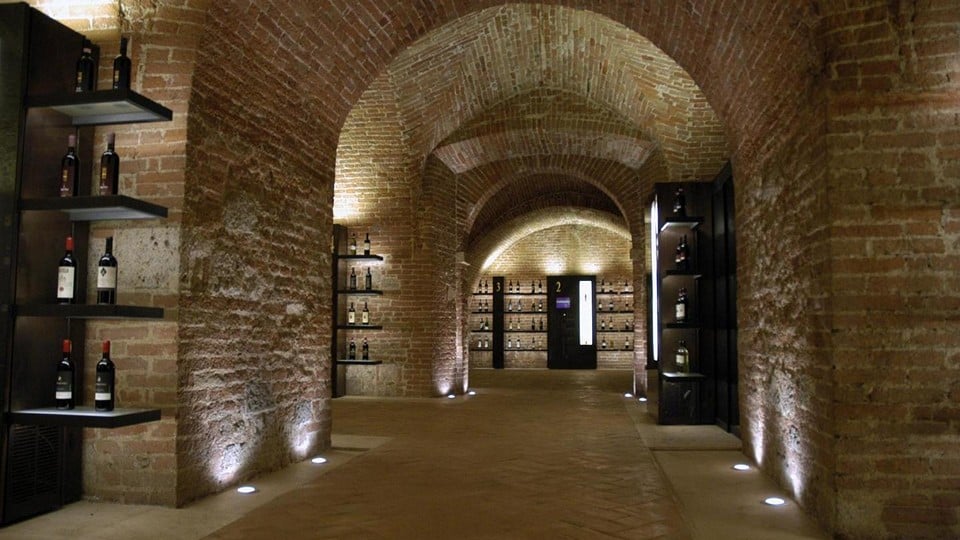
The citadel now functions as a museum, regularly hosting temporary exhibitions, and it also houses a library and audio archive. Additionally, it is home to the Siena Jazz Association (associazione Siena Jazz), which organizes concerts and workshops for musicians. The fortress’s underground chambers feature a wine shop where visitors can taste and purchase fine local wines.
Teatro dei Rinnovati
Teatro dei Rinnovati is the largest theater in Siena, with a seating capacity of 549. This temple of Melpomene is located on the first floor of the Palazzo Pubblico in Piazza del Campo.
The history of Teatro dei Rinnovati began in 1536, when Emperor Charles V (Carlo V) decided to host a grand celebration in the city. Since Siena didn’t have a theater at the time, one of the town hall’s halls was transformed with a stage and audience seating. A century later, the hall underwent a major renovation, with 107 boxes added.
In 1742, the theater was destroyed by fire, but was rebuilt and reopened ten years later. Unfortunately, another fire struck the following year, again destroying much of the hall. This time, repairs were swift, and the theater reopened to the public in the summer of 1753.
Misfortunes continued: an earthquake in 1798 caused significant damage. As a result, the aristocratic club l’Accademia degli Intronati, the theater’s original owner, sold it to the Accademia dei Rinnovati, who restored the hall. During the 19th century, it was renovated several times, including updates to the royal box, stage, dressing rooms, and decor.
In 1927, Teatro dei Rinnovati was closed and sold to the city. Restoration began ten years later to enhance fire safety, but was paused during World War II and resumed afterward.
The theater officially reopened in 1950 during Siena’s Music Week. Since then, it has remained in continuous operation.
City Walls
The Walls of Siena (Mura di Siena) form a circular defensive system composed of walls, towers, and bastions that enclose the medieval part of the city. Visitors can enter the historic center through numerous gates.
The defensive walls of Siena were constructed over several centuries (8th–15th centuries) in five phases, reflecting the city’s population growth. Unlike typical medieval cities, where new walls were built around older ones—eventually dismantling the inner rings—Siena’s fortifications were extended by attaching new sections to the existing ones, preserving earlier defensive lines. Many of the walls and gates into Siena are still standing today.
Parks
Medieval Siena has very little greenery, but just outside the center, you can find several peaceful parks perfect for a nature escape. These include the Botanical Garden, All’Orto de’ Pecci, Giardini la Lizza, and Giardini Pubblici.
All’Orto de’ Pecci
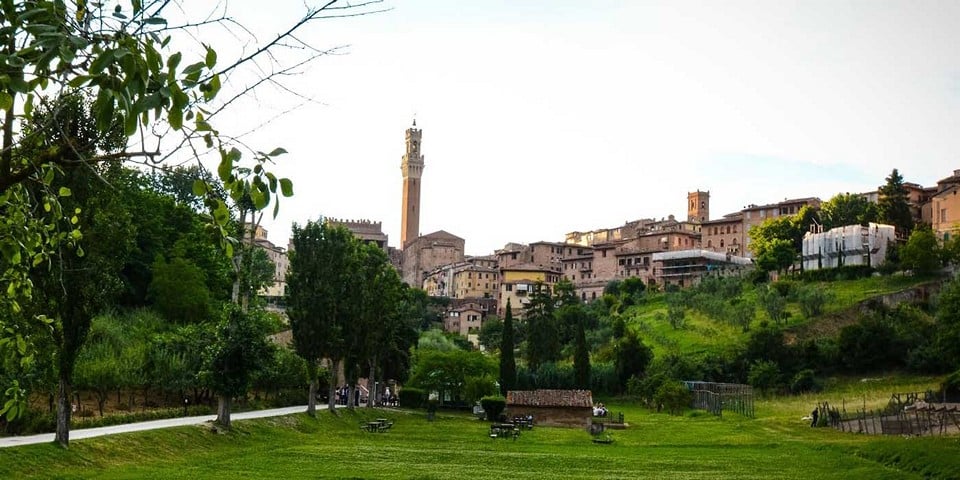
Take a break from the city bustle at All’Orto de’ Pecci, with its entrance on Via di Porta Giustizia, 39, just a five-minute walk from Piazza del Campo. This small, cozy garden is home to peacocks, donkeys, and goats that roam freely in the summer.
Picnicking is not allowed (and monitored), but there’s an affordable restaurant on-site. Two pizzas, two beers, and a cola cost about €22. However, during the high season, it can be fully booked. The garden offers a beautiful view of the historic center, especially the Torre del Mangia and the town hall.
Botanical Garden
Entry to the Siena Botanical Garden (Orto Botanico dell’Università di Siena) requires a fee, which has drawn some criticism from visitors. Some felt the €5 admission wasn’t justified due to parts of the garden appearing unkempt. Still, it’s a delight for exotic plant lovers.
You’ll find carnivorous plants, rare flowers, a Rock Garden, and a fern forest. Two ponds with aquatic plants greet visitors at the entrance.
The botanical garden covers an area of 2.5 hectares (6.2 acres). The main entrance is on Via Pier Andrea Mattioli, 4, about half a kilometer from the Cathedral. It is open daily.
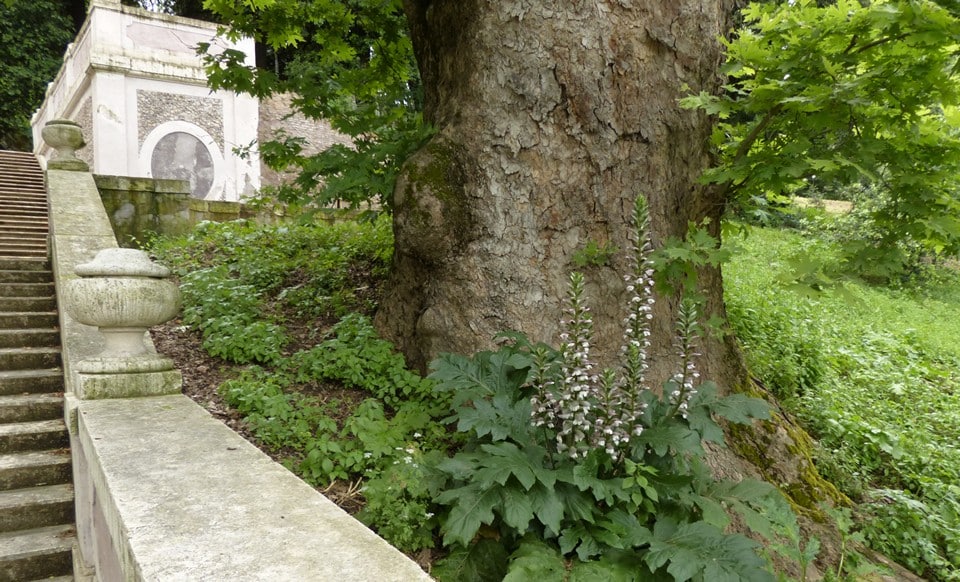
The Siena Botanical Garden was founded in 1588 when the local university began growing medicinal plants near the Santa Maria della Scala hospital.
Two centuries later, the original space became too small, so the garden was relocated to its current site. The garden’s first published report listed 900 plant species from around the world. Greenhouses were added to accommodate flora unsuited to the local climate.
What Is the Palio?
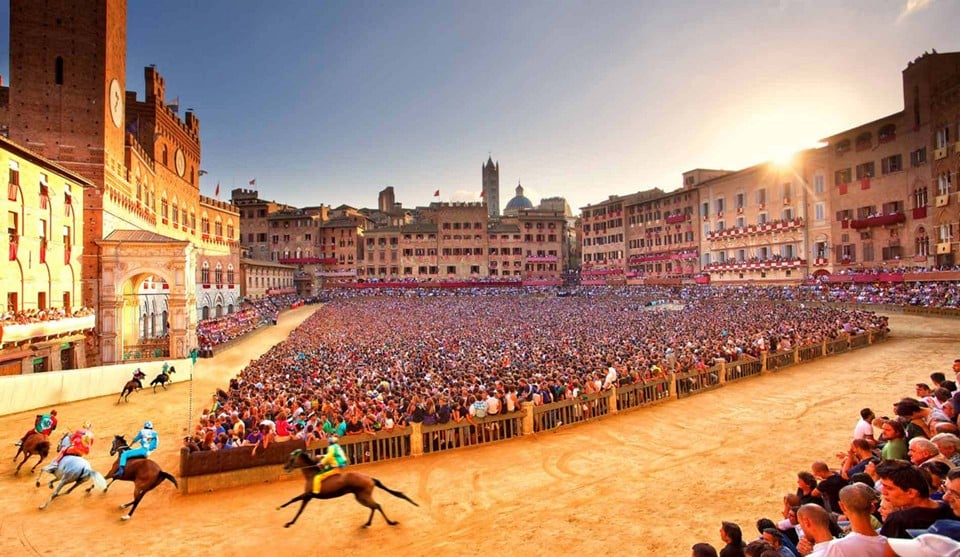
One of the most captivating events held in Siena is the Palio horse race (Il Palio), featuring riders from the city’s seventeen districts, known as contrade. For the occasion, Piazza del Campo is covered with a layer of sand along its perimeter, which is removed once the race concludes. A colorful costumed parade takes place before the competition.
Ten of the seventeen contrade compete in each Palio. To decide which districts will participate, a lottery is held beforehand. Interestingly, the true stars of the race are not the jockeys but the horses: even if a jockey falls and the horse finishes first, the victory still counts. Locals rarely serve as jockeys—professionals are usually brought in from other cities.
The race is held twice a year: the first on July 2 in honor of the Madonna of Provenzano, who is believed to have saved Siena from invaders; the second on August 16 in celebration of the Assumption of the Virgin Mary. Occasionally, a third race is added to mark a special occasion, such as the turn of a century or the anniversary of Italy’s unification.
How to Get There
Although Siena lies in the heart of Tuscany and boasts many attractions, it sits off the main tourist routes. The nearest airports serving domestic and international flights are about one to two hours away. However, Siena is accessible by intercity buses and regional trains.
- See detailed guide: how to get to Siena on your own
By Plane
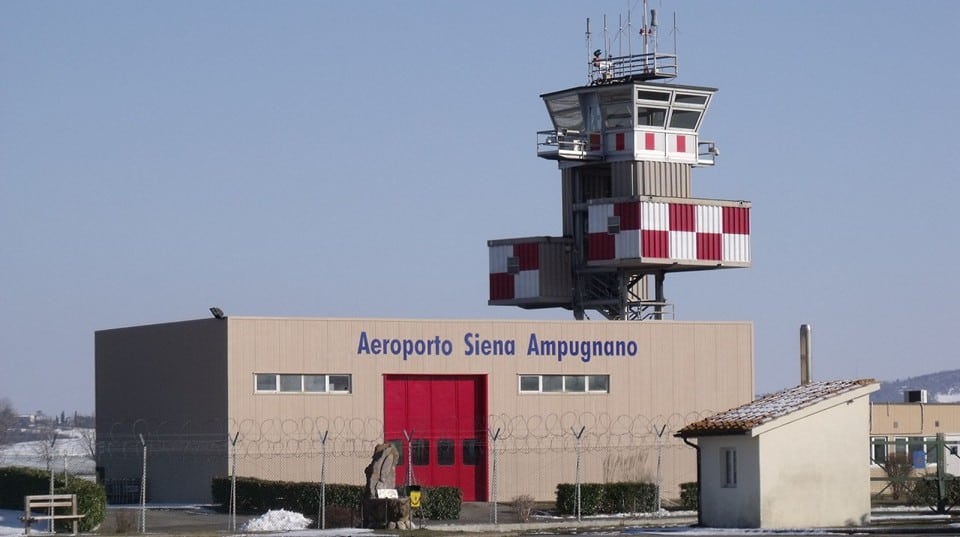
Just 9 km from Siena lies the small “Siena Ampugnano” airport, but it doesn’t serve passenger flights—used mainly for private and business aviation. So, to reach Siena by air, fly into Florence or Pisa (Pisa International Airport). You can also arrive from Rome (Fiumicino Airport), though the drive takes about two hours (268 km via highway).
The distance between Florence and Siena is 50 miles (80 km), about an hour by car. We recommend reserving a rental in advance at auto.italy4.me.
From Florence Airport (L’Aeroporto di Firenze-Peretola), take a shuttle to Santa Maria Novella train station and catch a train to Siena. A direct route is ideal, but if not available, transfer at Empoli station. Near the train station, at via Santa Caterina da Siena, 15, is the bus terminal where you can get a direct coach to Siena.
The Pisa Airport is named after Galileo Galilei. Buses to Siena depart directly from the airport. Distance is 100 miles (160 km). You can choose between Tiemme and TerraVision IT buses:
- Tiemme buses take two hours via Florence. One-way fare: €15, round trip: €28. Check schedules at tiemmespa.it.
- TerraVision IT buses leave hourly via Florence, travel time: 3 hours. Ticket: €28. Schedule available here.
Marozzi VT buses depart from Park Pietrasantina station on via Fazio degli Uberti (about 20 minutes from the airport) and arrive at Stazione FS. Check times at www2.marozzivt.it.
By Train
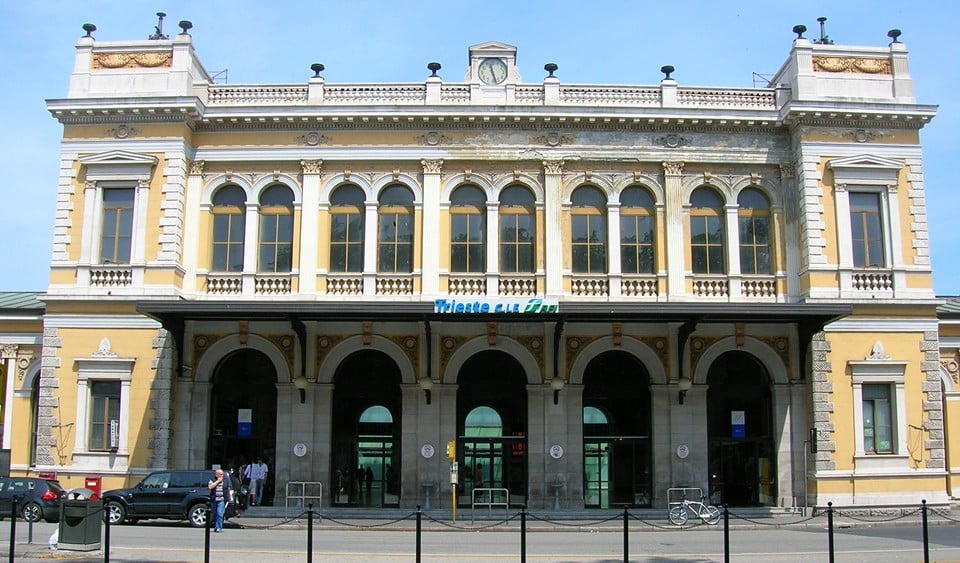
The railway station (La stazione di Siena) is located at piazza Carlo Rosselli, 1.5 miles (2.5 km) from Piazza del Campo. Trains arrive from various parts of Tuscany—for example, from Florence, the trip takes about 1.5 hours.
Check train schedules here: www.e656.net/orario/stazione/siena. Be sure to select the time window in the top-left corner: 00–06, 06–12, 12–18, or 18–24.
There is no direct connection to Rome. You’ll need to change trains at either Grosseto or Chiusi–Chianciano Terme.
The train station is 2 km (1.2 miles) from the city center, so you can walk (about 30 minutes) or take a bus to Piazza Antonio Gramsci, or a taxi (around €8).
By Bus
The main bus station in Siena is located at Piazza Antonio Gramsci. You can view ticket prices and schedules here: www.tiemmespa.it.
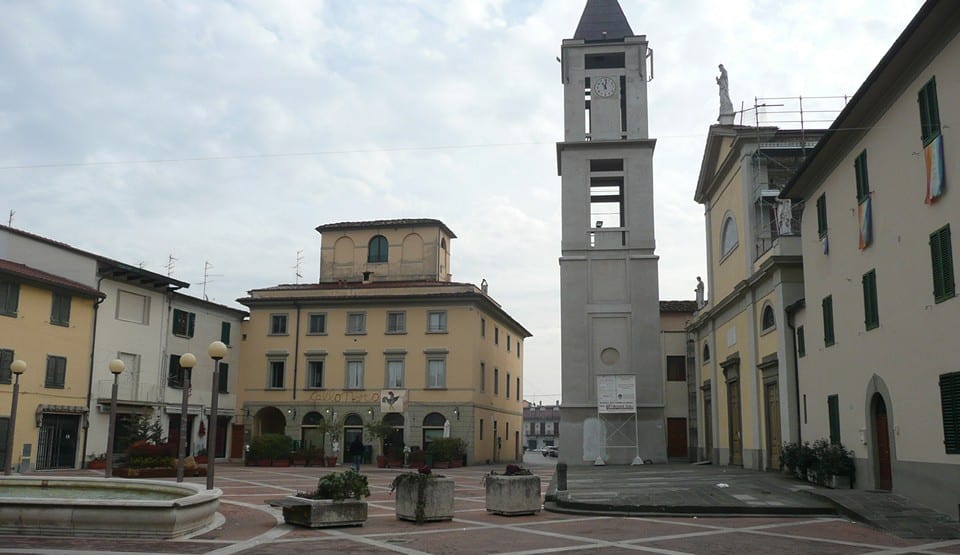
It’s just a 10-minute walk from here to the Siena Cathedral. The station resembles more of a bus terminal with several platforms. Toward the city center is a display board. In the middle, there’s an elevator that leads down to the ticket office. You can also access the ticket counters by crossing the street and heading down the stairs.
Tickets for intercity buses can be purchased here, and must be validated (punched) upon boarding.
There are no ticket sales onboard the bus.
If you plan to take a bus to another city, keep in mind that while buses may seem faster on paper than trains, traffic delays are common and can significantly impact arrival times. For business travel, taking the train is usually the better option.