 Italy for me From Italy with love

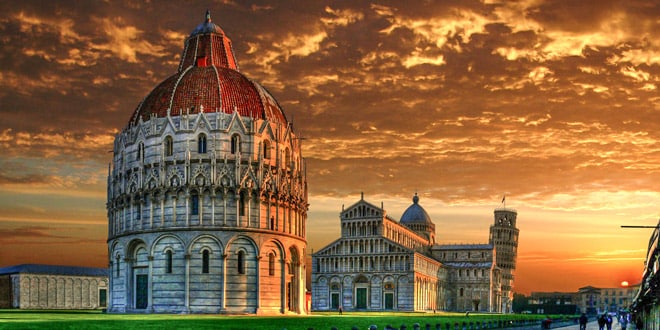
The unique and extraordinary Square of Miracles in Pisa draws large crowds of tourists every year. One of the most iconic landmarks in the square is the renowned Baptistery of St. John, designed in the Italian Gothic style of the 12th century.
Page Contents
Historical Background
Construction of this grand baptistery began back in 1152.
The site for its construction was no coincidence—it was previously home to an earlier baptistery. The building took nearly two centuries to complete. This prolonged construction timeline is evident in its design: the initial architect, Diotisalvi, envisioned the structure in Romanesque style, while later architects Nicola Pisano and Giovanni Pisano introduced Gothic elements. Far from clashing, the blend of styles enhanced the baptistery’s architectural beauty and helped make it globally renowned.
Description
The Pisa Baptistery, considered the largest in Italy, stands about 180 feet tall (55 meters) and has a diameter of 352 feet (107.24 meters).
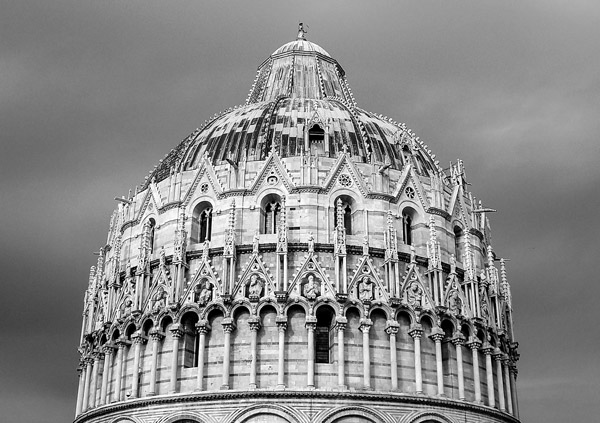
The building consists of three distinct levels. The first and lowest tier strictly follows Romanesque principles: clean symmetry, rounded arches, and narrow elongated windows. The second level is the most ornate and elegant, featuring numerous small columns and intricate marble carvings of saints’ faces, giving the structure its refined beauty. The top tier consists of a rounded roof with two domes and graceful triangular arches over the windows.
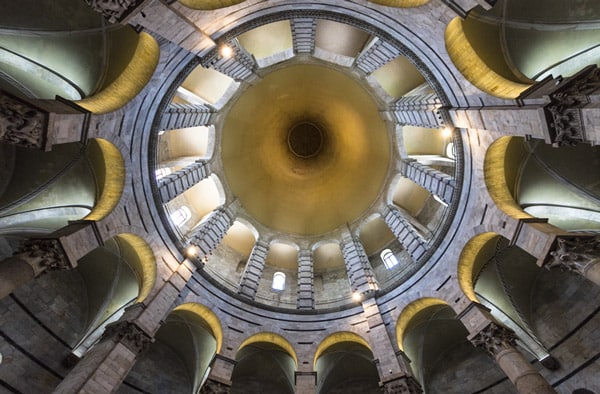
The interior of the baptistery is designed in a solemn Byzantine style. Its vast open space is supported by a few columns, with two tiers of decorative imagery. The lower tier depicts key scenes from the life of John the Baptist, while the upper tier shows St. John with the Madonna, surrounded by angels and evangelists.
At the heart of the baptistery is a large octagonal font, crowned by a bronze statue of John the Baptist. Also noteworthy is the hexagonal pulpit, adorned with high-relief carvings depicting scenes from the life of Christ. Three of its supporting columns rest atop lions. This pulpit is famous among art historians, many of whom consider it the first true work of art from the Renaissance era.
Interesting Facts
For years, scientists, builders, and architects have debated why the baptistery was topped with two stacked domes. Some claimed it was a triumph of Gothic style, while others believed the design enhanced structural integrity by having the cones support one another. However, the most compelling explanation is acoustic: the two domes of differing sizes create extraordinary sound resonance, lending the interior a uniquely majestic atmosphere.
Another remarkable fact: every year on June 24, sunlight passes through a small hole in the wall and illuminates the bronze statue of Saint John, creating the illusion that the statue itself emits light. Italians celebrate Saint John’s Day on this date.
It’s also worth noting that Galileo Galilei was baptized right here in the Pisa Baptistery.
This monumental and extraordinary structure forms an essential part of the architectural ensemble of the Square of Miracles, which is recognized as a UNESCO World Heritage Site.
How to Visit the Baptistery
The baptistery is open year-round. Visitors can admire its stunning exterior any day, any time. Entry to the interior, however, follows seasonal hours: – Winter: 9:00 AM – 4:30 PM – Summer: 8:00 AM – 7:00 PM – Spring and Fall: 9:00 AM – 5:40 PM
The baptistery is closed only on January 1 and December 25. Admission is €8.
Nearby Attractions
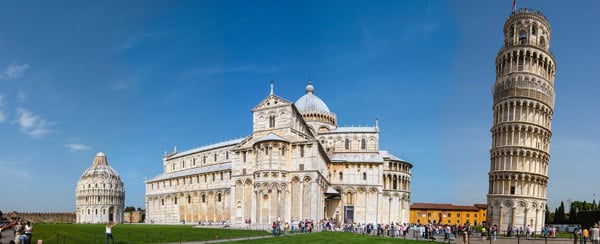
As part of the world-famous Square of Miracles, the Pisa Baptistery alone is worth the visit. Nearby, you’ll find equally astonishing landmarks known around the globe: the Leaning Tower of Pisa, the Pisa Cathedral, the monumental Campo Santo cemetery, and the statue of the Capitoline Wolf, which fed Rome’s legendary founders, Romulus and Remus.