 Italy for me From Italy with love


The Palazzo Comunale – Siena’s Town Hall – is located in the heart of the city of Siena, which today serves as the capital of the province bearing the same name in the region of Tuscany. The proud glory of the former Republic of Siena lives on in its medieval heritage, and the city quietly preserves the treasures created during that golden age—among them, the Palazzo Comunale.
Page Contents
History of Construction
Siena’s period of prosperity spanned the 12th to 14th centuries. During this time, the city built its future symbol—the Siena Cathedral—founded its university, and played an active role in regional politics. Initially, the city was governed by the “Council of Twenty-Four,” a body of bankers who met in the Church of San Pellegrino (Chiesa di San Pellegrino alla Sapienza), as they had no permanent seat of power. They were replaced by the “Council of the Bell,” an aristocratic government that convened at the sound of a bell in private palaces. Eventually, the nobles were overthrown.
In 1270, the “Council of Nine,” composed of merchants and financiers, came to power. They aligned themselves with Florence, supported the papacy, and were Guelphs by political affiliation.
Between 1288 and 1310, the “Council of Nine” began construction of their own seat of power—the town hall known as Palazzo Pubblico (Palazzo Comunale).
The chosen site was Piazza del Campo, the city’s marketplace, which then contained only one building—Bolgano, used as a customs house and mint. This structure was reoriented to face the square and expanded into a grand palace in the Sienese Gothic style. The local artistic tradition is defined by a blend of Gothic elements with Byzantine influences and early Renaissance features.
Exterior
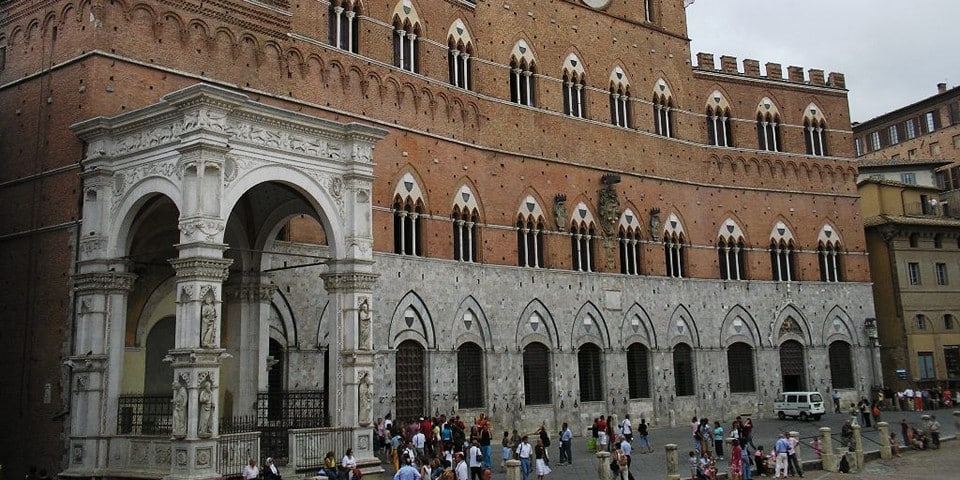
The palace’s ground floor was constructed from white travertine stone and features a covered gallery that forms an inner courtyard. Each arch of the lower level is adorned with the black-and-white coats of arms of Siena’s rulers. At the courtyard entrance, visitors are greeted by a statue of the She-Wolf of Siena—another symbol of the city—sculpted in the 15th century by Giovanni and Lorenzo di Turino.
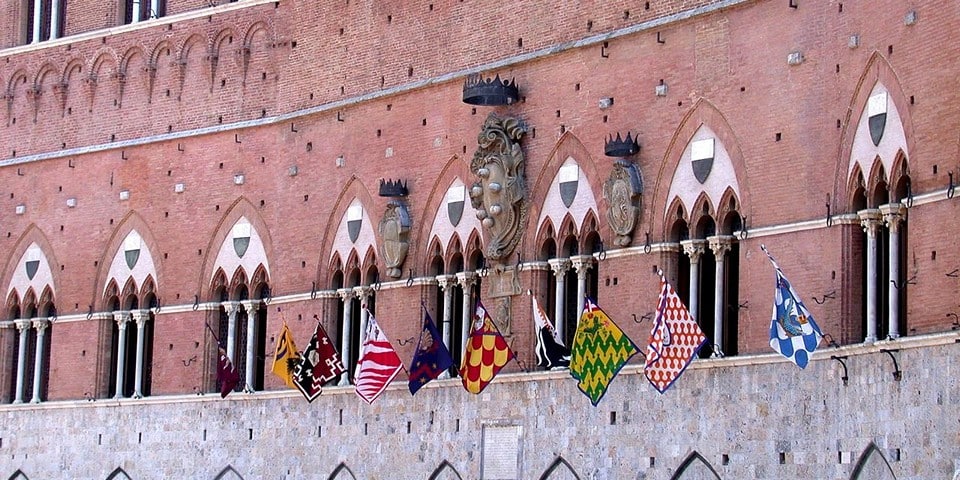
The upper part of the palace is built from reddish-brown brick in a hue known as “siena.” Local clay, when fired, produces a warm brown with golden undertones—a color so distinct it was named after Siena by artists. The palace’s signature detail is its windows, characteristic of the Sienese style: slender columns divide each window into three sections, each topped with a pointed arch. A larger arch frames the entire window and is embellished with Siena’s black-and-white emblem. These colors symbolize the legendary founding of the city: its residents trace their roots to Senius and Aschius, sons of Remus. According to legend, the brothers fled Romulus, their father’s killer, and arrived in Siena on a black and a white horse. The horses’ colors became the city’s symbol, along with the she-wolf statue they brought with them.
The building’s roofline is crowned with rectangular battlements, marking the ruling party’s affiliation with the Guelphs—supporters of the pope.
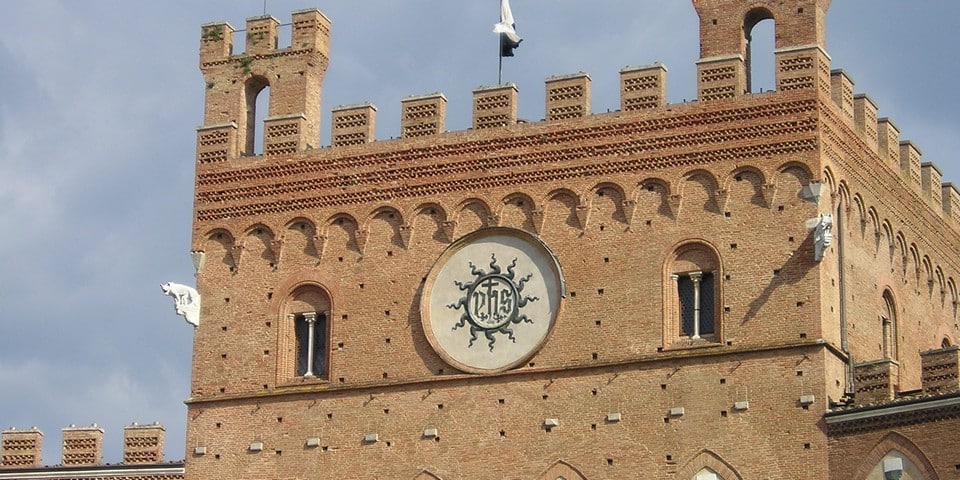
In the 14th century, the Palazzo Comunale’s width allowed for only four windows, and its concave façade followed the curve of the square. In the 17th century, symmetrical wings were added to the central section, carefully preserving the 14th-century style. The palace was then joined with the Torre del Mangia, built in the same century, and the Capella di Piazza, constructed between the 14th and 16th centuries. The final touch to the exterior was a large circular monogram of Jesus Christ in the form of a sun, set within a white circle. The numerous holes in the palace walls were used to anchor scaffolding during construction and later restorations.
Interior
The palace’s interior spaces were never used as living quarters. They housed municipal offices. Today, the second floor of the Palazzo Pubblico is occupied by city government departments, while the ground floor is home to the city museum—the Museo Civico.
The first hall of the museum displays material culture from Siena between the 14th and 16th centuries, including ceramics, weapons, and jewelry.
The Hall of the World Map (Sala del Mappamondo) provides insight into the territory of the Sienese Republic at the height of its power. The map, painted on wood, was created by the renowned 14th-century artist Ambrogio Lorenzetti. He belonged to the Sienese “Trecento” school—a 14th-century movement that transformed the strict canons of Byzantine iconography into a more grounded Gothic style.
Among the most popular works of Sienese artists were icons of the Virgin Mary. The fresco “Maestà” by Simone Martini (1321) was placed on the wall of the council chamber so that the Madonna could be spiritually present during important decision-making.
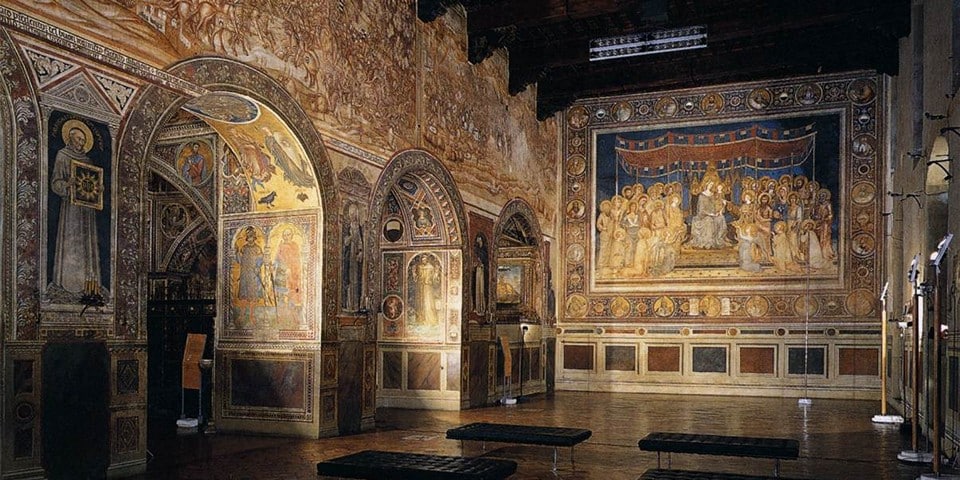
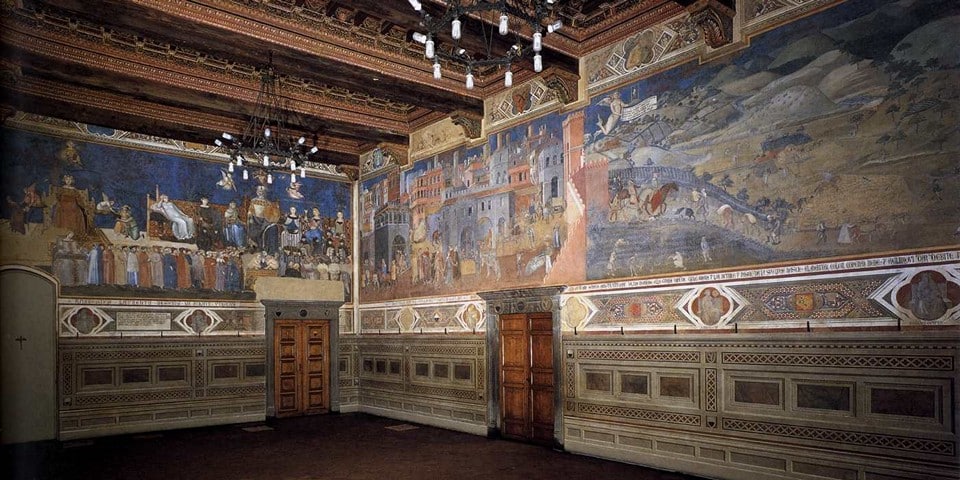
The Council Chamber (Sala della Pace) is adorned with the fresco cycle “Allegories of Good and Bad Government” by A. Lorenzetti. The fruits of good governance are blooming streets, dancing citizens, and flourishing agricultural work. Bad governance leads to crumbling buildings, abandoned homes, and desolate streets where ghostlike figures wander.
Lorenzetti’s frescoes are profound and poetic—perhaps the earliest example of Gothic painting devoted to secular themes.
The plague of 1348 dealt a devastating blow to the refined and spiritual Sienese school. But the masterpieces of that golden age live on within the halls of the Palazzo Pubblico—a palace built by bankers with the souls of artists.