 Italy for me From Italy with love


The ancient palace, known as Palazzo Vecchio, was a gift to the residents of Florence from one of the most prolific Italian architects of the 13th century, Arnolfo di Cambio. Palazzo Vecchio is the main adornment of Piazza della Signoria. The building resembles a medieval Romanesque fort.
A distinctive feature is the clock tower, which rises above the main structure. The monumental Palazzo Vecchio is not just one of the top attractions in Florence but also an essential symbol of the city and its political life.
Page Contents
Things to Know Before Visit
How much would it cost to build a building like the Palazzo Vecchio in Florence?
Is Palazzo Vecchio worth visiting?
What is Palazzo Vecchio’s purpose?
What are the statues in front of Palazzo Vecchio?
The Evolution of the Palace’s Name
Interestingly, since its inception, the town hall has had several names. 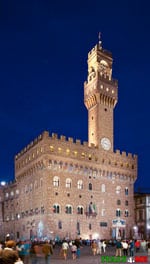 At the end of the 13th century, the complex was called the New Palace (Palagio Novo) as it was a new building for the Florentine administration. In the 15th century, the dignitaries who sat in the town hall gave themselves the title of signori, thus renaming the palace Palazzo della Signoria.
By the way, the Italian word “Signoria” translates to “power,” which fully reflects the purpose of the town hall. In the mid-16th century, Duke Cosimo I of Tuscany settled within the palace walls. From that moment, the town hall was called the Ducal Palace (Palazzo Ducale). In 1565, the grand duke chose another residence for himself, and the much-endured building acquired its modern name – Palazzo Vecchio, or the Old Palace.
Today, the town halls are filled with museum exhibits and open to visitors. Nevertheless, the municipal authorities of Florence are still based in Palazzo Vecchio, continuing the old tradition of their predecessors.
History
The construction of Palazzo Vecchio was preceded by turbulent political processes in the country and the city. The ruling circles of the Florentine commune decided to acquire a new residence in the late 13th century. To this end, construction began on land that had previously belonged to the powerful Uberti family. Initially, workers dismantled the ruins of the defeated aristocrats’ ancestral castle. In 1299, they began working on the new building under the guidance of the famous artist and architect Arnolfo di Cambio.
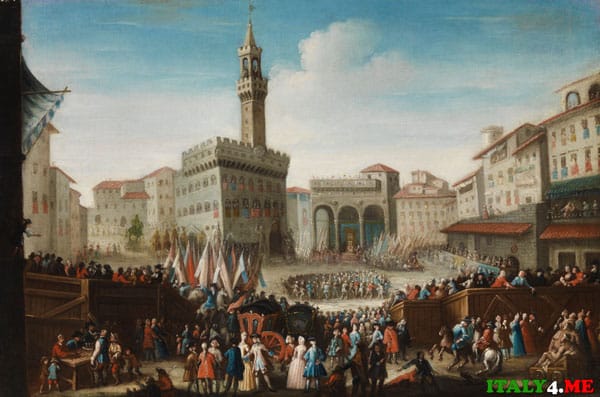
By that time, the renowned master had already gained wide fame as the creator of such masterpieces as the Church of Santa Croce and the Florentine Cathedral. Arnolfo envisioned his new project as a robust and reliable structure. The severe silhouette of the fortress was somewhat softened by elements of exterior decor and the elegant clock tower. Thus, Palazzo Vecchio symbolizes strength and steadfastness, harmoniously combined with external beauty.
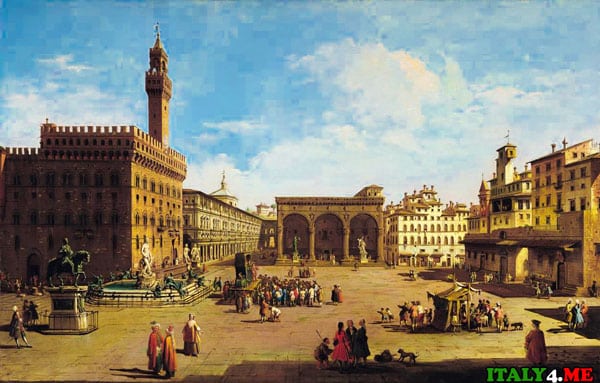
In the mid-15th century, the Old Palace became the site of quite dramatic events. A conspiracy was uncovered, aiming to overthrow the Medici family from the leadership of the Florentine Republic. The leader of the conspiracy, Francesco Pazzi, paid for his deeds with his life. As a lesson, the conspirator was hanged from the central window of the town hall. Just one year later, in 1479, the same fate befell Bernardo di Bandino, who had become the executioner of Giuliano Medici.
Exterior Decoration of the Old Palace
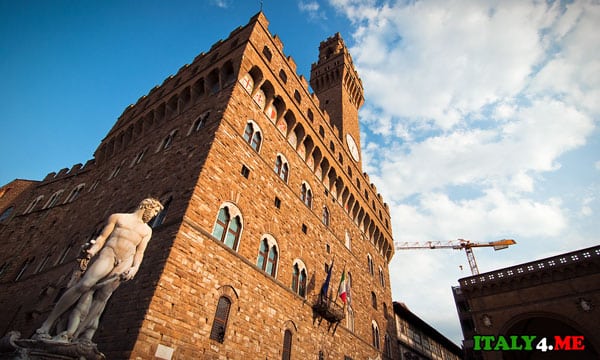
If viewed from above, the palace would look like a rectangle. The architect refrained from excessive embellishments here. The exterior of the building looks quite austere. The town hall is divided into three horizontal tiers. The lower tier, as befits a fortification, is devoid of any intricate decorations. However, the second tier features beautiful windows.
In accordance with Gothic canons, they have arches in the shape of a trefoil, later decorated by master Michelozzo.
The building is crowned with a crenelated parapet, which is well-known to fans of knight and princess films. Below, the stone border is attached to the building with small arches. Within these arches, artists depicted the coats of arms of the nine guilds that headed the Florentine Republic. By the way, the arches are not only decorative but also functional. Through them, the tower’s defenders could pour hot oil or throw stones on the heads of besiegers.
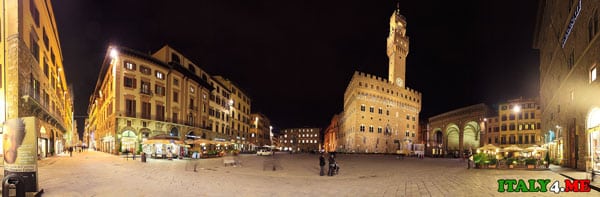
The decoration of Palazzo Vecchio’s leading entrance portal, reinforced on the wall in 1528, is particularly eye-catching. Two maned lions on a deep blue background guard a marble plaque.
The Latin inscription “Rex Regum et Dominus Dominantium” means “King of Kings, Lord of Lords,” a monogram of Jesus Christ, the Son of God.
Near the main entrance to the town hall, called the Lions’ Gate, and at the corner of the building stand beautiful examples of Italian architecture. Right at the entrance stands a copy of Michelangelo’s famous David. Joining him is Hercules, who is fighting Cacus from Baccio Bandinelli’s workshop.
Arnolfo Tower
The tower construction, part of the palace’s architectural ensemble, deserves a separate mention. 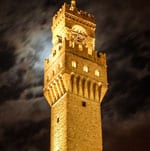 The building stands on the foundation of an older structure, the La Vacca Tower. The high stone walls are topped with an openwork summit with internal niches.
The structure, rising 94 meters (308 feet) above Piazza della Signoria, was named Arnolfo Tower in honor of its creator. In the mid-17th century, clocks created by master Giorgio Lederle were installed on the tower’s facade. Since then, the timepiece has reliably indicated the time to the square’s visitors.
Today, Arnolfo Tower adorns Palazzo Vecchio, but in medieval times, it was used as a prison. During the 15th century, the chambers held Cosimo Medici and Girolamo Savonarola.
The former belonged to the powerful Medici family, which ruled Florence. A penchant for intrigues and overly active participation in Italy’s political life led to unfortunate consequences. Savonarola, a Catholic priest who gathered thousands under the Duomo’s dome, was persecuted for his overly strict views.
Interior Decoration
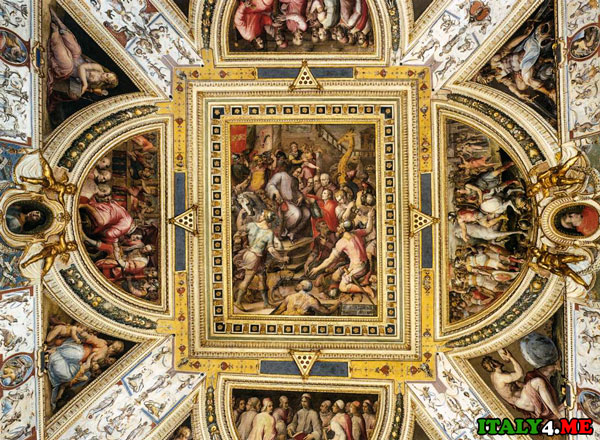
The interior beauty of the Old Palace sharply contrasts with the exterior simplicity of rusticated stone. The three tiers of the building are divided into numerous halls, each dedicated to a specific theme. Let’s begin our acquaintance with Palazzo Vecchio.
First Courtyard
The Lions’ Gate, guarded by statues of David and Hercules, opens the way to the Old Palace’s inner courtyard, also known as the First Courtyard. As soon as a traveler steps onto the courtyard’s stone slabs, they pause for a moment, trying to absorb all its beauty. Carved columns and the high arch of the painted ceiling are elegant and filled with the tiniest details.
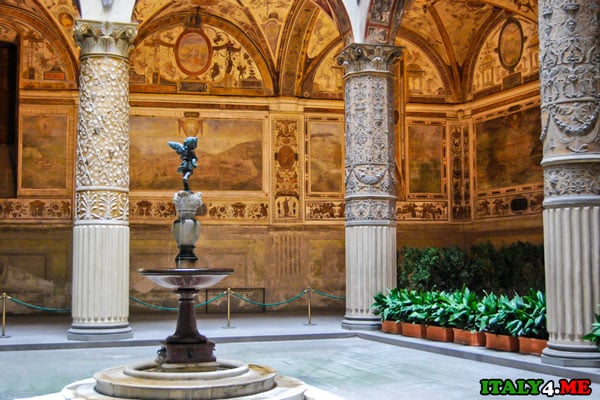
In the center of the First Courtyard stands a small fountain, its water gently murmuring in the company of dwarf orange trees. The fountain is adorned with a reduced copy of the statue Cupid with Dolphin, by Andrea del Verrocchio. The original sculpture is exhibited in the halls on the second floor. The impressive interior of the town hall was created in the mid-15th century by master Michelozzo. The creation of this place, filled with grandeur and romance, was timed to the wedding of the Florentine ruler Francesco Medici and Joanna of Austria.
On the courtyard walls, artist Giorgio Vasari meticulously painted views of ancient cities belonging to the Austro-Hungarian Empire. Familiar outlines of Graz, Vienna, Linz, and Prague were meant to soothe the young Italian nobleman’s wife’s longing for her distant homeland.
Hall of the Five Hundred
Passing through the charming inner courtyard, visitors enter a hall impressive for its size and beauty. The Hall of Five Hundred (Salone dei Cinquecento) occupies a significant part of the first tier of Palazzo Vecchio. The hall’s dimensions are substantial: 52 by 23 meters (171 by 75 feet). Its creation at the end of the 15th century was the work of Simone del Pollaiolo. In this hall, by the design of Girolamo Savonarola, the Great Council was to convene.
After the fall of the Medici family, the fate of the Florentine Republic was determined by 500 council members. Savonarola then closely attended to the affairs of the Catholic Church, fighting for the purity and righteousness of its ministers.
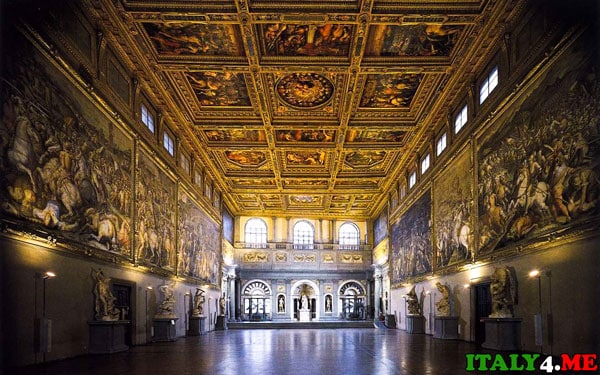
During the reign of the Grand Duke of Tuscany, Cosimo I, master Vasari decorated the hall’s walls with frescoes depicting battle scenes. During the hall’s conversion into the duke’s courtroom, frescoes by the great Italians Leonardo da Vinci and Michelangelo were deliberately destroyed. However, Michelangelo’s most significant masterpiece – the sculptural ensemble Genius, Defeating Brutal Force (1533-1534) – has been successfully preserved to this day.
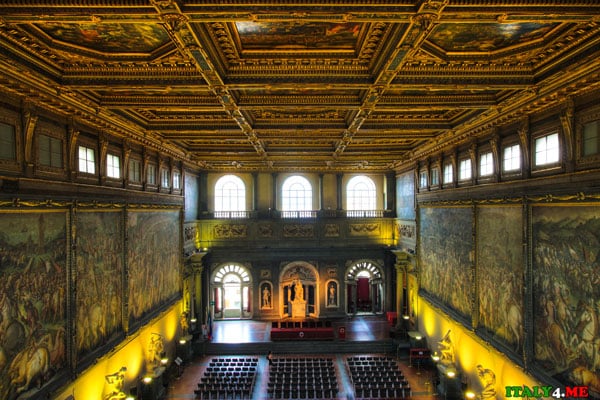
Along the hall’s walls, in particular niches, are displayed sculptures of popes who ruled the church in alliance with the Medici family. These were created by the great sculptor Baccio Bandinelli. If you look up, another wave of admiration will sweep over you. The high ceiling of the hall is decorated with paintings glorifying the Grand Duke and his army. In the center of the ceiling is a panel depicting the triumph of Cosimo I as Duke of Florence and Tuscany.
A small secret room behind the vast Hall of the Five Hundred served as Francesco Medici’s study. The son of Cosimo I had quite diverse interests; he used the study as a studio, laboratory, and even a sort of storage for items valuable to him. Sculptor and artist Giorgio Vasari also worked on the study’s creation and decoration. The walls and sloping ceiling of the studio are completely covered with paintings. Combined with bronze statuettes, this interior is considered a classic example of Mannerism.
Hall of Lilies
The second tier of Palazzo Vecchio is divided into several picturesque halls. The most majestic of these is the Hall of Lilies (Sala dei Gigli). The portal leading to this beautiful place is made of pure white marble. The hall’s walls are filled with a large fresco by Domenico Ghirlandaio. The master spent a significant part of 1482 painting on the walls the first Florentine bishop, Saint Zenobius, surrounded by Saints Stephen and Lawrence. Additionally, you can admire depictions of the pillars of the Roman Empire: Cicero, Scipio, and Brutus.
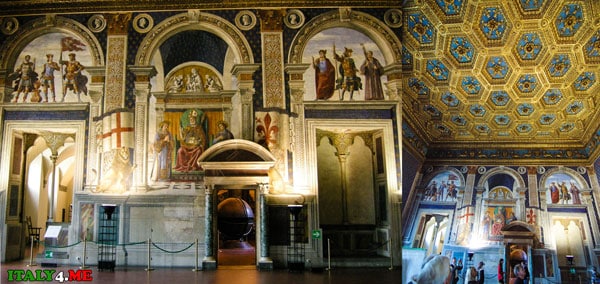
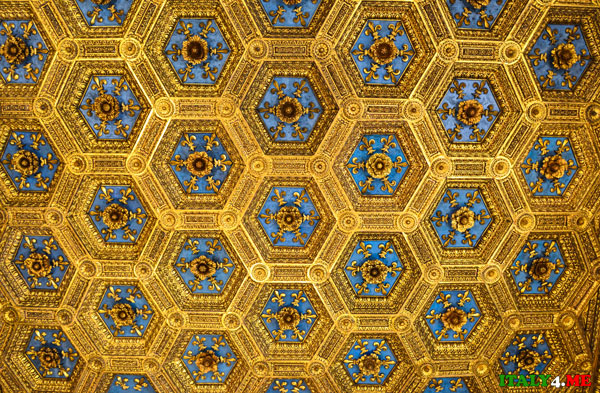
However, the ceiling decoration leaves the most significant impression on an unprepared visitor. The ceiling surface is covered with honeycomb-shaped gilded stucco. The base of each cell has a deep blue shade, against which golden lilies shine – a symbol of the influential French House of Anjou. During the feud between the religious Guelphs and the Ghibellines, the Count of Anjou and his descendants supported the papal side. The Florentines decided to immortalize the fateful contribution of their allies in this unusual way.
Another gem of the Hall of Lilies is the sculpture Judith and Holofernes by Donatello. A copy of this sculpture can be seen in Piazza della Signoria, outside the Old Palace.
Other Attractions of the Old Palace
Also worth mentioning is the Hall of Elements, depicting the four forces that give life on Earth: fire, water, wind, and earth. These elements are described as allegories, with Venus representing water, emerging from the sea foam.
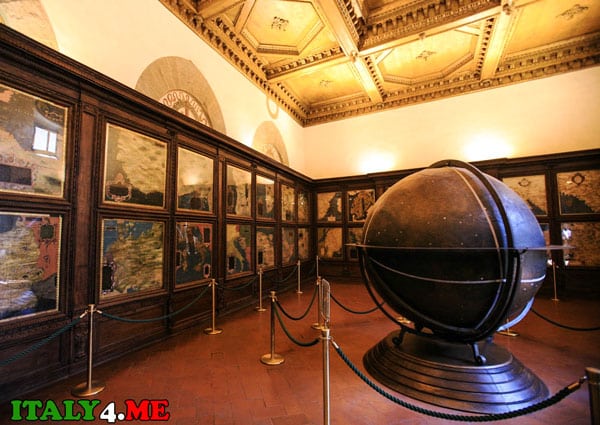
The Hall of Maps on the second floor of the palace contains 53 maps drawn by monk Ignazio Danti. These maps illustrate the breadth of Florentine geographical knowledge in the 16th century. In the center of the hall, a huge globe, the largest in Italy at that time, was installed in 1581.
Absorbing the palace’s splendor, a traveler might feel overwhelmed by the frescoes, sculptures, paintings, and other works of art. To take a short break, just go up to the top tier of Palazzo Vecchio. There you’ll find the Saturn Terrace, offering an excellent view of the city. The vantage point here is not as high as Giotto’s Campanile or Brunelleschi’s Dome, but you’ll still get a great view of Florence’s roofs, hills, and famous landmarks.
How to Visit
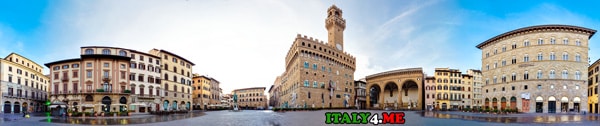
The Old Palace is located in Piazza della Signoria. This attraction is in the center of Florence, so getting there by public transport is not a problem.
Opening Hours
On Monday, Tuesday, Friday, Saturday, and Sunday, you can enter Palazzo Vecchio from 9:00 AM to 7:00 PM. On Thursday, the palace is open from 9:00 AM to 2:00 PM.
Ticket Prices
Visiting the museum halls of the Old Palace costs €12.5. You can also visit the town hall’s Arnolfo Tower for an additional €10. A combined “Museum + Tower” ticket is €24.5. There is also a “student” discount for groups of visitors aged 18-25 and over 65, with the appropriate documentation.
Official website of the Palazzo Vecchio Museum: musefirenze.it/attivita/
In conclusion, Piazza della Signoria and the halls of the Old Palace are multifaceted attractions. Remember to charge your camera batteries and prepare for incredibly deep impressions of medieval art’s luxury. We wish you a great mood, but save some energy for the other beauties of Florence!