 Italy for me From Italy with love


Piazza della Signoria, often referred to as an “open-air museum,” is considered one of the most beautiful spots in Florence (Firenze). This square has witnessed vibrant political and cultural events throughout the history of the renowned republic.
Millions of tourists flock to Tuscany’s capital, eager to visit this part of the city to soak in its historical atmosphere and immerse themselves in the world of high art, admiring the sculptures and architectural masterpieces of the square.
Page Contents
Historical Background
During the Roman Empire, a theater stood where the square is now. No remnants of this ancient building have survived. Later, several towers were built here, housing members of the influential Florentine Uberti clan, who advocated for limiting papal power.
In the latter half of the 13th century, when the Ghibellines, supporters of the Holy Roman Emperor, were defeated, their political opponents (the Guelphs) began persecution and repression. All houses and towers belonging to the Uberti family were demolished, and the freed space was paved with stone.
Thus, the city square was formed, changing names over time:
- Piazza dei Priori;
- Piazza del Gran Duca;
- Piazza della Nazione;
- Piazza della Signoria.
For many years, this place was Florence’s main political center. The square got its current name from the building where the commune’s rulers met. Its construction, designed by architect Arnolfo di Cambio, was completed in 1310. In the 15th century, this important government institution, which later became the residence of the powerful Medici family, was named Palazzo della Signoria and later Palazzo Vecchio.
Piazza della Signoria witnessed significant historical events, such as the execution of Girolamo Savonarola, a fanatical monk and reformer who briefly became the de facto ruler of Florence in 1498. A round plaque near the Neptune Fountain marks the site of his public execution.
Loggia dei Lanzi
In 1382, a few decades after the construction of Palazzo Vecchio, the Loggia dei Lanzi was completed on the square.
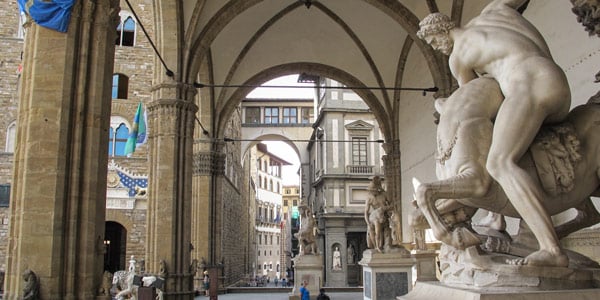
The seemingly airy architectural structure with wide arches and vaults supported by pilasters was intended for meetings and receptions organized by the rulers of the Florentine Republic.
Today, the Loggia is one of the most popular attractions in the city, housing an exhibition of sculptures from the art collection of the Uffizi Gallery (Gallerie degli Uffizi).
Masterpieces of Sculpture
The true “gems” of Piazza della Signoria are the statues adorning the urban space. Sculptural works by ancient masters and outstanding Renaissance artists were meant to inspire the rulers of the Florentine Republic heading to Palazzo Vecchio. These magnificent plastic works, depicting biblical and mythological heroes, are imbued with deep allegorical meaning.
It is notable that almost all the sculptures (except for the statue of “Perseus”) are exact replicas, with the originals carefully preserved in the city’s museums.
Fountain of Neptune
The octagonal Fountain of Neptune, created in the Mannerist style, is one of the square’s main decorations.
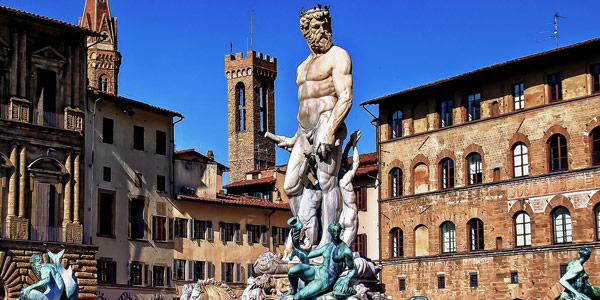
It was unveiled in 1565 to celebrate the dynastic marriage of Cosimo I’s eldest son, Francesco I de’ Medici, to Joanna of Austria, the youngest daughter of Emperor Ferdinand I.
The fountain’s creator was sculptor and architect Bartolomeo Ammannati. The renowned Florentine master worked on the massive piece with his apprentice Giambologna. The young assistant created bronze figures of mythological heroes associated with the water element.
The lower tier of the fountain is adorned with images of nymphs, satyrs, and fauns. The work, which brought the sculptors immense popularity, took ten long years to complete. The figure of the sea god is carved from precious Carrara marble, with Neptune’s face resembling that of the Grand Duke of Tuscany, Cosimo I.
David
The 5-meter (16.4-foot) marble statue of David, created by Michelangelo Buonarroti (Michelangelo di Buonarroti), is considered a symbol of the independence and strength of the Florentine Republic.
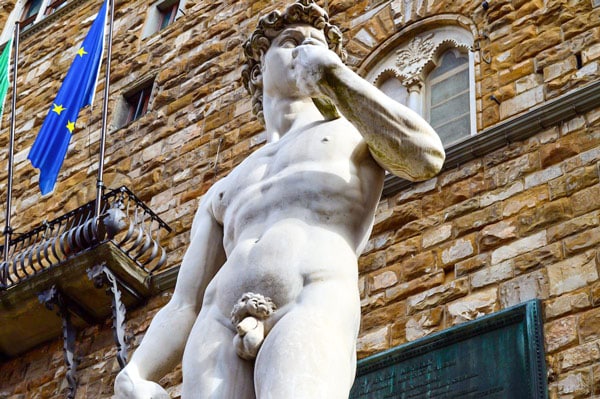
The master’s genius work was unveiled to the public in 1504. The sculptor was only 26 years old when he began working on the future masterpiece.
Renaissance artists often turned to the biblical story and the image of the Old Testament king who defeated the Philistine giant Goliath. Michelangelo’s hero is a strong, brave warrior with a perfect body. Despite his confident pose, David’s gaze reveals emotional tension and concentration, as if he is ready to engage in battle and launch a stone at the giant at any moment.
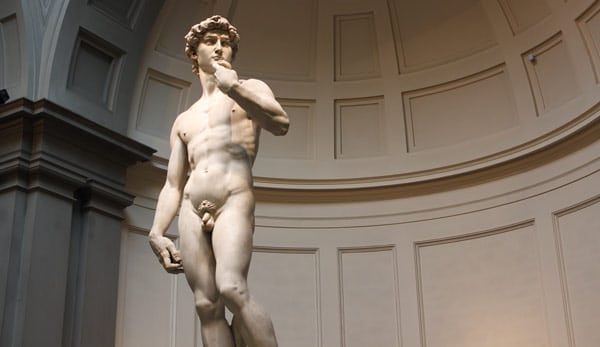
Since 1873, the original statue has been displayed in the Florentine Accademia di Belle Arti (Academy of Fine Arts).
Hercules and Cacus
The sculpture “Hercules and Cacus” by Baccio Bandinelli was installed in Piazza della Signoria in 1534.
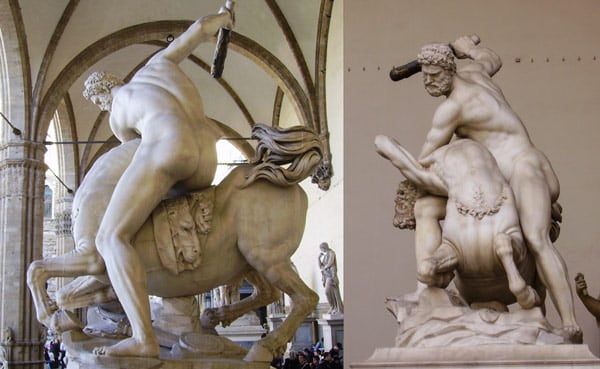
The sculpture, executed in the Mannerist style, is characterized by its broken lines and tense poses. The marble statue is over 5 meters (16.4 feet) tall. The plot is based on a scene from a Roman myth, describing how the renowned hero Hercules sneaked into the cave of the fire-breathing cannibal giant Cacus and killed him with a club.
According to the historian and art critic Giorgio Vasari, Bandinelli’s contemporaries harshly criticized the master’s work, but this did not prevent the sculptor from enjoying the patronage of the Medici family and receiving new commissions.
Equestrian Monument of Cosimo I
The equestrian statue of Cosimo I, created by Giambologna, appeared in the square in 1594.
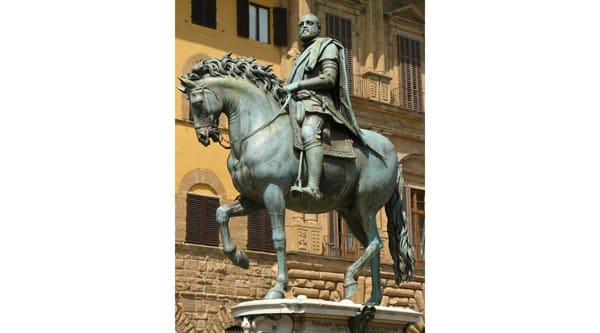
The proud image of the Grand Duke of Tuscany resembles that of the Roman Emperor Marcus Aurelius, whose monument stands in Rome.
Thus, the artist clearly aimed to emphasize the power of the Florentine ruler. Cosimo I is depicted seated on a large horse. The hero is clad in armor, his pose exudes confidence and calm, and the chest features the Order of Saint Stephen, established by the Medici after the Tuscan victory over French troops in 1537. The pedestal is adorned with bas-reliefs depicting significant events in the Duke’s life.
Perseus
The sculpture of Perseus was created by Benvenuto Cellini around 1545, and commissioned by Duke Cosimo I de’ Medici.
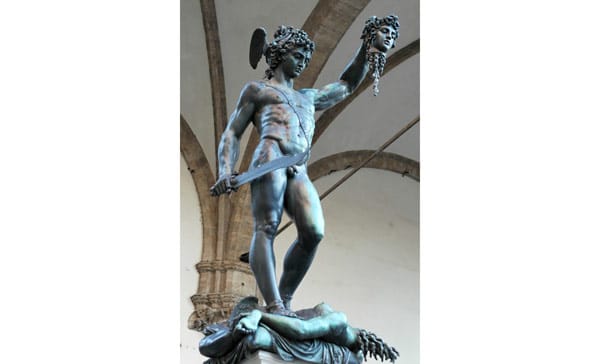
The bronze statue is considered the master’s most famous work. The inspiration came from an ancient Greek myth about Perseus’ victory over Medusa.
The sculptor depicted the hero in a triumphant pose: in one hand, the celebrated son of Zeus holds a sword, and in the other, he grasps the severed head of the monster with a woman’s face and snakes instead of hair. Cellini’s work is filled with allegorical meaning, symbolizing the invincibility of the Medici family’s power and the superiority of the powerful lineage over political rivals.
The Rape of the Sabine Women
The marble sculpture group “The Rape of the Sabine Women” by Giambologna is considered a true masterpiece of world sculpture.
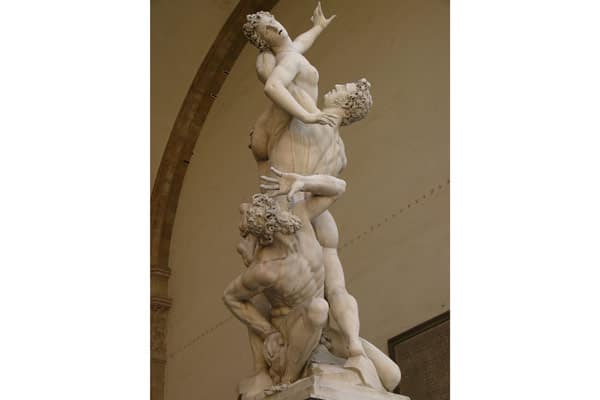
It was installed in the Loggia dei Lanzi in 1583, causing great admiration among the Florentine public. The work, executed in the Mannerist style, features characteristics typical of classical antique art. The plot is based on a scene from the so-called Sabine War, during which Roman warriors deceitfully kidnapped the wives and daughters of their enemies. The artist masterfully conveyed the drama of the situation. The complex composition allows one to feel the intensity of emotions and the full range of the characters’ experiences.
The Rape of Polyxena
“The Rape of Polyxena” is a brilliant sculptural work, distinguished by its complex composition and marble craftsmanship, created by Pio Fedi, an outstanding Italian artist of the modern era.
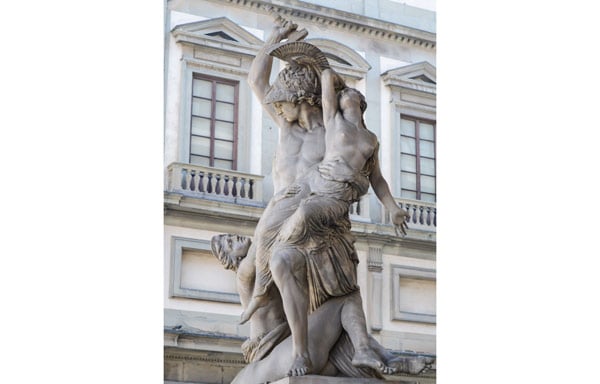
The marble statue dates back to the 1860s. The statue adorns the Loggia dei Lanzi. The plot is based on an ancient Greek myth about the tragic love of a Trojan War hero for the daughter of his enemy, Polyxena. Driven by passion, Achilles betrayed his compatriots and sided with the enemy. Unarmed, he was killed by Paris on the eve of his wedding to Polyxena.