 Italy for me From Italy with love

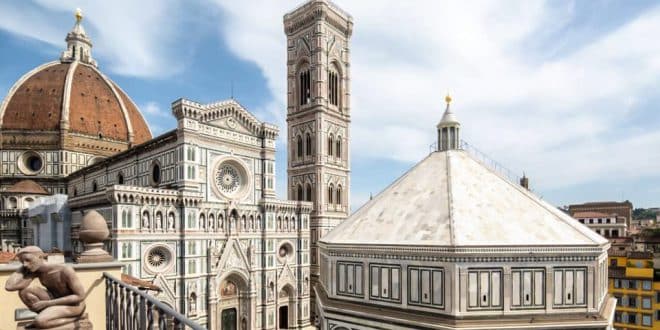
Piazza del Duomo is a unique tourist attraction in Florence, drawing millions of tourists each year who are eager to immerse themselves in Italy’s centuries-old history and experience the architectural masterpieces and artworks of the Renaissance’s finest masters.
No wonder it is considered the most beautiful and visited place in the world. Magical, enchanting, captivating – these are the words of awe-struck travelers who witness the architectural ensemble of Piazza del Duomo.
Page Contents
Location and How to Get There
Finding this attraction is not difficult as it is located in the central, historical part of the city. You can walk there starting from the Santa Maria Novella station (Stazione di Firenze Santa Maria Novella) towards via Panzani. Then turn onto via de Cerretani, which leads straight to Piazza del Duomo. The walk takes about 10 minutes. From more distant parts of the city, you can also reach the square by public transport. The nearest stops to the square are:
- Olio;
- Cerretani;
- Studio;
- Vecchietti;
- Pecori Duomo;
- Santa Maria Maggiore.
Buses heading to the center: No. 6, No. 17, No. 22, No. 37, and others.
History
The name of the square itself speaks to the significant role it played for Catholic Florence. Piazza del Duomo never served as a stage for major political and social events, nor was it a bustling commercial hub. Historically, it was the center of the spiritual and religious life of the Tuscan capital, home to important Christian structures.
“The heart of Florence” – this is how this part of the city was called after the construction of the new cathedral.
Cathedral of Santa Maria del Fiore
The brightest jewel in the temple ensemble of the square is the Cathedral of Santa Maria del Fiore (la Cattedrale di Santa Maria del Fiore). It was built on the site of a dilapidated small church and was intended to be the main adornment of the flourishing Florence. In terms of size, architectural style, and decoration, the cathedral was to surpass all previously built churches in Tuscany and accommodate about 90,000 citizens. Today, it ranks fourth among the largest structures of its kind in Europe.
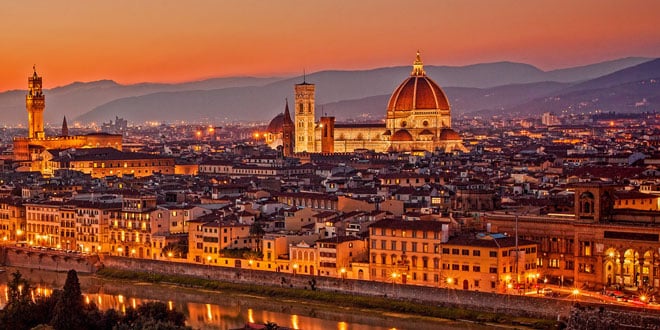
Construction began in 1296 and, with significant interruptions, lasted almost 140 years. The project in the initial phase was overseen by Arnolfo di Cambio. Several renowned masters contributed to the creation of this monumental structure:
- Giotto di Bondone;
- Francesco Talenti;
- Giovanni di Lapo Ghini;
- Alberto Arnoldi;
- Filippo Brunelleschi.
The cathedral was ceremoniously opened to believers in 1436. Notably, the external decoration was completed only in 1887. This part of the work was supervised by Emilio de Fabris. The walls are clad in colorful tiles of natural marble, with hues that echo the colors of the Italian national flag. The stone statues on the façade were handcrafted.
Giotto’s Campanile
Giotto’s Campanile (Campanile di Giotto) is a freestanding part of the cathedral complex, named after the master who designed it and managed to build only the lower tier of the structure.
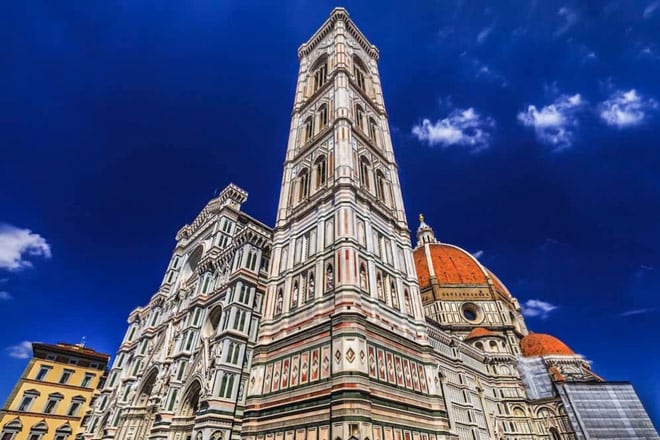
Andrea Pisano and Francesco Talenti also worked on the campanile. Construction was completed in 1359.
The bell tower has a square base with sides 15 meters (49 feet) long. The architectural structure is crafted in a refined Gothic style. The pointed windows on the upper floors create a sense of airiness and verticality. Inside the 85-meter (279-foot) campanile is a narrow staircase leading to the top tier, where there is an observation deck with a bell. You can enjoy a magnificent panoramic view of the city and its surrounding hills by climbing more than 400 steps.
Baptistery of San Giovanni
The Baptistery of San Giovanni (Battistero di San Giovanni) holds special historical significance, as it is considered the oldest building in Florence.
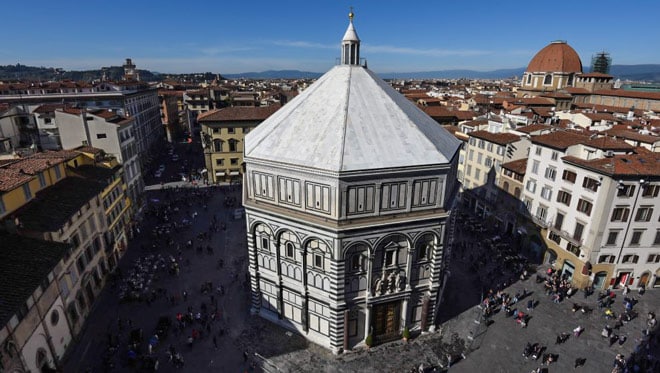
In ancient times, a temple of Mars (the god of war) stood on its site. No later than the 4th-5th centuries, the first Christian baptistery was erected on the ruins of the pagan temple – a special architectural structure for the sacrament of baptism, which was performed here until the 19th century.
From 1059 to 1129, the building underwent numerous reconstructions, acquiring its current appearance. The octagonal shape holds deep sacred meaning: each of the seven sides symbolizes the seven days of creation, while the eighth represents the new birth through baptism. The walls are skillfully clad in marble, and the style of the baptistery’s exterior decor was later used in the decoration of the cathedral. The interior is impressive: the dome features a mosaic in the Byzantine style, depicting the figure of the Savior and biblical scenes.
Opera del Duomo
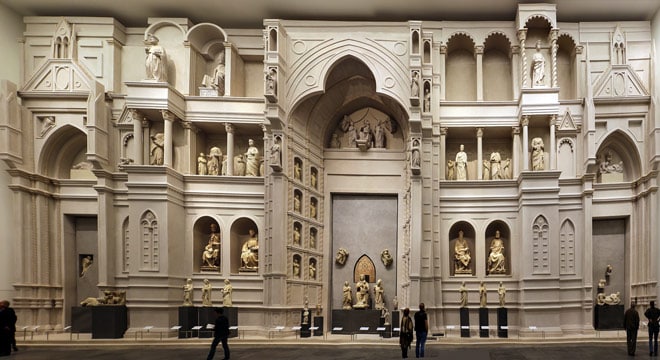
The Museo dell’Opera di Santa Maria del Fiore (Museum of the Works of the Cathedral) opened to the public in 1891. The building itself dates back to the 13th-14th centuries and initially served as the administrative center overseeing the cathedral’s construction. It was also used as a workshop for Donatello, Brunelleschi, and other architects and sculptors working on the cathedral complex of the square.
Restoration work is still carried out here, and, in addition to priceless exhibits, the museum houses old church books, project documentation, and unique drawings.
Brunelleschi’s Dome
Interestingly, after the walls of Santa Maria del Fiore were built in 1380, the building stood without a dome for several decades. Almost 40 years later, Filippo Brunelleschi took on the task. Using precise mathematical calculations, the architect determined the angle of the ribs and the pattern of the masonry, which prevented the brick structure from collapsing. The dome’s diameter is 42 meters (137.8 feet), and its height is 91 meters (298.6 feet) from the cathedral floor.
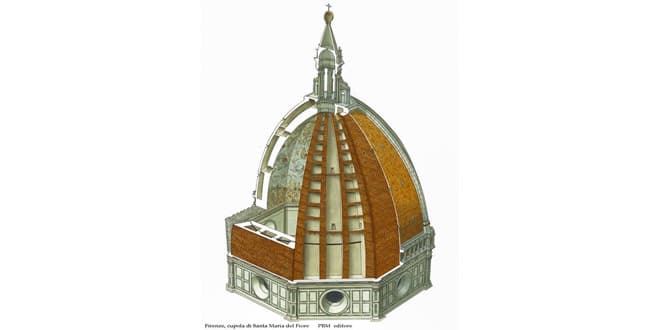
Creating such a structure without ground-based scaffolding and reinforcement was considered an almost impossible task at the time, which the master successfully accomplished. The dome, crowned with an observation deck, can be reached by climbing 463 steps, along which you can admire magnificent frescoes by Italian painter Giorgio Vasari and his student Federico Zuccari.
Loggia del Bigallo
A few steps from the cathedral is the Loggia del Bigallo, built in the 1350s.
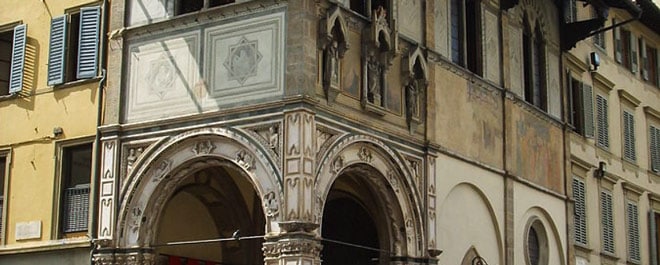
The construction was commissioned by the Society of the Virgin of Mercy. Later, the building became the property of the Brotherhood of Mercy. The upper-floor premises served as a refuge for orphans and abandoned children, while rhetoric lessons were held on the ground floor.
After a devastating fire in 1442, the loggia was reconstructed: the outer walls were adorned with large frescoes (one of which has survived to this day), and elegant windows with arched vaults appeared. Even in the early 20th century, attempts were made to organize an exhibition complex in the building, but the idea was realized only in 1966. The Museum of the Loggia del Bigallo (Museo del Bigallo) has three halls, showcasing paintings and frescoes on religious themes.
Brotherhood of Mercy
The Brotherhood of Mercy is a charitable organization founded in Florence in the 13th century, and still provides medical assistance to those in need. It is located in building No. 20 on Piazza del Duomo. On the feast day of Saint Sebastian, the patron saint of Tuscany’s capital, a new museum of Mercy (Museo della Misericordia) opened on the fourth floor.
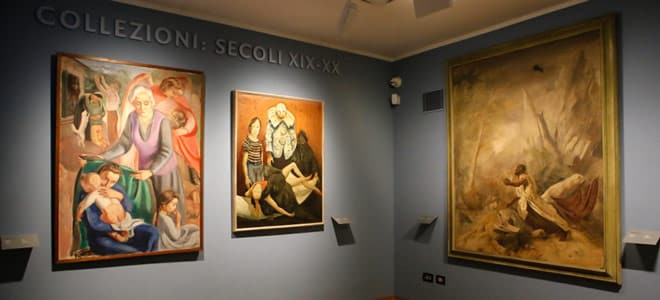
Visitors are invited to explore 14 exhibition halls with a total area of about 600 square meters. The collected exhibits vividly tell the story of the brotherhood’s centuries-old charitable activities. The museum complex features:
- antique paintings;
- antique furniture;
- artifacts from noble citizens;
- manuscripts;
- family crests;
- medical instruments for providing assistance.
Admission to the exhibition is free, and guests are also encouraged to leave a donation.
Palazzo dei Canonici
The majestic Palazzo dei Canonici is located on Piazza del Duomo, directly opposite the cathedral.
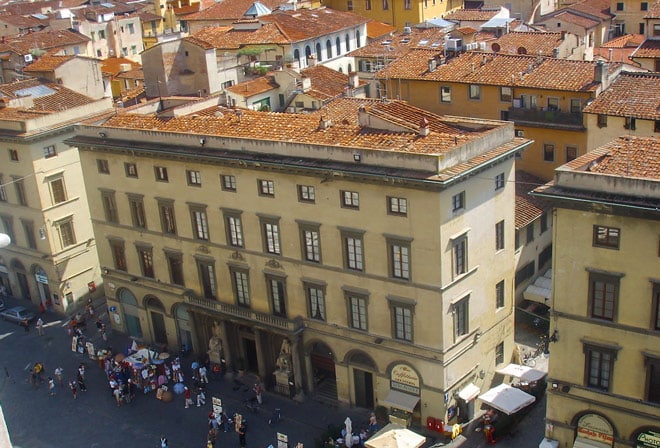
The palace’s façade is adorned with massive columns flanking the main entrance and deep niches with arched vaults. Here, monuments to outstanding Renaissance masters Arnolfo di Cambio and Filippo Brunelleschi, who contributed to the creation of the architectural ensemble of the Cathedral Square, are displayed. The monumental statues, seated on stone pedestals, were installed in 1830. The monuments’ sculptor is the Italian artist Luigi Pampaloni.
Museo Torrini
Museo Torrini is located at 12/R Piazza del Duomo. This museum is of special interest to connoisseurs and lovers of jewelry art.
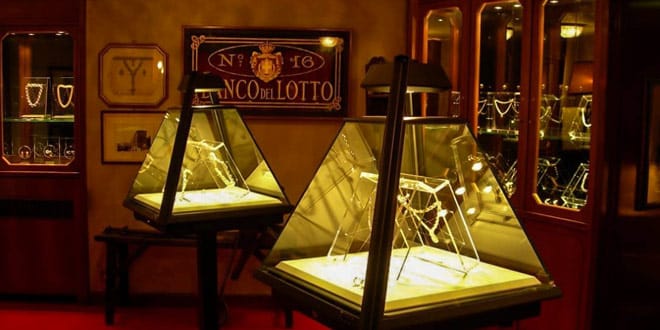
Jacopo Torrini, who lived in the Tuscan capital in the 14th century, was well-known as a talented craftsman, creating armor and weapons with great taste. He also established a jewelry workshop and became the founder of one of the world’s most legendary jewelry brands. Exquisite jewelry made of precious metals and stones combines the strictness of classical forms and the complexity of intricate patterns. Museo Torrini displays various exhibits illustrating the history of one of the world’s oldest jewelry houses:
- art objects;
- watches;
- silver and gold jewelry;
- accessories made of semi-precious and precious stones.
Visitors can not only admire but also purchase unique pieces from the famous Torrini jewelry house, which began its centuries-old history in 1369.
Tickets and Tour Programs
A special tour program, Grande Museo del Duomo, has been developed for tourists, offering a self-guided tour of the main architectural masterpieces of the square. With a single ticket (costing €18), you can visit the following attractions:
- The Baptistery and Museo dell’Opera del Duomo;
- Baptistery of San Giovanni;
- Giotto’s Campanile;
- Brunelleschi’s Dome.
Tourists can purchase a single ticket at the ticket office behind the Baptistery of San Giovanni or order it online on the official museum website www.museumflorence.com/ru. The ticket is valid for 3 days and activates upon visiting one of the sites.