 Italy for me From Italy with love


The Grand Canal (Canal Grande in Italian) cuts through the heart of Venice in a graceful S-shape, starting at the Saint Mark’s Basin and ending near the Santa Lucia railway station. This ancient maritime route stretches nearly 2.5 miles (4 kilometers) in length, with its width ranging from 100 to 295 feet (30 to 90 meters). On average, the canal is about 16 feet (5 meters) deep.
Along the shimmering blue waters lie nearly 170 buildings, most of which were constructed between the 13th and 18th centuries.
The majority of Venice’s public and private water traffic—including vaporettos, gondolas, and residents’ boats—navigates this canal. It’s crossed by three major bridges: the Rialto Bridge (Ponte di Rialto), the Scalzi Bridge (Ponte degli Scalzi), and the Accademia Bridge (Ponte dell’Accademia). More recently, the modern Constitution Bridge (Ponte della Costituzione) was added near the Scalzi Bridge as another significant crossing point.
We also recommend reading about the most beautiful bridges in Venice
Page Contents
History
Historians believe that the Grand Canal winds its way through Venice along the same path as a small river that once flowed here centuries ago. It’s also worth noting that the Venetian Lagoon and its canals first attracted settlers seeking refuge from the relentless invasions of foreign conquerors.
By the 10th century, the Grand Canal had become one of the city’s central arteries, serving as a hub for trade and commerce. And with good reason—ships from distant lands would dock here, bringing exotic goods rarely seen in the region, fueling the rapid rise of Veneto. Many of the palaces that line the canal were built by wealthy merchants who conducted business directly from the water.
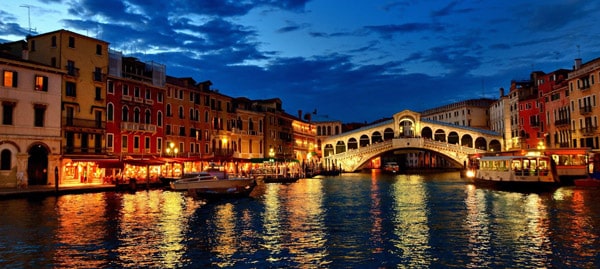
By the 12th and 13th centuries, the buildings rising above the tranquil waters of the Grand Canal began adopting the distinctive features of Byzantine architecture: elongated arches and grand loggias. This Venetian-Byzantine style has endured, continuing to charm locals and visitors alike. You can see this architectural influence in the many magnificent palaces along the canal.
Venetian Gothic architecture made its first mark on the Grand Canal in the 15th century. To this day, the city boasts numerous Gothic-style buildings, exuding an air of mystery and old-world romance. Facades from this period were often light in tone and adorned with painted arches and slender columns.
Buildings reflecting the classical and Renaissance styles began appearing in the 16th century. The vibrant facades gave way to warmer hues, and the ornate arches were replaced by uniquely shaped windows. Notable examples of this style include Palazzo Dario and Palazzo Grimani.
In the late 16th and early 17th centuries, the Baroque style swept through Venice, adding flair to the cityscape and mingling with Gothic and classical structures along the Grand Canal. This was also the era of Venice’s largest building boom. The elegant signature of Baroque design is clearly visible on many of the lagoon’s palaces and churches, with the Basilica di Santa Maria della Salute standing out as a prime example.
From the 18th century through the start of the 21st, the banks of the Grand Canal have remained largely untouched—no new buildings have been erected. Instead, many of the older structures have undergone thoughtful restorations. Several now house museums and exhibition halls that welcome visitors year-round.
Historical Regatta (Regata Storica)
Venice’s captivating past comes alive each year during the spectacular Historical Regatta, held on the first Sunday of September.
The earliest regattas—traditional rowing races—first sliced through the waters of the Grand Canal as far back as the 14th century. Over time, the event evolved to include a vibrant parade, led by a richly decorated ceremonial boat. The Regata Storica is one of Venice’s most stunning and iconic celebrations, drawing thousands of spectators from around the globe.