 Italy for me From Italy with love

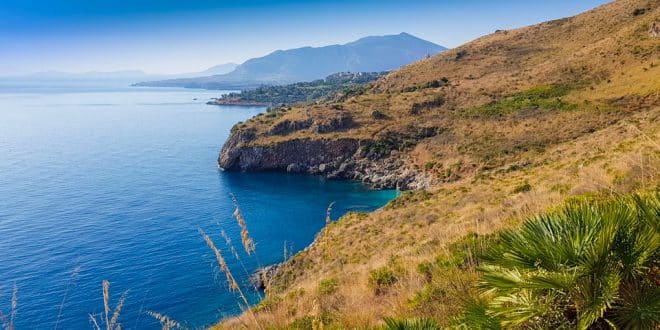
Zingaro Nature Reserve (Riserva dello Zingaro) is one of the most beautiful areas in Sicily (Sicilia), where the clear blue sky, rainbow-colored sea, green hills, and coastal cliffs merge into a mesmerizing Mediterranean landscape.
This unique reserve is located in the province of Trapani (provincia di Trapani), in the western part of the Gulf of Castellammare (Golfo di Castellammare) on the San Vito Lo Capo Peninsula, offering a magnificent view of the Tyrrhenian Sea (mar Tirreno).
Amazing to think that in Italy, there are still places where time has stood still, preserving the pristine beauty of wild nature for millennia.
Page Contents
Description
The Zingaro Reserve (Riserva dello Zingaro) extends for 7 km, encompassing the lands of San Vito Lo Capo and Castellammare municipalities, covering 1,650 hectares of untouched nature. The rocky coastline of the Gulf of Castellammare is formed from Mesozoic dolomitic limestones, reaching its highest point at Monte Speziale (930 meters).
Starting from the south, near the town of Scopello, and heading north, along the coast, you will find a series of lovely coves:
- Cala della Capreria
- Cala del Varo
- Cala della Disa o Zingaro
- Cala Beretta and Cala Marinella
- Cala Torre dell’Uzzo
- Tonnarella dell’Uzzo
You can download a high-quality PDF map of the reserve here.
Zingaro is strictly a pedestrian zone with no motor vehicle access, ensuring clean air, the scents of the Mediterranean, and perfect peace, apart from the sound of wind and sea. Even today, essential supplies and maintenance are transported just as they were centuries ago—by mule.
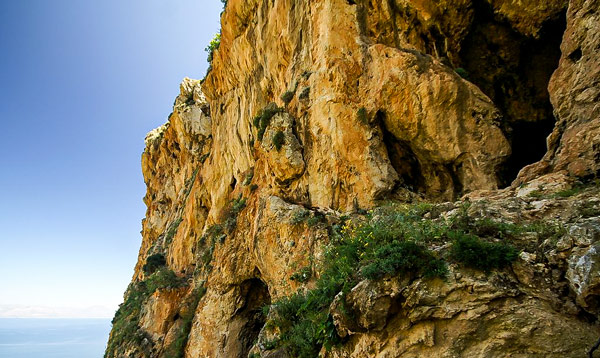
Exploring the hidden corners of Zingaro is also fascinating. The coastal area of the nature park has long contained underground passages and caves, the most interesting of which include Grotta della Colombaccio, Grotta della Corvina, Grotta della Craperia, Grotta della Mustia, and Grotta della Ficarella.
Visit the park’s museums to learn more about its history: Museo Naturalistico (Nature Museum), Museo delle Attivita Marinare (Marine Activities Museum), Museo della Civilta Contadina (Peasant Civilization Museum), and Museo della Manna.
The reserve also offers specially equipped rest areas, and you can stay overnight in small rural guest houses like Contrada Sughero (open from October to May; book in advance).
Check out this guide to the best hotels in San Vito Lo Capo for a beach vacation.
Flora
Zingaro’s flora is represented by various types of Mediterranean vegetation, some of which are endemic—rare and endangered species (over 40 in total).
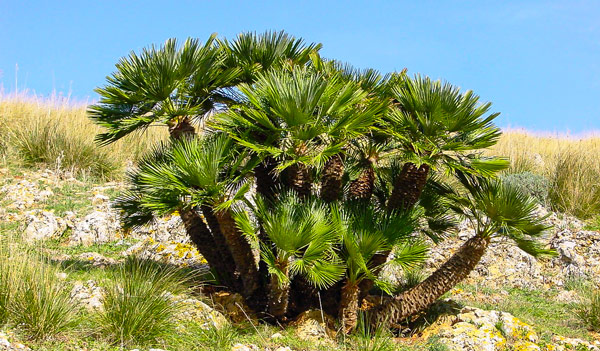
These palms are a symbol of the reserve and are a common feature in postcard views of the exotic coastline. The eastern slope of the protected park has the largest groves of European dwarf palms.
The green landscape is also dotted with carob, almond, manna ash, wild olive, pine, and oak trees. Lower down, you’ll find ferns, evergreen shrubs with red berries, grapevines, and many other rare and beautiful bushes and flowers.
The protected area contains over 670 plant species, including about 130 types of lichen, 27 mushroom varieties, and 25 wild orchid species, including the very rare crescent-shaped Ophrys lunula orchid.

Fauna
Zingaro’s peaceful, protected environment is home to numerous birds, animals, and marine life. The reserve is a nesting site for 39 bird species, including the rare peregrine falcon (Falco peregrinus) and Bonelli’s eagle (Hieraaetus fasciatus).

The mammal population mainly consists of small creatures such as foxes, rabbits, weasels, porcupines, hedgehogs, voles, and bats.
Diving enthusiasts will be thrilled by the colorful underwater world of the coast, which is similar to coral reefs in its vividness and diversity.
In the tidal zone, you’ll find the flower-like crimson sea anemone (Actinia equina), a marine predator that feeds on mollusks and small fish. Contact with this anemone can cause skin irritation.
Another unusual species is the sea anemone (Anemonia sulcata), poetically called “Venus’ Hair. ” It is recognized by its crown of tiny tentacles, which change color from white to green or dark brown.
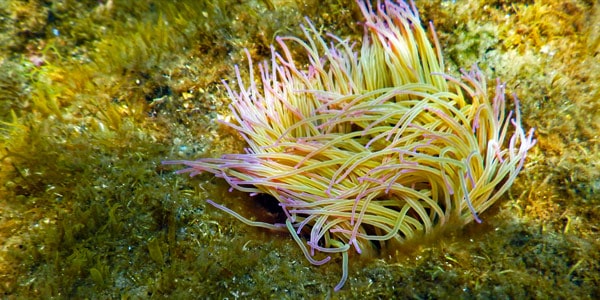
This exotic marine creature is considered a delicacy, popular not only in Sicily but also in Sardinia, Corsica, Andalusia, and other regions. It is typically prepared fried in batter or breadcrumbs.
History of Creation
Several naturalist associations in Italy raised public awareness through the press and television, and on May 18, 1980, they organized a protest march. Around 3,000 people symbolically occupied the construction site and succeeded in halting the work.
In 1981, under regional law, the first nature reserve on the island, Zingaro, was officially established and placed under the management of the Regional Forests of Sicily (Regionale Foreste Demaniali della Regione Sicilia). Today, there are 33 reserves on the island, protecting Sicily’s unique natural, historical, and cultural heritage.
Borgo Cusenza
The Zingaro lands have been inhabited for centuries. In the 16th century, poet and historian Antonio Cordici mentioned the settlement of Bagghiu di l’Acci, located in the valley of the reserve, where the grazing livestock produced especially tasty meat, and the cave lakes were breathtakingly beautiful.
The picturesque stone hamlet, known as Borgo Cusenza, has been preserved and today serves as an open-air museum.
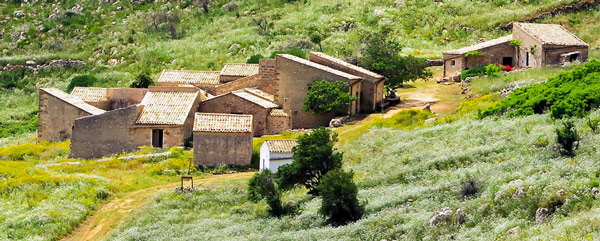
By 1930, the village had 14 families of 40 peasants who lived there permanently. Later, the villagers would return only for the summer season or to check on their homes, while shepherds remained in the settlement year-round. The peasants primarily grew wheat, oats, grapes, as well as vegetables and fruits. Life in the village wasn’t always peaceful. Sometimes, peasants were forced to offer hospitality to fugitives hiding in the nearby ravines.
During the war, fearing for their lives, villagers would hide in the cave of Mastro Peppe Siino, where they could stay for extended periods, equipped with grain, a mill, and an oven.
Hiking Routes for Travelers
To fully appreciate the wild beauty of Zingaro, travelers can choose one of several hiking routes, which will lead them along the stunning coastline to secluded beaches, large and small caves, mountains, museums, and rest areas.
The paths in Zingaro can be rather “thorny,” with sharp stones and dust, in addition to the ups and downs.
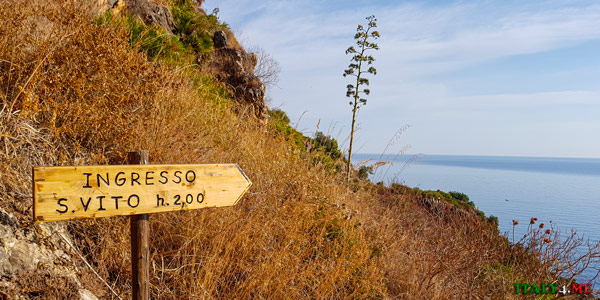
When planning your hike, keep in mind that you’ll need enough energy for the return trip, as there are no other transport options here.
During the summer, many tourists prefer to spend just 10-20 minutes walking from the northern entrance to reach the first beach, Cala Tonnarella dell’Uzzo, or the second, Cala Uzzo, which are considered the most beautiful and suitable for swimming.
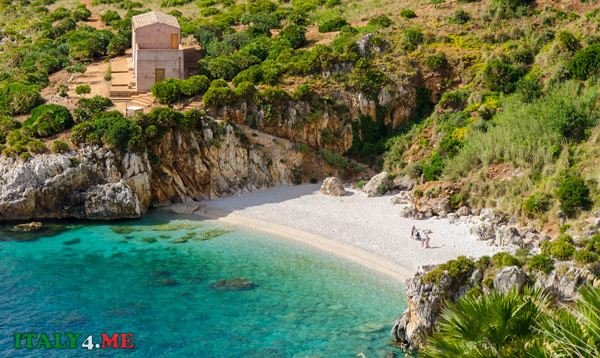
For a more solitary experience of the reserve’s pristine nature, you’ll need to take a longer route to reach the beaches of Marinella, Beretta, Disa, Varo, and Capreria. Depending on your physical fitness, there are three hiking options available.
Coastal Path
The easiest and most scenic route, the Coastal Path (Sentiero costiero), connects the southern entrance at Scopello with the northern entrance at San Vito Lo Capo. The 7 km trail runs along the coast through dreamy beaches—real oases where it’s especially pleasant to cool off in the crystal-clear waters of the Tyrrhenian Sea on a hot day.
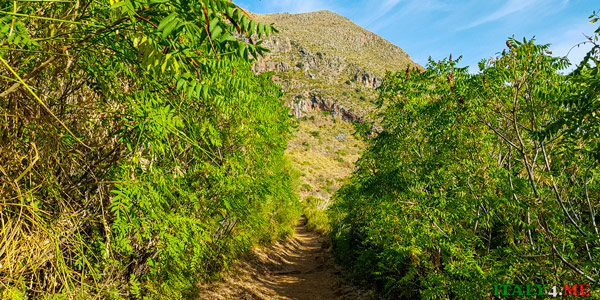
The Coastal Path enchants with its contrast of white pebbles on the beaches and the turquoise clarity of the water, the lush greenery, and the vibrant bursts of exotic flowers. Just 100 meters from the southern entrance, there’s a picnic area where you can relax.
From Cala Torre dell’Uzzo, a side path leads to Grotta dell’Uzzo, a fascinating cave worth exploring.
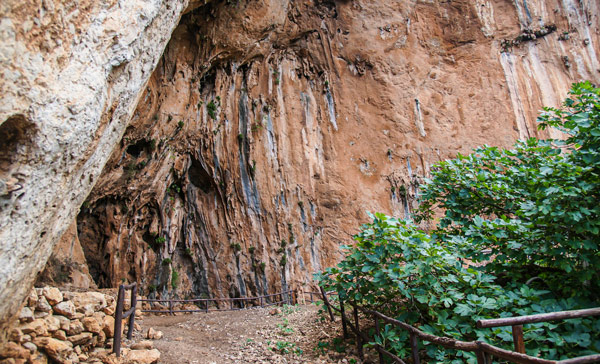
Along this route, you can visit the Nature Museum, Peasant Civilization Museum, and Marine Activities Museum. Without stopping at the beaches, the journey will take about 2 hours.
Mid-Coast Path
The Mid-Coast Path (Sentiero di mezza costa) is slightly more challenging but equally picturesque. It will take 4.5 hours to cover the 8.5 km trail, which is elevated 290 m above sea level. One of the most exciting stops along the way is Borgo Cusenza, where you can not only rest but also explore the life of the settlement, where people lived for several centuries.
Also along this route, at an elevation of 367 m, are the guest houses at Contrada Sughero. In spring, rare wild orchids bloom along the trail, but to see them during this season, you’ll need special permission from the reserve’s administration.
High Path
The High Path (Sentiero alto) is the third and most challenging route, starting from the southern entrance at Scopello and stretching 17 km. This trail is for more adventurous travelers, as it involves climbing Monte Passo del Lupo (868 m), Monte Speziale (914 m), and Monte Scardina (680 m). A stop at the Portella Mandra Nuova plateau (717 m) offers unforgettable mountain and sea views. On the descent, be sure to visit Borgo Cusenza and stop at the ancient watering hole built in 1696.
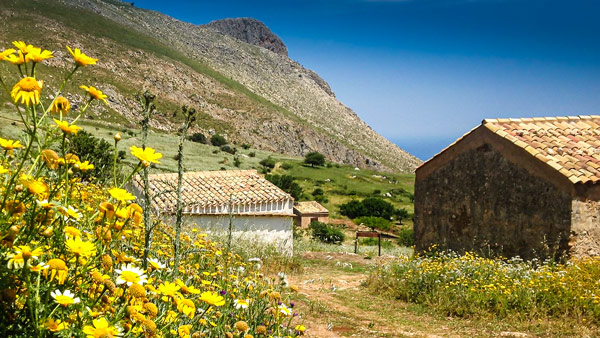
Zingaro Reserve is a little piece of paradise on the Sicilian map that will leave no one indifferent. Time spent hiking its coastal trails or relaxing on its secluded beaches will leave you with unforgettable memories of Sicily’s untouched natural beauty.
Opening Hours and Tickets
The reserve is open from 8:00 AM to 4:00 PM.
Ticket prices:
Regular – 5 euros.
Reduced – 3 eurosAccessible for tourists over 65 years old and children under 10.
Overnight accommodation in Zingaro is available from October to May for a maximum of two nights at a cost of 10 euros.
Many tour companies offer one-day excursions from Castellammare del Golfo, Trapani, Marsala, and Mazara del Vallo, with an average cost of 25 euros per person.
Up-to-date information is available on the official website: www.riservazingaro.it
How to Get There
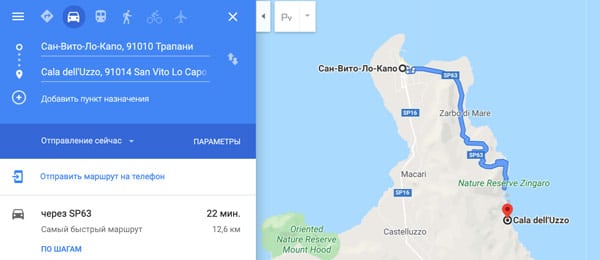
The drive from San Vito Lo Capo to Zingaro takes about 20 minutes. Park your car, and after a 15-minute walk, you can already be swimming in Cala dell’Uzzo—this is the simplest and fastest option.
Check out my custom driving guide with a route for exploring Sicily by car.
Personal Experience
The drive from Trapani to the southern entrance of Zingaro takes about an hour, covering 40 km, with some serpentine roads. Enter “Riserva Naturale dello Zingaro – Entrata Sud” into your GPS.
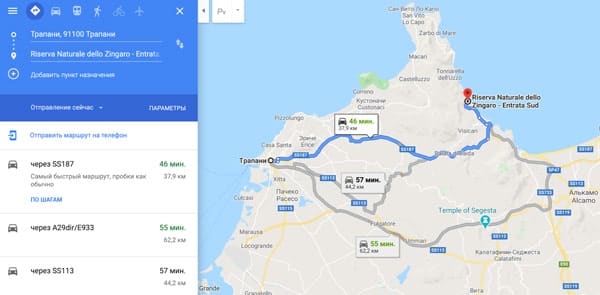
In summer, I recommend arriving by 9:00 AM, as the parking lot fills up quickly.
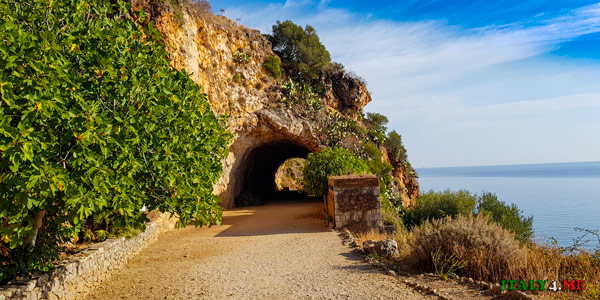
Buy your ticket at the entrance and start your walk. One of the first sights is a beautiful tunnel.
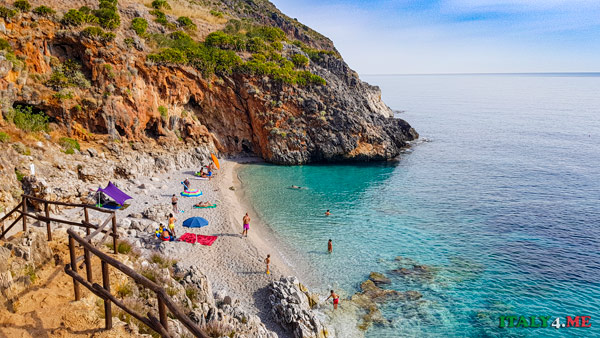
After about 20 minutes on the mountain trails, you’ll arrive at the stunning Cala Capreria bay. The photo below shows what the beach looks like at 9:00 AM—there’s still a chance to find a spot.
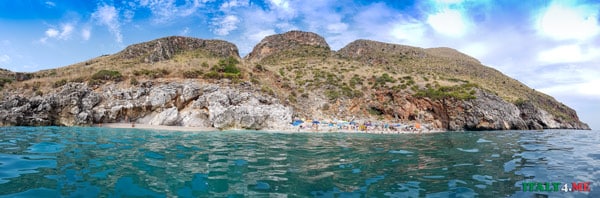
Here’s the view from the water.
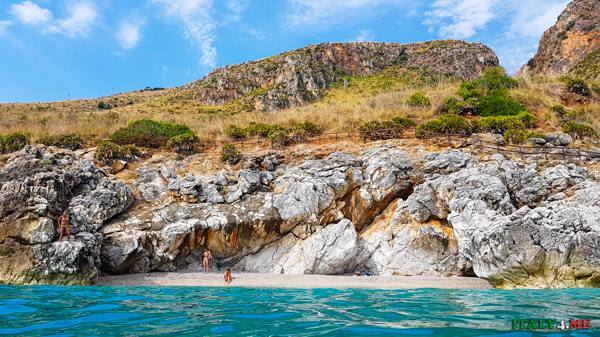
We usually take a small neighboring beach, perfect for groups of 2 to 5 people. It would help if you swam there with your belongings.
Around 11:00 AM in July, Cala Capreria looks like this:
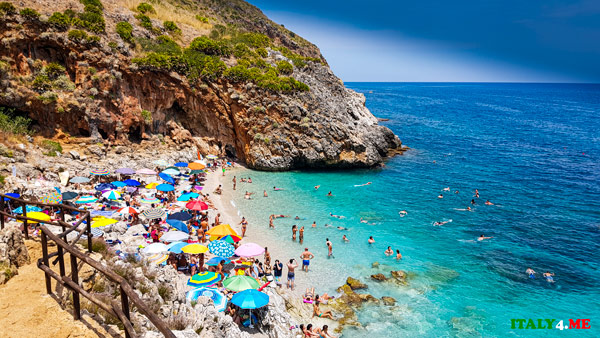
By about 11:30, when the sun gets too hot, we usually head back to the car and go for lunch.
From October to May, there are very few tourists in Zingaro, so you can choose any time for your walks and hikes.