 Italy for me From Italy with love


Juliet’s Tomb (Tomba di Giulietta) is one of the main attractions in Verona, dedicated to the heroine of Shakespeare’s famous tragedy “Romeo and Juliet.” Every year, tens of thousands of tourists visit the sarcophagus, many believing that “the real Juliet” rests here.
Page Contents
Origin Story
Juliet’s Tomb is located in the crypt of San Francesco al Corso (Complesso San Francesco al Corso) at Via Luigi da Porto, 5. The sarcophagus, made of red marble, dates back to the 13th–14th centuries. The monastery was founded in the 13th century by the Franciscan order.
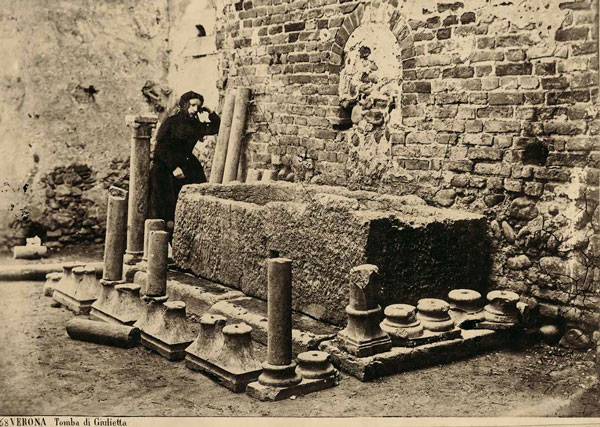
The tomb was first mentioned in a 1524 novella by Luigi da Porto. This work became the starting point for the tomb’s legacy, sparking mass pilgrimages to the site. To put a stop to this, religious authorities at the time repurposed the sarcophagus as a water container.
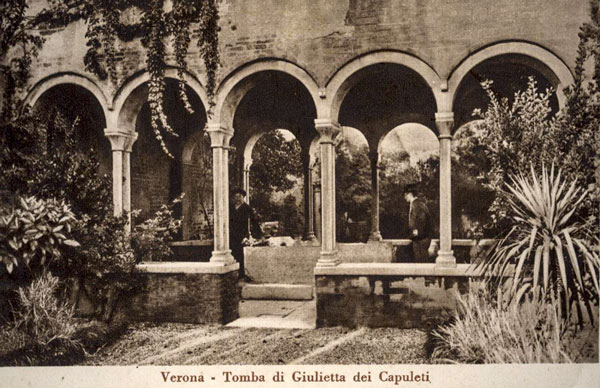
Following these events, the sarcophagus faded from memory for several centuries. However, in the 19th century it resurfaced in the novel “Corinne, or Italy.” Germaine de Staël refers to Shakespeare’s play and briefly notes that the tomb is still in Verona.
It is known that marble from the tomb was once used to create a piece of jewelry for the daughter of the Holy Roman Emperor, Maria Luisa of Austria. After this event, items made from this particular marble became highly fashionable, which is why the sarcophagus no longer appears in its original condition.
In 1868, the sarcophagus was moved from the garden grounds to a wall of the monastery and surrounded by porticoes and arches. Thirty years later, ancient gravestones and columns were placed nearby. In 1936, when George Cukor’s film Romeo and Juliet was released, the sarcophagus was transferred to the crypt, which today is known as the “Lovers’ Tomb.”
Nearby, there is a mailbox where anyone can drop off a letter addressed to the heroine of the famous play. This charming idea was conceived by caretaker Ettore Solimani, who occasionally replies to messages sent by travelers from all over the world.
Monastery Highlights
The sculptures and frescoes near the tomb, located on the grounds of the monastery itself, are no less remarkable. Since the site became a popular destination among tourists, local authorities made sure that travelers could also admire other historic monuments in the area.
Interestingly, finding the sarcophagus isn’t as straightforward as one might think—navigating the monastery’s interior can be a bit confusing at first. To help visitors, the monks installed a special sign in the early 20th century to point the way.
At the entrance to the monastery stands a sculpture of Liang Shanbo and Zhu Yingtai. A gift from Chinese visitors, the statue depicts two lovers with large wings. Locals, ever the romantics, immediately dubbed them the “Chinese Romeo and Juliet.”
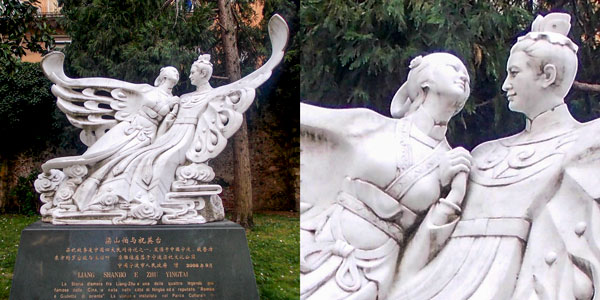
In this work, the wings symbolize love—making its location especially fitting.
At the site of the tomb’s former location beneath the arcaded portico, visitors can now see a bust of William Shakespeare and a white marble memorial plaque. Created by sculptor Renato Cattani, the monument was installed in 1910.
At the center of the courtyard stands a well, where visitors often toss in a coin for good luck. According to old legend, anyone who does so will find their soulmate. Even those already in a relationship are encouraged to take part—it’s said to bring harmony and balance to existing love lives.
Inside the crypt, the tomb is surrounded by sculptures discovered among the monastery’s ruins. These were added in 1898. Nearby, you’ll also find a display stand beautifully decorated with bronze panels depicting scenes from Shakespeare’s tragedy. These are the work of sculptor Sergio Pasetto, who still lives in Verona today.
The former monks’ cells were transformed into a fresco museum in 1970. The collection, featuring frescoes from the 10th to the 16th centuries, was carefully restored and transferred to the monastery over several years. Each fresco illustrates biblical scenes.
Fun Facts
Juliet’s Tomb is a beloved destination, and over the years, many curious and surprising things have taken place in the crypt and around the monastery grounds:
- If you peer inside the sarcophagus, you won’t find Juliet herself. Instead, nearly every inch of the tomb’s surface is covered in love notes, heart drawings, and couples’ names—scribbled in marker or pen.
- One jeweler, located near the heart of the city on Piazza Erbe, once sold pieces of marble—claimed to be from the tomb’s entrance columns—for a handsome price. He denied any wrongdoing, insisting that the marble from the columns and the sarcophagus were exactly the same.
- The famed ballerina Galina Ulanova visited the tomb. In 1940, she became the first to dance the role of Juliet to Sergei Prokofiev’s music.
- Travelers chip off pieces of marble not just as souvenirs. There’s a popular belief that carrying a fragment from the tomb brings good fortune in love and harmony in marriage.
- The tomb is about a 30-minute walk from the Casa di Giulietta (Juliet’s House).
What Is Count Paris Doing in Juliet’s Tomb?
A common question in school literature classes is: what is Count Paris doing in Juliet’s tomb? The answer lies in careful reading, but I’ll let Shakespeare speak for himself:
Paris:
Lie there among the flowers—you, a garden in full bloom.
Your bed of ash and granite I will grace.
I’ll fold my hands above you in this gloom
And wash these stones with tears upon your face.
Tomorrow I will come again with flowers,
And cover you in petals, like soft showers.
Count Paris was a close friend of the Capulet family and had persistently sought Juliet’s hand in marriage.
- The correct answer: He lays flowers and promises to return the next day.
Opening Hours and Admission
Juliet’s Tomb is open on Mondays from 1:30 PM to 7:30 PM, and from Tuesday to Sunday from 8:30 AM to 7:30 PM. Admission is €4.50. Entry is free for holders of the Verona Card.
How to Get There
There are several ways to reach the tomb from Verona’s train station:
- By bus: Routes 11, 12, 13, and 30 stop at Stradone Maffei. From there, it’s a 7-minute walk to the tomb.
- On foot: The walk from the station is about 1,800 feet (550 m). Head west toward Largo Divisione Pasubio, turn left onto Via Pallone, then right onto Via del Pontiere. From there, take a left—you’ll see the monastery on your right.