 Italy for me From Italy with love


Venice is world-famous for its enchanting canals, which form a one-of-a-kind architectural masterpiece. For travelers exploring this open-air museum, a visit to the Bridge of Sighs (Ponte dei Sospiri) is an absolute must—an awe-inspiring arched structure built in the Baroque style at the beginning of the 17th century.
Shrouded in legends and mystery, the bridge has inspired painters, poets, and writers for centuries. Every year, this architectural gem draws hundreds of thousands of tourists who come to witness its legendary beauty and feel the atmosphere of its dramatic and emotional past.
Page Contents
Location and How to Visit
The Bridge of Sighs connects the former prison with the Doge’s Palace (Palazzo Ducale) and spans the Palace Canal (Rio di Palazzo) in central Venice.
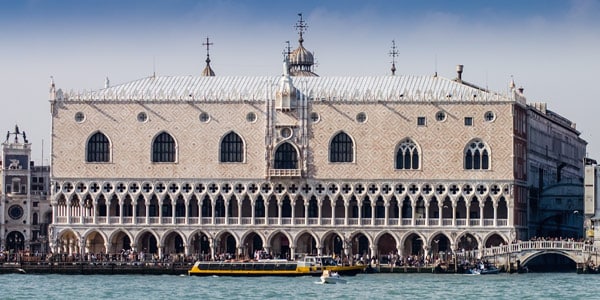
Just a few minutes’ walk from St. Mark’s Square (Piazza San Marco), the bridge is best viewed from the Ponte della Paglia near the Riva degli Schiavoni, right between the two iconic columns topped with statues. From this viewpoint, you’ll get the most iconic photo of the landmark.
If you want to walk across the bridge, we recommend purchasing an online ticket starting from €30 for the Doge’s Palace museum—it’s the best way to skip the 2-3 hour ticket line.
The guided experience includes access to the prison cells and the former government chambers, as well as the chance to cross the Bridge of Sighs to the prison and back. You’ll also enjoy skip-the-line access to St. Mark’s Basilica. Group tours start at €96 and are available in English, German, Spanish, French, and Italian.
Construction History
The Bridge of Sighs was commissioned by the powerful and wealthy Venetian statesman Marino Grimani, who served as the head of the Venetian Republic. His family coat of arms is still visible on the bridge’s main façade.
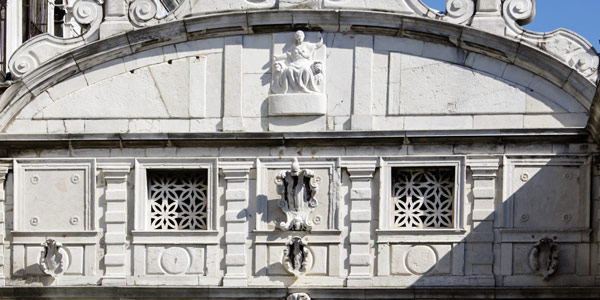
Construction began in 1600 and was completed in 1603—a remarkably short timeframe for that era. The bridge was designed and built by Antonio Contino, a member of a renowned family of Italian architects.
The Buildings Connected by the Bridge
In the days of the Venetian Republic, the Doge’s Palace served as more than just the residence of the ruling elite. It was also the seat of the city’s political and judicial power. The palace housed the Great Council (main governing body), the Council of Ten (secret police), the Council of Three (inquisition), the Senate, and the Supreme Court. Numerous departments responsible for domestic and foreign affairs also operated from within the palace walls.
Unsurprisingly, the palace also contained a prison, divided into two distinct zones: “Piombi” and “Pozzi.” The Piombi (from *piombo*, Italian for “lead”) were seven cells located under the lead-covered roof—used to detain political prisoners and prominent figures in solitary confinement. The Pozzi (from *pozzo*, or “well”) were dank, underground cells at canal level, reserved for the most dangerous criminals.
In the 16th century, as the number of detainees outgrew the palace’s capacity, a new prison was constructed across the canal: the Carceri (Italian for “prison”). It gained a grim reputation as one of medieval Italy’s harshest detention facilities. The building was designed by renowned architect Antonio da Ponte. Remarkably, Carceri functioned as a prison until the end of World War II. It was officially decommissioned in the late 1940s and now serves as a museum visited by tourists from around the world.
Thus, the Bridge of Sighs marked the final, short passage for the condemned—from the courtroom where their sentence was pronounced to the dark, cramped prison cells filled with fear, hopelessness, iron bars, damp air, rats, starvation, and torture.
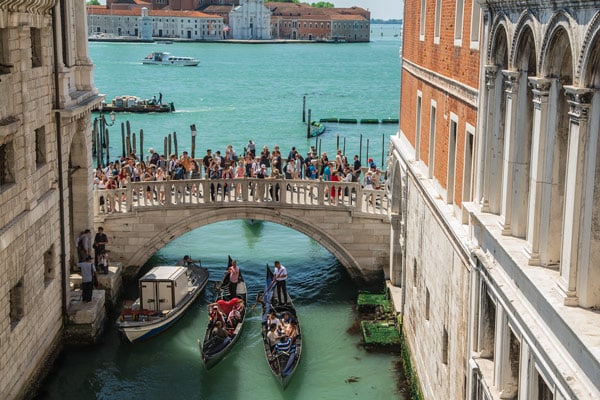
Below is the haunting view of Venice once glimpsed by those on their final walk across the bridge:
Architectural Features
The Bridge of Sighs is an unusual structure crafted from gleaming white limestone, with a semi-circular roof and small windows—features dictated by its function. Designed in the popular Baroque style of the 17th century, the bridge showcases intricate detailing. Sturdy walls are elegantly adorned with classical arches and pilasters that mimic columns. The windows are framed with delicate marble carvings, creating a whimsical lace-like effect.
A bas-relief of Saint Mark, the patron saint of Venice, decorates the center façade, flanked by the iconic winged lion—the city’s most enduring symbol.
Inside, the bridge feels dark and ominous. Its heavy brick walls are devoid of decoration. The interior is divided into two narrow parallel corridors—one for prisoners headed to the jail, the other for return.
Related read: The Most Beautiful Bridges in Venice
Legends and Myths
Like many of Venice’s landmarks, the Bridge of Sighs is wrapped in legend and mystery.
One of the most compelling stories involves the infamous Giacomo Casanova, who was sentenced to the Doge’s prison and walked across the bridge as a convicted man. The notorious lover, writer, adventurer, alchemist, and mystic was arrested in 1755 on charges of heresy, occult practices, fraud, and immorality.
Fun Fact: After spending more than a year in captivity, Casanova managed to escape—becoming the only prisoner ever to break free from this grim facility.
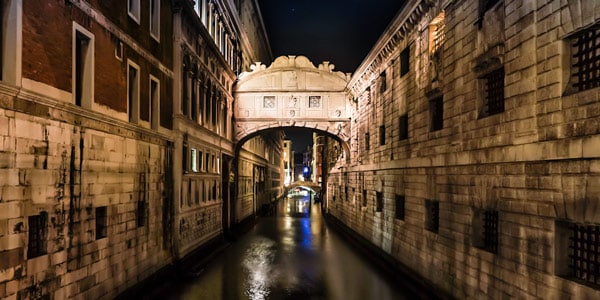
Despite its grim past, the Bridge of Sighs is also one of Venice’s most romantic sites.
A whimsical legend claims that lovers who kiss beneath the bridge at midnight will stay together forever, their love sealed in eternity.
Inspiration for Artists and Writers
For centuries, the Bridge of Sighs has stirred the imagination of poets and painters alike. It owes its current name to Lord Byron, who mentioned it in his 19th-century poem *Childe Harold’s Pilgrimage*. The English poet even spent a night in one of the prison’s cells to better capture the sorrowful reflections of a condemned man.
The bridge is also referenced by Edgar Allan Poe in his surreal tale *The Assignation*, as well as by Goethe, Stendhal, Chekhov, and Anna Akhmatova.
Painters throughout the ages have tried to capture its ethereal charm. One of the most celebrated works is Mikhail Vrubel’s *Venice. Bridge of Sighs*.
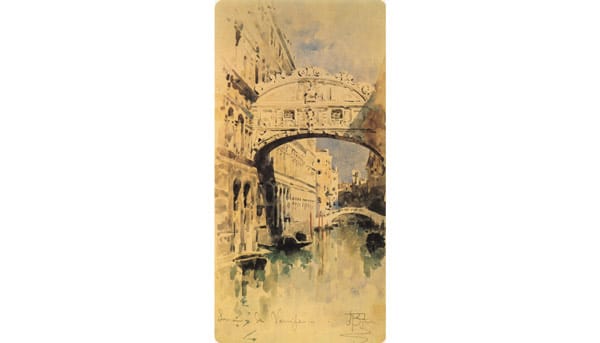
This small sketch, made in pencil and watercolor, is considered one of the most poetic visual tributes to Venice in both Russian and global art history.
Replicas of the Bridge
The bridge’s stunning design and evocative history have inspired replicas across the globe. You can find similar structures in:
- New York City
- Oxford
- Cambridge
- Lima
- Moscow
- Saint Petersburg
Dramatic, elegant, unforgettable—these are the words that come to mind for visitors lucky enough to see the Bridge of Sighs in person. On any must-see list of Venice’s attractions, it rightfully holds a top spot.