 Italy for me From Italy with love


Sauces are essential links in the chain of Italy’s culinary traditions, with none more famous than **Pesto**. This Ligurian-origin sauce, made primarily from basil, accompanies many dishes.
Pesto Genovese (Genovese) is the classic version of the sauce, though its recipe, like the world, evolves and adapts to modern tastes. Want to add some Italian notes to your kitchen’s melody? The “sheet music” for Pesto is right here in our article.
Page Contents
History
Though Pesto is deeply rooted in Italian cuisine, its history is relatively recent. The first recipe appeared in the mid-19th century. The use of aromatic herbs in cooking began during the Middle Ages among Ligurians. Wealthy people preferred refined spices, while the poor masked the unappetizing flavors of their dishes with herbs—this practice laid the foundation for basil-based Pesto.
Basil, originally from Arabia, has a curious botanical name: Ocimum basilicum, which means “royal herb.”
First Mention
This recipe is thought to be an evolution of an older garlic-based paste used in the 13th century.
The Legend
There’s also a famous legend about a monk living in the monastery of San Basilio who gathered aromatic herbs called *basilium* in honor of Saint Basil. He ground them together with other ingredients brought by pilgrims, thus creating the first Pesto sauce.
The pesto recipe hardly changed throughout the 19th century and was quite popular. However, the early version of the dish likely contained more garlic, based on two factors: the Arab-Persian influence on Genoese cuisine until the early 20th century and the heavy use of garlic in the diet of Ligurian sailors.
In fact, it was thanks to the sea that Pesto gained widespread popularity. From the port of Genoa, trade and passenger ships sailed to far-flung countries.
Varieties
Traditionally, when people say “Pesto,” they refer to **Pesto Genovese**. Its ingredients consistently include basil, pine nuts, cheese (Parmesan or Grana Padano, and Fiore Sardo), salt, garlic, and olive oil. However, beyond the classic recipe, there are different variations of Pesto created to match the flavors of specific dishes, often using ingredients typical of the region.
Ligurian
Ligurian Pesto (Pesto Ligure) is a traditional product of the Liguria region, made with **basilico genovese D.O.P.**, a specific type of basil with a more delicate flavor than other varieties. Ligurian Pesto is a version of Pesto Genovese but with less strict ingredient requirements. It pairs perfectly with pasta and bruschetta.
Trapanese
Pesto alla Trapanese (Pesto alla trapanese)** is a typical Sicilian product, passed down through generations. It originated when Genoese sailors shared their Pesto with the residents of Trapani, who modified the recipe by adding local ingredients like tomatoes, almonds, and dried fruits. This tomato-scented Pesto pairs wonderfully with pasta.
Gargano
The Pesto recipe popular on the **Gargano** peninsula stands out because it uses turnip greens instead of basil. Additional ingredients include garlic, chili pepper, and olive oil. This versatile sauce is used with various types of pasta.
Pistachio
Pistachio Pesto (Pesto di pistacchio) is a delicacy typical of Sicily, made from **Bronte pistachios** (pistacchio di Bronte) DOP, grown between Mount Etna and the Nebrodi Mountains. The nuts (60-80% of the total ingredients) are ground with salt, pepper, and olive oil, creating a rich and refined sauce that complements pasta and canapés.
Sicilian Hazelnut
Sicilian Hazelnut Pesto (Pesto di nocciole siciliano) is a gourmet product that adds a unique touch to both meat and fish dishes. It’s made by grinding hazelnuts and sunflower seeds with salt, pepper, nutmeg, and olive oil.
Features of Pesto Genovese
Although Pesto Genovese is not labeled as a D.O.P. or I.G.P. product, its production and sale are tightly regulated to prevent counterfeits. These rules cover the selection, proportion, and origin of ingredients.
Any product that doesn’t meet these strict standards cannot be labeled “Pesto Genovese.”
Key ingredients include:
- Basilico Genovese D.O.P. (at least 25% of the total ingredients);
- Extra virgin olive oil produced in Italy;
- Parmigiano Reggiano DOP or Grana Padano DOP;
- Pecorino DOP;
- Garlic, pine nuts, and sea salt;
- Optional: walnuts.
The garlic, sea salt, and oil must all be Italian, while the walnuts may come from anywhere within the E.U. Pine nuts (from the Pinus Pinea tree) are sourced from the Mediterranean region.
The finishing touch: true Genovese Pesto is made by hand with a mortar and pestle. Electric mixers can heat the ingredients, and the metal blades can oxidize the basil, which affects the flavor.
Characteristics
Each batch of Pesto Genovese can vary in color from dark to light green, depending on the basil’s hue. The sauce’s texture is dense and smooth, determined by the proportion of olive oil.
The true highlight of Pesto is its aroma: strong yet subtle, thanks to the perfect blend of ingredients. The first notes are garlic, which then melt into the warm fragrance of basil and cheese.
In taste, the aged cheeses’ dominant initial flavor is followed by the spiciness of garlic and basil.
Serving Suggestions
Pesto Genovese is used to flavor both first and second courses, especially different types of pasta. The sauce’s most famous pairing is with **trofie**, a pasta typical of Liguria.
When it comes to drinks, note that garlic and basil do not pair well with red wine, which tends to develop a bitter, metallic taste. It’s better to choose a dry white wine, such as Ligurian Pigato DOC.
Classic Recipe for Home Cooking
The classic Pesto recipe is popular worldwide not only for its versatility but also because the ingredients are readily available. This simple sauce is perfect for summer dishes.
Ingredients:
- Fresh basil leaves – 50 g
- Garlic – 2 cloves
- Pine nuts – 15 g
- Hard cheese (Parmesan) – 70 g
- Sheep’s milk cheese (Pecorino) – 30 g
- Olive oil – 100 ml (or as needed for consistency)
- A pinch of coarse salt
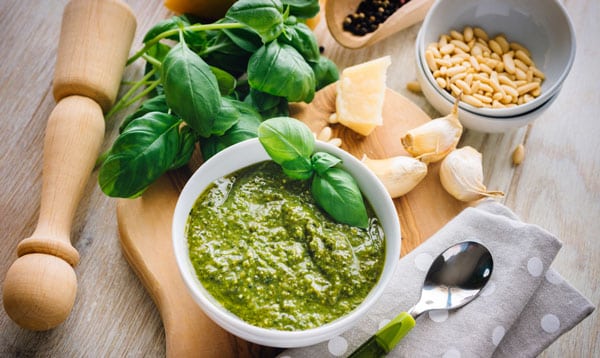
This recipe makes enough Pesto to dress around 600 g of pasta.
First, wash and dry the basil leaves, placing them on a paper towel. Be gentle, as bruising or crushing the leaves can cause them to blacken and turn bitter.
Next, using a mortar and pestle, mash the garlic (after removing the core) with a few grains of salt until it becomes a paste. Add the basil and the rest of the salt, continuing to grind in a circular motion.
Once the basil releases its bright green juice, add the pine nuts and continue grinding. For a richer flavor, the pine nuts can be lightly toasted in a dry pan beforehand.
Finally, add the grated cheese and olive oil, stirring as you go. The sauce is now ready.
Not everyone has a mortar and pestle in their kitchen, and while blenders are standard, using one can negatively affect the taste. A handy trick is to place the blender blades in the freezer an hour before making the Pesto. Blend in short pulses to prevent the ingredients from heating up.
The finished sauce can be stored in the refrigerator for up to 10 days or frozen and thawed as needed.
Calories and Health Benefits
The approximate caloric content of Pesto is 450-500 kcal per 100 g, with:
- Protein – 5 g
- Fat – 12.7 g
- Carbohydrates – 46.9 g
Classic Pesto is rich in fats, many of which are beneficial. Monounsaturated fats help normalize cholesterol levels, while polyunsaturated fats support endurance and vitality, as well as healthy skin, hair, and nails.
Basil, the main ingredient, is rich in vitamin C, potassium, calcium, and phosphorus. It has antioxidant, anti-inflammatory, and antibacterial properties. Garlic adds B vitamins and pine nuts provide zinc and iron.
Despite its benefits, Pesto does contain salt and cholesterol. To enjoy its flavor and maintain health, the recommended serving size for pasta is 40-50 g (200-250 kcal).
We’ve provided all the “notes” of the famous sauce. Now, it’s time to create your own culinary masterpieces. Sing the loudest, love deeply, enjoy summer, and remember: “The smell of fresh basil is the best song about Italy!”