 Italy for me From Italy with love


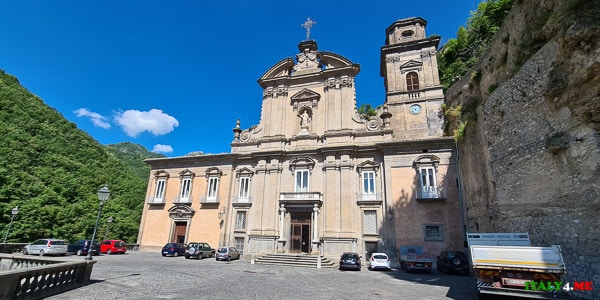
In the province of Salerno (Provincia di Salerno), in the Campania region, near the Amalfi Coast (Costiera Amalfitana), lies the ancient Benedictine Abbey of the Holy Trinity (Abbazia territoriale della Santissima Trinità di Cava de’ Tirreni).
The large monastic complex is situated in a picturesque location on the slope of a hill, three kilometers from the commune of Cava de’ Tirreni.
Page Contents
History
The founder of the abbey was the nobleman Alferio Pappacarbone from Salerno, who in 1011, driven by spiritual motives, decided to become a hermit and moved into a cave. His pious lifestyle attracted many followers, and by 1025, a small monastery had been established at the site of his voluntary solitude.
Throughout its history, the Abbey of Cava de’ Tirreni received many privileges and was placed under papal jurisdiction. Princes of Salerno supported the abbey through their patronage and donations, helping expand the church’s lands and ensuring the community’s prosperity.
Within three centuries of the monastery’s founding, the first four abbots, including Alferio, were canonized by the Catholic Church, and the subsequent eight were beatified.
The spiritual and secular influence of the abbey spread throughout Southern Italy, becoming a powerful center of the Benedictine congregation with hundreds of dependent churches and monasteries.
In the 14th–15th centuries, the Abbey of Cava de’ Tirreni was administered by bishops and even cardinals, often through trusted representatives, which did not contribute to the community’s prosperity or spiritual discipline.
Only when abbots were physically present did they manage to maintain monastic discipline, where the pursuit of knowledge and art outweighed material values.
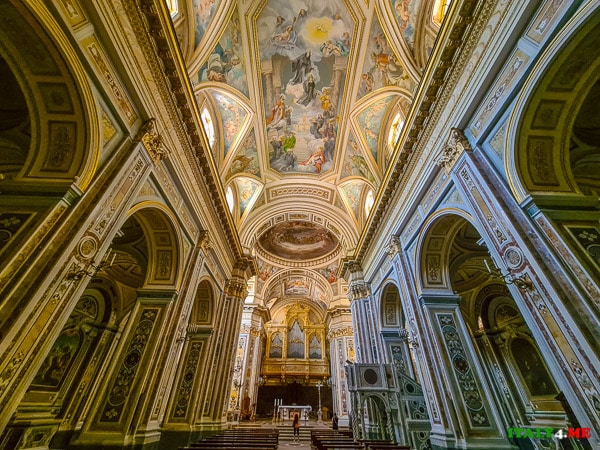
Throughout its centuries-long history, the abbey amassed a unique library and numerous works of art.
The Basilica
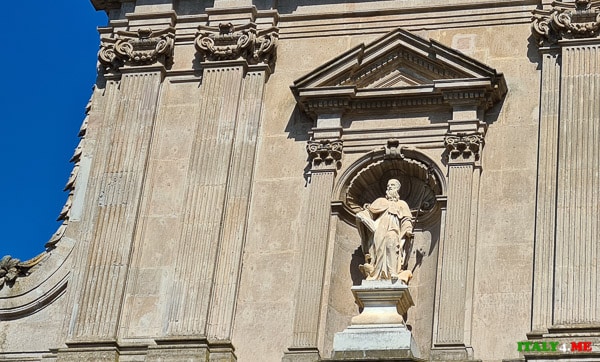
The basilica took its present form in 1761. Giovanni Del Gaizo completely renovated the old 11th-century building.
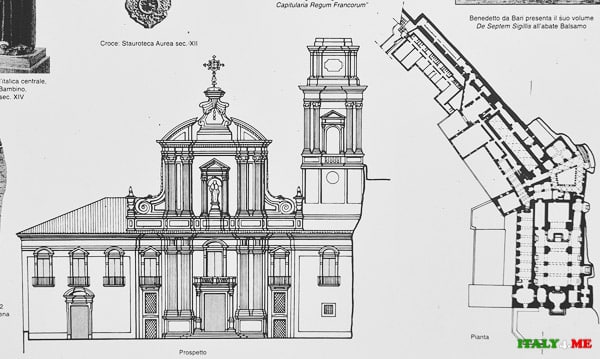
Remnants of the original basilica include the Chapel of the Holy Fathers, which was rebuilt and lined with polychrome marble in 1641, an 11th-century altar with a 14th-century sculpture by Tino di Camaino, a 15th-century majolica floor, and a 12th-century pulpit. The latter is considered one of the most valuable pieces of the basilica’s interior, and it is often the reason tourists visit the monastic complex. The pulpit stands out for its intricate form and complex colored pattern in the Cosmatesque style.
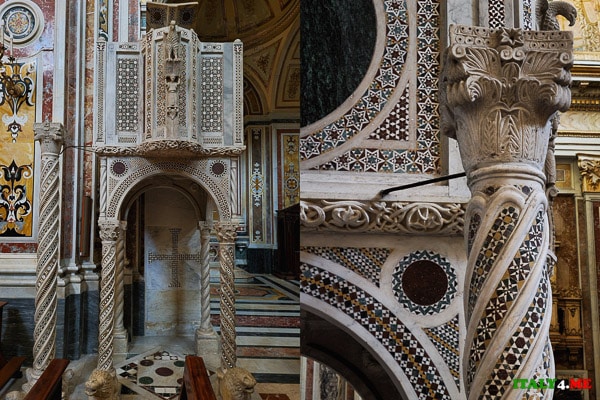
It is believed that the pulpit was donated to the church by Roger II in exchange for permission to bury his second wife within the monastery’s walls.
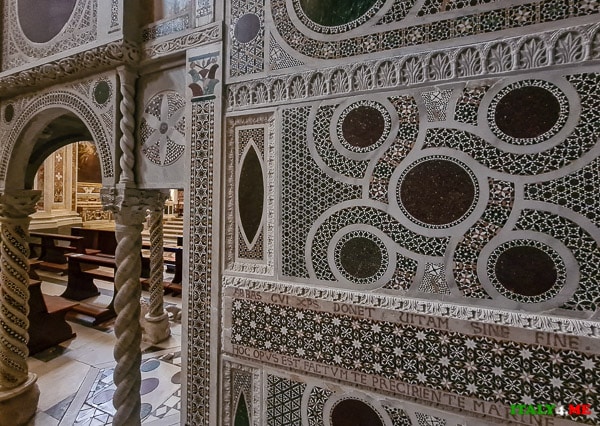
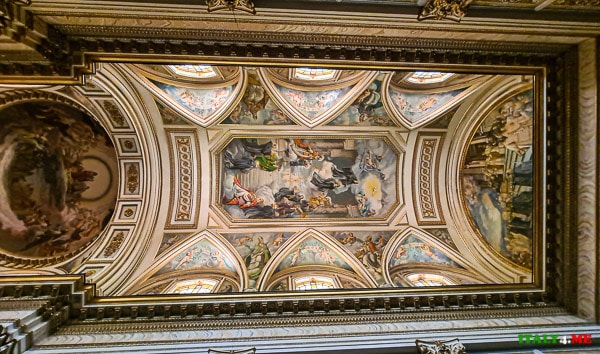
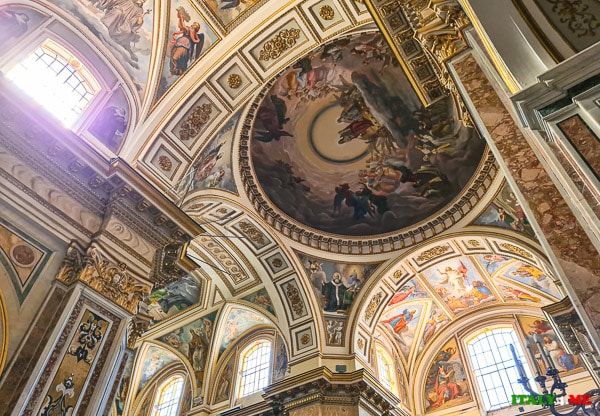
The church’s interior is notable for its brightness and harmony. Numerous 19th-century frescoes by Vincenzo Morani from Calabria depict religious scenes featuring Benedictine saints.
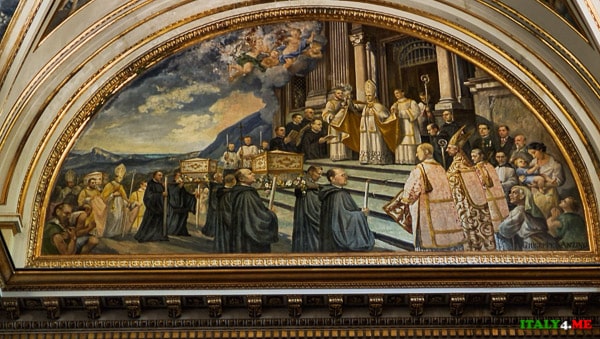
The vaulted ceiling of the church, with its complex structure and decadent decorations, is a true highlight.
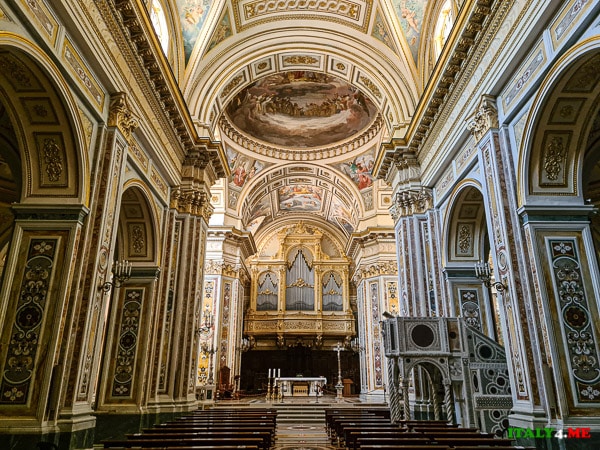
Another attraction is the magnificent pipe organ, built in 1927 and housed in a Neobaroque-style case.
The Library
The abbey’s unique library is housed in three rooms. It contains about 80,000 printed and handwritten books, 15,000 parchment pages, 120 incunabula, 25,000 miscellaneous written documents, and other paper artifacts, the oldest dating back to 792 AD.
The library has been carefully guarded by the monks since the abbey’s foundation to preserve its integrity. In 1595, a papal bull from Pope Clement VIII prohibited the removal of books from the library.
The Monastery
The 11th–13th-century monastery building, located beneath the cave, is the most imposing part of the Benedictine abbey. It retains elements of an ancient wall dating back to before Alferio’s time. The monastery’s inner courtyard, with its double marble columns, has preserved its original 13th-century appearance.
The Chapter Hall
Adjacent to the monastery courtyard is the old 13th-century chapter hall, where the general meetings of the monastic order were held. Built-in Gothic style, it still features ancient frescoes from various eras. This hall also contains valuable Roman sarcophagi from the 3rd century, used for the burial of notable individuals.
The new chapter hall was established in 1761 in the old sacristy. Of artistic and historical interest are the carved wooden seats from 1540, frescoes from 1632, a majolica tile floor from 1777, and a ceiling painted in 1940 by monk Raffaele Maria Stramondo.
The Lombard Cemetery
The Lombard Cemetery (Cimitero Longobardo), established in the abbey’s 12th-century crypts with arched vaults and 9th–10th-century columns, makes a strong impression. One of the ancient monastery’s most remarkable features is the Chapel of St. Germano (Cappella di S. Germano), built in 1280.
The Museum
A grand room that was once used as a guest hall in the 13th century now serves as a museum. It displays a collection of paintings, sculptures, sarcophagi, ancient manuscripts, and works from Greco-Roman and Etruscan cultures.
Opening Hours
The basilica is open daily from 9:00 AM to 12:00 PM, except Monday, and entrance is free. I recommend booking a guided tour in advance by calling +39 347 1946957. The monks will be happy to show you around for a small donation.
- Official website: www.badiadicava.it
- Address: Via Abate, Via Michele Morcaldi, 6, 84013 Cava de’ Tirreni SA