 Italy for me From Italy with love


The famous Palazzo Rucellai – one of Florence’s architectural gems – is a must-see for anyone traveling through Italy.
This historic palace is one of the city’s most admired landmarks. Built in a revolutionary style for its time, it is considered one of the earliest examples of secular architecture from the Early Renaissance. In 1982, it was inscribed on the UNESCO World Heritage List.
Page Contents
Location and How to Get There
Palazzo Rucellai is located on the historic Via della Vigna Nuova, in the central, old part of the Tuscan capital, on the right bank of the Arno River. It lies about 1,300 feet (400 meters) southwest of Piazza del Duomo—Europe’s most visited square—and around 1,640 feet (500 meters) upstream from the Ponte Vecchio. You can reach it by car or public transportation, taking a bus to the Pescaia Di Santa Rosa stop, followed by a short walk.
History of Construction
Like most early Renaissance residences, Palazzo Rucellai was originally a private mansion built for the wealthy family of Giovanni Rucellai—a prominent Florentine merchant, patron, and philanthropist. Construction began in 1446 and was completed just five years later, in 1451—an impressive timeline for the era.
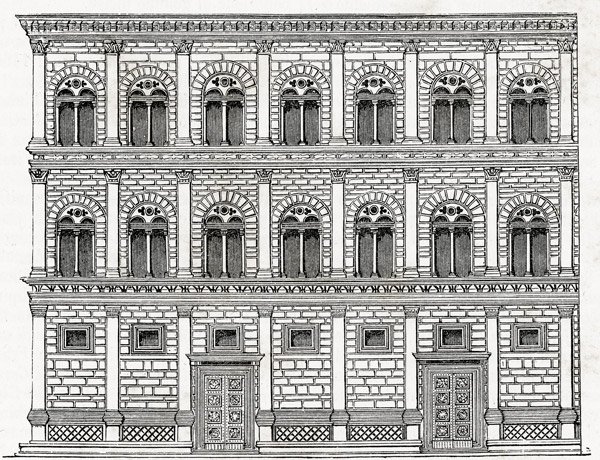
According to historians, the current palace was built by merging eight separate residential buildings into a unified architectural complex. The project and construction, which integrated the existing structures, were carried out by Bernardo Rossellino (Bernardo Rossellino). The facade design was conceptualized by Leon Battista Alberti—one of the most renowned and forward-thinking architects of the time.
Leon Battista Alberti
Architect Alberti came from a noble Florentine family with ties to the Knights Templar. He was a true Renaissance polymath—an accomplished architect, painter, poet, musician, and scholar. Alberti authored many literary and theoretical works on architecture, art, and science, including Ten Books on Architecture, Mathematical Amusements, and Three Books on Painting.
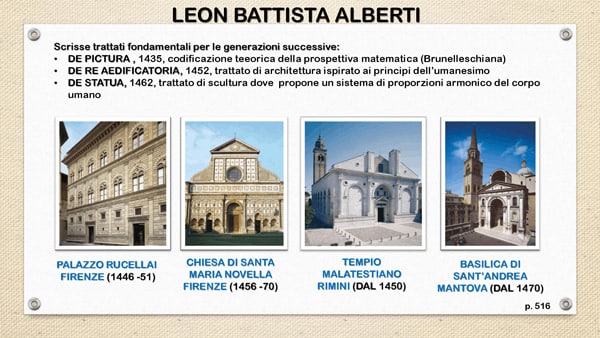
Palazzo Rucellai is one of Alberti’s earliest creations and has become a benchmark of Renaissance architecture. He masterfully incorporated classical motifs and introduced a completely new style for private urban residences—one that would go on to influence architectural design throughout Tuscany and far beyond.
Architectural Features
From the outside, the palace appears as a massive, three-story structure with a flat facade and a traditional Florentine-style interior courtyard. Opposite the palazzo stands the Rucellai Loggia (Loggia Rucellai)—a unique architectural structure built a few years later. Historians believe it was constructed to commemorate a special occasion: the prestigious marriage that united the Rucellai family with the powerful Medici dynasty. This is further confirmed by the family crests prominently displayed on the facade.
Until 1677, the Loggia was used by the mansion’s owners for festive gatherings, weddings, banquets, and receptions of distinguished guests. Together with the courtyard and the palace itself, it forms a cohesive architectural ensemble.
The Facade
The front of the building is especially significant in cultural terms. Divided horizontally into three tiers, it resembles the outer walls of the Colosseum. The use of classical Roman design elements is no surprise, considering Leon Battista Alberti spent many years living and working in Rome. For the facade of each floor, Alberti applied rhythmic segmentation using pilasters (projecting columns) in different classical orders:
- Doric – on the ground floor,
- Ionian – on the second level,
- Corinthian – on the uppermost tier.
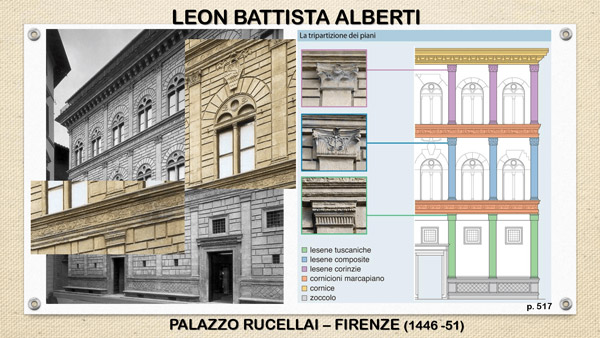
Horizontal entablature bands paired with the pilasters add refinement to the forms and precision to the proportions. Each tier decreases in height from bottom to top, creating a sense of upward movement and lightness. This visual effect is enhanced by the rounded window arches on the second and third floors, as well as the rustication of the walls—where larger stone blocks are used at the base.
The foundation and the bench-lined base running along the facade further ground the building, lending it visual stability and grandeur. For the architectural norms of the time, these design choices were truly groundbreaking.
Interior Courtyard
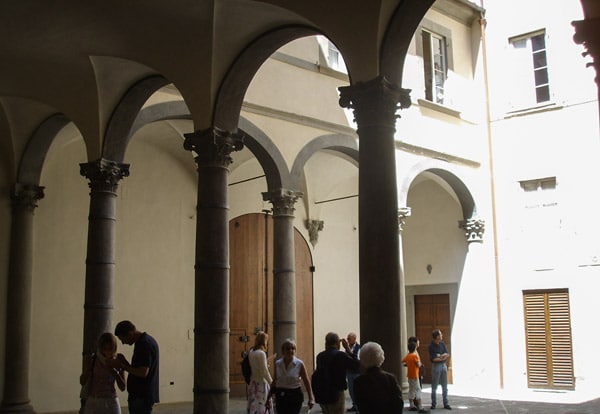
The rectangular courtyard, a signature feature of Florentine private residences, is adorned with classically styled capitals and vaulted arcades supported by solid sandstone columns. Its ornate design stands in stark contrast to the main building’s more restrained exterior. Visually, the courtyard of Palazzo Rucellai recalls the design of the Ospedale degli Innocenti, built in the early 15th century by Filippo Brunelleschi. Many historians believe that a different architect may have been involved in this portion of the construction.
How the Building Was Previously Used
Throughout its history, the palazzo underwent multiple renovations, making it difficult to determine the original interior layout or how rooms were used. However, it is known that each floor served a specific purpose:
- The ground floor was dedicated to business: here, the influential merchant and banker Rucellai met with partners, conducted negotiations, and closed deals;
- The second floor, featuring large reception halls, was used for official functions and celebrations;
- The third floor housed private living quarters and bedrooms.
Interestingly, a concealed fourth floor was built under the roof. Invisible from the street and almost windowless, it was designated for household staff.
Current Use of the Palazzo
The illustrious Rucellai family owned the palazzo for an impressive 500 years. Part of the building still remains in the hands of their descendants, who retain private access to the residence. Art exhibitions and sculpture displays are often held in the inner courtyard.
Since 2001, the first and second floors of the palazzo have housed the Institute for International Studies in Florence (ISI Florence). Within the palazzo, you’ll find spacious classrooms, a computer lab, a library, and other essential facilities for higher education. A major renovation took place in 2009. During the restoration, the unique 18th-century interior was carefully preserved—featuring antique furniture, refined paintings, mirrors, and vaulted ceilings adorned with frescoes of ancient Greek mythological figures.
Palazzo Rucellai is a remarkable architectural monument that invites visitors to experience and connect with the spirit of the early Renaissance era.